
The CompTIA PenTest+ Exam (PT0-003)
Passing CompTIA PenTest+ exam ensures for the successful candidate a powerful array of professional and personal benefits. The first and the foremost benefit comes with a global recognition that validates your knowledge and skills, making possible your entry into any organization of your choice.


PT0-003 Exam Dumps
- Exam Code: PT0-003
- Vendor: CompTIA
- Certifications: PenTest+
- Exam Name: CompTIA PenTest+ Exam
Why CertAchieve is Better than Standard PT0-003 Dumps
In 2026, CompTIA uses variable topologies. Basic dumps will fail you.
| Quality Standard | Generic Dump Sites | CertAchieve Premium Prep |
|---|---|---|
| Technical Explanation | None (Answer Key Only) | Step-by-Step Expert Rationales |
| Syllabus Coverage | Often Outdated (v1.0) | 2026 Updated (Latest Syllabus) |
| Scenario Mastery | Blind Memorization | Conceptual Logic & Troubleshooting |
| Instructor Access | No Post-Sale Support | 24/7 Professional Help |
Customers Passed Exams
10
Success backed by proven exam prep tools
Questions Came Word for Word
94%
Real exam match rate reported by verified users
Average Score in Real Testing Centre
85%
Consistently high performance across certifications
Study Time Saved With CertAchieve
60%
Efficient prep that reduces study hours significantly
Coverage of Official CompTIA PT0-003 Exam Domains
Our curriculum is meticulously mapped to the CompTIA official blueprint.
Engagement Management (13%)
Master the non-technical foundations. Focus on planning and scoping, rules of engagement (RoE), and legal/compliance requirements. This domain now includes Reporting and Communication, ensuring you can articulate technical risks to executive stakeholders effectively.
Reconnaissance and Enumeration (21%)
Master the art of information gathering. Focus on active and passive reconnaissance, OSINT techniques, and advanced enumeration of target systems.
Vulnerability Discovery and Analysis (17%)
Focus on identifying the weak links. Master vulnerability scanning (Nessus, OpenVAS), analyzing scan outputs, and validating findings.
Attacks and Exploits (35%)
The core of the exam. Master network, host-based, web application, and Cloud-based attacks. Focus on modern vectors like API abuse, container escapes, and specialized attacks against AI/ML models (Prompt Injection) and IoT devices.
Post-Exploitation and Lateral Movement (14%)
Focus on what happens after the initial breach. Master techniques for establishing persistence, escalating privileges, and moving laterally through a network using tools like Metasploit, PowerShell, and Living-off-the-Land (LotL) tactics.
CompTIA PT0-003 Exam Domains Q&A
Certified instructors verify every question for 100% accuracy, providing detailed, step-by-step explanations for each.
Question 1
CompTIA PT0-003
QUESTION DESCRIPTION:
A penetration tester wants to gather the names of potential phishing targets who have access to sensitive data. Which of the following would best meet this goal?
Correct Answer & Rationale:
Answer: D
Explanation:
theHarvester is purpose-built for reconnaissance that supports social engineering and phishing assessments by collecting email addresses, employee names, and related identity information from public sources (for example, search engines, PGP key servers, and other OSINT repositories). In a PenTest+ workflow, this aligns directly with the objective of identifying specific people who could be targeted in a phishing simulation—especially when the tester needs a list of likely corporate users and roles to validate awareness controls and email security.
By contrast, WHOIS primarily reveals domain registration details (often privacy-protected) and is not optimized for enumerating a broad set of internal users. Censys.io focuses on internet-exposed hosts, certificates, and services, which is valuable for attack surface mapping but not for building a human target list. SpiderFoot is a general OSINT automation platform, but theHarvester most directly matches the stated goal of harvesting names/emails suitable for phishing target identification.
Question 2
CompTIA PT0-003
QUESTION DESCRIPTION:
A penetration tester creates the following Python script that can be used to enumerate information about email accounts on a target mail server:
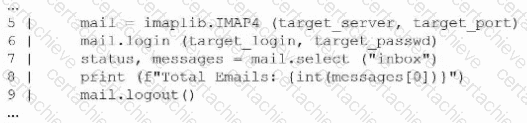
Which of the following logic constructs would permit the script to continue despite failure?
Correct Answer & Rationale:
Answer: C
Explanation:
The correct construct for handling runtime failures (for example, login failures, network timeouts, or server errors) in Python is a try/except block (option C). Wrapping potentially failing operations in a try block and handling exceptions in except allows the script to catch the exception and continue execution (log the error, skip the target, retry, etc.) rather than crashing.
Why C is correct:
try/except is the Python mechanism to handle exceptions raised during execution. For network/email operations (IMAP login/select), IMAP libraries raise exceptions on failure — try/except catches these and enables recovery logic.
Example corrected snippet:
import imaplib, sys
def enumerate_inbox(server, port, user, passwd):
try:
mail = imaplib.IMAP4(server, port)
mail.login(user, passwd)
status, messages = mail.select( " inbox " )
print(f " Total Emails: {int(messages[0])} " )
except imaplib.IMAP4.error as e:
print(f " IMAP error for {user}: {e} " )
# continue to next account or retry
except Exception as e:
print(f " Unexpected error for {user}: {e} " )
finally:
try:
mail.logout()
except:
pass
Why the other options are not the best fit:
A. do/while loop: Python has no native do/while; loops alone won’t catch exceptions — they may repeat the crash.
B. iterator: Iterators control iteration over collections, not exception handling.
D. if/else conditional: Conditionals can test return values but cannot handle exceptions thrown by library calls; they are not sufficient to prevent the script from aborting when an exception is raised.
CompTIA PT0-003 Mapping:
Domain 4.0 Tools and Code Analysis — basic defensive programming and error handling when writing or reviewing scripts used in engagements (use exception handling to make enumeration tools robust and predictable).
Question 3
CompTIA PT0-003
QUESTION DESCRIPTION:
During a penetration test, a tester attempts to pivot from one Windows 10 system to another Windows system. The penetration tester thinks a local firewall is blocking connections. Which of the following command-line utilities built into Windows is most likely to disable the firewall?
Correct Answer & Rationale:
Answer: D
Explanation:
Understanding netsh.exe:
Purpose: Configures network settings, including IP addresses, DNS, and firewall settings.
Firewall Management: Can enable, disable, or modify firewall rules.
Disabling the Firewall:
Command: Use netsh.exe to disable the firewall.
netsh advfirewall set allprofiles state off
Usage in Penetration Testing:
Pivoting: Disabling the firewall can help the penetration tester pivot from one system to another by removing network restrictions.
Command Execution: Ensure the command is executed with appropriate privileges.
References from Pentesting Literature:
netsh.exe is commonly mentioned in penetration testing guides for configuring network settings and managing firewalls.
HTB write-ups often reference the use of netsh.exe for managing firewall settings during network-based penetration tests.
[References:, Penetration Testing - A Hands-on Introduction to Hacking, HTB Official Writeups, ======, , , , ]
Question 4
CompTIA PT0-003
QUESTION DESCRIPTION:
A penetration tester performs a service enumeration process and receives the following result after scanning a server using the Nmap tool:
PORT STATE SERVICE
22/tcp open ssh
25/tcp filtered smtp
111/tcp open rpcbind
2049/tcp open nfs
Based on the output, which of the following services provides the best target for launching an attack?
Correct Answer & Rationale:
Answer: D
Explanation:
Based on the Nmap scan results, the services identified on the target server are as follows:
22/tcp open ssh:
Service: SSH (Secure Shell)
Function: Provides encrypted remote access.
Attack Surface: Brute force attacks or exploiting vulnerabilities in outdated SSH implementations. However, it is generally considered secure if properly configured.
25/tcp filtered smtp:
Service: SMTP (Simple Mail Transfer Protocol)
Function: Email transmission.
Attack Surface: Potential for email-related attacks such as spoofing, but the port is filtered, indicating that access may be restricted or protected by a firewall.
111/tcp open rpcbind:
Service: RPCBind (Remote Procedure Call Bind)
Function: Helps in mapping RPC program numbers to network addresses.
Attack Surface: Can be exploited in specific configurations, but generally not a primary target compared to others.
2049/tcp open nfs:
Service: NFS (Network File System)
Function: Allows for file sharing over a network.
Attack Surface: NFS can be a significant target for attacks due to potential misconfigurations that can allow unauthorized access to file shares or exploitation of vulnerabilities in NFS services.
Conclusion: The NFS service (2049/tcp) provides the best target for launching an attack. File sharing services like NFS often contain sensitive data and can be vulnerable to misconfigurations that allow unauthorized access or privilege escalation.
Question 5
CompTIA PT0-003
QUESTION DESCRIPTION:
Which of the following is the most efficient way to exfiltrate a file containing data that could be sensitive?
Correct Answer & Rationale:
Answer: D
Explanation:
Enviar un archivo cifrado por HTTPS es el método más eficiente, seguro y menos sospechoso para exfiltrar datos. HTTPS cifra el contenido y es un protocolo común que no genera tantas alertas en los sistemas de monitoreo.
Otras opciones como dnscat son más sigilosas pero menos eficientes y requieren control sobre la infraestructura. Steganografía o TFTP pueden ser útiles, pero FTP/TFTP son inseguros y poco usados actualmente, lo cual los hace más sospechosos.
Referencia: PT0-003 Objective 4.3 – Explain post-exploitation techniques, including data exfiltration methods.
Question 6
CompTIA PT0-003
QUESTION DESCRIPTION:
Which of the following frameworks can be used to classify threats?
Correct Answer & Rationale:
Answer: B
Explanation:
STRIDE is a threat classification model created by Microsoft that breaks down threats into six categories:
Spoofing
Tampering
Repudiation
Information disclosure
Denial of Service
Elevation of privilege
It is specifically designed for threat modeling.
PTES is a general pentesting methodology.
OSSTMM is a framework for operational security testing.
OCTAVE is a risk assessment methodology, not focused on threat classification.
[Reference: PT0-003 Objective 3.1 – Understand and apply threat modeling methodologies like STRIDE., , , , , ]
Question 7
CompTIA PT0-003
QUESTION DESCRIPTION:
A penetration tester enters an invalid user ID on the login page of a web application. The tester receives a message indicating the user is not found. Then, the tester tries a valid user ID but an incorrect password, but the web application indicates the password is invalid. Which of the following should the tester attempt next?
Correct Answer & Rationale:
Answer: C
Explanation:
The application is giving distinct error messages for valid vs. invalid usernames. This is a classic case of user enumeration, where an attacker can determine valid accounts before proceeding to brute-force or password attacks.
From the CompTIA PenTest+ PT0-003 Official Study Guide (Chapter 6 – Vulnerability Identification):
“Authentication systems that return different error messages based on the validity of the username can allow attackers to enumerate valid accounts.”
[Reference: Chapter 6, CompTIA PenTest+ PT0-003 Official Study Guide, , , ]
Question 8
CompTIA PT0-003
QUESTION DESCRIPTION:
During a penetration test, the tester gains full access to the application ' s source code. The application repository includes thousands of code files. Given that the assessment timeline is very short, which of the following approaches would allow the tester to identify hard-coded credentials most effectively?
Correct Answer & Rationale:
Answer: A
Explanation:
Given a short assessment timeline and the need to identify hard-coded credentials in a large codebase, using an automated tool designed for this specific purpose is the most effective approach. Here’s an explanation of each option:
Run TruffleHog against a local clone of the application (Answer: A):
TruffleHog is a specialized tool that scans for hard-coded secrets such as passwords, API keys, and other sensitive data within the code repositories.
Effectiveness: It quickly and automatically identifies potential credentials and other sensitive information across thousands of files, making it the most efficient choice under time constraints.
[References:, TruffleHog is widely recognized for its ability to uncover hidden secrets in code repositories, making it a valuable tool for penetration testers., Scan the live web application using Nikto (Option B):, Explanation: Nikto is a web server scanner that identifies vulnerabilities in web applications., Drawbacks: It is not designed to scan source code for hard-coded credentials. Instead, it focuses on web application vulnerabilities such as outdated software and misconfigurations., Perform a manual code review of the Git repository (Option C):, Explanation: Manually reviewing code can be thorough but is extremely time-consuming, especially with thousands of files., Drawbacks: Given the short timeline, this approach is impractical and inefficient for identifying hard-coded credentials quickly., Use SCA software to scan the application source code (Option D):, Explanation: Software Composition Analysis (SCA) tools are used to analyze open source and third-party components within the code for vulnerabilities and license compliance., Drawbacks: While SCA tools are useful for dependency analysis, they are not specifically tailored for finding hard-coded credentials., Conclusion: Running TruffleHog against a local clone of the application is the most effective approach for quickly identifying hard-coded credentials in a large codebase within a limited timeframe., , , , , , , ]
Question 9
CompTIA PT0-003
QUESTION DESCRIPTION:
During a security assessment, a penetration tester captures plaintext login credentials on the communication between a user and an authentication system. The tester wants to use this information for further unauthorized access.
Which of the following tools is the tester using?
Correct Answer & Rationale:
Answer: B
Explanation:
Capturing plaintext credentials in network traffic is done using packet sniffing. Wireshark is the best tool for this task.
Option A (Burp Suite) ❌: Used for web application testing and intercepting HTTPS traffic, but not general network sniffing.
Option B (Wireshark) ✅: Correct.
Wireshark is a packet analysis tool that captures unencrypted network traffic, including plaintext credentials.
Option C (ZAP - Zed Attack Proxy) ❌: Similar to Burp Suite, but focused on web application security, not network packet capture.
Option D (Metasploit) ❌: Metasploit is used for exploitation rather than capturing traffic.
???? Reference: CompTIA PenTest+ PT0-003 Official Guide – Packet Sniffing & Network Traffic Analysis
Question 10
CompTIA PT0-003
QUESTION DESCRIPTION:
During an assessment, a penetration tester obtains an NTLM hash from a legacy Windows machine. Which of the following tools should the penetration tester use to continue the attack?
Correct Answer & Rationale:
Answer: D
Explanation:
When a penetration tester obtains an NTLM hash from a legacy Windows machine, they need to use a tool that can leverage this hash for further attacks, such as pass-the-hash attacks, or for cracking the hash. Here’s a breakdown of the options:
Option A: Responder
Responder is primarily used for poisoning LLMNR, NBT-NS, and MDNS to capture hashes, but not for leveraging NTLM hashes obtained post-exploitation.
Option B: Hydra
Hydra is a password-cracking tool but not specifically designed for NTLM hashes or pass-the-hash attacks.
Option C: BloodHound
BloodHound is used for mapping out Active Directory relationships and identifying potential attack paths but not for using NTLM hashes directly.
Option D: CrackMapExec
CrackMapExec is a versatile tool that can perform pass-the-hash attacks, execute commands, and more using NTLM hashes. It is designed for post-exploitation scenarios involving NTLM hashes.
References from Pentest:
Forge HTB: Demonstrates the use of CrackMapExec for leveraging NTLM hashes to gain further access within a network.
Horizontall HTB: Shows how CrackMapExec can be used for various post-exploitation activities, including using NTLM hashes to authenticate and execute commands.
Conclusion:
Option D, CrackMapExec, is the most suitable tool for continuing the attack using an NTLM hash. It supports pass-the-hash techniques and other operations that can leverage NTLM hashes effectively.
======

Verified by Certified Instructors
This CompTIA PT0-003 study pack was audited and verified on September 24, 2026 by Bruce Kensington,. We ensure every technical rationale aligns with real-world enterprise standards.
A Stepping Stone for Enhanced Career Opportunities
Your profile having PenTest+ certification significantly enhances your credibility and marketability in all corners of the world. The best part is that your formal recognition pays you in terms of tangible career advancement. It helps you perform your desired job roles accompanied by a substantial increase in your regular income. Beyond the resume, your expertise imparts you confidence to act as a dependable professional to solve real-world business challenges.
Your success in CompTIA PT0-003 certification exam makes your visible and relevant in the fast-evolving tech landscape. It proves a lifelong investment in your career that give you not only a competitive advantage over your non-certified peers but also makes you eligible for a further relevant exams in your domain.
What You Need to Ace CompTIA Exam PT0-003
Achieving success in the PT0-003 CompTIA exam requires a blending of clear understanding of all the exam topics, practical skills, and practice of the actual format. There's no room for cramming information, memorizing facts or dependence on a few significant exam topics. It means your readiness for exam needs you develop a comprehensive grasp on the syllabus that includes theoretical as well as practical command.
Here is a comprehensive strategy layout to secure peak performance in PT0-003 certification exam:
- Develop a rock-solid theoretical clarity of the exam topics
- Begin with easier and more familiar topics of the exam syllabus
- Make sure your command on the fundamental concepts
- Focus your attention to understand why that matters
- Ensure hands-on practice as the exam tests your ability to apply knowledge
- Develop a study routine managing time because it can be a major time-sink if you are slow
- Find out a comprehensive and streamlined study resource for your help
Ensuring Outstanding Results in Exam PT0-003!
In the backdrop of the above prep strategy for PT0-003 CompTIA exam, your primary need is to find out a comprehensive study resource. It could otherwise be a daunting task to achieve exam success. The most important factor that must be kep in mind is make sure your reliance on a one particular resource instead of depending on multiple sources. It should be an all-inclusive resource that ensures conceptual explanations, hands-on practical exercises, and realistic assessment tools.
Certachieve: A Reliable All-inclusive Study Resource
Certachieve offers multiple study tools to do thorough and rewarding PT0-003 exam prep. Here's an overview of Certachieve's toolkit:
CompTIA PT0-003 PDF Study Guide
This premium guide contains a number of CompTIA PT0-003 exam questions and answers that give you a full coverage of the exam syllabus in easy language. The information provided efficiently guides the candidate's focus to the most critical topics. The supportive explanations and examples build both the knowledge and the practical confidence of the exam candidates required to confidently pass the exam. The demo of CompTIA PT0-003 study guide pdf free download is also available to examine the contents and quality of the study material.
CompTIA PT0-003 Practice Exams
Practicing the exam PT0-003 questions is one of the essential requirements of your exam preparation. To help you with this important task, Certachieve introduces CompTIA PT0-003 Testing Engine to simulate multiple real exam-like tests. They are of enormous value for developing your grasp and understanding your strengths and weaknesses in exam preparation and make up deficiencies in time.
These comprehensive materials are engineered to streamline your preparation process, providing a direct and efficient path to mastering the exam's requirements.
CompTIA PT0-003 exam dumps
These realistic dumps include the most significant questions that may be the part of your upcoming exam. Learning PT0-003 exam dumps can increase not only your chances of success but can also award you an outstanding score.
Top Exams & Certification Providers
New & Trending
- New Released Exams
- Related Exam
- Hot Vendor