
The Microsoft Azure AI Fundamentals (AI-900)
Passing Microsoft Microsoft Certified: Azure AI Fundamentals exam ensures for the successful candidate a powerful array of professional and personal benefits. The first and the foremost benefit comes with a global recognition that validates your knowledge and skills, making possible your entry into any organization of your choice.

AI-900 Exam Dumps
- Exam Code: AI-900
- Vendor: Microsoft
- Certifications: Microsoft Certified: Azure AI Fundamentals
- Exam Name: Microsoft Azure AI Fundamentals
Why CertAchieve is Better than Standard AI-900 Dumps
In 2026, Microsoft uses variable topologies. Basic dumps will fail you.
| Quality Standard | Generic Dump Sites | CertAchieve Premium Prep |
|---|---|---|
| Technical Explanation | None (Answer Key Only) | Step-by-Step Expert Rationales |
| Syllabus Coverage | Often Outdated (v1.0) | 2026 Updated (Latest Syllabus) |
| Scenario Mastery | Blind Memorization | Conceptual Logic & Troubleshooting |
| Instructor Access | No Post-Sale Support | 24/7 Professional Help |
Customers Passed Exams
10
Success backed by proven exam prep tools
Questions Came Word for Word
89%
Real exam match rate reported by verified users
Average Score in Real Testing Centre
87%
Consistently high performance across certifications
Study Time Saved With CertAchieve
60%
Efficient prep that reduces study hours significantly
Coverage of Official Microsoft AI-900 Exam Domains
Our curriculum is meticulously mapped to the Microsoft official blueprint.
Artificial Intelligence Workloads and Considerations (20%)
Identify common AI use cases and the core principles of Responsible AI (Fairness, Reliability & Safety, Privacy & Security, Inclusiveness, Transparency, and Accountability).
Fundamental Principles of Machine Learning on Azure (25%)
Master core ML concepts: Regression, Classification, and Clustering. Identify the capabilities of Azure Machine Learning service and automated machine learning (AutoML).
Features of Computer Vision Workloads on Azure (20%)
Identifying solutions for Image Classification, Object Detection, Optical Character Recognition (OCR), and Facial Detection using Azure AI Vision services.
Features of Natural Language Processing (NLP) Workloads on Azure (20%)
Identifying features for Text Analysis, Sentiment Analysis, Named Entity Recognition, and Translation using Azure AI Language and Speech services.
Features of Generative AI Workloads on Azure (20%)
Mastering the capabilities of Azure OpenAI Service, understanding Large Language Models (LLMs), and identifying common generative AI scenarios and considerations.
Microsoft AI-900 Exam Domains Q&A
Certified instructors verify every question for 100% accuracy, providing detailed, step-by-step explanations for each.
Question 1
Microsoft AI-900
QUESTION DESCRIPTION:
You have 100 instructional videos that do NOT contain any audio. Each instructional video has a script. You need to generate a narration audio file for each video based on the script. Which type of workload should you use?
Correct Answer & Rationale:
Answer: C
Explanation:
Speech synthesis, also known as text-to-speech (TTS), is the AI workload that converts written text into spoken words. In this case, the task is to generate narration audio from provided scripts for silent instructional videos.
Speech recognition performs the opposite function — it converts speech into text. Language modeling is for text understanding and prediction (e.g., GPT). Translation converts text between languages, not from text to audio.
Therefore, the most appropriate workload, according to Microsoft’s AI-900 study material under the “Speech AI capabilities” section, is speech synthesis, which enables natural voice narration generation.
Question 2
Microsoft AI-900
QUESTION DESCRIPTION:
You build a machine learning model by using the automated machine learning user interface (UI).
You need to ensure that the model meets the Microsoft transparency principle for responsible AI.
What should you do?
Correct Answer & Rationale:
Answer: B
Explanation:
Model Explain Ability.
Most businesses run on trust and being able to open the ML “black box” helps build transparency and trust. In heavily regulated industries like healthcare and banking, it is critical to comply with regulations and best practices. One key aspect of this is understanding the relationship between input variables (features) and model output. Knowing both the magnitude and direction of the impact each feature (feature importance) has on the predicted value helps better understand and explain the model. With model explain ability, we enable you to understand feature importance as part of automated ML runs.
[Reference:, https://azure.microsoft.com/en-us/blog/new-automated-machine-learning-capabilities-in-azure-machine-learning-service/, , , , , ]
Question 3
Microsoft AI-900
QUESTION DESCRIPTION:
Which term is used to describe uploading your own data to customize an Azure OpenAI model?
Correct Answer & Rationale:
Answer: C
Explanation:
In Azure OpenAI Service, fine-tuning refers to the process of uploading your own labeled dataset to customize or adapt a pretrained model (such as GPT-3.5 or Curie) for a specific use case. According to the Microsoft Learn documentation and AI-900 official study guide, fine-tuning allows organizations to improve a model’s performance on domain-specific tasks or to align responses with brand tone and context.
Fine-tuning differs from simple prompting because it requires providing structured training data (usually in JSONL format) that contains pairs of input prompts and ideal completions. The model uses this data to adjust its internal weights, thereby “learning” your organization’s language patterns, terminology, or industry context.
Option review:
A. Completion: Refers to the text generated by a model in response to a prompt. It’s the output, not the customization process.
B. Grounding: Integrates external, up-to-date data sources (like search results or databases) during inference but doesn’t alter the model’s parameters.
C. Fine-tuning: ✅ Correct — this is the process of uploading and training with your own data.
D. Prompt engineering: Involves designing effective prompts but does not change the underlying model.
Thus, fine-tuning is the term used for customizing an Azure OpenAI model using your own uploaded data.
Question 4
Microsoft AI-900
QUESTION DESCRIPTION:
Which two actions can you perform by using the Azure OpenAI DALL-E model? Each correct answer presents a complete solution.
NOTE: Each correct answer is worth one point.
Correct Answer & Rationale:
Answer: A, D
Explanation:
The correct answers are A. Create images and D. Modify images.
The Azure OpenAI DALL-E model is a text-to-image generative AI model that can create original images and modify existing ones based on text prompts. According to Microsoft Learn and Azure OpenAI documentation, DALL-E interprets natural language descriptions to produce unique and creative visual content, making it useful for design, illustration, marketing, and educational applications.
Create images (A) – DALL-E can generate new images entirely from textual input. For example, the prompt “a futuristic city skyline at sunrise” would result in a custom-generated artwork that visually represents that description.
Modify images (D) – DALL-E also supports inpainting and outpainting, allowing users to edit or expand existing images. You can replace parts of an image (for example, changing a background or object) or add new elements consistent with the visual style of the original.
The remaining options are incorrect:
B. OCR is performed by Azure AI Vision, not DALL-E.
C. Detect objects in images is also an Azure AI Vision (Image Analysis) feature.
E. Generate captions for images is handled by Azure AI Vision, not DALL-E, since DALL-E generates—not interprets—visuals.
Question 5
Microsoft AI-900
QUESTION DESCRIPTION:
You need to build an image tagging solution for social media that tags images of your friends automatically. Which Azure Cognitive Services service should you use?
Correct Answer & Rationale:
Answer: B
Explanation:
The correct answer is B. Face because the Azure Face service, part of Azure Cognitive Services, provides capabilities for detecting, recognizing, and analyzing human faces in images. According to the Microsoft Azure AI Fundamentals (AI-900) official study guide and Microsoft Learn module “Explore computer vision”, the Face service can automatically detect faces, determine attributes such as age, gender, emotion, and identify or verify individuals based on facial features.
In this scenario, the goal is to build an image tagging solution that automatically tags images of friends on social media. This requires the ability to recognize and match faces of known individuals, which is a key feature of the Face API. The API uses facial recognition technology to create face IDs for detected faces and can compare new faces against stored face data to identify known individuals. Microsoft Learn notes: “The Face service can detect, recognize, and identify people in images, enabling automated tagging or authentication scenarios.”
Other options explained:
A. Computer Vision identifies objects, landmarks, and general content but does not specialize in identifying individual people.
C. Text Analytics analyzes textual data for sentiment, key phrases, or entities, not image data.
D. Form Recognizer extracts structured data from forms or receipts, unrelated to face detection.
Thus, for automatically tagging people in photos, Azure Face is the correct and most suitable service.
Question 6
Microsoft AI-900
QUESTION DESCRIPTION:
For a machine learning progress, how should you split data for training and evaluation?
Correct Answer & Rationale:
Answer: B
Explanation:
https://docs.microsoft.com/en-us/azure/machine-learning/algorithm-module-reference/split-data
The correct answer is B. Randomly split the data into rows for training and rows for evaluation.
According to the Microsoft Azure AI Fundamentals (AI-900) official study guide and the Microsoft Learn module “Describe fundamental principles of machine learning on Azure”, the process of developing a machine learning model involves dividing the available dataset into two or more parts—commonly training data and evaluation (or testing) data. The goal is to ensure that the model can learn patterns from one subset of the data (training set) and then be objectively tested on unseen data (evaluation set) to measure how well it generalizes to new situations.
The training dataset contains both features (the measurable inputs) and labels (the target outputs). The model learns from the patterns and relationships between these features and labels. The evaluation dataset also contains features and labels, but it is kept separate during the training phase. Once the model has been trained, it is tested on this unseen evaluation data to calculate metrics like accuracy, precision, recall, or F1 score.
Microsoft emphasizes that the data split should be random and based on rows, not columns. Each row represents a complete observation (for example, one customer record, one transaction, or one image). Randomly splitting ensures that both subsets represent the same distribution of data, avoiding bias. Splitting by columns would separate features themselves, which would make the model training invalid.
The AI-900 materials often illustrate this using Azure Machine Learning’s data preparation workflow, where data is randomly divided (commonly 70% for training and 30% for testing). This ensures the model learns from diverse examples and is fairly evaluated.
Therefore, the verified and correct approach, as per Microsoft’s official guidance, is B. Randomly split the data into rows for training and rows for evaluation.
Question 7
Microsoft AI-900
QUESTION DESCRIPTION:
Which two components can you drag onto a canvas in Azure Machine Learning designer? Each correct answer presents a complete solution.
NOTE: Each correct selection is worth one point.
Correct Answer & Rationale:
Answer: A, D
Explanation:
In Azure Machine Learning designer, a low-code drag-and-drop interface, users can visually build machine learning workflows. According to the AI-900 study guide and Microsoft Learn module “Create and publish models with Azure Machine Learning designer”, two key components that can be dragged onto the designer canvas are datasets and modules.
Datasets (A): These are collections of data that serve as the input for training or evaluating models. They can be registered in the workspace and then dragged onto the canvas for use in transformations or model training.
Modules (D): These are prebuilt processing and modeling components that perform operations such as data cleaning, feature engineering, model training, and evaluation. Examples include “Split Data,” “Train Model,” and “Evaluate Model.”
Compute (B) and Pipeline (C) are not drag-and-drop items within the designer. Compute targets are infrastructure resources used to run the pipeline, while a pipeline represents the overall workflow, not a component that can be added like a dataset or module.
Hence, the correct answers are A. Dataset and D. Module.
[Reference:Microsoft Learn – Create a machine learning model with Azure Machine Learning designer, , , , , ]
Question 8
Microsoft AI-900
QUESTION DESCRIPTION:
You have an Internet of Things (loT) device that monitors engine temperature.
The device generates an alert if the engine temperature deviates from expected norms.
Which type of Al workload does the device represent?
Correct Answer & Rationale:
Answer: C
Explanation:
According to the Microsoft Azure AI Fundamentals (AI-900) Official Study Guide and the Microsoft Learn module “Explore fundamental principles of machine learning,” anomaly detection is a machine learning workload used to identify data points or patterns that deviate significantly from expected behavior.
In this scenario, the IoT device monitors engine temperature and generates alerts when the readings deviate from normal operating ranges. This directly matches the definition of anomaly detection, where the AI system learns what “normal” looks like and identifies outliers or abnormal conditions that may indicate potential issues.
Common real-world uses of anomaly detection include:
Detecting equipment malfunctions or overheating in IoT systems.
Identifying fraudulent transactions in finance.
Detecting unusual spikes or drops in system metrics (e.g., temperature, traffic, or pressure).
Other options are incorrect:
A. NLP (Natural Language Processing): Focuses on understanding and interpreting human language, not sensor data.
B. Computer Vision: Involves analyzing images or videos, which is unrelated to temperature data.
D. Knowledge Mining: Refers to extracting information from large document stores, not identifying abnormal readings.
Question 9
Microsoft AI-900
QUESTION DESCRIPTION:
You use Azure Machine Learning designer to publish an inference pipeline.
Which two parameters should you use to consume the pipeline? Each correct answer presents part of the solution.
NOTE: Each correct selection is worth one point.
Correct Answer & Rationale:
Answer: C, D
Explanation:
According to the Microsoft Azure AI Fundamentals (AI-900) Official Study Guide and the Microsoft Learn module “Explore Azure Machine Learning”, when you publish an inference pipeline (a deployed web service for real-time predictions) using Azure Machine Learning designer, you make the model accessible as a RESTful endpoint. Consumers—such as applications, scripts, or services—interact with this endpoint to submit data and receive predictions.
To securely access this deployed pipeline, two critical parameters are required:
REST endpoint (Option D):The REST endpoint is a URL automatically generated when the inference pipeline is deployed. It defines the network location where clients send HTTP POST requests containing input data (usually in JSON format). The endpoint routes these requests to the deployed model, which processes the data and returns prediction results. The REST endpoint acts as the primary access point for consuming the model’s inferencing capability programmatically.
Authentication key (Option C):The authentication key (or API key) is a security token provided by Azure to ensure that only authorized users or systems can access the endpoint. When invoking the REST service, the key must be included in the request header (typically as the value of the Authorization header). This mechanism enforces secure, authenticated access to the deployed model.
The other options are incorrect:
A. The model name is not required to consume the endpoint; it is used internally within the workspace.
B. The training endpoint is used for training pipelines, not for inference.
Therefore, according to Microsoft’s official AI-900 learning objectives and Azure Machine Learning documentation, when consuming a published inference pipeline, you must use both the REST endpoint (D) and the authentication key (C). These parameters ensure secure, controlled, and programmatic access to the deployed AI model for real-time predictions.
Question 10
Microsoft AI-900
QUESTION DESCRIPTION:
You are creating an app to help employees write emails and reports based on user prompts. What should you use?
Correct Answer & Rationale:
Answer: B
Explanation:
For an app that helps employees write emails and reports based on user prompts, you need a text generation model capable of understanding natural language instructions and producing coherent, contextually appropriate output. Azure OpenAI GPT models—available through Azure AI Foundry (formerly Azure OpenAI Studio)—are specifically designed for such generative tasks.
By integrating GPT-3.5 or GPT-4, the app can analyze prompts like “Write a professional email to a client about project updates” and automatically generate polished text in seconds.
The other options do not fit:
A. Azure AI Speech: Converts spoken language to text or text to speech; not suitable for generating written content.
C. Azure AI Vision: Processes and analyzes images or video content.
D. Azure Machine Learning Studio: Used for training, testing, and deploying custom ML models, not directly for content generation.
Therefore, to create a writing-assistance app for emails and reports, the correct solution is B. Azure OpenAI in Foundry Models using GPT-based language generation.

Verified by Certified Instructors
This Microsoft AI-900 study pack was audited and verified on September 23, 2026 by Hilary Beaumont,. We ensure every technical rationale aligns with real-world enterprise standards.
A Stepping Stone for Enhanced Career Opportunities
Your profile having Microsoft Certified: Azure AI Fundamentals certification significantly enhances your credibility and marketability in all corners of the world. The best part is that your formal recognition pays you in terms of tangible career advancement. It helps you perform your desired job roles accompanied by a substantial increase in your regular income. Beyond the resume, your expertise imparts you confidence to act as a dependable professional to solve real-world business challenges.
Your success in Microsoft AI-900 certification exam makes your visible and relevant in the fast-evolving tech landscape. It proves a lifelong investment in your career that give you not only a competitive advantage over your non-certified peers but also makes you eligible for a further relevant exams in your domain.
What You Need to Ace Microsoft Exam AI-900
Achieving success in the AI-900 Microsoft exam requires a blending of clear understanding of all the exam topics, practical skills, and practice of the actual format. There's no room for cramming information, memorizing facts or dependence on a few significant exam topics. It means your readiness for exam needs you develop a comprehensive grasp on the syllabus that includes theoretical as well as practical command.
Here is a comprehensive strategy layout to secure peak performance in AI-900 certification exam:
- Develop a rock-solid theoretical clarity of the exam topics
- Begin with easier and more familiar topics of the exam syllabus
- Make sure your command on the fundamental concepts
- Focus your attention to understand why that matters
- Ensure hands-on practice as the exam tests your ability to apply knowledge
- Develop a study routine managing time because it can be a major time-sink if you are slow
- Find out a comprehensive and streamlined study resource for your help
Ensuring Outstanding Results in Exam AI-900!
In the backdrop of the above prep strategy for AI-900 Microsoft exam, your primary need is to find out a comprehensive study resource. It could otherwise be a daunting task to achieve exam success. The most important factor that must be kep in mind is make sure your reliance on a one particular resource instead of depending on multiple sources. It should be an all-inclusive resource that ensures conceptual explanations, hands-on practical exercises, and realistic assessment tools.
Certachieve: A Reliable All-inclusive Study Resource
Certachieve offers multiple study tools to do thorough and rewarding AI-900 exam prep. Here's an overview of Certachieve's toolkit:
Microsoft AI-900 PDF Study Guide
This premium guide contains a number of Microsoft AI-900 exam questions and answers that give you a full coverage of the exam syllabus in easy language. The information provided efficiently guides the candidate's focus to the most critical topics. The supportive explanations and examples build both the knowledge and the practical confidence of the exam candidates required to confidently pass the exam. The demo of Microsoft AI-900 study guide pdf free download is also available to examine the contents and quality of the study material.
Microsoft AI-900 Practice Exams
Practicing the exam AI-900 questions is one of the essential requirements of your exam preparation. To help you with this important task, Certachieve introduces Microsoft AI-900 Testing Engine to simulate multiple real exam-like tests. They are of enormous value for developing your grasp and understanding your strengths and weaknesses in exam preparation and make up deficiencies in time.
These comprehensive materials are engineered to streamline your preparation process, providing a direct and efficient path to mastering the exam's requirements.
Microsoft AI-900 exam dumps
These realistic dumps include the most significant questions that may be the part of your upcoming exam. Learning AI-900 exam dumps can increase not only your chances of success but can also award you an outstanding score.
CertAchieve provided excellent AI-900 Exam Questions that covered artificial intelligence workloads, machine learning principles, and Azure AI services clearly. The explanations simplified complex topics for beginners.
Leah Morris
Jun 10, 2026
Top Exams & Certification Providers
New & Trending
- New Released Exams
- Related Exam
- Hot Vendor
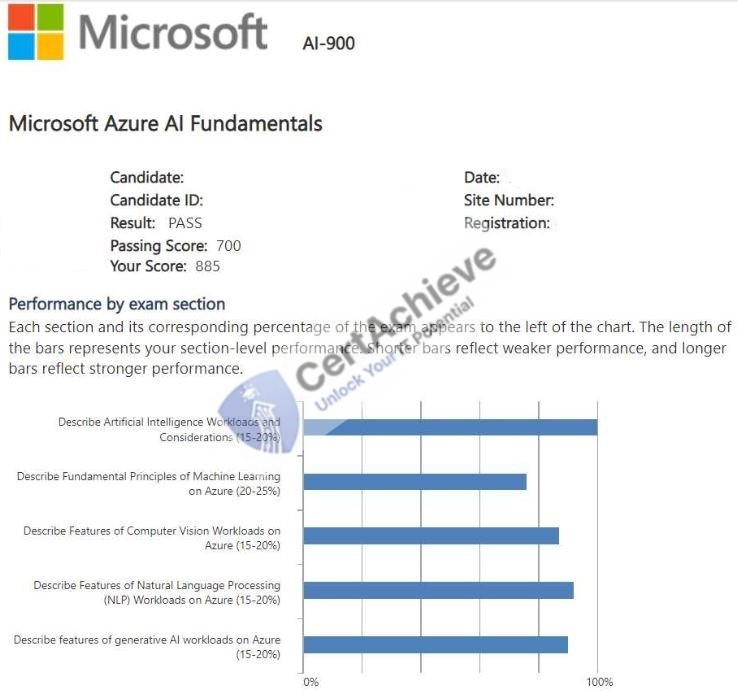
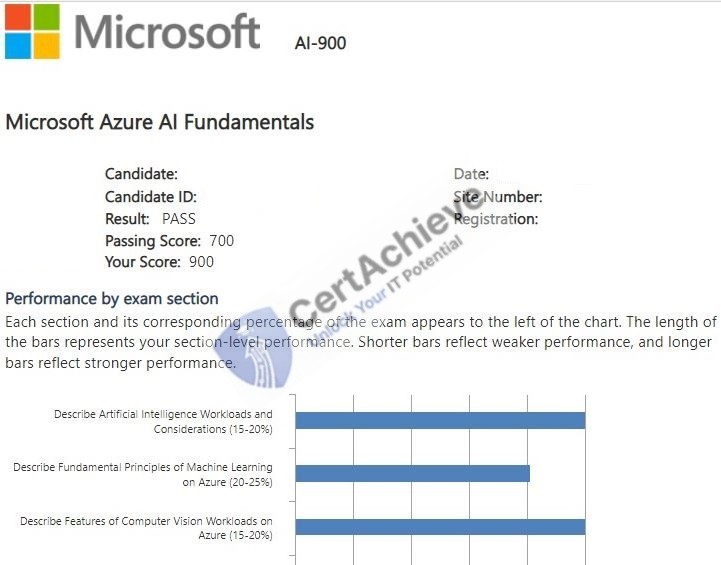
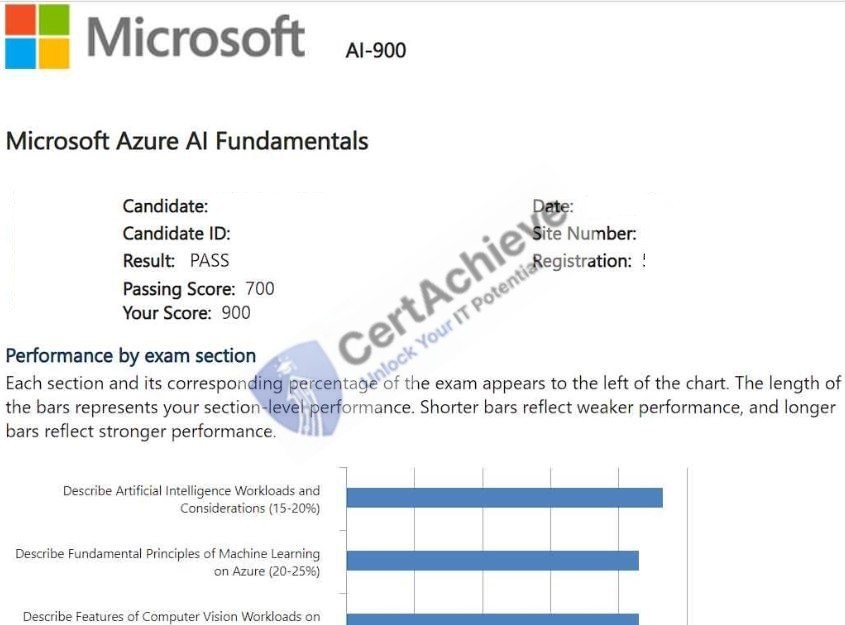
Verified Performance Reports
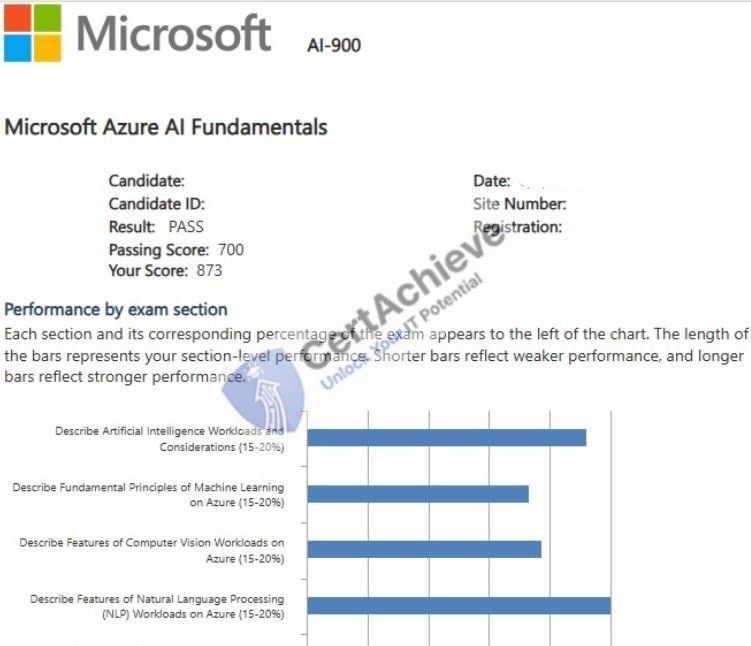
Authentic score reports from candidates who cleared the AI-900 exam.
Verified Case #1
Verified Case #2
Verified Case #3
Verified Case #4
×
![]()