
The Databricks Certified Data Analyst Associate Exam (Databricks-Certified-Data-Analyst-Associate)
Passing Databricks Data Analyst exam ensures for the successful candidate a powerful array of professional and personal benefits. The first and the foremost benefit comes with a global recognition that validates your knowledge and skills, making possible your entry into any organization of your choice.


Databricks-Certified-Data-Analyst-Associate Exam Dumps
- Exam Code: Databricks-Certified-Data-Analyst-Associate
- Vendor: Databricks
- Certifications: Data Analyst
- Exam Name: Databricks Certified Data Analyst Associate Exam
Why CertAchieve is Better than Standard Databricks-Certified-Data-Analyst-Associate Dumps
In 2026, Databricks uses variable topologies. Basic dumps will fail you.
| Quality Standard | Generic Dump Sites | CertAchieve Premium Prep |
|---|---|---|
| Technical Explanation | None (Answer Key Only) | Step-by-Step Expert Rationales |
| Syllabus Coverage | Often Outdated (v1.0) | 2026 Updated (Latest Syllabus) |
| Scenario Mastery | Blind Memorization | Conceptual Logic & Troubleshooting |
| Instructor Access | No Post-Sale Support | 24/7 Professional Help |
Customers Passed Exams
10
Success backed by proven exam prep tools
Questions Came Word for Word
93%
Real exam match rate reported by verified users
Average Score in Real Testing Centre
87%
Consistently high performance across certifications
Study Time Saved With CertAchieve
60%
Efficient prep that reduces study hours significantly
Databricks Databricks-Certified-Data-Analyst-Associate Exam Domains Q&A
Certified instructors verify every question for 100% accuracy, providing detailed, step-by-step explanations for each.
Question 1
Databricks Databricks-Certified-Data-Analyst-Associate
QUESTION DESCRIPTION:
A stakeholder has provided a data analyst with a lookup dataset in the form of a 50-row CSV file. The data analyst needs to upload this dataset for use as a table in Databricks SQL.
Which approach should the data analyst use to quickly upload the file into a table for use in Databricks SOL?
Correct Answer & Rationale:
Answer: A
Explanation:
Databricks provides a user-friendly interface that allows data analysts to quickly upload small datasets, such as a 50-row CSV file, and create tables within Databricks SQL. The steps are as follows:
Access the Data Upload Interface:
In the Databricks workspace, navigate to the sidebar and click on New > Add or upload data.
Select Create or modify a table.
Upload the CSV File:
Click on the browse button or drag and drop the CSV file directly onto the designated area.
The interface supports uploading up to 10 files simultaneously, with a total size limit of 2 GB.
Configure Table Settings:
After uploading, a preview of the data is displayed.
Specify the table name, select the appropriate schema, and configure any additional settings as needed.
Create the Table:
Once all configurations are set, click on the Create Table button to finalize the process.
This method is efficient for quickly importing small datasets without the need for additional tools or complex configurations. Options B, C, and D involve more complex or manual processes that are unnecessary for this task.
[Reference: Create or modify a table using file upload, , ]
Question 2
Databricks Databricks-Certified-Data-Analyst-Associate
QUESTION DESCRIPTION:
What is used as a compute resource for Databricks SQL?
Correct Answer & Rationale:
Answer: C
Explanation:
Databricks SQL uses SQL warehouses as its compute resource. A SQL warehouse is a dedicated compute engine designed specifically for executing SQL queries and powering dashboards within the Databricks workspace. According to Databricks official documentation, SQL warehouses are optimized for fast, scalable query execution, whereas clusters are used primarily for data engineering and machine learning workloads.
Question 3
Databricks Databricks-Certified-Data-Analyst-Associate
QUESTION DESCRIPTION:
What is an advantage of using a Delta Lake-based data lakehouse over classic enterprise data warehouse solutions?
Correct Answer & Rationale:
Answer: A
Explanation:
Option A is correct. Classic enterprise data warehouses commonly use proprietary storage formats, while the Databricks lakehouse is built around open table formats such as Delta Lake and Iceberg. Databricks documentation states that Delta Lake is open source and that the Databricks platform uses no proprietary data formats to avoid vendor lock-in. Schema enforcement and ACID transactions are important Delta Lake capabilities, but they are not the best differentiator “over classic enterprise data warehouse solutions,” because enterprise warehouses also typically provide managed reliability and transactional behavior. The unique lakehouse advantage here is open-source/open-format interoperability. References: Databricks Delta Lake and lakehouse architecture documentation.
Question 4
Databricks Databricks-Certified-Data-Analyst-Associate
QUESTION DESCRIPTION:
A data analyst is attempting to drop a table my_table. The analyst wants to delete all table metadata and data.
They run the following command:
DROP TABLE IF EXISTS my_table;
While the object no longer appears when they run SHOW TABLES, the data files still exist.
Which of the following describes why the data files still exist and the metadata files were deleted?
Correct Answer & Rationale:
Answer: C
Explanation:
An external table is a table that is defined in the metastore, but its data is stored outside of the Databricks environment, such as in S3, ADLS, or GCS. When an external table is dropped, only the metadata is deleted from the metastore, but the data files are not affected. This is different from a managed table, which is a table whose data is stored in the Databricks environment, and whose data files are deleted when the table is dropped. To delete the data files of an external table, the analyst needs to specify the PURGE option in the DROP TABLE command, or manually delete the files from the storage system. References: DROP TABLE, Drop Delta table features, Best practices for dropping a managed Delta Lake table
Question 5
Databricks Databricks-Certified-Data-Analyst-Associate
QUESTION DESCRIPTION:
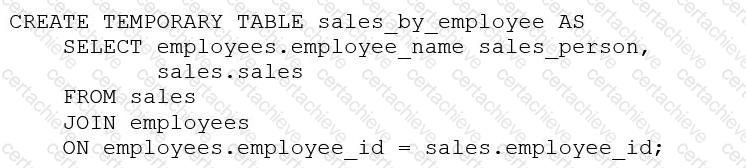
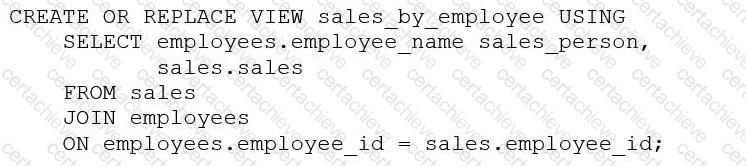
A business analyst has been asked to create a data entity/object called sales_by_employee. It should always stay up-to-date when new data are added to the sales table. The new entity should have the columns sales_person, which will be the name of the employee from the employees table, and sales, which will be all sales for that particular sales person. Both the sales table and the employees table have an employee_id column that is used to identify the sales person.
Which of the following code blocks will accomplish this task?
A)
B)
C)
D)

Correct Answer & Rationale:
Answer: D
Explanation:
The SQL code provided in Option D is the correct way to create a view named sales_by_employee that will always stay up-to-date with the sales and employees tables. The code uses the CREATE OR REPLACE VIEW statement to define a new view that joins the sales and employees tables on the employee_id column. It selects the employee_name as sales_person and all sales for each employee, ensuring that the data entity/object is always up-to-date when new data are added to these tables.
The answer can be verified from Databricks SQL documentation which provides insights on creating views using SQL queries, joining tables, and selecting specific columns to be included in the view. Reference link: Databricks SQL
Question 6
Databricks Databricks-Certified-Data-Analyst-Associate
QUESTION DESCRIPTION:
A data analysis team is working with the table_bronze SQL table as a source for one of its most complex projects. A stakeholder of the project notices that some of the downstream data is duplicative. The analysis team identifies table_bronze as the source of the duplication.
Which of the following queries can be used to deduplicate the data from table_bronze and write it to a new table table_silver?
A)
CREATE TABLE table_silver AS
SELECT DISTINCT *
FROM table_bronze;
B)
CREATE TABLE table_silver AS
INSERT *
FROM table_bronze;
C)
CREATE TABLE table_silver AS
MERGE DEDUPLICATE *
FROM table_bronze;
D)
INSERT INTO TABLE table_silver
SELECT * FROM table_bronze;
E)
INSERT OVERWRITE TABLE table_silver
SELECT * FROM table_bronze;
Correct Answer & Rationale:
Answer: A
Explanation:
Option A uses the SELECT DISTINCT statement to remove duplicate rows from the table_bronze and create a new table table_silver with the deduplicated data. This is the correct way to deduplicate data using Spark SQL12. Option B simply inserts all the rows from table_bronze into table_silver, without removing any duplicates. Option C is not a valid syntax for Spark SQL, as there is no MERGE DEDUPLICATE statement. Option D appends all the rows from table_bronze into table_silver, without removing any duplicates. Option E overwrites the existing data in table_silver with the data from table_bronze, without removing any duplicates. References: Delete Duplicate using SPARK SQL, Spark SQL - How to Remove Duplicate Rows
Question 7
Databricks Databricks-Certified-Data-Analyst-Associate
QUESTION DESCRIPTION:
Which of the following is an advantage of using a Delta Lake-based data lakehouse over common data lake solutions?
Correct Answer & Rationale:
Answer: A
Explanation:
A Delta Lake-based data lakehouse is a data platform architecture that combines the scalability and flexibility of a data lake with the reliability and performance of a data warehouse. One of the key advantages of using a Delta Lake-based data lakehouse over common data lake solutions is that it supports ACID transactions, which ensure data integrity and consistency. ACID transactions enable concurrent reads and writes, schema enforcement and evolution, data versioning and rollback, and data quality checks. These features are not available in traditional data lakes, which rely on file-based storage systems that do not support transactions. References:
Delta Lake: Lakehouse, warehouse, advantages | Definition
Synapse – Data Lake vs. Delta Lake vs. Data Lakehouse
Data Lake vs. Delta Lake - A Detailed Comparison
Building a Data Lakehouse with Delta Lake Architecture: A Comprehensive Guide
Question 8
Databricks Databricks-Certified-Data-Analyst-Associate
QUESTION DESCRIPTION:
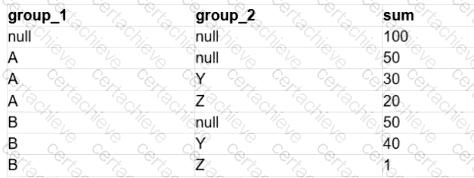
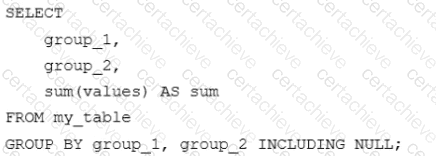
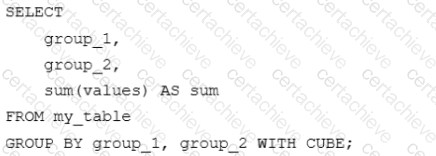
A data analyst is processing a complex aggregation on a table with zero null values and the query returns the following result:
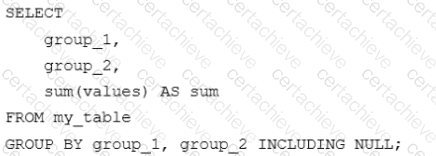
Which query did the analyst execute in order to get this result?
A)

B)
C)
D)
Correct Answer & Rationale:
Answer: D
Explanation:
Option D is correct because the table has zero real null values, but the result contains null values representing subtotal and grand-total rows. That behavior is produced by WITH CUBE, which creates aggregations for combinations of grouping columns, including (group_1, group_2), (group_1), (group_2), and the grand total (). The Databricks SQL documentation states that GROUP BY supports advanced aggregations through CUBE, and that CUBE is shorthand for grouping sets. Option A only returns detailed groups. Options B and C use invalid syntax in Databricks SQL. Reference: Databricks GROUP BY clause documentation.
Question 9
Databricks Databricks-Certified-Data-Analyst-Associate
QUESTION DESCRIPTION:
A data analyst is troubleshooting a query in Databricks SQL that fails when processing large datasets and complex join operations. Logs indicate that the job consistently aborts due to resource constraint errors on the cluster.
Which Query Profile metric should the analyst use to identify the operator that is causing resource overuse?
Correct Answer & Rationale:
Answer: C
Explanation:
The correct answer is C because the issue is a resource constraint failure, and the analyst needs to identify which operator is consuming excessive memory. In Query Profile, Memory peak shows memory usage at the operator level and helps identify the operator causing resource overuse. Time spent helps identify slow operators, shuffle read size helps analyze data movement, and bytes spilled to disk indicates spill behavior, but the most direct metric for resource overuse due to memory pressure is memory peak.
Official documentation extract used: Databricks Query Profile graph view shows metrics such as “Time spent, Memory peak, and Rows.”
Question 10
Databricks Databricks-Certified-Data-Analyst-Associate
QUESTION DESCRIPTION:
A table named user_ltv is being used to create a view that will be used by data analysts on various teams. Users in the workspace are configured into groups, which are used for setting up data access using ACLs.
The user_ltv table has the following schema:
email STRING, age INT, ltv INT
The following view definition is executed:
CREATE VIEW user_ltv_no_minors AS
SELECT email, age, ltv
FROM user_ltv
WHERE
CASE
WHEN is_member( " auditing " ) THEN TRUE
ELSE age > = 18
END;
An analyst who is not a member of the auditing group executes the following query:
SELECT * FROM user_ltv_no_minors;
Which statement describes the results returned by this query?
Correct Answer & Rationale:
Answer: A
Explanation:
Option A is correct. The user is not a member of the auditing group, so is_member( " auditing " ) evaluates to false and the ELSE age > = 18 branch controls the filter. Rows with age > = 18 are returned; rows under 18 are omitted. “Age greater than 17” is equivalent to age > = 18 for integer ages. Official Databricks extract: is_member() “returns TRUE if the current user is a member” of the specified group, and Databricks describes dynamic views as views that can filter rows based on group membership.

Verified by Certified Instructors
This Databricks Databricks-Certified-Data-Analyst-Associate study pack was audited and verified on September 24, 2026 by Hilary Beaumont,. We ensure every technical rationale aligns with real-world enterprise standards.
A Stepping Stone for Enhanced Career Opportunities
Your profile having Data Analyst certification significantly enhances your credibility and marketability in all corners of the world. The best part is that your formal recognition pays you in terms of tangible career advancement. It helps you perform your desired job roles accompanied by a substantial increase in your regular income. Beyond the resume, your expertise imparts you confidence to act as a dependable professional to solve real-world business challenges.
Your success in Databricks Databricks-Certified-Data-Analyst-Associate certification exam makes your visible and relevant in the fast-evolving tech landscape. It proves a lifelong investment in your career that give you not only a competitive advantage over your non-certified peers but also makes you eligible for a further relevant exams in your domain.
What You Need to Ace Databricks Exam Databricks-Certified-Data-Analyst-Associate
Achieving success in the Databricks-Certified-Data-Analyst-Associate Databricks exam requires a blending of clear understanding of all the exam topics, practical skills, and practice of the actual format. There's no room for cramming information, memorizing facts or dependence on a few significant exam topics. It means your readiness for exam needs you develop a comprehensive grasp on the syllabus that includes theoretical as well as practical command.
Here is a comprehensive strategy layout to secure peak performance in Databricks-Certified-Data-Analyst-Associate certification exam:
- Develop a rock-solid theoretical clarity of the exam topics
- Begin with easier and more familiar topics of the exam syllabus
- Make sure your command on the fundamental concepts
- Focus your attention to understand why that matters
- Ensure hands-on practice as the exam tests your ability to apply knowledge
- Develop a study routine managing time because it can be a major time-sink if you are slow
- Find out a comprehensive and streamlined study resource for your help
Ensuring Outstanding Results in Exam Databricks-Certified-Data-Analyst-Associate!
In the backdrop of the above prep strategy for Databricks-Certified-Data-Analyst-Associate Databricks exam, your primary need is to find out a comprehensive study resource. It could otherwise be a daunting task to achieve exam success. The most important factor that must be kep in mind is make sure your reliance on a one particular resource instead of depending on multiple sources. It should be an all-inclusive resource that ensures conceptual explanations, hands-on practical exercises, and realistic assessment tools.
Certachieve: A Reliable All-inclusive Study Resource
Certachieve offers multiple study tools to do thorough and rewarding Databricks-Certified-Data-Analyst-Associate exam prep. Here's an overview of Certachieve's toolkit:
Databricks Databricks-Certified-Data-Analyst-Associate PDF Study Guide
This premium guide contains a number of Databricks Databricks-Certified-Data-Analyst-Associate exam questions and answers that give you a full coverage of the exam syllabus in easy language. The information provided efficiently guides the candidate's focus to the most critical topics. The supportive explanations and examples build both the knowledge and the practical confidence of the exam candidates required to confidently pass the exam. The demo of Databricks Databricks-Certified-Data-Analyst-Associate study guide pdf free download is also available to examine the contents and quality of the study material.
Databricks Databricks-Certified-Data-Analyst-Associate Practice Exams
Practicing the exam Databricks-Certified-Data-Analyst-Associate questions is one of the essential requirements of your exam preparation. To help you with this important task, Certachieve introduces Databricks Databricks-Certified-Data-Analyst-Associate Testing Engine to simulate multiple real exam-like tests. They are of enormous value for developing your grasp and understanding your strengths and weaknesses in exam preparation and make up deficiencies in time.
These comprehensive materials are engineered to streamline your preparation process, providing a direct and efficient path to mastering the exam's requirements.
Databricks Databricks-Certified-Data-Analyst-Associate exam dumps
These realistic dumps include the most significant questions that may be the part of your upcoming exam. Learning Databricks-Certified-Data-Analyst-Associate exam dumps can increase not only your chances of success but can also award you an outstanding score.
Top Exams & Certification Providers
New & Trending
- New Released Exams
- Related Exam
- Hot Vendor
Verified Performance Reports
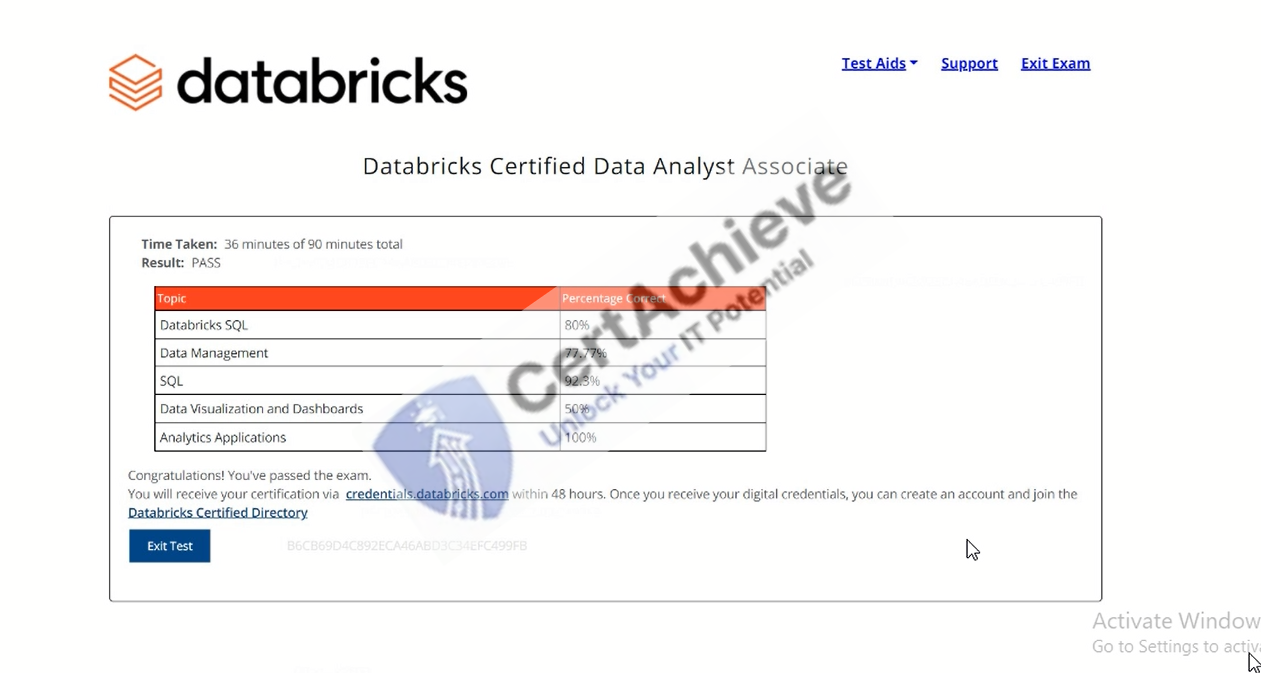
Authentic score reports from candidates who cleared the Databricks-Certified-Data-Analyst-Associate exam.
Verified Case #1
×
![]()