
The Databricks Certified Data Engineer Associate Exam (Databricks-Certified-Data-Engineer-Associate)
Passing Databricks Databricks Certification exam ensures for the successful candidate a powerful array of professional and personal benefits. The first and the foremost benefit comes with a global recognition that validates your knowledge and skills, making possible your entry into any organization of your choice.

Databricks-Certified-Data-Engineer-Associate Exam Dumps
- Exam Code: Databricks-Certified-Data-Engineer-Associate
- Vendor: Databricks
- Certifications: Databricks Certification
- Exam Name: Databricks Certified Data Engineer Associate Exam
Why CertAchieve is Better than Standard Databricks-Certified-Data-Engineer-Associate Dumps
In 2026, Databricks uses variable topologies. Basic dumps will fail you.
| Quality Standard | Generic Dump Sites | CertAchieve Premium Prep |
|---|---|---|
| Technical Explanation | None (Answer Key Only) | Step-by-Step Expert Rationales |
| Syllabus Coverage | Often Outdated (v1.0) | 2026 Updated (Latest Syllabus) |
| Scenario Mastery | Blind Memorization | Conceptual Logic & Troubleshooting |
| Instructor Access | No Post-Sale Support | 24/7 Professional Help |
Customers Passed Exams
10
Success backed by proven exam prep tools
Questions Came Word for Word
88%
Real exam match rate reported by verified users
Average Score in Real Testing Centre
88%
Consistently high performance across certifications
Study Time Saved With CertAchieve
60%
Efficient prep that reduces study hours significantly
Databricks Databricks-Certified-Data-Engineer-Associate Exam Domains Q&A
Certified instructors verify every question for 100% accuracy, providing detailed, step-by-step explanations for each.
Question 1
Databricks Databricks-Certified-Data-Engineer-Associate
QUESTION DESCRIPTION:
A Databricks Job with four sequential tasks is executed. The job fails at Task 3. After the root cause is fixed, the data engineer needs to complete the workflow without rerunning the successful Tasks 1 and 2.
Which action on the Job Run details page allows the engineer to resume execution from the point of failure?
Correct Answer & Rationale:
Answer: C
Explanation:
The engineer should use Repair run . A repair reruns unsuccessful tasks as part of the original job run while preserving the successful status of tasks that do not need to be executed again. In this scenario, Tasks 1 and 2 remain successful, Task 3 is rerun after its problem is corrected, and Task 4 can execute after its dependency succeeds. Run now starts a separate job run and normally executes the workflow from its beginning. Cloning a task creates another task definition and does not resume the failed run. Reset job is not the appropriate Lakeflow Jobs recovery operation. Databricks also notes that repaired tasks should use idempotent write logic where possible because a failed task might have produced partial output before failing. Therefore, option C correctly resumes the workflow without unnecessarily repeating the successful upstream tasks.
================
Question 2
Databricks Databricks-Certified-Data-Engineer-Associate
QUESTION DESCRIPTION:
Which of the following Git operations must be performed outside of Databricks Repos?
Correct Answer & Rationale:
Answer: E
Explanation:
Databricks Repos is a visual Git client and API in Databricks that supports common Git operations such as commit, pull, push, branch management, and visual comparison of diffs when committing1. However, merge is not supported in the Git dialog2. You need to use the Repos UI or your Git provider to merge branches3. Merge is a way to combine the commit history from one branch into another branch1. During a merge, a merge conflict is encountered when Git cannot automatically combine code from one branch into another. Merge conflicts require manual resolution before a merge can be completed1. References: 4: Run Git operations on Databricks Repos4, 1: CI/CD techniques with Git and Databricks Repos1, 3: Collaborate in Repos3, 2: Databricks Repos - What it is and how we can use it2.
Databricks Repos is a visual Git client and API in Databricks that supports common Git operations such as commit, pull, push, merge, and branch management. However, to clone a remote Git repository to a Databricks repo, you must use the Databricks UI or API. You cannot clone a Git repo using the CLI through a cluster’s web terminal, as the files won’t display in the Databricks UI1. References: 1: Run Git operations on Databricks Repos | Databricks on AWS2
Question 3
Databricks Databricks-Certified-Data-Engineer-Associate
QUESTION DESCRIPTION:
A data engineer is attempting to grant a user access to a view. They successfully run the following command:
GRANT SELECT ON VIEW sales_catalog.market_data.summary
TO analyst_group;
However, the analyst still receives an “Insufficient Permissions” error when trying to query the view.
In which order should the engineer verify the hierarchy of securable objects to ensure that the analyst has the necessary usage permissions?
Correct Answer & Rationale:
Answer: B
Explanation:
Unity Catalog organizes data objects through a three-level namespace consisting of catalog, schema, and object. To query sales_catalog.market_data.summary, the analyst requires USE CATALOG on sales_catalog, USE SCHEMA on market_data, and SELECT on the summary view. Granting SELECT on the view alone is insufficient when either parent usage privilege is missing. The analyst does not normally require access to the underlying tables queried by the view because the view owner’s privileges are used to resolve those objects. A workspace or cluster is not part of the Unity Catalog securable hierarchy for resolving the view name. Storage credentials and external locations govern cloud-storage access rather than ordinary view-query permissions. Therefore, the engineer should verify privileges in the order catalog, schema, and view, making option B correct.
================
Question 4
Databricks Databricks-Certified-Data-Engineer-Associate
QUESTION DESCRIPTION:
Which of the following code blocks will remove the rows where the value in column age is greater than 25 from the existing Delta table my_table and save the updated table?
Correct Answer & Rationale:
Answer: C
Explanation:
The DELETE command in Delta Lake allows you to remove data that matches a predicate from a Delta table. This command will delete all the rows where the value in the column age is greater than 25 from the existing Delta table my_table and save the updated table. The other options are either incorrect or do not achieve the desired result. Option A will only select the rows that match the predicate, but not delete them. Option B will update the rows that match the predicate, but not delete them. Option D will update the rows that do not match the predicate, but not delete them. Option E will delete the rows that do not match the predicate, which is the opposite of what we want. References: Table deletes, updates, and merges — Delta Lake Documentation
Question 5
Databricks Databricks-Certified-Data-Engineer-Associate
QUESTION DESCRIPTION:
A governance team is evaluating whether to use Unity Catalog attribute-based access control policies or manually applied row filters and column masks to protect sensitive data across its catalog.
Why should the team use attribute-based access control policies instead of manually applied row filters and column masks?
Correct Answer & Rationale:
Answer: A
Explanation:
Unity Catalog attribute-based access control policies provide centralized, tag-driven governance. Administrators define policies at a catalog or schema scope and use governed tags to identify the tables or columns to which the policies apply. When matching tags are assigned to current or future objects, the applicable policy is evaluated automatically, avoiding repetitive manual attachment of filters and masks to individual tables. This approach improves scalability and consistency when many objects require the same protection rules. It is important that the policy applies to objects matching its tag conditions, rather than indiscriminately to every object. The other choices incorrectly describe supported object types, multiple-filter behavior, or implementation languages. Databricks specifically positions attribute-based access control as the centralized approach for consistently applying row filtering and column masking across many governed tables. Therefore, option A is correct.
================
Question 6
Databricks Databricks-Certified-Data-Engineer-Associate
QUESTION DESCRIPTION:
Which Databricks SQL predicate correctly performs a null-safe equality comparison so that rows are matched when both sides are NULL or when both are equal non-NULL values?
Correct Answer & Rationale:
Answer: A
Explanation:
The < = > operator performs null-safe equality in Databricks SQL. It returns TRUE when both operands contain the same non-NULL value and also when both operands are NULL. It returns FALSE when only one operand is NULL. By contrast, the standard equality operator returns UNKNOWN when either side is NULL, so it cannot match two NULL values in a WHERE condition. Option C implements inequality logic and does not provide null-safe equality. Option D can incorrectly treat a genuine empty string as equivalent to NULL, changing the meaning of the data. Therefore, option A is the only predicate that preserves SQL values while implementing the required NULL comparison behavior. This question was also checked against the existing Word question bank.
================
Question 7
Databricks Databricks-Certified-Data-Engineer-Associate
QUESTION DESCRIPTION:
A data engineer is transforming a Bronze table containing API-response data into a Silver table. The Bronze table has a user_profile column of type STRING that contains JSON data. An example value is:
{ " user_id " : " 12345 " , " name " : " John Smith " , " age " :32, " email " : " john@example.com " }
The Silver table must make this data easily queryable for analytics without requiring JSON parsing in every downstream query.
Which approach standardizes this column for the Silver table?
Correct Answer & Rationale:
Answer: C
Explanation:
Option C extracts each JSON field into a separate Silver-table column and casts age to the appropriate integer type. get_json_object accepts a JSON string and a JSONPath expression rooted at $; paths such as $.user_id and $.age therefore identify the required top-level fields correctly. This produces analytics-ready columns and prevents downstream queries from repeatedly parsing the original JSON string. Option A returns one nested struct and incorrectly defines age as STRING, so further projection or casting would still be required. Option B attempts field notation directly on a STRING column, which is not valid until the JSON has been parsed into a structured type. Option D omits the required $ JSONPath root and leaves age uncast. Therefore, option C most completely standardizes the source data for the Silver layer.
================
Question 8
Databricks Databricks-Certified-Data-Engineer-Associate
QUESTION DESCRIPTION:
A data engineer is designing a cost-optimized, event-driven pipeline. They configure a Lakeflow Job with a File Arrival trigger to watch an Amazon S3 bucket. The job runs a notebook that uses Auto Loader with trigger(availableNow=True) to ingest data into a Bronze table.
What is the technical relationship between the File Arrival trigger and Auto Loader in this integration pattern?
Correct Answer & Rationale:
Answer: A
Explanation:
The File Arrival trigger and Auto Loader perform separate, complementary functions. The trigger monitors the configured storage location and starts the Lakeflow Job after detecting new files. After the notebook starts, Auto Loader examines its own checkpoint and file-tracking state to determine which files have not yet been committed successfully. This separation provides incremental processing and exactly-once ingestion behavior. With availableNow=True, Auto Loader processes all data available when the query starts and then stops, allowing the job compute to terminate and control costs. File Notification mode is not required solely because a File Arrival trigger is used. Disabling checkpoints would remove progress tracking and could cause duplicate processing. The trigger also does not eliminate the need to configure the Auto Loader source path. Therefore, option A is correct.
================
Question 9
Databricks Databricks-Certified-Data-Engineer-Associate
QUESTION DESCRIPTION:
A data engineer is using the OPTIMIZE command on a Delta table. What happens when OPTIMIZE is run twice on the same table with the same data?
Correct Answer & Rationale:
Answer: D
Explanation:
The OPTIMIZE command in Delta Lake is designed to compact small files into larger files to improve query performance and reduce file system overhead. Importantly, OPTIMIZE is considered an idempotent operation when run on unchanged data. This means that once files have been compacted optimally, running OPTIMIZE again does not produce additional changes unless new small files have been added to the table. Databricks ensures that file compaction is efficient and avoids unnecessary rewrites, which helps control compute costs and maintain stable performance. While features like ZORDER can be applied during OPTIMIZE to improve data skipping, re-running the same command without new data will not further reorganize files. Options A, B, and C incorrectly imply additional restructuring or changes on repeated execution. According to Delta Lake best practices, OPTIMIZE should be run periodically after data ingestion events rather than repeatedly on unchanged datasets. This behavior reinforces predictable performance and efficient resource utilization in Databricks environments.
=========
Question 10
Databricks Databricks-Certified-Data-Engineer-Associate
QUESTION DESCRIPTION:
A data engineer is cleaning a Bronze table. The requirement is to eliminate rows where either the customer_email field or the customer_phone field is NULL. The cleaning must be performed in one operation using a single method call.
Which PySpark approach supports filtering multiple columns for NULL values in one call?
Correct Answer & Rationale:
Answer: A
Explanation:
DataFrame.dropna() removes rows containing NULL or NaN values. Its default how= " any " behavior removes a row when any column included in the specified subset is NULL. By passing [ " customer_email " , " customer_phone " ] as the subset, the operation removes a record when either required field is missing, while ignoring NULL values in unrelated columns. Option B can produce the same filtering result, but it uses two chained where() calls and therefore does not meet the single-method-call requirement. Option C uses how= " all " and would remove a row only when all evaluated columns are NULL. Option D contains one filter() operation but requires multiple column-function calls. Consequently, option A is the direct PySpark method designed for this requirement.
================

Verified by Certified Instructors
This Databricks Databricks-Certified-Data-Engineer-Associate study pack was audited and verified on September 24, 2026 by Hilary Beaumont,. We ensure every technical rationale aligns with real-world enterprise standards.
A Stepping Stone for Enhanced Career Opportunities
Your profile having Databricks Certification certification significantly enhances your credibility and marketability in all corners of the world. The best part is that your formal recognition pays you in terms of tangible career advancement. It helps you perform your desired job roles accompanied by a substantial increase in your regular income. Beyond the resume, your expertise imparts you confidence to act as a dependable professional to solve real-world business challenges.
Your success in Databricks Databricks-Certified-Data-Engineer-Associate certification exam makes your visible and relevant in the fast-evolving tech landscape. It proves a lifelong investment in your career that give you not only a competitive advantage over your non-certified peers but also makes you eligible for a further relevant exams in your domain.
What You Need to Ace Databricks Exam Databricks-Certified-Data-Engineer-Associate
Achieving success in the Databricks-Certified-Data-Engineer-Associate Databricks exam requires a blending of clear understanding of all the exam topics, practical skills, and practice of the actual format. There's no room for cramming information, memorizing facts or dependence on a few significant exam topics. It means your readiness for exam needs you develop a comprehensive grasp on the syllabus that includes theoretical as well as practical command.
Here is a comprehensive strategy layout to secure peak performance in Databricks-Certified-Data-Engineer-Associate certification exam:
- Develop a rock-solid theoretical clarity of the exam topics
- Begin with easier and more familiar topics of the exam syllabus
- Make sure your command on the fundamental concepts
- Focus your attention to understand why that matters
- Ensure hands-on practice as the exam tests your ability to apply knowledge
- Develop a study routine managing time because it can be a major time-sink if you are slow
- Find out a comprehensive and streamlined study resource for your help
Ensuring Outstanding Results in Exam Databricks-Certified-Data-Engineer-Associate!
In the backdrop of the above prep strategy for Databricks-Certified-Data-Engineer-Associate Databricks exam, your primary need is to find out a comprehensive study resource. It could otherwise be a daunting task to achieve exam success. The most important factor that must be kep in mind is make sure your reliance on a one particular resource instead of depending on multiple sources. It should be an all-inclusive resource that ensures conceptual explanations, hands-on practical exercises, and realistic assessment tools.
Certachieve: A Reliable All-inclusive Study Resource
Certachieve offers multiple study tools to do thorough and rewarding Databricks-Certified-Data-Engineer-Associate exam prep. Here's an overview of Certachieve's toolkit:
Databricks Databricks-Certified-Data-Engineer-Associate PDF Study Guide
This premium guide contains a number of Databricks Databricks-Certified-Data-Engineer-Associate exam questions and answers that give you a full coverage of the exam syllabus in easy language. The information provided efficiently guides the candidate's focus to the most critical topics. The supportive explanations and examples build both the knowledge and the practical confidence of the exam candidates required to confidently pass the exam. The demo of Databricks Databricks-Certified-Data-Engineer-Associate study guide pdf free download is also available to examine the contents and quality of the study material.
Databricks Databricks-Certified-Data-Engineer-Associate Practice Exams
Practicing the exam Databricks-Certified-Data-Engineer-Associate questions is one of the essential requirements of your exam preparation. To help you with this important task, Certachieve introduces Databricks Databricks-Certified-Data-Engineer-Associate Testing Engine to simulate multiple real exam-like tests. They are of enormous value for developing your grasp and understanding your strengths and weaknesses in exam preparation and make up deficiencies in time.
These comprehensive materials are engineered to streamline your preparation process, providing a direct and efficient path to mastering the exam's requirements.
Databricks Databricks-Certified-Data-Engineer-Associate exam dumps
These realistic dumps include the most significant questions that may be the part of your upcoming exam. Learning Databricks-Certified-Data-Engineer-Associate exam dumps can increase not only your chances of success but can also award you an outstanding score.
Top Exams & Certification Providers
New & Trending
- New Released Exams
- Related Exam
- Hot Vendor
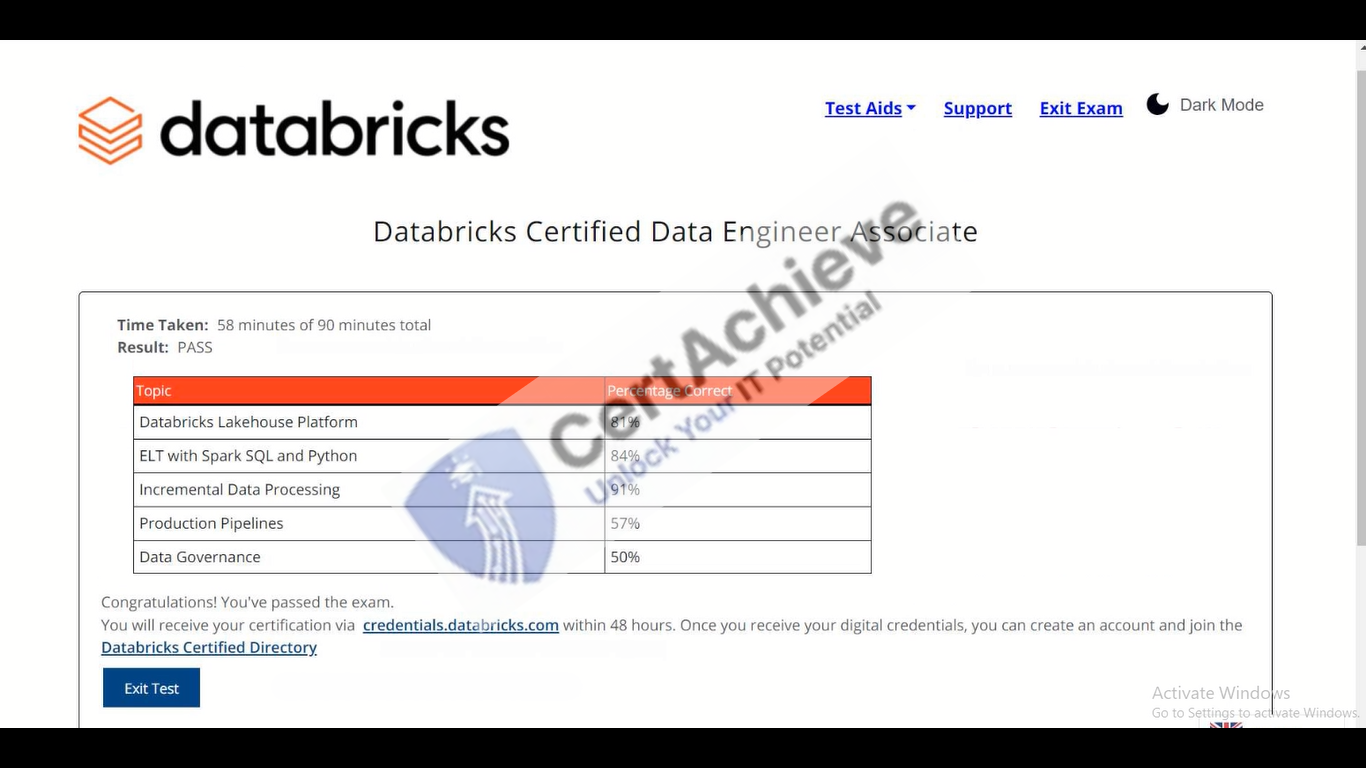
Verified Performance Reports
Authentic score reports from candidates who cleared the Databricks-Certified-Data-Engineer-Associate exam.
Verified Case #1
×
![]()