
The Databricks Certified Generative AI Engineer Associate (Databricks-Generative-AI-Engineer-Associate)
Passing Databricks Generative AI Engineer exam ensures for the successful candidate a powerful array of professional and personal benefits. The first and the foremost benefit comes with a global recognition that validates your knowledge and skills, making possible your entry into any organization of your choice.

Databricks-Generative-AI-Engineer-Associate Exam Dumps
- Exam Code: Databricks-Generative-AI-Engineer-Associate
- Vendor: Databricks
- Certifications: Generative AI Engineer
- Exam Name: Databricks Certified Generative AI Engineer Associate
Why CertAchieve is Better than Standard Databricks-Generative-AI-Engineer-Associate Dumps
In 2026, Databricks uses variable topologies. Basic dumps will fail you.
| Quality Standard | Generic Dump Sites | CertAchieve Premium Prep |
|---|---|---|
| Technical Explanation | None (Answer Key Only) | Step-by-Step Expert Rationales |
| Syllabus Coverage | Often Outdated (v1.0) | 2026 Updated (Latest Syllabus) |
| Scenario Mastery | Blind Memorization | Conceptual Logic & Troubleshooting |
| Instructor Access | No Post-Sale Support | 24/7 Professional Help |
Customers Passed Exams
10
Success backed by proven exam prep tools
Questions Came Word for Word
95%
Real exam match rate reported by verified users
Average Score in Real Testing Centre
88%
Consistently high performance across certifications
Study Time Saved With CertAchieve
60%
Efficient prep that reduces study hours significantly
Databricks Databricks-Generative-AI-Engineer-Associate Exam Domains Q&A
Certified instructors verify every question for 100% accuracy, providing detailed, step-by-step explanations for each.
Question 1
Databricks Databricks-Generative-AI-Engineer-Associate
QUESTION DESCRIPTION:
A Generative AI Engineer is creating an LLM-powered application that will need access to up-to-date news articles and stock prices.
The design requires the use of stock prices which are stored in Delta tables and finding the latest relevant news articles by searching the internet.
How should the Generative AI Engineer architect their LLM system?
Correct Answer & Rationale:
Answer: D
Explanation:
To build an LLM-powered system that accesses up-to-date news articles and stock prices, the best approach is to create an agent that has access to specific tools (option D).
Agent with SQL and Web Search Capabilities : By using an agent-based architecture, the LLM can interact with external tools. The agent can query Delta tables (for up-to-date stock prices) via SQL and perform web searches to retrieve the latest news articles. This modular approach ensures the system can access both structured (stock prices) and unstructured (news) data sources dynamically.
Why This Approach Works :
SQL Queries for Stock Prices : Delta tables store stock prices, which the agent can query directly for the latest data.
Web Search for News : For news articles, the agent can generate search queries and retrieve the most relevant and recent articles, then pass them to the LLM for processing.
Why Other Options Are Less Suitable :
A (Summarizing News for Stock Prices) : This convoluted approach would not ensure accuracy when retrieving stock prices, which are already structured and stored in Delta tables.
B (Stock Price Volatility Queries) : While this could retrieve relevant information, it doesn ' t address how to obtain the most up-to-date news articles.
C (Vector Store) : Storing news articles and stock prices in a vector store might not capture the real-time nature of stock data and news updates, as it relies on pre-existing data rather than dynamic querying.
Thus, using an agent with access to both SQL for querying stock prices and web search for retrieving news articles is the best approach for ensuring up-to-date and accurate responses.
Question 2
Databricks Databricks-Generative-AI-Engineer-Associate
QUESTION DESCRIPTION:
What is an effective method to preprocess prompts using custom code before sending them to an LLM?
Correct Answer & Rationale:
Answer: D
Explanation:
The most effective way to preprocess prompts using custom code is to write a custom model, such as an MLflow PyFunc model . Here’s a breakdown of why this is the correct approach:
MLflow PyFunc Models : MLflow is a widely used platform for managing the machine learning lifecycle, including experimentation, reproducibility, and deployment. A PyFunc model is a generic Python function model that can implement custom logic, which includes preprocessing prompts.
Preprocessing Prompts : Preprocessing could include various tasks like cleaning up the user input, formatting it according to specific rules, or augmenting it with additional context before passing it to the LLM. Writing this preprocessing as part of a PyFunc model allows the custom code to be managed, tested, and deployed easily.
Modular and Reusable : By separating the preprocessing logic into a PyFunc model, the system becomes modular, making it easier to maintain and update without needing to modify the core LLM or retrain it.
Why Other Options Are Less Suitable :
A (Modify LLM’s Internal Architecture) : Directly modifying the LLM ' s architecture is highly impractical and can disrupt the model’s performance. LLMs are typically treated as black-box models for tasks like prompt processing.
B (Avoid Custom Code) : While it’s true that LLMs haven ' t been explicitly trained with preprocessed prompts, preprocessing can still improve clarity and alignment with desired input formats without confusing the model.
C (Postprocessing Outputs) : While postprocessing the output can be useful, it doesn ' t address the need for clean and well-formatted inputs, which directly affect the quality of the model ' s responses.
Thus, using an MLflow PyFunc model allows for flexible and controlled preprocessing of prompts in a scalable way, making it the most effective method.
Question 3
Databricks Databricks-Generative-AI-Engineer-Associate
QUESTION DESCRIPTION:
A Generative AI Engineer is using LangGraph to define multiple tools in a single agentic application. They want to enable the main orchestrator LLM to decide on its own which tools are most appropriate to call for a given prompt. To do this, they must determine the general flow of the code. Which sequence will do this?
Correct Answer & Rationale:
Answer: B
Explanation:
In modern agentic frameworks like LangGraph or LangChain, the standard workflow for creating an autonomous tool-calling agent follows a specific sequence. First, tools must be defined (often as Python functions with clear docstrings, which the LLM uses to understand the tool ' s purpose). Second, the agent logic is defined, which specifies how the LLM should think. Third, the agent is initialized using a logic pattern like ReAct (Reason + Act). The ReAct framework is essential here because it enables the " orchestrator " loop: the LLM receives a prompt, generates a " Thought " about which tool to use, generates an " Action " to call that tool, receives an " Observation " (the tool ' s output), and repeats until it can provide a final answer. Loading tools into " separate agents " (C) or defining tools " inside " agents (D) are non-standard patterns that add unnecessary complexity and do not align with the centralized orchestration model required for LangGraph.
Question 4
Databricks Databricks-Generative-AI-Engineer-Associate
QUESTION DESCRIPTION:
A Generative Al Engineer needs to design an LLM pipeline to conduct multi-stage reasoning that leverages external tools. To be effective at this, the LLM will need to plan and adapt actions while performing complex reasoning tasks.
Which approach will do this?
Correct Answer & Rationale:
Answer: B
Explanation:
The task requires an LLM pipeline for multi-stage reasoning with external tools, necessitating planning, adaptability, and complex reasoning. Let’s evaluate the options based on Databricks’ recommendations for advanced LLM workflows.
Option A: Train the LLM to generate a single, comprehensive response without interacting with any external tools, relying solely on its pre-trained knowledge
This approach limits the LLM to its static knowledge base, excluding external tools and multi-stage reasoning. It can’t adapt or plan actions dynamically, failing the requirements.
Databricks Reference : " External tools enhance LLM capabilities beyond pre-trained knowledge " ( " Building LLM Applications with Databricks, " 2023).
Option B: Implement a framework like ReAct which allows the LLM to generate reasoning traces and perform task-specific actions that leverage external tools if necessary
ReAct (Reasoning + Acting) combines reasoning traces (step-by-step logic) with actions (e.g., tool calls), enabling the LLM to plan, adapt, and execute complex tasks iteratively. This meets all requirements: multi-stage reasoning, tool use, and adaptability.
Databricks Reference : " Frameworks like ReAct enable LLMs to interleave reasoning and external tool interactions for complex problem-solving " ( " Generative AI Cookbook, " 2023).
Option C: Encourage the LLM to make multiple API calls in sequence without planning or structuring the calls, allowing the LLM to decide when and how to use external tools spontaneously
Unstructured, spontaneous API calls lack planning and may lead to inefficient or incorrect tool usage. This doesn’t ensure effective multi-stage reasoning or adaptability.
Databricks Reference : Structured frameworks are preferred: " Ad-hoc tool calls can reduce reliability in complex tasks " ( " Building LLM-Powered Applications " ).
Option D: Use a Chain-of-Thought (CoT) prompting technique to guide the LLM through a series of reasoning steps, then manually input the results from external tools for the final answer
CoT improves reasoning but relies on manual tool interaction, breaking automation and adaptability. It’s not a scalable pipeline solution.
Databricks Reference : " Manual intervention is impractical for production LLM pipelines " ( " Databricks Generative AI Engineer Guide " ).
Conclusion : Option B (ReAct) is the best approach, as it integrates reasoning and tool use in a structured, adaptive framework, aligning with Databricks’ guidance for complex LLM workflows.
Question 5
Databricks Databricks-Generative-AI-Engineer-Associate
QUESTION DESCRIPTION:
A Generative Al Engineer is building a system which will answer questions on latest stock news articles.
Which will NOT help with ensuring the outputs are relevant to financial news?
Correct Answer & Rationale:
Answer: B
Explanation:
In the context of ensuring that outputs are relevant to financial news, increasing compute power (option B) does not directly improve the relevance of the LLM-generated outputs. Here’s why:
Compute Power and Relevancy : Increasing compute power can help the model process inputs faster, but it does not inherently improve the relevance of the answers. Relevancy depends on the data sources, the retrieval method, and the filtering mechanisms in place, not on how quickly the model processes the query.
What Actually Helps with Relevance : Other methods, like content filtering, guardrails, or manual review, can directly impact the relevance of the model’s responses by ensuring the model focuses on pertinent financial content. These methods help tailor the LLM’s responses to the financial domain and avoid irrelevant or harmful outputs.
Why Other Options Are More Relevant :
A (Comprehensive Guardrail Framework) : This will ensure that the model avoids generating content that is irrelevant or inappropriate in the finance sector.
C (Profanity Filter) : While not directly related to financial relevancy, ensuring the output is clean and professional is still important in maintaining the quality of responses.
D (Manual Review) : Incorporating human oversight to catch and correct issues with the LLM’s output ensures the final answers are aligned with financial content expectations.
Thus, increasing compute power does not help with ensuring the outputs are more relevant to financial news, making option B the correct answer.
Question 6
Databricks Databricks-Generative-AI-Engineer-Associate
QUESTION DESCRIPTION:
Databricks offers a number of built-in AI judges that provide metrics and rationale for different types of quality issues a Generative AI application may have.
Which of the following pairs of judges both require a ground-truth label in the evaluation dataset field expected_response to execute?
Correct Answer & Rationale:
Answer: A
Explanation:
In the Agent Evaluation terminology used by this question, correctness compares the generated response with the expected answer, while context_sufficiency determines whether the retrieved context contains enough information to produce that expected answer. Both therefore depend on ground-truth information supplied through expected_response. Groundedness instead examines whether the response is supported by the retrieved context; it does not inherently need a reference answer. Chunk relevance and relevance to the query assess alignment with the user’s request, while guideline adherence evaluates compliance with specified instructions. Databricks explicitly distinguishes the ground-truth-dependent judges in its migration documentation. In MLflow 3, names and schemas have evolved, including expectations.expected_response and explicitly selected scorers, so the question should be interpreted using its stated legacy judge terminology. Databricks documentation
Question 7
Databricks Databricks-Generative-AI-Engineer-Associate
QUESTION DESCRIPTION:
A Generative Al Engineer has created a RAG application to look up answers to questions about a series of fantasy novels that are being asked on the author’s web forum. The fantasy novel texts are chunked and embedded into a vector store with metadata (page number, chapter number, book title), retrieved with the user’s query, and provided to an LLM for response generation. The Generative AI Engineer used their intuition to pick the chunking strategy and associated configurations but now wants to more methodically choose the best values.
Which TWO strategies should the Generative AI Engineer take to optimize their chunking strategy and parameters? (Choose two.)
Correct Answer & Rationale:
Answer: C, E
Explanation:
To optimize a chunking strategy for a Retrieval-Augmented Generation (RAG) application, the Generative AI Engineer needs a structured approach to evaluating the chunking strategy, ensuring that the chosen configuration retrieves the most relevant information and leads to accurate and coherent LLM responses. Here ' s why C and E are the correct strategies:
Strategy C: Evaluation Metrics (Recall, NDCG)
Define an evaluation metric : Common evaluation metrics such as recall, precision, or NDCG (Normalized Discounted Cumulative Gain) measure how well the retrieved chunks match the user ' s query and the expected response.
Recall measures the proportion of relevant information retrieved.
NDCG is often used when you want to account for both the relevance of retrieved chunks and the ranking or order in which they are retrieved.
Experiment with chunking strategies : Adjusting chunking strategies based on text structure (e.g., splitting by paragraph, chapter, or a fixed number of tokens) allows the engineer to experiment with various ways of slicing the text. Some chunks may better align with the user ' s query than others.
Evaluate performance : By using recall or NDCG, the engineer can methodically test various chunking strategies to identify which one yields the highest performance. This ensures that the chunking method provides the most relevant information when embedding and retrieving data from the vector store.
Strategy E: LLM-as-a-Judge Metric
Use the LLM as an evaluator : After retrieving chunks, the LLM can be used to evaluate the quality of answers based on the chunks provided. This could be framed as a " judge " function, where the LLM compares how well a given chunk answers previous user queries.
Optimize based on the LLM ' s judgment : By having the LLM assess previous answers and rate their relevance and accuracy, the engineer can collect feedback on how well different chunking configurations perform in real-world scenarios.
This metric could be a qualitative judgment on how closely the retrieved information matches the user ' s intent.
Tune chunking parameters : Based on the LLM ' s judgment, the engineer can adjust the chunk size or structure to better align with the LLM ' s responses, optimizing retrieval for future queries.
By combining these two approaches, the engineer ensures that the chunking strategy is systematically evaluated using both quantitative (recall/NDCG) and qualitative (LLM judgment) methods. This balanced optimization process results in improved retrieval relevance and, consequently, better response generation by the LLM.
Question 8
Databricks Databricks-Generative-AI-Engineer-Associate
QUESTION DESCRIPTION:
A Generative AI Engineer needs to allocate costs for an agent deployed via Agent Framework behind AI Gateway. The finance team requires daily reporting by workspace and endpoint, including token usage and request counts. The engineer wants to query this data with SQL and join it to an internal cost-center mapping table.
Which table type best serves their needs?
Correct Answer & Rationale:
Answer: A
Explanation:
The AI Gateway usage table is designed to capture operational consumption information for SQL-based reporting. Its records include identifiers for the workspace, endpoint, and request, together with token-usage information and timestamps. The engineer can aggregate consumption by day and endpoint, then join those results to the company’s cost-center mapping. Request counting should respect the table’s request and invocation identifiers because a single logical request can involve multiple inference calls. Served-entity metadata describes deployed entities rather than providing the primary consumption records. Inference tables emphasize request and response payloads, while MLflow runs organize experiments and evaluations. Token consumption supports cost allocation, but calculating actual monetary charges may additionally require applicable pricing or billing records. Databricks documentation
Question 9
Databricks Databricks-Generative-AI-Engineer-Associate
QUESTION DESCRIPTION:
A Generative AI Engineer is designing an LLM-powered live sports commentary platform. The platform provides real-time updates and LLM-generated analyses for any users who would like to have live summaries, rather than reading a series of potentially outdated news articles.
Which tool below will give the platform access to real-time data for generating game analyses based on the latest game scores?
Correct Answer & Rationale:
Answer: C
Explanation:
Problem Context : The engineer is developing an LLM-powered live sports commentary platform that needs to provide real-time updates and analyses based on the latest game scores. The critical requirement here is the capability to access and integrate real-time data efficiently with the platform for immediate analysis and reporting.
Explanation of Options :
Option A: DatabricksIQ : While DatabricksIQ offers integration and data processing capabilities, it is more aligned with data analytics rather than real-time feature serving, which is crucial for immediate updates necessary in a live sports commentary context.
Option B: Foundation Model APIs : These APIs facilitate interactions with pre-trained models and could be part of the solution, but on their own, they do not provide mechanisms to access real-time game scores.
Option C: Feature Serving : This is the correct answer as feature serving specifically refers to the real-time provision of data (features) to models for prediction. This would be essential for an LLM that generates analyses based on live game data, ensuring that the commentary is current and based on the latest events in the sport.
Option D: AutoML : This tool automates the process of applying machine learning models to real-world problems, but it does not directly provide real-time data access, which is a critical requirement for the platform.
Thus, Option C (Feature Serving) is the most suitable tool for the platform as it directly supports the real-time data needs of an LLM-powered sports commentary system, ensuring that the analyses and updates are based on the latest available information.
Question 10
Databricks Databricks-Generative-AI-Engineer-Associate
QUESTION DESCRIPTION:
A Generative Al Engineer is ready to deploy an LLM application written using Foundation Model APIs. They want to follow security best practices for production scenarios
Which authentication method should they choose?
Correct Answer & Rationale:
Answer: A
Explanation:
The task is to deploy an LLM application using Foundation Model APIs in a production environment while adhering to security best practices. Authentication is critical for securing access to Databricks resources, such as the Foundation Model API. Let’s evaluate the options based on Databricks’ security guidelines for production scenarios.
Option A: Use an access token belonging to service principals
Service principals are non-human identities designed for automated workflows and applications in Databricks. Using an access token tied to a service principal ensures that the authentication is scoped to the application, follows least-privilege principles (via role-based access control), and avoids reliance on individual user credentials. This is a security best practice for production deployments.
Databricks Reference : " For production applications, use service principals with access tokens to authenticate securely, avoiding user-specific credentials " ( " Databricks Security Best Practices, " 2023). Additionally, the " Foundation Model API Documentation " states: " Service principal tokens are recommended for programmatic access to Foundation Model APIs. "
Option B: Use a frequently rotated access token belonging to either a workspace user or a service principal
Frequent rotation enhances security by limiting token exposure, but tying the token to a workspace user introduces risks (e.g., user account changes, broader permissions). Including both user and service principal options dilutes the focus on application-specific security, making this less ideal than a service-principal-only approach. It also adds operational overhead without clear benefits over Option A.
Databricks Reference : " While token rotation is a good practice, service principals are preferred over user accounts for application authentication " ( " Managing Tokens in Databricks, " 2023).
Option C: Use OAuth machine-to-machine authentication
OAuth M2M (e.g., client credentials flow) is a secure method for application-to-service communication, often using service principals under the hood. However, Databricks’ Foundation Model API primarily supports personal access tokens (PATs) or service principal tokens over full OAuth flows for simplicity in production setups. OAuth M2M adds complexity (e.g., managing refresh tokens) without a clear advantage in this context.
Databricks Reference : " OAuth is supported in Databricks, but service principal tokens are simpler and sufficient for most API-based workloads " ( " Databricks Authentication Guide, " 2023).
Option D: Use an access token belonging to any workspace user
Using a user’s access token ties the application to an individual’s identity, violating security best practices. It risks exposure if the user leaves, changes roles, or has overly broad permissions, and it’s not scalable or auditable for production.
Databricks Reference : " Avoid using personal user tokens for production applications due to security and governance concerns " ( " Databricks Security Best Practices, " 2023).
Conclusion : Option A is the best choice, as it uses a service principal’s access token, aligning with Databricks’ security best practices for production LLM applications. It ensures secure, application-specific authentication with minimal complexity, as explicitly recommended for Foundation Model API deployments.

Verified by Certified Instructors
This Databricks Databricks-Generative-AI-Engineer-Associate study pack was audited and verified on September 23, 2026 by Hilary Beaumont,. We ensure every technical rationale aligns with real-world enterprise standards.
A Stepping Stone for Enhanced Career Opportunities
Your profile having Generative AI Engineer certification significantly enhances your credibility and marketability in all corners of the world. The best part is that your formal recognition pays you in terms of tangible career advancement. It helps you perform your desired job roles accompanied by a substantial increase in your regular income. Beyond the resume, your expertise imparts you confidence to act as a dependable professional to solve real-world business challenges.
Your success in Databricks Databricks-Generative-AI-Engineer-Associate certification exam makes your visible and relevant in the fast-evolving tech landscape. It proves a lifelong investment in your career that give you not only a competitive advantage over your non-certified peers but also makes you eligible for a further relevant exams in your domain.
What You Need to Ace Databricks Exam Databricks-Generative-AI-Engineer-Associate
Achieving success in the Databricks-Generative-AI-Engineer-Associate Databricks exam requires a blending of clear understanding of all the exam topics, practical skills, and practice of the actual format. There's no room for cramming information, memorizing facts or dependence on a few significant exam topics. It means your readiness for exam needs you develop a comprehensive grasp on the syllabus that includes theoretical as well as practical command.
Here is a comprehensive strategy layout to secure peak performance in Databricks-Generative-AI-Engineer-Associate certification exam:
- Develop a rock-solid theoretical clarity of the exam topics
- Begin with easier and more familiar topics of the exam syllabus
- Make sure your command on the fundamental concepts
- Focus your attention to understand why that matters
- Ensure hands-on practice as the exam tests your ability to apply knowledge
- Develop a study routine managing time because it can be a major time-sink if you are slow
- Find out a comprehensive and streamlined study resource for your help
Ensuring Outstanding Results in Exam Databricks-Generative-AI-Engineer-Associate!
In the backdrop of the above prep strategy for Databricks-Generative-AI-Engineer-Associate Databricks exam, your primary need is to find out a comprehensive study resource. It could otherwise be a daunting task to achieve exam success. The most important factor that must be kep in mind is make sure your reliance on a one particular resource instead of depending on multiple sources. It should be an all-inclusive resource that ensures conceptual explanations, hands-on practical exercises, and realistic assessment tools.
Certachieve: A Reliable All-inclusive Study Resource
Certachieve offers multiple study tools to do thorough and rewarding Databricks-Generative-AI-Engineer-Associate exam prep. Here's an overview of Certachieve's toolkit:
Databricks Databricks-Generative-AI-Engineer-Associate PDF Study Guide
This premium guide contains a number of Databricks Databricks-Generative-AI-Engineer-Associate exam questions and answers that give you a full coverage of the exam syllabus in easy language. The information provided efficiently guides the candidate's focus to the most critical topics. The supportive explanations and examples build both the knowledge and the practical confidence of the exam candidates required to confidently pass the exam. The demo of Databricks Databricks-Generative-AI-Engineer-Associate study guide pdf free download is also available to examine the contents and quality of the study material.
Databricks Databricks-Generative-AI-Engineer-Associate Practice Exams
Practicing the exam Databricks-Generative-AI-Engineer-Associate questions is one of the essential requirements of your exam preparation. To help you with this important task, Certachieve introduces Databricks Databricks-Generative-AI-Engineer-Associate Testing Engine to simulate multiple real exam-like tests. They are of enormous value for developing your grasp and understanding your strengths and weaknesses in exam preparation and make up deficiencies in time.
These comprehensive materials are engineered to streamline your preparation process, providing a direct and efficient path to mastering the exam's requirements.
Databricks Databricks-Generative-AI-Engineer-Associate exam dumps
These realistic dumps include the most significant questions that may be the part of your upcoming exam. Learning Databricks-Generative-AI-Engineer-Associate exam dumps can increase not only your chances of success but can also award you an outstanding score.
Top Exams & Certification Providers
New & Trending
- New Released Exams
- Related Exam
- Hot Vendor
Verified Performance Reports
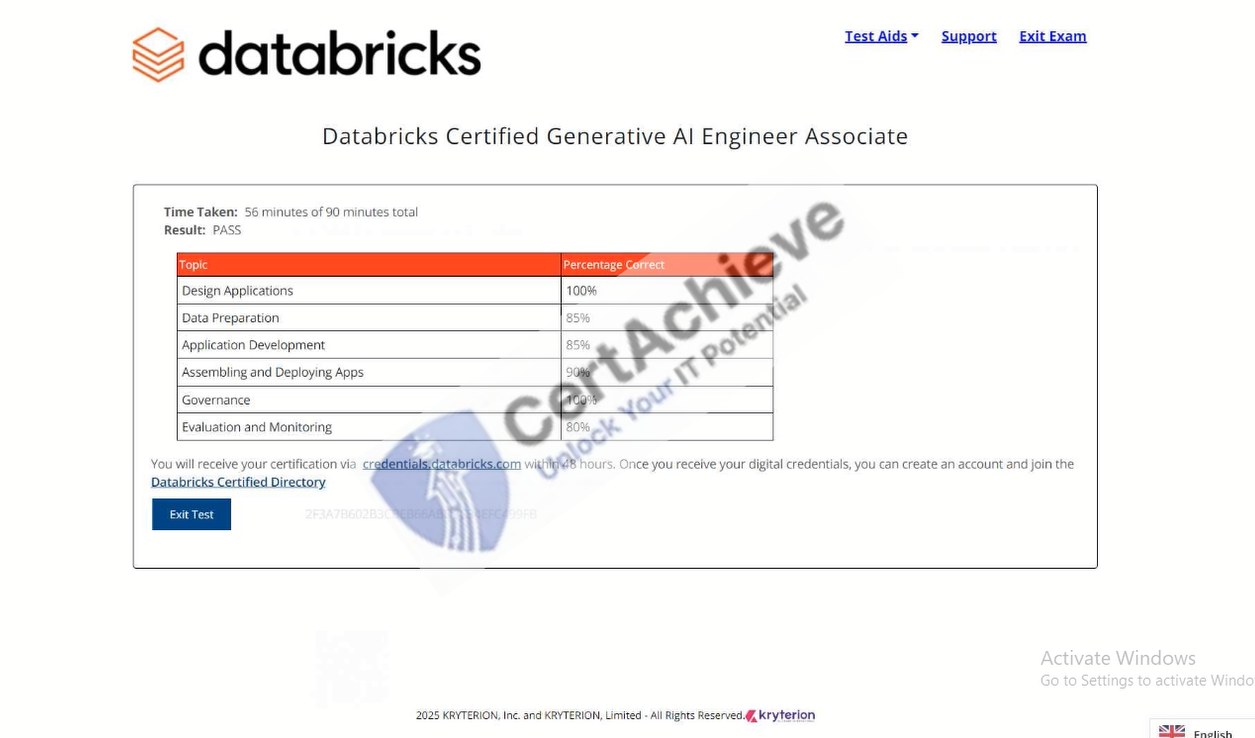
Authentic score reports from candidates who cleared the Databricks-Generative-AI-Engineer-Associate exam.
Verified Case #1
×
![]()