
The Google Cloud Associate Data Practitioner (ADP Exam) (Associate-Data-Practitioner)
Passing Google Google Cloud Platform exam ensures for the successful candidate a powerful array of professional and personal benefits. The first and the foremost benefit comes with a global recognition that validates your knowledge and skills, making possible your entry into any organization of your choice.


Associate-Data-Practitioner Exam Dumps
- Exam Code: Associate-Data-Practitioner
- Vendor: Google
- Certifications: Google Cloud Platform
- Exam Name: Google Cloud Associate Data Practitioner (ADP Exam)
Why CertAchieve is Better than Standard Associate-Data-Practitioner Dumps
In 2026, Google uses variable topologies. Basic dumps will fail you.
| Quality Standard | Generic Dump Sites | CertAchieve Premium Prep |
|---|---|---|
| Technical Explanation | None (Answer Key Only) | Step-by-Step Expert Rationales |
| Syllabus Coverage | Often Outdated (v1.0) | 2026 Updated (Latest Syllabus) |
| Scenario Mastery | Blind Memorization | Conceptual Logic & Troubleshooting |
| Instructor Access | No Post-Sale Support | 24/7 Professional Help |
Customers Passed Exams
10
Success backed by proven exam prep tools
Questions Came Word for Word
94%
Real exam match rate reported by verified users
Average Score in Real Testing Centre
92%
Consistently high performance across certifications
Study Time Saved With CertAchieve
60%
Efficient prep that reduces study hours significantly
Google Associate-Data-Practitioner Exam Domains Q&A
Certified instructors verify every question for 100% accuracy, providing detailed, step-by-step explanations for each.
Question 1
Google Associate-Data-Practitioner
QUESTION DESCRIPTION:
Your organization's website uses an on-premises MySQL as a backend database. You need to migrate the on-premises MySQL database to Google Cloud while maintaining MySQL features. You want to minimize administrative overhead and downtime. What should you do?
Correct Answer & Rationale:
Answer: B
Explanation:
Comprehensive and Detailed in Depth Explanation:
Why B is correct:Database Migration Service (DMS) is designed for migrating databases to Cloud SQL with minimal downtime and administrative overhead.
Cloud SQL for MySQL is a fully managed MySQL service, which aligns with the requirement to minimize administrative overhead.
Why other options are incorrect:A: Installing MySQL on Compute Engine requires manual management of the database instance, which increases administrative overhead.
C: BigQuery is not a direct replacement for a relational MySQL database. It's an analytical data warehouse.
D: Spanner is a globally distributed, scalable database, but it requires schema conversion and is not a direct replacement for MySQL, and it is also much more complex than cloud SQL.
[References:, , Database Migration Service: https://cloud.google.com/database-migration, Cloud SQL for MySQL: https://cloud.google.com/sql/docs/mysql]
Question 2
Google Associate-Data-Practitioner
QUESTION DESCRIPTION:
Your company wants to implement a data transformation (ETL) pipeline for their BigQuery data warehouse. You need to identify a managed transformation solution that allows users to develop with SQL and JavaScript, has version control, allows for modular code, and has data quality checks. What should you do?
Correct Answer & Rationale:
Answer: C
Explanation:
Comprehensive and Detailed in Depth Explanation:
Why C is correct:Dataform is a managed data transformation service that allows you to define data pipelines using SQL and JavaScript.
It provides version control, modular code development, and data quality checks.
Why other options are incorrect:A: Cloud Composer is an orchestration tool, not a data transformation tool.
B: Scheduled queries are not suitable for complex ETL pipelines.
D: Dataproc requires setting up a Spark cluster and writing code, which is more complex than using Dataform.
[References:, Dataform: https://cloud.google.com/dataform/docs]
Question 3
Google Associate-Data-Practitioner
QUESTION DESCRIPTION:
Your team wants to create a monthly report to analyze inventory data that is updated daily. You need to aggregate the inventory counts by using only the most recent month of data, and save the results to be used in a Looker Studio dashboard. What should you do?
Correct Answer & Rationale:
Answer: A
Explanation:
Creating a materialized view in BigQuery with the SUM() function and the DATE_SUB() function is the best approach. Materialized views allow you to pre-aggregate and cache query results, making them efficient for repeated access, such as monthly reporting. By using the DATE_SUB() function, you can filter the inventory data to include only the most recent month. This approach ensures that the aggregation is up-to-date with minimal latency and provides efficient integration with Looker Studio for dashboarding.
Question 4
Google Associate-Data-Practitioner
QUESTION DESCRIPTION:
You need to transfer approximately 300 TB of data from your company's on-premises data center to Cloud Storage. You have 100 Mbps internet bandwidth, and the transfer needs to be completed as quickly as possible. What should you do?
Correct Answer & Rationale:
Answer: D
Explanation:
Comprehensive and Detailed In-Depth Explanation:
Transferring 300 TB over a 100 Mbps connection would take an impractical amount of time (over 300 days at theoretical maximum speed, ignoring real-world constraints like latency). Google Cloud provides the Transfer Appliance for large-scale, time-sensitive transfers.
Option A : Cloud Client Libraries over the internet would be slow and unreliable for 300 TB due to bandwidth limitations.
Option B : The gcloud storage command is similarly constrained by internet speed and not designed for such large transfers.
Option C : Compressing and splitting across multiple providers adds complexity and isn’t a Google-supported method for Cloud Storage ingestion.
[: Google Cloud Documentation - "Transfer Appliance Overview" (https://cloud.google.com/transfer-appliance)., ]
Question 5
Google Associate-Data-Practitioner
QUESTION DESCRIPTION:
You are a data analyst at your organization. You have been given a BigQuery dataset that includes customer information. The dataset contains inconsistencies and errors, such as missing values, duplicates, and formatting issues. You need to effectively and quickly clean the data. What should you do?
Correct Answer & Rationale:
Answer: D
Explanation:
Using BigQuery's built-in functions is the most effective and efficient way to clean the dataset directly within BigQuery. BigQuery provides powerful SQL capabilities to handle missing values, remove duplicates, and resolve formatting issues without needing to export data or create complex pipelines. This approach minimizes overhead and leverages the scalability of BigQuery for large datasets, making it an ideal solution for quickly addressing data quality issues.
Question 6
Google Associate-Data-Practitioner
QUESTION DESCRIPTION:
Your company is adopting BigQuery as their data warehouse platform. Your team has experienced Python developers. You need to recommend a fully-managed tool to build batch ETL processes that extract data from various source systems, transform the data using a variety of Google Cloud services, and load the transformed data into BigQuery. You want this tool to leverage your team’s Python skills. What should you do?
Correct Answer & Rationale:
Answer: C
Explanation:
Comprehensive and Detailed In-Depth Explanation:
The tool must be fully managed, support batch ETL, integrate with multiple Google Cloud services, and leverage Python skills.
Option A : Dataform is SQL-focused for ELT within BigQuery, not Python-centric, and lacks broad service integration for extraction.
Option B : Cloud Data Fusion is a visual ETL tool, not Python-focused, and requires more UI-based configuration than coding.
Option C : Cloud Composer (managed Apache Airflow) is fully managed, supports batch ETL via DAGs, integrates with various Google Cloud services (e.g., BigQuery, GCS) through operators, and allows custom Python code in tasks. It’s ideal for Python developers per the "Cloud Composer" documentation.
[: Google Cloud Documentation - "Cloud Composer Overview" (https://cloud.google.com/composer/docs)., , , ]
Question 7
Google Associate-Data-Practitioner
QUESTION DESCRIPTION:
Your organization uses Dataflow pipelines to process real-time financial transactions. You discover that one of your Dataflow jobs has failed. You need to troubleshoot the issue as quickly as possible. What should you do?
Correct Answer & Rationale:
Answer: C
Explanation:
To troubleshoot a failed Dataflow job as quickly as possible, you should navigate to the Dataflow Jobs page in the Google Cloud console . The console provides access to detailed job logs and worker logs, which can help you identify the cause of the failure. The graphical interface also allows you to visualize pipeline stages, monitor performance metrics, and pinpoint where the error occurred, making it the most efficient way to diagnose and resolve the issue promptly.
Extract from Google Documentation : From "Monitoring Dataflow Jobs" ( https://cloud.google.com/dataflow/docs/guides/monitoring-jobs ): "To troubleshoot a failed Dataflow job quickly, go to the Dataflow Jobs page in the Google Cloud Console, where you can view job logs and worker logs to identify errors and their root causes."
[: Google Cloud Documentation - "Dataflow Monitoring" (https://cloud.google.com/dataflow/docs/guides/monitoring-jobs)., , ]
Question 8
Google Associate-Data-Practitioner
QUESTION DESCRIPTION:
You work for a healthcare company that has a large on-premises data system containing patient records with personally identifiable information (PII) such as names, addresses, and medical diagnoses. You need a standardized managed solution that de-identifies PII across all your data feeds prior to ingestion to Google Cloud. What should you do?
Correct Answer & Rationale:
Answer: B
Explanation:
Using Cloud Data Fusion is the best solution for this scenario because:
Standardized managed solution : Cloud Data Fusion provides a visual interface for building data pipelines and includes prebuilt connectors and transformations for data cleaning and de-identification.
Compliance : It ensures sensitive data such as PII is de-identified prior to ingestion into Google Cloud, adhering to regulatory requirements for healthcare data.
Ease of use : Cloud Data Fusion is designed for transforming and preparing data, making it a managed and user-friendly tool for this purpose.
It's a fully managed, cloud-native data integration service for building ETL/ELT data pipelines visually.
It offers built-in transformations and connectors, including those suitable for data masking and de-identification.
It provides a standardized, visual interface, making it easier to create and manage data pipelines across various data sources.
It's designed for data integration and transformation, making it ideal for this scenario.
It helps to achieve a standardized managed solution.
Question 9
Google Associate-Data-Practitioner
QUESTION DESCRIPTION:
You are building a batch data pipeline to process 100 GB of structured data from multiple sources for daily reporting. You need to transform and standardize the data prior to loading the data to ensure that it is stored in a single dataset. You want to use a low-code solution that can be easily built and managed. What should you do?
Correct Answer & Rationale:
Answer: B
Explanation:
Comprehensive and Detailed in Depth Explanation:
Why B is correct:Cloud Data Fusion is a fully managed, cloud-native data integration service for building and managing ETL/ELT data pipelines.
It provides a graphical interface for building pipelines without coding, making it a low-code solution.
Cloud data fusion is perfect for the ingestion, transformation and loading of data into BigQuery.
Why other options are incorrect:A: Looker studio is for visualization, not data transformation.
C: Cloud SQL is a relational database, not ideal for large-scale analytical data.
D: Cloud run is for stateless applications, not batch data processing.
[References:, , Cloud Data Fusion: https://cloud.google.com/data-fusion/docs]
Question 10
Google Associate-Data-Practitioner
QUESTION DESCRIPTION:
Your company is migrating their batch transformation pipelines to Google Cloud. You need to choose a solution that supports programmatic transformations using only SQL. You also want the technology to support Git integration for version control of your pipelines. What should you do?
Correct Answer & Rationale:
Answer: B
Explanation:
Dataform workflows are the ideal solution for migrating batch transformation pipelines to Google Cloud when you want to perform programmatic transformations using only SQL. Dataform allows you to define SQL-based workflows for data transformations and supports Git integration for version control, enabling collaboration and version tracking of your pipelines. This approach is purpose-built for SQL-driven data pipeline management and aligns perfectly with your requirements.
The solution must use SQL for transformations and integrate with Git for version control, focusing on batch pipelines. Let’s evaluate:
Option A : Cloud Data Fusion uses a visual UI with plugins, not SQL-only transformations. It lacks native Git integration (requires external tools), missing a key requirement.
Option B : Dataform is a SQL-based workflow tool for BigQuery transformations, defining pipelines as SQLX scripts. It integrates natively with Git for version control, supporting batch ELT processes with minimal overhead.
Option C : Cloud Composer uses Python DAGs and operators, not SQL-only transformations. Git is possible but not intrinsic to its workflow design.
[: Google Cloud Documentation - "Dataform" (https://cloud.google.com/dataform)., , , ]

Verified by Certified Instructors
This Google Associate-Data-Practitioner study pack was audited and verified on September 23, 2026 by Hilary Beaumont,. We ensure every technical rationale aligns with real-world enterprise standards.
A Stepping Stone for Enhanced Career Opportunities
Your profile having Google Cloud Platform certification significantly enhances your credibility and marketability in all corners of the world. The best part is that your formal recognition pays you in terms of tangible career advancement. It helps you perform your desired job roles accompanied by a substantial increase in your regular income. Beyond the resume, your expertise imparts you confidence to act as a dependable professional to solve real-world business challenges.
Your success in Google Associate-Data-Practitioner certification exam makes your visible and relevant in the fast-evolving tech landscape. It proves a lifelong investment in your career that give you not only a competitive advantage over your non-certified peers but also makes you eligible for a further relevant exams in your domain.
What You Need to Ace Google Exam Associate-Data-Practitioner
Achieving success in the Associate-Data-Practitioner Google exam requires a blending of clear understanding of all the exam topics, practical skills, and practice of the actual format. There's no room for cramming information, memorizing facts or dependence on a few significant exam topics. It means your readiness for exam needs you develop a comprehensive grasp on the syllabus that includes theoretical as well as practical command.
Here is a comprehensive strategy layout to secure peak performance in Associate-Data-Practitioner certification exam:
- Develop a rock-solid theoretical clarity of the exam topics
- Begin with easier and more familiar topics of the exam syllabus
- Make sure your command on the fundamental concepts
- Focus your attention to understand why that matters
- Ensure hands-on practice as the exam tests your ability to apply knowledge
- Develop a study routine managing time because it can be a major time-sink if you are slow
- Find out a comprehensive and streamlined study resource for your help
Ensuring Outstanding Results in Exam Associate-Data-Practitioner!
In the backdrop of the above prep strategy for Associate-Data-Practitioner Google exam, your primary need is to find out a comprehensive study resource. It could otherwise be a daunting task to achieve exam success. The most important factor that must be kep in mind is make sure your reliance on a one particular resource instead of depending on multiple sources. It should be an all-inclusive resource that ensures conceptual explanations, hands-on practical exercises, and realistic assessment tools.
Certachieve: A Reliable All-inclusive Study Resource
Certachieve offers multiple study tools to do thorough and rewarding Associate-Data-Practitioner exam prep. Here's an overview of Certachieve's toolkit:
Google Associate-Data-Practitioner PDF Study Guide
This premium guide contains a number of Google Associate-Data-Practitioner exam questions and answers that give you a full coverage of the exam syllabus in easy language. The information provided efficiently guides the candidate's focus to the most critical topics. The supportive explanations and examples build both the knowledge and the practical confidence of the exam candidates required to confidently pass the exam. The demo of Google Associate-Data-Practitioner study guide pdf free download is also available to examine the contents and quality of the study material.
Google Associate-Data-Practitioner Practice Exams
Practicing the exam Associate-Data-Practitioner questions is one of the essential requirements of your exam preparation. To help you with this important task, Certachieve introduces Google Associate-Data-Practitioner Testing Engine to simulate multiple real exam-like tests. They are of enormous value for developing your grasp and understanding your strengths and weaknesses in exam preparation and make up deficiencies in time.
These comprehensive materials are engineered to streamline your preparation process, providing a direct and efficient path to mastering the exam's requirements.
Google Associate-Data-Practitioner exam dumps
These realistic dumps include the most significant questions that may be the part of your upcoming exam. Learning Associate-Data-Practitioner exam dumps can increase not only your chances of success but can also award you an outstanding score.
Top Exams & Certification Providers
New & Trending
- New Released Exams
- Related Exam
- Hot Vendor
Verified Performance Reports
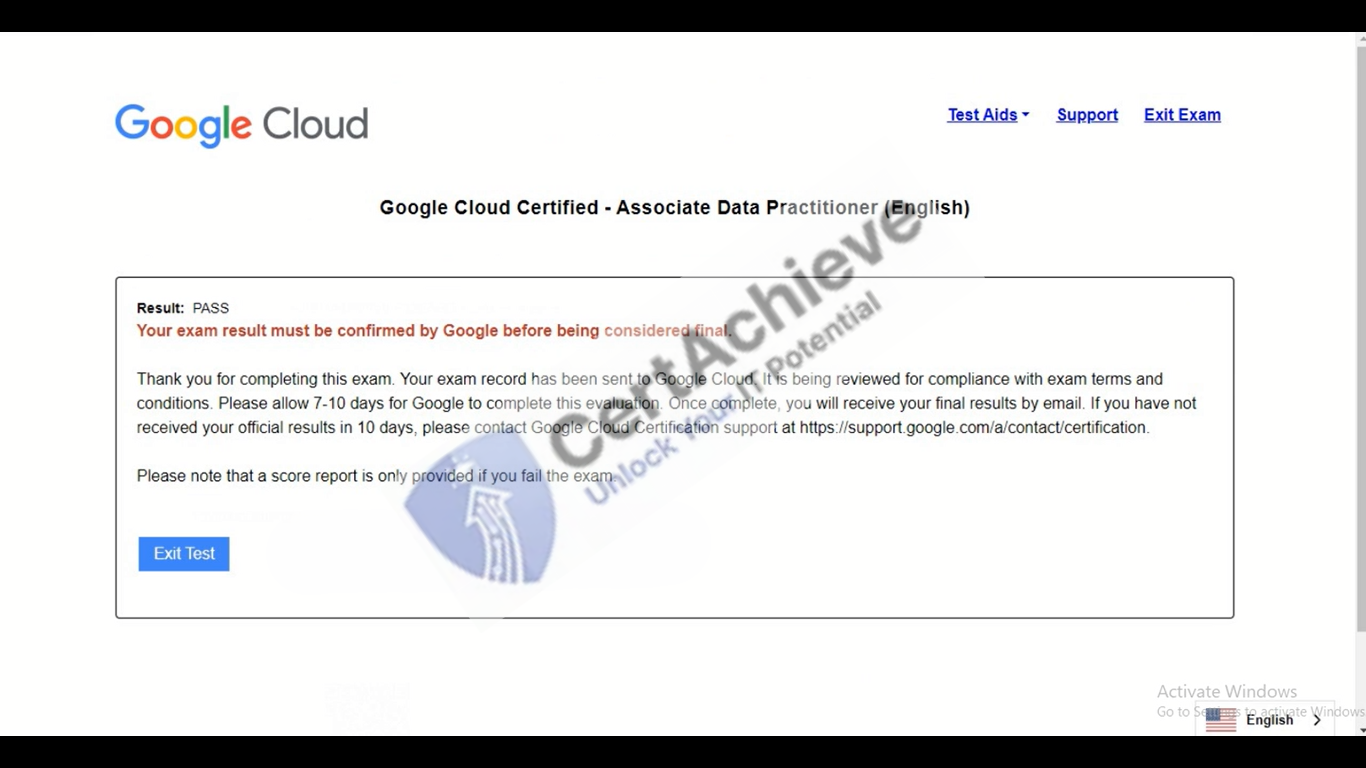
Authentic score reports from candidates who cleared the Associate-Data-Practitioner exam.
Verified Case #1
×
![]()