
The Google Cloud Certified - Associate Cloud Engineer (Associate-Cloud-Engineer)
Passing Google Google Cloud Certified exam ensures for the successful candidate a powerful array of professional and personal benefits. The first and the foremost benefit comes with a global recognition that validates your knowledge and skills, making possible your entry into any organization of your choice.

Associate-Cloud-Engineer Exam Dumps
- Exam Code: Associate-Cloud-Engineer
- Vendor: Google
- Certifications: Google Cloud Certified
- Exam Name: Google Cloud Certified - Associate Cloud Engineer
Why CertAchieve is Better than Standard Associate-Cloud-Engineer Dumps
In 2026, Google uses variable topologies. Basic dumps will fail you.
| Quality Standard | Generic Dump Sites | CertAchieve Premium Prep |
|---|---|---|
| Technical Explanation | None (Answer Key Only) | Step-by-Step Expert Rationales |
| Syllabus Coverage | Often Outdated (v1.0) | 2026 Updated (Latest Syllabus) |
| Scenario Mastery | Blind Memorization | Conceptual Logic & Troubleshooting |
| Instructor Access | No Post-Sale Support | 24/7 Professional Help |
Customers Passed Exams
10
Success backed by proven exam prep tools
Questions Came Word for Word
87%
Real exam match rate reported by verified users
Average Score in Real Testing Centre
94%
Consistently high performance across certifications
Study Time Saved With CertAchieve
60%
Efficient prep that reduces study hours significantly
Coverage of Official Google Associate-Cloud-Engineer Exam Domains
Our curriculum is meticulously mapped to the Google official blueprint.
Setting up a Cloud Solution Environment (17%)
Master the foundational setup of the Google Cloud hierarchy. Focus on managing projects, configuring billing accounts, and enabling necessary APIs. Learn to install and configure the Google Cloud CLI (Cloud SDK) and manage project-level identity and access.
Planning and Configuring a Cloud Solution (17%)
Master the selection of appropriate services for specific workloads. Focus on designing cost-effective compute solutions (Preemptible vs. Spot VMs), planning for data storage and database needs (Cloud SQL, BigQuery, Firestore), and configuring network resources like VPCs and subnets.
Deploying and Implementing a Cloud Solution (23%)
Focus on execution. Master the deployment of Compute Engine instances and the management of Google Kubernetes Engine (GKE) clusters, including node pools and workloads. Learn to implement serverless solutions via Cloud Run and Cloud Functions, and automate infrastructure using Terraform.
Ensuring Successful Operation of a Cloud Solution (34%)
The highest-weighted domain for 2026. Master the management of VM lifecycles, GKE workload operations, and storage lifecycle policies. Focus on proactive monitoring and alerting using Cloud Monitoring, log analysis in Cloud Logging, and troubleshooting networking and resource connectivity.
Configuring Access and Security (9%)
Focus on the "Least Privilege" security model. Master the management of IAM roles (Primitive, Predefined, and Custom) and Service Accounts. Learn to configure VPC Service Controls, audit logs, and security perimeters to protect sensitive data and cloud assets.
Google Associate-Cloud-Engineer Exam Domains Q&A
Certified instructors verify every question for 100% accuracy, providing detailed, step-by-step explanations for each.
Question 1
Google Associate-Cloud-Engineer
QUESTION DESCRIPTION:
Your development team needs a new Jenkins server for their project. You need to deploy the server using the fewest steps possible. What should you do?
Correct Answer & Rationale:
Answer: D
Explanation:
[Reference: https://cloud.google.com/solutions/using-jenkins-for-distributed-builds-on-compute-engine, , , , ]
Question 2
Google Associate-Cloud-Engineer
QUESTION DESCRIPTION:
You have developed a web application that serves traffic for a local event and are expecting unpredictable traffic. You have containerized the application, and you now want to deploy the application on Google Cloud. You also want to minimize costs. What should you do?
Correct Answer & Rationale:
Answer: A
Explanation:
Comprehensive and Detailed Explanation From Exact Extract:
The key requirements are a containerized web application that handles unpredictable traffic and must minimize costs.
Cloud Run is the ideal solution because it is a fully managed, serverless platform for containers that automatically scales to zero instances when there is no traffic. This directly fulfills the cost requirement by eliminating charges for idle resources. It excels at handling unpredictable, bursty traffic.
GKE Standard and Autopilot (Options B and D) incur costs for the cluster or nodes even when not serving traffic (unless carefully scaled down), making them less cost-efficient than Cloud Run ' s native scale-to-zero for unpredictable, non-constant workloads.
[Reference: Google Cloud Documentation - Cloud Run (Overview):, , "Cloud Run is a managed compute platform that enables you to run containers that are invocable via HTTP requests... Because Cloud Run is serverless, it abstracts away all infrastructure management. It scales up or down automatically, including scaling to zero to minimize your cost.", , , ]
Question 3
Google Associate-Cloud-Engineer
QUESTION DESCRIPTION:
You work for a large company that recently acquired three smaller startups. All of the startups’ Google Cloud resources must be centrally managed under a single Google Cloud organization. However, each startup has its own budget and financial reporting structure. You need to ensure that each startup receives a separate monthly invoice for its Google Cloud consumption. What should you do?
Correct Answer & Rationale:
Answer: C
Explanation:
The correct answer is C because the resources must be centrally managed under a single Google Cloud organization, but each startup requires separate billing and invoicing. Folders provide administrative separation inside one organization, while separate Cloud Billing accounts allow costs to be tracked and invoiced separately. Google Cloud Billing accounts define who pays for linked resources, track charges for projects linked to that billing account, and invoiced accounts result in invoices per Cloud Billing account. A single shared billing account would not satisfy the requirement for separate monthly invoices. Creating multiple organizations would violate the requirement for centralized management under one Google Cloud organization.
Question 4
Google Associate-Cloud-Engineer
QUESTION DESCRIPTION:
You are the organization and billing administrator for your company. The engineering team has the Project Creator role on the organization. You do not want the engineering team to be able to link projects to the billing account. Only the finance team should be able to link a project to a billing account, but they should not be able to make any other changes to projects. What should you do?
Correct Answer & Rationale:
Answer: C
Explanation:
From this source:https://cloud.google.com/billing/docs/how-to/custom-roles#permission_association_and_inheritance
" For example, associating a project with a billing account requires the billing.resourceAssociations.create permission on the billing account and also the resourcemanager.projects.createBillingAssignment permission on the project. This is because project permissions are required for actions where project owners control access, while billing account permissions are required for actions where billing account administrators control access. When both should be involved, both permissions are necessary. "
Question 5
Google Associate-Cloud-Engineer
QUESTION DESCRIPTION:
You want to send and consume Cloud Pub/Sub messages from your App Engine application. The Cloud Pub/Sub API is currently disabled. You will use a service account to authenticate yourapplication to the API. You want to make sure your application can use Cloud Pub/Sub. What should you do?
Correct Answer & Rationale:
Answer: A
Explanation:
Quickstart: using the Google Cloud Console
This page shows you how to perform basic tasks in Pub/Sub using the Google Cloud Console.
Note: If you are new to Pub/Sub, we recommend that you start with the interactive tutorial.
Before you begin
Set up a Cloud Console project.
Set up a project
Click to:
Create or select a project.
Enable the Pub/Sub API for that project.
You can view and manage these resources at any time in the Cloud Console.
Install and initialize the Cloud SDK.
Note: You can run the gcloud tool in the Cloud Console without installing the Cloud SDK. To run the gcloud tool in the Cloud Console, use Cloud Shell .
https://cloud.google.com/pubsub/docs/quickstart-console
Question 6
Google Associate-Cloud-Engineer
QUESTION DESCRIPTION:
You create a new Google Kubernetes Engine (GKE) cluster and want to make sure that it always runs a supported and stable version of Kubernetes. What should you do?
Correct Answer & Rationale:
Answer: B
Explanation:
Creating or upgrading a cluster by specifying the version as latest does not provide automatic upgrades. Enable node auto-upgrades to ensure that the nodes in your cluster are up-to-date with the latest stable version.
https://cloud.google.com/kubernetes-engine/versioning-and-upgrades
Node auto-upgrades help you keep the nodes in your cluster up to date with the cluster master version when your master is updated on your behalf. When you create a new cluster or node pool with Google Cloud Console or the gcloud command, node auto-upgrade is enabled by default.
Ref: https://cloud.google.com/kubernetes-engine/docs/how-to/node-auto-upgrades
Question 7
Google Associate-Cloud-Engineer
QUESTION DESCRIPTION:
You have a Linux VM that must connect to Cloud SQL. You created a service account with the appropriate access rights. You want to make sure that the VM uses this service account instead of the default Compute Engine service account. What should you do?
Correct Answer & Rationale:
Answer: A
Explanation:
[Reference: https://cloud.google.com/compute/docs/access/create-enable-service-accounts-for-instances, , https://cloud.google.com/compute/docs/access/create-enable-service-accounts-for-instances, Changing the service account and access scopes for an instance If you want to run the VM as a different identity, or you determine that the instance needs a different set of scopes to call the required APIs, you can change the service account and the access scopes of an existing instance. For example, you can change access scopes to grant access to a newAPI, or change an instance so that it runs as a service account that you created, instead of the Compute Engine default service account. However, Google recommends that you use the fine-grained IAM policies instead of relying on access scopes to control resource access for the service account. To change an instance's service account and access scopes, the instance must be temporarily stopped. To stop your instance, read the documentation for Stopping an instance. After changing the service account or access scopes, remember to restart the instance. Use one of the following methods to the change service account or access scopes of the stopped instance., , ]
Question 8
Google Associate-Cloud-Engineer
QUESTION DESCRIPTION:
Your company’s infrastructure is on-premises, but all machines are running at maximum capacity. You want to burst to Google Cloud. The workloads on Google Cloud must be able to directly communicate to the workloads on-premises using a private IP range. What should you do?
Correct Answer & Rationale:
Answer: D
Explanation:
" Google Cloud VPC Network Peering allows internal IP address connectivity across two Virtual Private Cloud (VPC) networks regardless of whether they belong to the same project or the same organization. "
https://cloud.google.com/vpc/docs/vpc-peering
while
" Cloud Interconnect provides low latency, high availability connections that enable you to reliably transfer data between your on-premises and Google Cloud Virtual Private Cloud (VPC) networks. "
https://cloud.google.com/network-connectivity/docs/interconnect/concepts/overview
and
" HA VPN is a high-availability (HA) Cloud VPN solution that lets you securely connect your on-premises network to your VPC network through an IPsec VPN connection in a single region. "
https://cloud.google.com/network-connectivity/docs/vpn/concepts/overview
Question 9
Google Associate-Cloud-Engineer
QUESTION DESCRIPTION:
You are setting up a Windows VM on Compute Engine and want to make sure you can log in to the VM via RDP. What should you do?
Correct Answer & Rationale:
Answer: B
Explanation:
You can generate Windows passwords using either the Google Cloud Console or the gcloud command-line tool. This option uses the right syntax to reset the windows password.
gcloud compute reset-windows-password windows-instance
Ref: https://cloud.google.com/compute/docs/instances/windows/creating-passwords-for-windows-instances#gcloud
Question 10
Google Associate-Cloud-Engineer
QUESTION DESCRIPTION:
You are writing a shell script that includes a few gcloud CLI commands to access some Google Cloud resources. You want to test the script in your local development environment with a service account in the most secure way. What should you do?
Correct Answer & Rationale:
Answer: B
Explanation:
Comprehensive and Detailed Explanation From Exact Extract:
To adhere to the most secure way and Google-recommended practices, you must avoid the creation and handling of service account key files.
Option B (Impersonation): This method allows the currently logged-in user to temporarily assume the identity and permissions of the service account. It is keyless, meaning no long-lived secret is downloaded or stored on the local machine, drastically improving security. The gcloud config command sets this behavior for all subsequent gcloud commands in the session.
[Reference: Google Cloud Documentation - Best practices for using service accounts:, , "Avoid creating service account keys... Instead, use service account impersonation or workload identity federation.", Reference: Google Cloud Documentation - Service Account Impersonation (Overview):, , "With service account impersonation, a user or service can temporarily gain the permissions of a service account... [This] helps you to avoid creating and downloading a service account key.", , ]

Verified by Certified Instructors
This Google Associate-Cloud-Engineer study pack was audited and verified on September 23, 2026 by Gene Whitlock,. We ensure every technical rationale aligns with real-world enterprise standards.
A Stepping Stone for Enhanced Career Opportunities
Your profile having Google Cloud Certified certification significantly enhances your credibility and marketability in all corners of the world. The best part is that your formal recognition pays you in terms of tangible career advancement. It helps you perform your desired job roles accompanied by a substantial increase in your regular income. Beyond the resume, your expertise imparts you confidence to act as a dependable professional to solve real-world business challenges.
Your success in Google Associate-Cloud-Engineer certification exam makes your visible and relevant in the fast-evolving tech landscape. It proves a lifelong investment in your career that give you not only a competitive advantage over your non-certified peers but also makes you eligible for a further relevant exams in your domain.
What You Need to Ace Google Exam Associate-Cloud-Engineer
Achieving success in the Associate-Cloud-Engineer Google exam requires a blending of clear understanding of all the exam topics, practical skills, and practice of the actual format. There's no room for cramming information, memorizing facts or dependence on a few significant exam topics. It means your readiness for exam needs you develop a comprehensive grasp on the syllabus that includes theoretical as well as practical command.
Here is a comprehensive strategy layout to secure peak performance in Associate-Cloud-Engineer certification exam:
- Develop a rock-solid theoretical clarity of the exam topics
- Begin with easier and more familiar topics of the exam syllabus
- Make sure your command on the fundamental concepts
- Focus your attention to understand why that matters
- Ensure hands-on practice as the exam tests your ability to apply knowledge
- Develop a study routine managing time because it can be a major time-sink if you are slow
- Find out a comprehensive and streamlined study resource for your help
Ensuring Outstanding Results in Exam Associate-Cloud-Engineer!
In the backdrop of the above prep strategy for Associate-Cloud-Engineer Google exam, your primary need is to find out a comprehensive study resource. It could otherwise be a daunting task to achieve exam success. The most important factor that must be kep in mind is make sure your reliance on a one particular resource instead of depending on multiple sources. It should be an all-inclusive resource that ensures conceptual explanations, hands-on practical exercises, and realistic assessment tools.
Certachieve: A Reliable All-inclusive Study Resource
Certachieve offers multiple study tools to do thorough and rewarding Associate-Cloud-Engineer exam prep. Here's an overview of Certachieve's toolkit:
Google Associate-Cloud-Engineer PDF Study Guide
This premium guide contains a number of Google Associate-Cloud-Engineer exam questions and answers that give you a full coverage of the exam syllabus in easy language. The information provided efficiently guides the candidate's focus to the most critical topics. The supportive explanations and examples build both the knowledge and the practical confidence of the exam candidates required to confidently pass the exam. The demo of Google Associate-Cloud-Engineer study guide pdf free download is also available to examine the contents and quality of the study material.
Google Associate-Cloud-Engineer Practice Exams
Practicing the exam Associate-Cloud-Engineer questions is one of the essential requirements of your exam preparation. To help you with this important task, Certachieve introduces Google Associate-Cloud-Engineer Testing Engine to simulate multiple real exam-like tests. They are of enormous value for developing your grasp and understanding your strengths and weaknesses in exam preparation and make up deficiencies in time.
These comprehensive materials are engineered to streamline your preparation process, providing a direct and efficient path to mastering the exam's requirements.
Google Associate-Cloud-Engineer exam dumps
These realistic dumps include the most significant questions that may be the part of your upcoming exam. Learning Associate-Cloud-Engineer exam dumps can increase not only your chances of success but can also award you an outstanding score.
CertAchieve provided updated Associate-Cloud-Engineer Practice Questions that covered Google Cloud deployment, monitoring, networking, and IAM topics effectively. The Exam Dumps were extremely helpful for certification success.
Amelia Brooks
Jun 25, 2026
Top Exams & Certification Providers
New & Trending
- New Released Exams
- Related Exam
- Hot Vendor
Verified Performance Reports
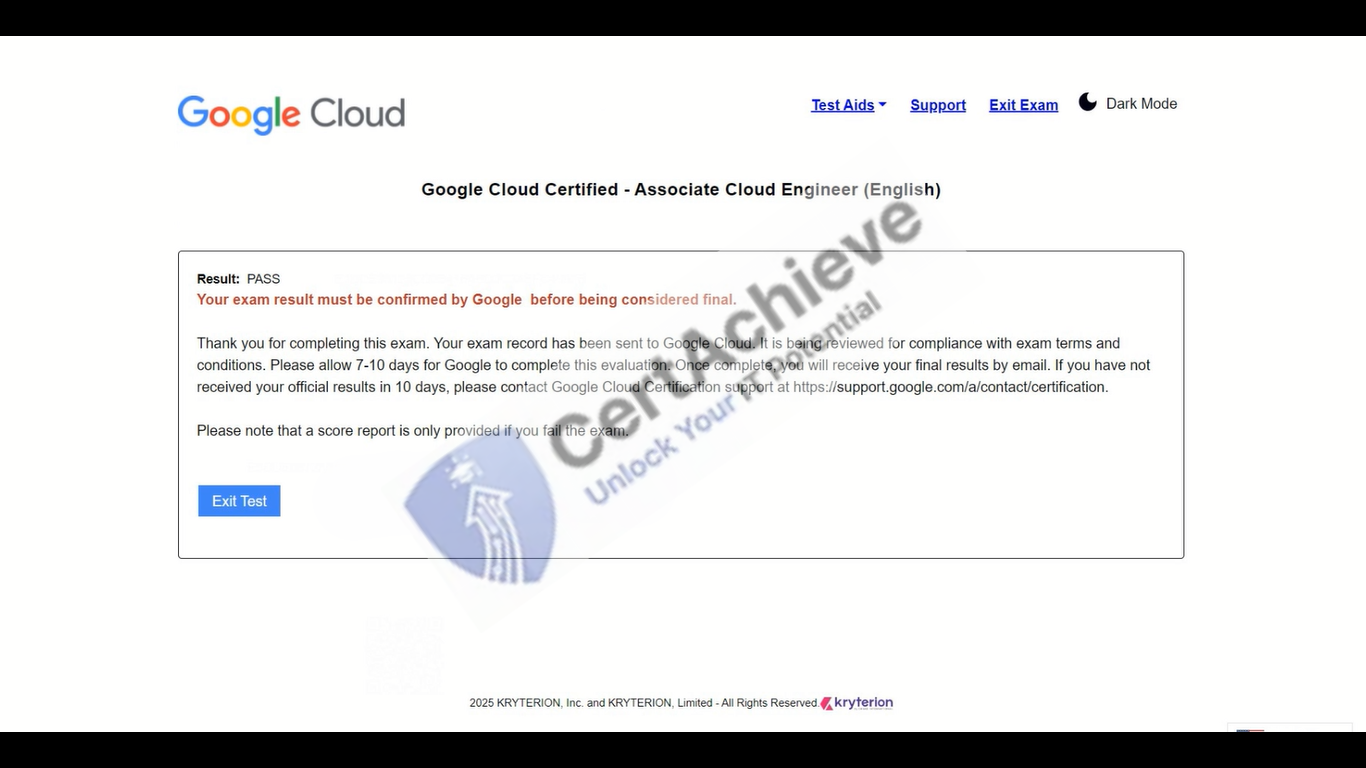
Authentic score reports from candidates who cleared the Associate-Cloud-Engineer exam.
Verified Case #1
×
![]()