
The Implementing Analytics Solutions Using Microsoft Fabric (DP-600)
Passing Microsoft Microsoft Certified: Fabric Analytics Engineer Associate exam ensures for the successful candidate a powerful array of professional and personal benefits. The first and the foremost benefit comes with a global recognition that validates your knowledge and skills, making possible your entry into any organization of your choice.


DP-600 Exam Dumps
- Exam Code: DP-600
- Vendor: Microsoft
- Certifications: Microsoft Certified: Fabric Analytics Engineer Associate
- Exam Name: Implementing Analytics Solutions Using Microsoft Fabric
Why CertAchieve is Better than Standard DP-600 Dumps
In 2026, Microsoft uses variable topologies. Basic dumps will fail you.
| Quality Standard | Generic Dump Sites | CertAchieve Premium Prep |
|---|---|---|
| Technical Explanation | None (Answer Key Only) | Step-by-Step Expert Rationales |
| Syllabus Coverage | Often Outdated (v1.0) | 2026 Updated (Latest Syllabus) |
| Scenario Mastery | Blind Memorization | Conceptual Logic & Troubleshooting |
| Instructor Access | No Post-Sale Support | 24/7 Professional Help |
Customers Passed Exams
10
Success backed by proven exam prep tools
Questions Came Word for Word
94%
Real exam match rate reported by verified users
Average Score in Real Testing Centre
94%
Consistently high performance across certifications
Study Time Saved With CertAchieve
60%
Efficient prep that reduces study hours significantly
Coverage of Official Microsoft DP-600 Exam Domains
Our curriculum is meticulously mapped to the Microsoft official blueprint.
Plan, Implement, and Manage a Solution for Data Analytics (15%)
The "Governance" layer. Master the administration of the Fabric tenant and capacity. Focus on workspace management, implementing security (Row-level and Object-level), and the Lifecycle Management of analytics assets using Git integration and Deployment Pipelines. Learn to balance performance and cost within the Fabric capacity (F-SKUs).
Prepare and Serve Data (45%)
The "Engineering" core. This is the highest-weighted domain. Master the ingestion and transformation of data using Data Factory (Dataflows Gen2 and Pipelines) and Synapse Data Engineering (Spark/Notebooks). Focus on the Medallion Architecture (Bronze, Silver, Gold), loading data into a Lakehouse or Warehouse, and utilizing T-SQL or PySpark for complex transformations within OneLake.
Implement and Manage Semantic Models (25%)
The "Intelligence" engine. Master the creation of sophisticated semantic models. Focus heavily on Direct Lake mode—the revolutionary Fabric feature that bypasses the need for data imports or DirectQuery. Learn to optimize model performance, write complex DAX expressions, and manage large-scale models using the XMLA endpoint and Tabular Editor.
Explore and Analyze Data (25%)
The "Insights" layer. Master data exploration using SQL analytics endpoints and KQL databases. Focus on creating impactful visualizations in Power BI, utilizing Copilot for Fabric to automate report creation, and identifying trends through exploratory data analysis (EDA). Understand how to leverage Fabric's "built-in" AI capabilities to deliver predictive value to stakeholders.
Microsoft DP-600 Exam Domains Q&A
Certified instructors verify every question for 100% accuracy, providing detailed, step-by-step explanations for each.
Question 1
Microsoft DP-600
QUESTION DESCRIPTION:
You have a Microsoft Power Bl project that contains a semantic model. You plan to use Azure DevOps for version control.
You need to modify the .gitignore file to prevent the data values from the data sources from being pushed to the repository. Which file should you reference?
Correct Answer & Rationale:
Answer: D
Explanation:
When using Power BI Project (.pbip) with Git integration:
The .pbip project separates model metadata (schema, measures, relationships, etc.) from actual data values.
The localSettings.json file stores machine-specific and environment-specific settings, including data source credentials and local configurations. These should not be checked into version control to avoid exposing sensitive information or environment-specific configs.
Other options:
unappliedChanges.json → tracks unsaved changes, not data values.
model.bim → defines the semantic model schema (measures, relationships, metadata) and must be included in version control.
cache.abf → stores Analysis Services cache data, not part of source control.
Therefore, the correct file to exclude is localSettings.json.
[Reference:, Power BI Projects and Git integration, localSettings.json in PBIP projects, , ]
Question 2
Microsoft DP-600
QUESTION DESCRIPTION:
You have a Fabric tenant that contains a new semantic model in OneLake.
You use a Fabric notebook to read the data into a Spark DataFrame.
You need to evaluate the data to calculate the min, max, mean, and standard deviation values for all the string and numeric columns.
Solution: You use the following PySpark expression:
df.explain()
Does this meet the goal?
Correct Answer & Rationale:
Answer: B
Explanation:
The df.explain() method does not meet the goal of evaluating data to calculate statistical functions. It is used to display the physical plan that Spark will execute. References = The correct usage of the explain() function can be found in the PySpark documentation.
Question 3
Microsoft DP-600
QUESTION DESCRIPTION:
You have a Fabric tenant
You are creating a Fabric Data Factory pipeline.
You have a stored procedure that returns the number of active customers and their average sales for the current month.
You need to add an activity that will execute the stored procedure in a warehouse. The returned values must be available to the downstream activities of the pipeline.
Which type of activity should you add?
Correct Answer & Rationale:
Answer: B
Explanation:
Lookup activity can execute a SQL query or stored procedure and retrieve a single row or dataset. The returned values can then be passed to downstream pipeline activities.
Switch is for branching logic, not executing procedures.
Append variable just adds values to a variable.
KQL activity executes Kusto queries, not SQL stored procedures.
Therefore, the correct choice is Lookup.
[Reference: Lookup activity in Fabric pipelines, , , ]
Question 4
Microsoft DP-600
QUESTION DESCRIPTION:
You have a Fabric tenant that contains a warehouse. The warehouse uses row-level security (RLS). You create a Direct Lake semantic model that uses the Delta tables and RLS of the warehouse. When users interact with a report built from the model, which mode will be used by the DAX queries?
Correct Answer & Rationale:
Answer: A
Explanation:
When users interact with a report built from a Direct Lake semantic model that uses row-level security (RLS), the DAX queries will operate in DirectQuery mode (A). This is because the model directly queries the underlying data source without importing data into Power BI. References = The Power BI documentation on DirectQuery provides detailed explanations of how RLS and DAX queries function in this mode.
Question 5
Microsoft DP-600
QUESTION DESCRIPTION:
You have a Fabric tenant that contains a semantic model. The model uses Direct Lake mode.
You suspect that some DAX queries load unnecessary columns into memory.
You need to identify the frequently used columns that are loaded into memory.
What are two ways to achieve the goal? Each correct answer presents a complete solution.
NOTE: Each correct answer is worth one point.
Correct Answer & Rationale:
Answer: A, C
Explanation:
The Vertipaq Analyzer tool (B) and querying the $system.discovered_STORAGE_TABLE_COLUMNS_IN_SEGMENTS dynamic management view (DMV) (C) can help identify which columns are frequently loaded into memory. Both methods provide insights into the storage and retrieval aspects of the semantic model. References = The Power BI documentation on Vertipaq Analyzer and DMV queries offers detailed guidance on how to use these tools for performance analysis.
Question 6
Microsoft DP-600
QUESTION DESCRIPTION:
You have a Fabric tenant that contains a warehouse.
You are designing a star schema model that will contain a customer dimension. The customer dimension table will be a Type 2 slowly changing dimension (SCD).
You need to recommend which columns to add to the table. The columns must NOT already exist in the source.
Which three types of columns should you recommend? Each correct answer presents part of the solution.
NOTE: Each correct answer is worth one point.
Correct Answer & Rationale:
Answer: A, C, E
Explanation:
For a Type 2 slowly changing dimension (SCD), you typically need to add the following types of columns that do not exist in the source system:
An effective start date and time (E): This column records the date and time from which the data in the row is effective.
An effective end date and time (A): This column indicates until when the data in the row was effective. It allows you to keep historical records for changes over time.
A surrogate key (C): A surrogate key is a unique identifier for each row in a table, which is necessary for Type 2 SCDs to differentiate between historical and current records.
[References: Best practices for designing slowly changing dimensions in data warehousing solutions, which include Type 2 SCDs, are commonly discussed in data warehousing and business intelligence literature and would be part of the modeling guidance in a Fabric tenant's documentation., , , , ]
Question 7
Microsoft DP-600
QUESTION DESCRIPTION:
You have a semantic model named Model1 that contains data that relates to customers and their bank account balances.
Model1 has the following tables and columns.
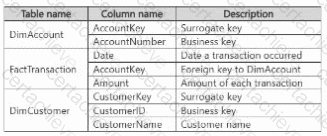
A customer can have one or more accounts. Each account can be associated to multiple customers.
You need to ensure that users can query Model1 to identify the total transaction amounts by customer.
What should you add to Model1?
Correct Answer & Rationale:
Answer: C
Explanation:
Scenario:
Tables:
DimAccount (accounts)
FactTransaction (transactions)
DimCustomer (customers)
Business rule:
A customer can have multiple accounts.
An account can be linked to multiple customers.
Many-to-many relationship.
Requirement: Calculate total transaction amounts by customer.
Analysis:
Direct many-to-many between FactTransaction and DimCustomer would not properly resolve aggregation.
Adding CustomerKey directly in FactTransaction is not possible because transactions link to accounts, not customers directly.
Correct approach: Create a bridge table (CustomerAccount) that maps Customer ↔ Account.
Then link FactTransaction → DimAccount → Bridge → DimCustomer.
Correct Answer:
C. A bridge table with relationships to DimCustomer and DimAccount
Question 8
Microsoft DP-600
QUESTION DESCRIPTION:
You have a Fabric tenant that contains a warehouse named Warehouse!. Warehousel contains two schemas name schemal and schema2 and a table named schemal.city.
You need to make a copy of schemal.city in schema2. The solution must minimize the copying of data.
Which T-SQL statement should you run?
Correct Answer & Rationale:
Answer: B
Explanation:
INSERT INTO … SELECT and SELECT INTO both physically copy all rows, which is heavy and not minimal.
CREATE TABLE AS SELECT (CTAS) also copies the data.
CREATE TABLE … AS CLONE OF creates a shallow clone in Fabric Warehouse, meaning it references the existing data without duplicating it, minimizing storage and copying.
Correct answer: B.
[Reference: Clone tables in Fabric warehouse, , ]
Question 9
Microsoft DP-600
QUESTION DESCRIPTION:
You have a Fabric tenant that contains a data warehouse.
You need to load rows into a large Type 2 slowly changing dimension (SCD). The solution must minimize resource usage. Which T-SQL statement should you use?
Correct Answer & Rationale:
Answer: B
Explanation:
For Type 2 Slowly Changing Dimensions (SCD):
MERGE is the standard T-SQL approach, allowing conditional UPDATE for existing rows and INSERT for new history records, in a single statement.
UPDATE + INSERT would require multiple steps and higher resource usage.
TRUNCATE + INSERT would destroy historical data, violating SCD rules.
CREATE TABLE AS SELECT is not suitable for incremental Type 2 handling.
Correct answer: B.
[Reference: Implement SCD Type 2 with MERGE, , ]
Question 10
Microsoft DP-600
QUESTION DESCRIPTION:
You need to implement the date dimension in the data store. The solution must meet the technical requirements.
What are two ways to achieve the goal? Each correct answer presents a complete solution.
NOTE: Each correct selection is worth one point.
Correct Answer & Rationale:
Answer: A, B
Explanation:
Both a dataflow (A) and a Stored procedure activity in a pipeline (B) are capable of creating and populating a date dimension table. A dataflow can perform the transformation needed to create the date dimension, and it aligns with the preference for using low-code tools for data ingestion when possible. A Stored procedure could be written to generate the necessary date dimension data and executed within a pipeline, which also adheres to the technical requirements for the PoC.

Verified by Certified Instructors
This Microsoft DP-600 study pack was audited and verified on September 23, 2026 by Hilary Beaumont,. We ensure every technical rationale aligns with real-world enterprise standards.
A Stepping Stone for Enhanced Career Opportunities
Your profile having Microsoft Certified: Fabric Analytics Engineer Associate certification significantly enhances your credibility and marketability in all corners of the world. The best part is that your formal recognition pays you in terms of tangible career advancement. It helps you perform your desired job roles accompanied by a substantial increase in your regular income. Beyond the resume, your expertise imparts you confidence to act as a dependable professional to solve real-world business challenges.
Your success in Microsoft DP-600 certification exam makes your visible and relevant in the fast-evolving tech landscape. It proves a lifelong investment in your career that give you not only a competitive advantage over your non-certified peers but also makes you eligible for a further relevant exams in your domain.
What You Need to Ace Microsoft Exam DP-600
Achieving success in the DP-600 Microsoft exam requires a blending of clear understanding of all the exam topics, practical skills, and practice of the actual format. There's no room for cramming information, memorizing facts or dependence on a few significant exam topics. It means your readiness for exam needs you develop a comprehensive grasp on the syllabus that includes theoretical as well as practical command.
Here is a comprehensive strategy layout to secure peak performance in DP-600 certification exam:
- Develop a rock-solid theoretical clarity of the exam topics
- Begin with easier and more familiar topics of the exam syllabus
- Make sure your command on the fundamental concepts
- Focus your attention to understand why that matters
- Ensure hands-on practice as the exam tests your ability to apply knowledge
- Develop a study routine managing time because it can be a major time-sink if you are slow
- Find out a comprehensive and streamlined study resource for your help
Ensuring Outstanding Results in Exam DP-600!
In the backdrop of the above prep strategy for DP-600 Microsoft exam, your primary need is to find out a comprehensive study resource. It could otherwise be a daunting task to achieve exam success. The most important factor that must be kep in mind is make sure your reliance on a one particular resource instead of depending on multiple sources. It should be an all-inclusive resource that ensures conceptual explanations, hands-on practical exercises, and realistic assessment tools.
Certachieve: A Reliable All-inclusive Study Resource
Certachieve offers multiple study tools to do thorough and rewarding DP-600 exam prep. Here's an overview of Certachieve's toolkit:
Microsoft DP-600 PDF Study Guide
This premium guide contains a number of Microsoft DP-600 exam questions and answers that give you a full coverage of the exam syllabus in easy language. The information provided efficiently guides the candidate's focus to the most critical topics. The supportive explanations and examples build both the knowledge and the practical confidence of the exam candidates required to confidently pass the exam. The demo of Microsoft DP-600 study guide pdf free download is also available to examine the contents and quality of the study material.
Microsoft DP-600 Practice Exams
Practicing the exam DP-600 questions is one of the essential requirements of your exam preparation. To help you with this important task, Certachieve introduces Microsoft DP-600 Testing Engine to simulate multiple real exam-like tests. They are of enormous value for developing your grasp and understanding your strengths and weaknesses in exam preparation and make up deficiencies in time.
These comprehensive materials are engineered to streamline your preparation process, providing a direct and efficient path to mastering the exam's requirements.
Microsoft DP-600 exam dumps
These realistic dumps include the most significant questions that may be the part of your upcoming exam. Learning DP-600 exam dumps can increase not only your chances of success but can also award you an outstanding score.
Top Exams & Certification Providers
New & Trending
- New Released Exams
- Related Exam
- Hot Vendor
Verified Performance Reports
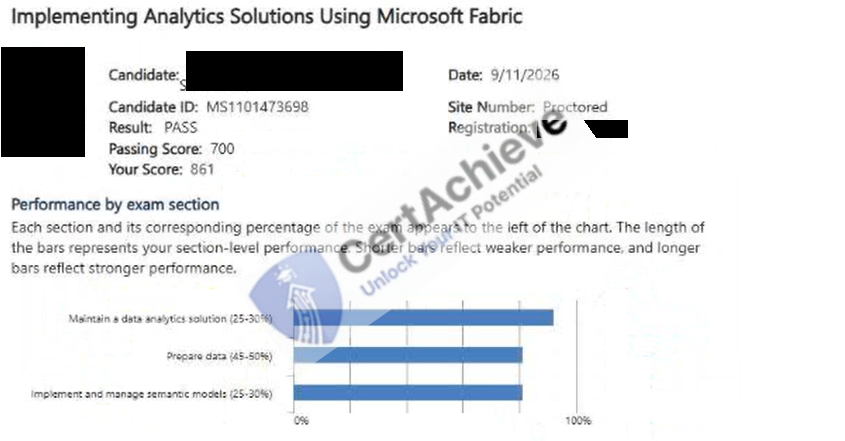
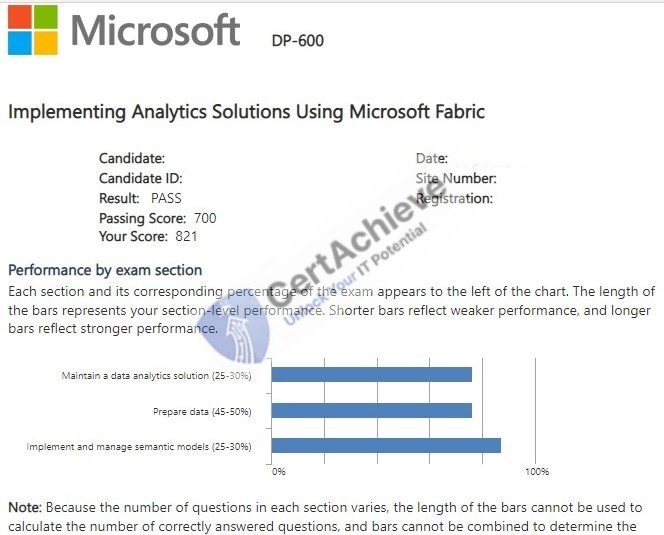
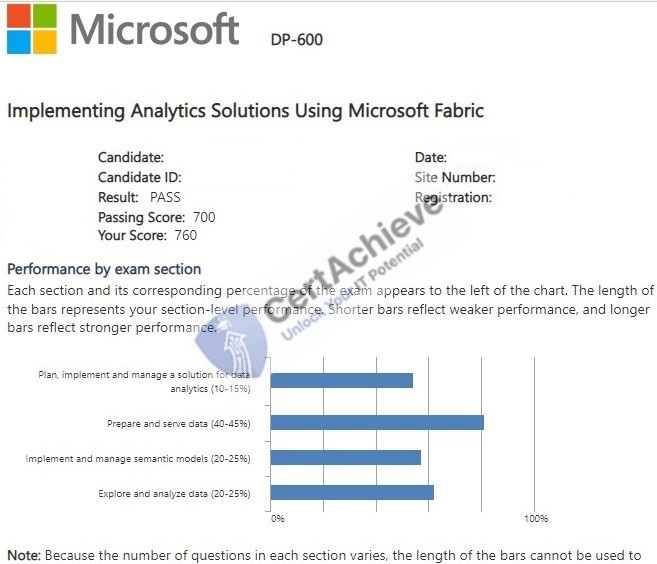
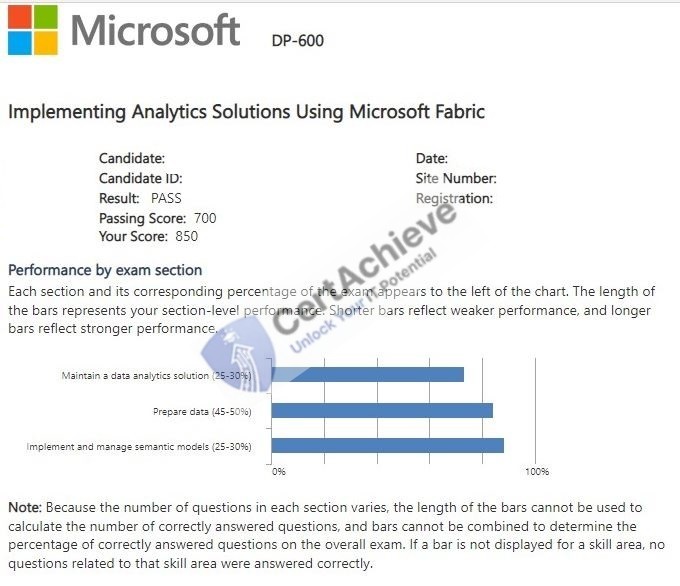
Authentic score reports from candidates who cleared the DP-600 exam.
Verified Case #1
Verified Case #2
Verified Case #3
Verified Case #4
×
![]()