
The MuleSoft Certified Developer - Level 1 (Mule 4) (MCD-Level-1)
Passing MuleSoft MuleSoft Certified Developer exam ensures for the successful candidate a powerful array of professional and personal benefits. The first and the foremost benefit comes with a global recognition that validates your knowledge and skills, making possible your entry into any organization of your choice.

MCD-Level-1 Exam Dumps
- Exam Code: MCD-Level-1
- Vendor: MuleSoft
- Certifications: MuleSoft Certified Developer
- Exam Name: MuleSoft Certified Developer - Level 1 (Mule 4)
Why CertAchieve is Better than Standard MCD-Level-1 Dumps
In 2026, MuleSoft uses variable topologies. Basic dumps will fail you.
| Quality Standard | Generic Dump Sites | CertAchieve Premium Prep |
|---|---|---|
| Technical Explanation | None (Answer Key Only) | Step-by-Step Expert Rationales |
| Syllabus Coverage | Often Outdated (v1.0) | 2026 Updated (Latest Syllabus) |
| Scenario Mastery | Blind Memorization | Conceptual Logic & Troubleshooting |
| Instructor Access | No Post-Sale Support | 24/7 Professional Help |
Customers Passed Exams
10
Success backed by proven exam prep tools
Questions Came Word for Word
90%
Real exam match rate reported by verified users
Average Score in Real Testing Centre
94%
Consistently high performance across certifications
Study Time Saved With CertAchieve
60%
Efficient prep that reduces study hours significantly
MuleSoft MCD-Level-1 Exam Domains Q&A
Certified instructors verify every question for 100% accuracy, providing detailed, step-by-step explanations for each.
Question 1
MuleSoft MCD-Level-1
QUESTION DESCRIPTION:
What HTTP method in a RESTful web service is typically used to completely replace an existing resource?
Correct Answer & Rationale:
Answer: C
Explanation:
PUT replaces the original version of the resource, whereas the PATCH method supplies a set of instructions to modify the resource
Question 2
MuleSoft MCD-Level-1
QUESTION DESCRIPTION:
Refer to exhibits.
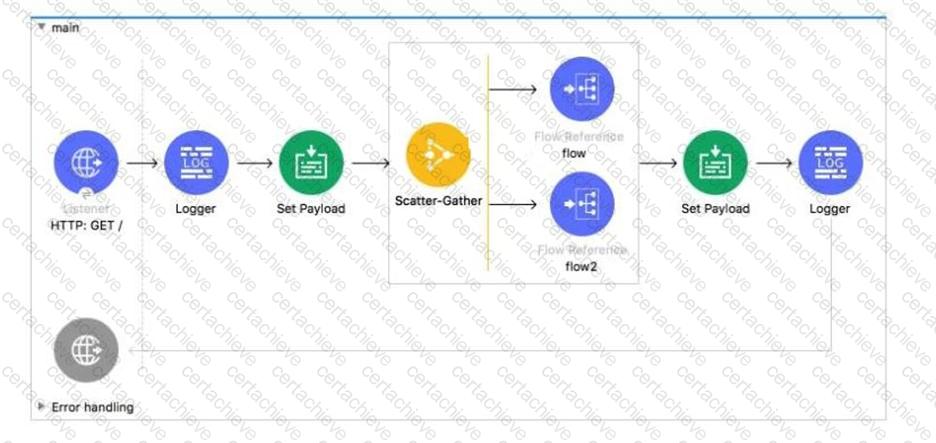
In the execution of the Scatter-Gather , the flow route completes after 10 seconds and the flow2 route completes in 40 seconds. How many seconds does it take for the Scatter-Gather to complete?
Correct Answer & Rationale:
Answer: C
Explanation:
Scatter-Gather sends the event to each routes concurrently. Hence both route in this example will start in parallel. So total time to complete processing is 40 seconds
The Scatter-Gather component is a routing event processor that processes a Mule event through different parallel processing routes that contain different event processors. Each route receives a reference to the Mule event and executes a sequence of one or more event processors. Each of these routes uses a separate thread to execute the event processors, and the resulting Mule event can be either the same Mule event without modifications or a new Mule event with its own payload, attributes, and variables. The Scatter-Gather component then combines the Mule events returned by each processing route into a new Mule event that is passed to the next event processor only after every route completes successfully.
The Scatter-Gather component executes each route in parallel, not sequentially. Parallel execution of routes can greatly increase the efficiency of your Mule application and may provide more information than sequential processing.
Mule Ref Doc : https://docs.mulesoft.com/mule-runtime/4.3/scatter-gather-concept
Question 3
MuleSoft MCD-Level-1
QUESTION DESCRIPTION:
In an application network. If the implementation but not the interface of a product API changes, what needs to be done to the other APIs that consume the product API?
Correct Answer & Rationale:
Answer: D
Explanation:
Correct answer is Nothing needs to be changed in the other APIs or their associated applications
This is the benefit of having separate interface layer. As there are no changes to interface , no changes are required on the API ' s which consumes this API in context
Question 4
MuleSoft MCD-Level-1
QUESTION DESCRIPTION:
A Mule flow has three Set Variable transformers. What global data structure can be used to access the variables?
Correct Answer & Rationale:
Answer: D
Explanation:
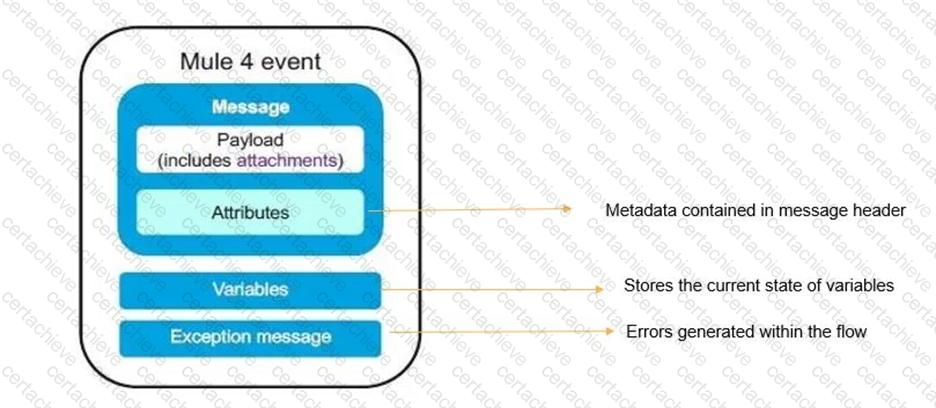
Mule event is correct answer. Mule event has two parts which are as follows
1) Message (which contains payload and attributes like headers and query/uri parameters
2) Variables
 Diagram
Description automatically generated
Diagram
Description automatically generated
Question 5
MuleSoft MCD-Level-1
QUESTION DESCRIPTION:
Refer to the exhibits.
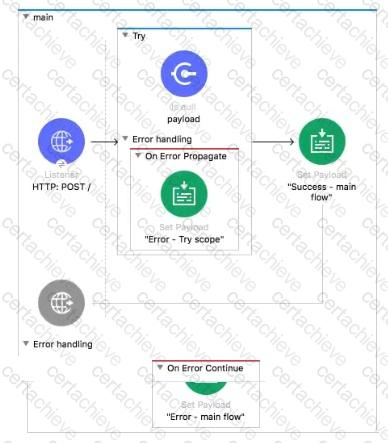
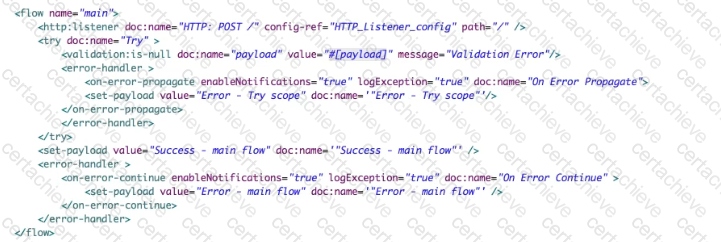
The Validation component in the Try scope throws an error.
What response message is returned to a client request to the main flow ' s HTTP Listener?
The Validation component in the Try scope throws an error. What response message is returned to a client request to the main flow ' s HTTP Listener?
Correct Answer & Rationale:
Answer: A
Explanation:
Note that private flow has error scope defined as On Error Continue . So when error occurs in private flow , it is handled by this On Error Continue scope which sends success response back to main flow and does not throw back an error. So main continues normally and payload is set to Success - main flow.
Hence correct answer is Success - main flow
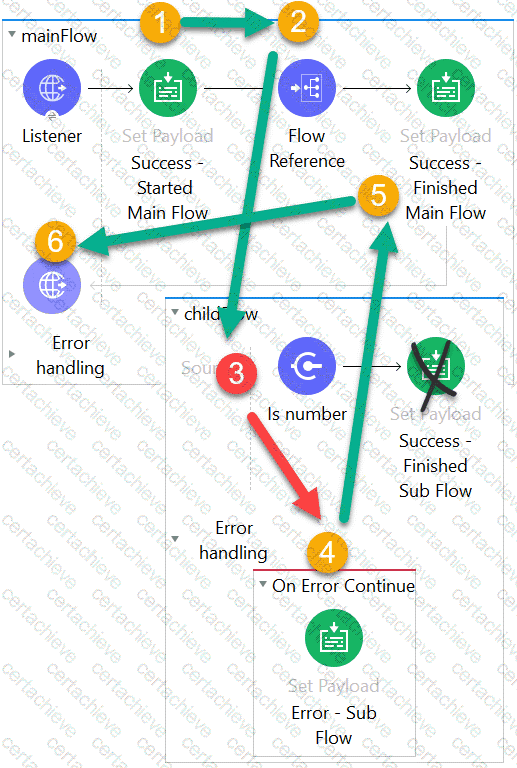
1) HTTP listener received request
2) The Flow Reference calls the child flow
3) The Is Number validator creates an Error Object because the payload isn’t an integer. Child Flow execution stops
#[error.description] = “payload is not a valid INTEGER value”
#[error.errorType] = VALIDATION:INVALID_NUMBER
4) The On Error Continue handles the errorThe payload is set to “Error – Sub Flow”
5) “Error – Sub Flow” is returned to the main flow as if the child flow was a success. The Set Payload is executed. The payload is reset to “Success – Finished Main Flow”
6) “Success – Main Flow” is returned to the requestor in the body of the HTTP request. HTTP Status Code: 200
As you can see, in the above example, because the error was caught by an On Error Continue scope in the child flow (RED in, GREEN out) when the Mule Message returns to the parent flow, the parent flow knows none-the-different that there was a failure because the on error continue returns a 200 success message. Note that because, to the mainFlow, the childFlow appeared to succeed, the processing of mainFlow resumed after the flow reference.
 A picture containing timeline
Description automatically generated
A picture containing timeline
Description automatically generated
Question 6
MuleSoft MCD-Level-1
QUESTION DESCRIPTION:
Which of the module is imported automatically in Dataweave scripts?
Correct Answer & Rationale:
Answer: A
Explanation:
Core (dw::Core) This module contains core DataWeave functions for data transformations. It is automatically imported into any DataWeave script.
Question 7
MuleSoft MCD-Level-1
QUESTION DESCRIPTION:
Refer to the exhibits.
Larger image
Larger image
Larger image
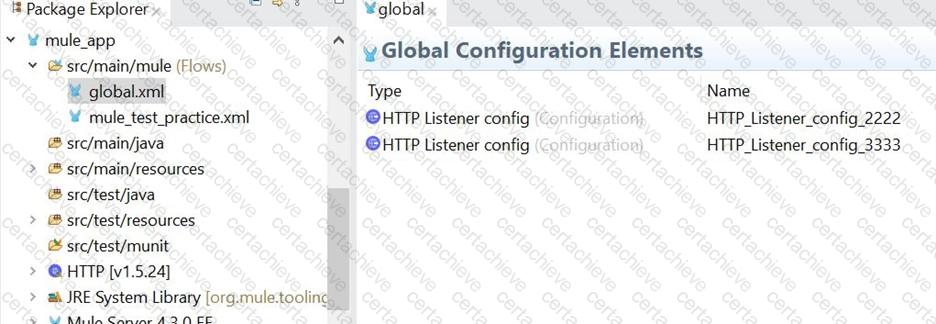
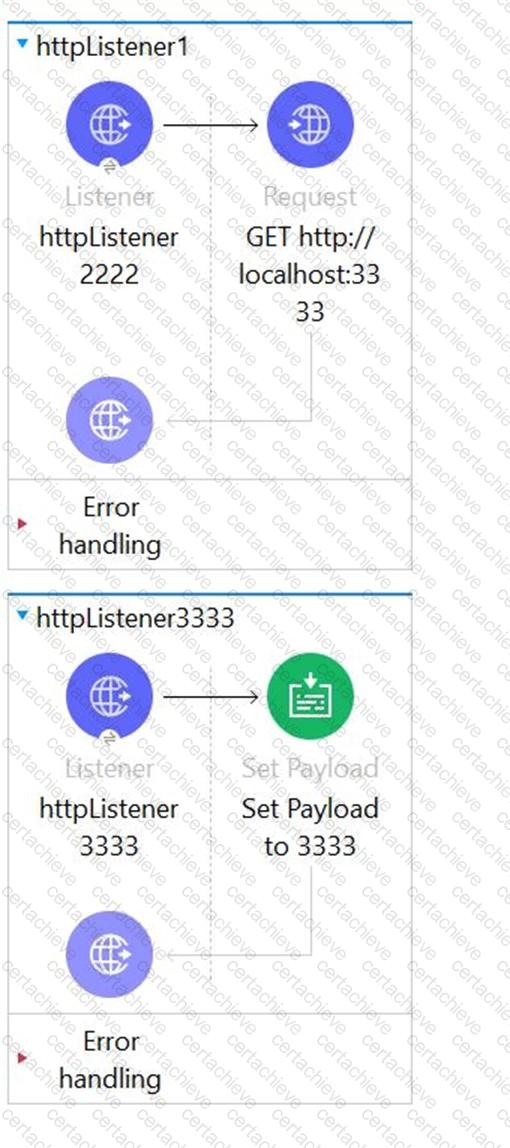
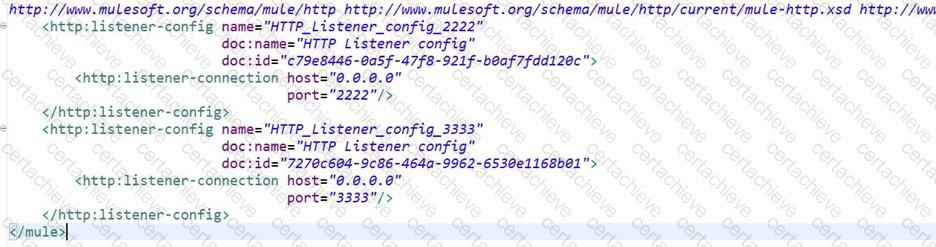
The Mule application configures and uses two HTTP Listener global configuration elements.
Mule application is run in Anypoint Studio.
If the mule application starts correctly, what URI and port numbers can receive web client requests? If the mule applications fails to start , what is the reason for the failure?
Correct Answer & Rationale:
Answer: D
Explanation:
In this case both the flows can start without any error and requests can be received on both ports. Flow names httpListener1 can call other flow using HTTP request without any issues.
Hence correct answer is
The mule application start successfully
Web client requests can be received at URI on port 2222 and on port 3333.
Lets check why other options are incorrect
1) The mule application fails to start. There is URL path conflict because both HTTP Listeners are configured with same path ---- This is incorrect as port value is different in both listeners
2) The mule application start successfully. Web client requests can only be received at URI on port 2222 but not on port 3333 --- This is incorrect as there is no reason for not receiving requests on port 3333
3) The mule application fails to start because of the port binding conflict as HTTP request also use same port i.e. 3333 --- Port binding conflict will not happen in this case. It would have if both listener configurations would have been on same port . But that is not the case here.
Mule Ref Doc : HTTP Listener Reference - Mule 4 | MuleSoft Documentation
Question 8
MuleSoft MCD-Level-1
QUESTION DESCRIPTION:
Refer to the exhibits.
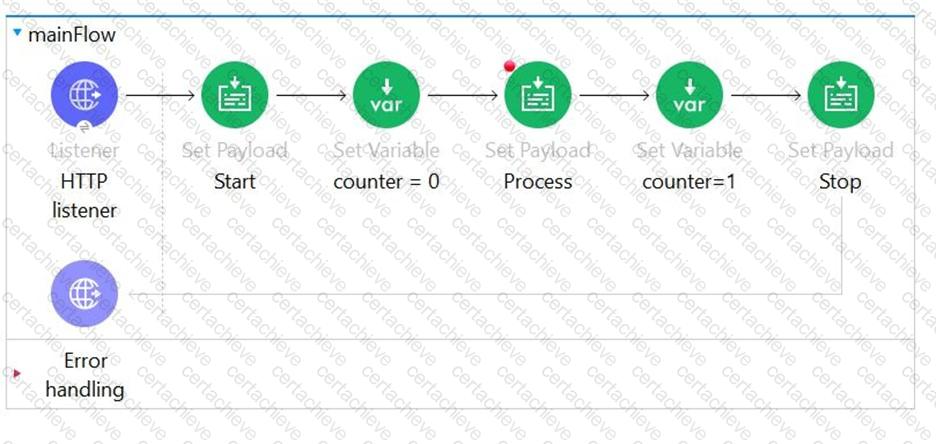
The mule application is debugged in Anypoint Studio and stops at the breakpoint as shown in below exhibit.
What is the value of the payload displayed in the debugger at this breakpoint?
Correct Answer & Rationale:
Answer: A
Explanation:
Setting Breakpoints
To set breakpoints, right-click a building block, then select Toggle Breakpoint.
Studio applies a red dot to the building block’s icon on the canvas.
When you run your application in Debug mode, Studio stops the flow execution at the breakpoint you have set, allowing you to check the Mule Event content in the Mule Debugger View.
Mule Ref Doc : Setting Breakpoints | MuleSoft Documentation
Question 9
MuleSoft MCD-Level-1
QUESTION DESCRIPTION:
What is not true about application properties?
Correct Answer & Rationale:
Answer: C
Explanation:
Application properties can be defined in .yaml or in .properties file.
MuleSoft Doc Ref : https://docs.mulesoft.com/mule-runtime/4.3/configuring-properties#supported_files
Question 10
MuleSoft MCD-Level-1
QUESTION DESCRIPTION:
A shopping API contains a method to look up store details by department.
To get the information for a particular store, web clients will submit requests with a query parameter named department and uri parameter named storeId
What is valid RAML snippet that supports requests from a web client to get a data for a specific storeId and department name?
Correct Answer & Rationale:
Answer: D
Explanation:
Lets revise few concepts RAML which can help us to find the answer of this question.
URI Parameters
Lets have a look at below example.
/ foos :
/{ id }:
/ name /{ name }:
Here, the braces { } around property names define URI parameters. They represent placeholders in each URI and do not reference root-level RAML file properties as we saw above in the baseUri declaration. The added lines represent the resources /foos/{id} and /foos/name/{name} .
Query Parameters
Now we ' ll define a way to query the foos collection using query parameters. Note that query parameters are defined using the same syntax that we used above for data types:
/ foos :
get :
description : List all Foos matching query criteria , if provided ;
otherwise list all Foos
queryParameters :
name ?: string
ownerName ?: string
Based on the above information , below is the only option which defines storeid as uri parameter and department as query parameter.
/{ storeId }:
get :
queryParameter :
department :

Verified by Certified Instructors
This MuleSoft MCD-Level-1 study pack was audited and verified on September 23, 2026 by John Prescott,. We ensure every technical rationale aligns with real-world enterprise standards.
A Stepping Stone for Enhanced Career Opportunities
Your profile having MuleSoft Certified Developer certification significantly enhances your credibility and marketability in all corners of the world. The best part is that your formal recognition pays you in terms of tangible career advancement. It helps you perform your desired job roles accompanied by a substantial increase in your regular income. Beyond the resume, your expertise imparts you confidence to act as a dependable professional to solve real-world business challenges.
Your success in MuleSoft MCD-Level-1 certification exam makes your visible and relevant in the fast-evolving tech landscape. It proves a lifelong investment in your career that give you not only a competitive advantage over your non-certified peers but also makes you eligible for a further relevant exams in your domain.
What You Need to Ace MuleSoft Exam MCD-Level-1
Achieving success in the MCD-Level-1 MuleSoft exam requires a blending of clear understanding of all the exam topics, practical skills, and practice of the actual format. There's no room for cramming information, memorizing facts or dependence on a few significant exam topics. It means your readiness for exam needs you develop a comprehensive grasp on the syllabus that includes theoretical as well as practical command.
Here is a comprehensive strategy layout to secure peak performance in MCD-Level-1 certification exam:
- Develop a rock-solid theoretical clarity of the exam topics
- Begin with easier and more familiar topics of the exam syllabus
- Make sure your command on the fundamental concepts
- Focus your attention to understand why that matters
- Ensure hands-on practice as the exam tests your ability to apply knowledge
- Develop a study routine managing time because it can be a major time-sink if you are slow
- Find out a comprehensive and streamlined study resource for your help
Ensuring Outstanding Results in Exam MCD-Level-1!
In the backdrop of the above prep strategy for MCD-Level-1 MuleSoft exam, your primary need is to find out a comprehensive study resource. It could otherwise be a daunting task to achieve exam success. The most important factor that must be kep in mind is make sure your reliance on a one particular resource instead of depending on multiple sources. It should be an all-inclusive resource that ensures conceptual explanations, hands-on practical exercises, and realistic assessment tools.
Certachieve: A Reliable All-inclusive Study Resource
Certachieve offers multiple study tools to do thorough and rewarding MCD-Level-1 exam prep. Here's an overview of Certachieve's toolkit:
MuleSoft MCD-Level-1 PDF Study Guide
This premium guide contains a number of MuleSoft MCD-Level-1 exam questions and answers that give you a full coverage of the exam syllabus in easy language. The information provided efficiently guides the candidate's focus to the most critical topics. The supportive explanations and examples build both the knowledge and the practical confidence of the exam candidates required to confidently pass the exam. The demo of MuleSoft MCD-Level-1 study guide pdf free download is also available to examine the contents and quality of the study material.
MuleSoft MCD-Level-1 Practice Exams
Practicing the exam MCD-Level-1 questions is one of the essential requirements of your exam preparation. To help you with this important task, Certachieve introduces MuleSoft MCD-Level-1 Testing Engine to simulate multiple real exam-like tests. They are of enormous value for developing your grasp and understanding your strengths and weaknesses in exam preparation and make up deficiencies in time.
These comprehensive materials are engineered to streamline your preparation process, providing a direct and efficient path to mastering the exam's requirements.
MuleSoft MCD-Level-1 exam dumps
These realistic dumps include the most significant questions that may be the part of your upcoming exam. Learning MCD-Level-1 exam dumps can increase not only your chances of success but can also award you an outstanding score.
Top Exams & Certification Providers
New & Trending
- New Released Exams
- Related Exam
- Hot Vendor