
The Palo Alto Networks Next-Generation Firewall Engineer (NGFW-Engineer)
Passing Paloalto Networks Network Security Administrator exam ensures for the successful candidate a powerful array of professional and personal benefits. The first and the foremost benefit comes with a global recognition that validates your knowledge and skills, making possible your entry into any organization of your choice.


NGFW-Engineer Exam Dumps
- Exam Code: NGFW-Engineer
- Vendor: Paloalto Networks
- Certifications: Network Security Administrator
- Exam Name: Palo Alto Networks Next-Generation Firewall Engineer
Why CertAchieve is Better than Standard NGFW-Engineer Dumps
In 2026, Paloalto Networks uses variable topologies. Basic dumps will fail you.
| Quality Standard | Generic Dump Sites | CertAchieve Premium Prep |
|---|---|---|
| Technical Explanation | None (Answer Key Only) | Step-by-Step Expert Rationales |
| Syllabus Coverage | Often Outdated (v1.0) | 2026 Updated (Latest Syllabus) |
| Scenario Mastery | Blind Memorization | Conceptual Logic & Troubleshooting |
| Instructor Access | No Post-Sale Support | 24/7 Professional Help |
Customers Passed Exams
10
Success backed by proven exam prep tools
Questions Came Word for Word
87%
Real exam match rate reported by verified users
Average Score in Real Testing Centre
92%
Consistently high performance across certifications
Study Time Saved With CertAchieve
60%
Efficient prep that reduces study hours significantly
Coverage of Official Paloalto Networks NGFW-Engineer Exam Domains
Our curriculum is meticulously mapped to the Paloalto Networks official blueprint.
Core Concepts (12%)
Master the Palo Alto Networks security ecosystem. Focus on the management and data plane functions, virtual systems (multi-vsys), User-ID architecture, and advanced decryption deployment strategies (SSL/TLS).
Deploy and Configure Core Components (20%)
Deep dive into firewall configuration. Master interface management, Security profiles, and routing (Static, Dynamic, and Policy-Based Forwarding).
Deploy and Configure Features and Subscriptions (17%)
Master the power of Palo Alto subscriptions. Focus on Advanced Threat Prevention, DNS Security, Advanced URL Filtering, and the deployment of GlobalProtect for remote access security.
Deploy and Configure Firewalls Using Panorama (17%)
Master centralized management. Focus on template stacks, device groups, and the push process. Understand how Panorama manages configuration consistency and log collection across distributed environments.
Manage and Operate (16%)
Focus on daily operations and visibility. Master the use of the Dashboard, ACC, and reporting tools. Manage App-ID updates, firewall software upgrades, and High Availability state synchronization.
Troubleshooting (18%)
The engineering core. Apply the CLI for advanced diagnostics. Master traffic debugging (packet-diag), analyzing system and traffic logs, and resolving complex VPN, routing, and policy enforcement issues.
Paloalto Networks NGFW-Engineer Exam Domains Q&A
Certified instructors verify every question for 100% accuracy, providing detailed, step-by-step explanations for each.
Question 1
Paloalto Networks NGFW-Engineer
QUESTION DESCRIPTION:
A Palo Alto Networks firewall has the following interfaces configured:
• ethernet1/1 (Layer 3)
• ethernet1/2 (TAP)
• ethernet1/3 (Layer 2)
• ethernet1/4 (virtual wire)
An administrator needs to create a link group to monitor upstream connectivity for high availability (HA) failover.
Which set of interfaces can be added to the link group?
Correct Answer & Rationale:
Answer: D
Explanation:
Basic Concept: HA link monitoring uses production forwarding interfaces. HA links themselves are not monitored as production links, and TAP is not a forwarding path.
Why D is Correct: Layer 3, Layer 2, and virtual wire interfaces can be included in link groups because they carry live traffic.
Why A is Wrong: ethernet1/1, ethernet1/2, ethernet1/4 is an HA-related setting or behavior, but it is not the specific HA link, LACP pre-negotiation option, or upgrade sequence required here.
Why B is Wrong: ethernet1/1, ethernet1/2, ethernet1/3 is an HA-related setting or behavior, but it is not the specific HA link, LACP pre-negotiation option, or upgrade sequence required here.
Why C is Wrong: ethernet1/2, ethernet1/3, ethernet1/4 is an HA-related setting or behavior, but it is not the specific HA link, LACP pre-negotiation option, or upgrade sequence required here.
Question 2
Paloalto Networks NGFW-Engineer
QUESTION DESCRIPTION:
A network administrator is hardening a new Palo Alto Networks firewall and wants to ensure that all firewall-generated management traffic, such as calls to Strata Logging Service, uses a dedicated in-band data port instead of the out-of-band management port.
Which configuration setting should the administrator modify to reroute this type of traffic?
Correct Answer & Rationale:
Answer: A
Explanation:
Basic Concept: Service route configuration controls egress for firewall-generated management traffic. It can force cloud service or update traffic through a data-plane interface.
Why A is Correct: Service route is the setting that reroutes firewall-originated traffic away from the management port.
Why B is Wrong: Interface Management profile is related to management or logging, but it does not provide the required Panorama operation, rule hierarchy behavior, or dual-log forwarding outcome.
Why C is Wrong: Virtual router is related to management or logging, but it does not provide the required Panorama operation, rule hierarchy behavior, or dual-log forwarding outcome.
Why D is Wrong: Static route is related to management or logging, but it does not provide the required Panorama operation, rule hierarchy behavior, or dual-log forwarding outcome.
Question 3
Paloalto Networks NGFW-Engineer
QUESTION DESCRIPTION:
A network security engineer at a 24/7 online retailer is upgrading an active/passive high availability (HA) cluster of PAN-OS firewalls. The primary goal is to perform the upgrade with no service interruption to online transactions. The engineer has already downloaded the new software to both devices.
Which sequence of actions will meet this requirement?
Correct Answer & Rationale:
Answer: C
Explanation:
Basic Concept: For active/passive HA upgrades, the safest method is to upgrade the passive firewall first, fail over to it, then upgrade the remaining peer. This preserves forwarding during most of the process.
Why C is Correct: The selected sequence keeps one firewall forwarding traffic at all times and avoids simultaneous reboots.
Why A is Wrong: From Panorama, create a scheduled software update job targeting both firewalls in the HA pair to run at the same time, then rely on the HA election process to manage the failover automatically. is an HA-related setting or behavior, but it is not the specific HA link, LACP pre-negotiation option, or upgrade sequence required here.
Why B is Wrong: Upgrade the passive firewall first while it is still in the passive state. Once it reboots and is operational, suspend the active firewall to fail over to the newly upgraded device. Then, upgrade the remaining firewall. is an HA-related setting or behavior, but it is not the specific HA link, LACP pre-negotiation option, or upgrade sequence required here.
Why D is Wrong: Disable HA synchronization on the active firewall, upgrade the passive firewall, and then re-enable synchronization. Once synchronized, repeat the process on the other firewall. is an HA-related setting or behavior, but it is not the specific HA link, LACP pre-negotiation option, or upgrade sequence required here.
Question 4
Paloalto Networks NGFW-Engineer
QUESTION DESCRIPTION:
An engineer at a managed services provider is updating an application that allows its customers to request firewall changes to also manage SD-WAN. The application will be able to make any approved changes directly to devices via API.
What is a requirement for the application to create SD-WAN interfaces?
Correct Answer & Rationale:
Answer: A
Explanation:
Basic Concept: Palo Alto Networks SD-WAN automation through Panorama uses API objects and parameters for SD-WAN interfaces and profiles. The application must call the correct Panorama API endpoint/object.
Why A is Correct: The REST API sdwanInterfaceprofiles parameter on Panorama is correct because SD-WAN interface creation for managed deployments is orchestrated centrally through Panorama.
Why B is Wrong: REST API’s “sdwanInterfaces” parameter on a firewall device is an automation or management concept, but it performs a different role than the requested IaC provisioning, playbook configuration, or API object operation.
Why C is Wrong: XML API’s “sdwanprofiles/interfaces” parameter on a Panorama device is an automation or management concept, but it performs a different role than the requested IaC provisioning, playbook configuration, or API object operation.
Why D is Wrong: XML API’s “InterfaceProfiles/sdwan” parameter on a firewall device is an automation or management concept, but it performs a different role than the requested IaC provisioning, playbook configuration, or API object operation.
Question 5
Paloalto Networks NGFW-Engineer
QUESTION DESCRIPTION:
An administrator is troubleshooting a newly configured site-to-site VPN between a PAN-OS firewall and a third-party policy-based VPN gateway. The tunnel allows traffic between the first pair of configured subnets, but traffic to a newly added remote subnet is failing. The administrator has confirmed that routing and Security policies are correct.
What is the most likely cause of this issue?
Correct Answer & Rationale:
Answer: C
Explanation:
Basic Concept: Policy-based VPN peers require each encryption domain pair to be represented in Proxy ID selectors. Adding a subnet requires adding the matching selector.
Why C is Correct: The most likely cause is that the new local/remote subnet pair is missing from Proxy ID configuration even though route and Security policy are correct.
Why A is Wrong: A static route may be needed for route-based VPN reachability, but the scenario says routing is correct and only the newly added subnet pair fails.
Why B is Wrong: Moving the Security policy would matter if the traffic were matching the wrong rule, but the scenario states that Security policy is already correct.
Why D is Wrong: MTU problems usually affect packet size and fragmentation behavior, not only a newly added policy-based VPN subnet selector.
Question 6
Paloalto Networks NGFW-Engineer
QUESTION DESCRIPTION:
An organization must secure its AWS and Azure environments using a managed Palo Alto Networks solution, and all policies must be synchronized from an existing Panorama deployment. The organization wants to insert security with the least possible impact on its application teams and use existing hub-and-spoke network designs.
• The AWS environment uses a centralized AWS Transit Gateway (TGW) architecture.
• The Azure environment uses a Virtual WAN (vWAN) hub.
Which two actions are the most appropriate in this use case? (Choose two.)
Correct Answer & Rationale:
Answer: B, D
Explanation:
Basic Concept: Managed Cloud NGFW should be inserted into existing cloud hub designs with Panorama policy synchronization. AWS TGW and Azure vWAN both support centralized inspection patterns.
Why B and D are Correct: Deploying Cloud NGFW in the vWAN hub and Cloud NGFW endpoints/security VPC behind TGW preserves existing routing patterns and centralizes policy.
Why A is Wrong: Deploy Cloud NGFW endpoints in every application virtual private cloud (VPC), ignoring the TGW. is a cloud deployment or routing approach, but it does not match the required managed insertion model, resilience pattern, or Panorama-controlled policy design in this scenario.
Why C is Wrong: Deploy individual VM-Series firewalls in each spoke virtual network (VNet) and manage them as a device group in Panorama. is a cloud deployment or routing approach, but it does not match the required managed insertion model, resilience pattern, or Panorama-controlled policy design in this scenario.
Question 7
Paloalto Networks NGFW-Engineer
QUESTION DESCRIPTION:
Which two Palo Alto Networks firewall services are secured by attaching an SSL/TLS service profile to their configuration? (Choose two.)
Correct Answer & Rationale:
Answer: A, B
Explanation:
Basic Concept: SSL/TLS service profiles secure firewall-hosted TLS services by binding certificates and protocol settings.
Why A and B are Correct: Authentication Portal and GlobalProtect Portal are services that present TLS certificates and use SSL/TLS service profiles.
Why C is Wrong: LDAP server profiles is associated with authentication, PKI, or TLS configuration, but it is not the object or step that enforces the certificate validation or service identity requirement being tested.
Why D is Wrong: Prisma Access service connections is associated with authentication, PKI, or TLS configuration, but it is not the object or step that enforces the certificate validation or service identity requirement being tested.
Question 8
Paloalto Networks NGFW-Engineer
QUESTION DESCRIPTION:
A large organization has separate production and development environments, each with its own set of firewalls managed by Panorama. The organization uses Cloud Identity Engine (CIE) to consolidate user identities from Active Directory (AD) and Okta.
A security mandate requires that development firewalls must only learn about "DEV" and "QA" user groups, while production firewalls should only see "Prod" user groups.
How can an administrator enforce this separation using CIE with minimal complexity?
Correct Answer & Rationale:
Answer: A
Explanation:
Basic Concept: CIE segments create filtered identity views for different firewall populations. This avoids redistributing all identity data everywhere.
Why A is Correct: Creating one segment for DEV/QA and one for Prod and redistributing them only to the corresponding firewalls enforces identity separation with minimal complexity.
Why B is Wrong: Redistribute all user and group information to all firewalls and use Panorama Device Group hierarchy to apply different Group Mapping profiles. is related to management or logging, but it does not provide the required Panorama operation, rule hierarchy behavior, or dual-log forwarding outcome.
Why C is Wrong: Create filters using CLI commands to filter "Prod," "DEV," and "QA" groups. is related to management or logging, but it does not provide the required Panorama operation, rule hierarchy behavior, or dual-log forwarding outcome.
Why D is Wrong: Configure two separate CIE instances, one for production and the other for development. Sync each instance to both AD and Okta. is related to management or logging, but it does not provide the required Panorama operation, rule hierarchy behavior, or dual-log forwarding outcome.
Question 9
Paloalto Networks NGFW-Engineer
QUESTION DESCRIPTION:
A network administrator is configuring an Aggregate Ethernet (AE) interface on an active/passive high availability (HA) pair. To reduce network downtime during a failover, the administrator wants the passive firewall's AE interface to be fully negotiated with the switch before it becomes active.
Which Link Aggregation Control Protocol (LACP) setting achieves this administrator's goal?
Correct Answer & Rationale:
Answer: B
Explanation:
Basic Concept: LACP pre-negotiation on a passive HA peer lets the aggregate interface maintain negotiation with the switch before failover.
Why B is Correct: Enable in HA passive state is the specific LACP setting that reduces convergence delay after failover.
Why A is Wrong: LACP Mode active is an HA-related setting or behavior, but it is not the specific HA link, LACP pre-negotiation option, or upgrade sequence required here.
Why C is Wrong: System Priority: 1 is an HA-related setting or behavior, but it is not the specific HA link, LACP pre-negotiation option, or upgrade sequence required here.
Why D is Wrong: Transmission Rate: fast is an HA-related setting or behavior, but it is not the specific HA link, LACP pre-negotiation option, or upgrade sequence required here.
Question 10
Paloalto Networks NGFW-Engineer
QUESTION DESCRIPTION:
An administrator needs to ensure that a firewall can download threat prevention and software updates, but the management port is on an isolated network without internet access.
Which service must be rerouted through a data plane interface using a service route to allow the firewall to download these updates?
Correct Answer & Rationale:
Answer: C
Explanation:
Basic Concept: Service routes can move firewall-originated Palo Alto Networks service traffic from the management port to a data-plane interface when the management network lacks Internet access.
Why C is Correct: Palo Alto Networks Services must be rerouted so the firewall can reach update and support services through the data-plane path.
Why A is Wrong: External dynamic lists are downloaded objects that can be used in policy. They are not the Palo Alto Networks update service used for threat prevention and software downloads.
Why B is Wrong: GlobalProtect Clientless VPN provides browser-based access to internal applications. It is unrelated to downloading PAN-OS software or content updates.
Why D is Wrong: Syslog is used to forward logs to external collectors. Rerouting syslog would not allow the firewall to reach Palo Alto Networks update services.

Verified by Certified Instructors
This Paloalto Networks NGFW-Engineer study pack was audited and verified on September 23, 2026 by Bruce Kensington,. We ensure every technical rationale aligns with real-world enterprise standards.
A Stepping Stone for Enhanced Career Opportunities
Your profile having Network Security Administrator certification significantly enhances your credibility and marketability in all corners of the world. The best part is that your formal recognition pays you in terms of tangible career advancement. It helps you perform your desired job roles accompanied by a substantial increase in your regular income. Beyond the resume, your expertise imparts you confidence to act as a dependable professional to solve real-world business challenges.
Your success in Paloalto Networks NGFW-Engineer certification exam makes your visible and relevant in the fast-evolving tech landscape. It proves a lifelong investment in your career that give you not only a competitive advantage over your non-certified peers but also makes you eligible for a further relevant exams in your domain.
What You Need to Ace Paloalto Networks Exam NGFW-Engineer
Achieving success in the NGFW-Engineer Paloalto Networks exam requires a blending of clear understanding of all the exam topics, practical skills, and practice of the actual format. There's no room for cramming information, memorizing facts or dependence on a few significant exam topics. It means your readiness for exam needs you develop a comprehensive grasp on the syllabus that includes theoretical as well as practical command.
Here is a comprehensive strategy layout to secure peak performance in NGFW-Engineer certification exam:
- Develop a rock-solid theoretical clarity of the exam topics
- Begin with easier and more familiar topics of the exam syllabus
- Make sure your command on the fundamental concepts
- Focus your attention to understand why that matters
- Ensure hands-on practice as the exam tests your ability to apply knowledge
- Develop a study routine managing time because it can be a major time-sink if you are slow
- Find out a comprehensive and streamlined study resource for your help
Ensuring Outstanding Results in Exam NGFW-Engineer!
In the backdrop of the above prep strategy for NGFW-Engineer Paloalto Networks exam, your primary need is to find out a comprehensive study resource. It could otherwise be a daunting task to achieve exam success. The most important factor that must be kep in mind is make sure your reliance on a one particular resource instead of depending on multiple sources. It should be an all-inclusive resource that ensures conceptual explanations, hands-on practical exercises, and realistic assessment tools.
Certachieve: A Reliable All-inclusive Study Resource
Certachieve offers multiple study tools to do thorough and rewarding NGFW-Engineer exam prep. Here's an overview of Certachieve's toolkit:
Paloalto Networks NGFW-Engineer PDF Study Guide
This premium guide contains a number of Paloalto Networks NGFW-Engineer exam questions and answers that give you a full coverage of the exam syllabus in easy language. The information provided efficiently guides the candidate's focus to the most critical topics. The supportive explanations and examples build both the knowledge and the practical confidence of the exam candidates required to confidently pass the exam. The demo of Paloalto Networks NGFW-Engineer study guide pdf free download is also available to examine the contents and quality of the study material.
Paloalto Networks NGFW-Engineer Practice Exams
Practicing the exam NGFW-Engineer questions is one of the essential requirements of your exam preparation. To help you with this important task, Certachieve introduces Paloalto Networks NGFW-Engineer Testing Engine to simulate multiple real exam-like tests. They are of enormous value for developing your grasp and understanding your strengths and weaknesses in exam preparation and make up deficiencies in time.
These comprehensive materials are engineered to streamline your preparation process, providing a direct and efficient path to mastering the exam's requirements.
Paloalto Networks NGFW-Engineer exam dumps
These realistic dumps include the most significant questions that may be the part of your upcoming exam. Learning NGFW-Engineer exam dumps can increase not only your chances of success but can also award you an outstanding score.
Top Exams & Certification Providers
New & Trending
- New Released Exams
- Related Exam
- Hot Vendor
Verified Performance Reports
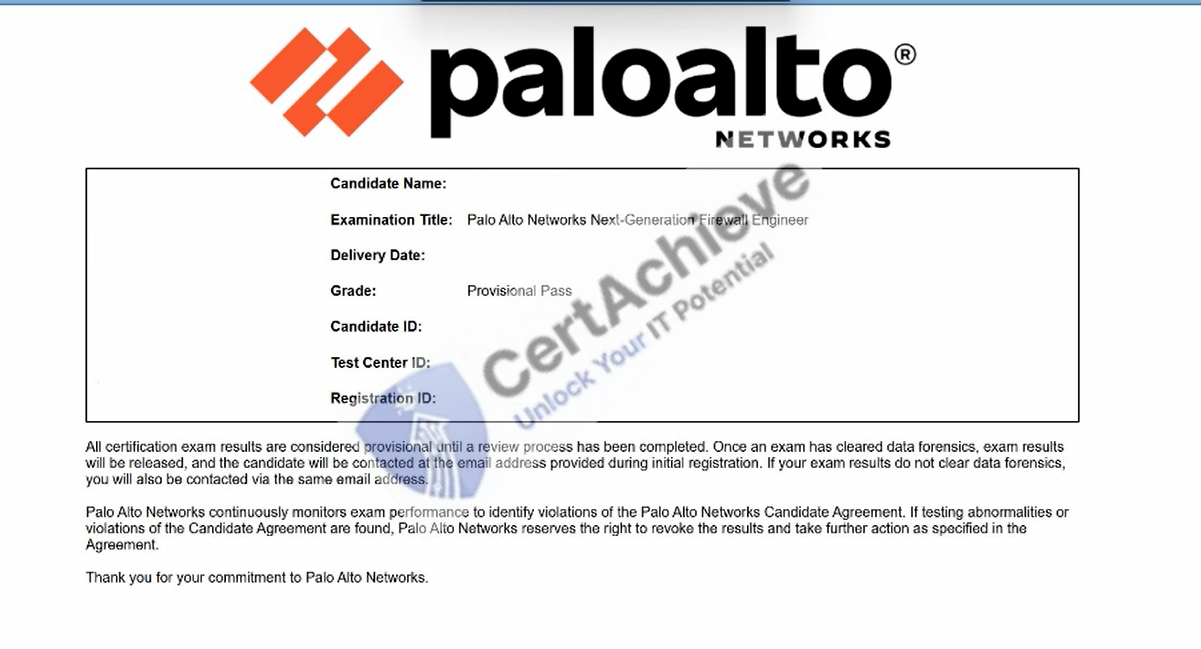
Authentic score reports from candidates who cleared the NGFW-Engineer exam.
Verified Case #1
×
![]()