
The PMI Agile Certified Practitioner (PMI-ACP) (PMI-ACP)
Passing PMI PMI Agile exam ensures for the successful candidate a powerful array of professional and personal benefits. The first and the foremost benefit comes with a global recognition that validates your knowledge and skills, making possible your entry into any organization of your choice.

PMI-ACP Exam Dumps
- Exam Code: PMI-ACP
- Vendor: PMI
- Certifications: PMI Agile
- Exam Name: PMI Agile Certified Practitioner (PMI-ACP)
Why CertAchieve is Better than Standard PMI-ACP Dumps
In 2026, PMI uses variable topologies. Basic dumps will fail you.
| Quality Standard | Generic Dump Sites | CertAchieve Premium Prep |
|---|---|---|
| Technical Explanation | None (Answer Key Only) | Step-by-Step Expert Rationales |
| Syllabus Coverage | Often Outdated (v1.0) | 2026 Updated (Latest Syllabus) |
| Scenario Mastery | Blind Memorization | Conceptual Logic & Troubleshooting |
| Instructor Access | No Post-Sale Support | 24/7 Professional Help |
Customers Passed Exams
10
Success backed by proven exam prep tools
Questions Came Word for Word
90%
Real exam match rate reported by verified users
Average Score in Real Testing Centre
95%
Consistently high performance across certifications
Study Time Saved With CertAchieve
60%
Efficient prep that reduces study hours significantly
Coverage of Official PMI PMI-ACP Exam Domains
Our curriculum is meticulously mapped to the PMI official blueprint.
Mindset (28%)
Master the absolute foundation of agile thinking, philosophy, and cross-framework principles (Scrum, Kanban, Lean, XP). Evaluate how to analyze scenarios using adaptive frameworks, promote corporate or team transparency through high-visibility information radiators, establish common definitions, and seed an organic agile culture across standard organizational boundaries.
Leadership (25%)
Deep dive into the core behaviors of active servant leadership within hybrid and agile ecosystems. Master systems thinking to evaluate operational risks, empower cross-functional teams, facilitate constructive conflict resolution steps, champion open communication rules, remove production blockers, and align group dynamics toward a shared project vision.
Product (19%)
Govern the high-value lifecycle creation of an active product solution. Master building and grooming dynamic product backlogs, prioritizing functional user stories using business-value models, collaborating closely with stakeholder perimeters, and validating incremental releases to match the strict expectations of the Product Owner.
Delivery (28%)
Execute practical agile implementation metrics to safely complete iterative delivery cycles. Master planning sprints, driving continuous integration loops, managing WIP limits to maximize workflow velocity, identifying and cutting production waste, collecting customer feedback loops, and guiding iterative retrospectives to achieve continuous process optimization.
PMI PMI-ACP Exam Domains Q&A
Certified instructors verify every question for 100% accuracy, providing detailed, step-by-step explanations for each.
Question 1
PMI PMI-ACP
QUESTION DESCRIPTION:
A project team is working with an enterprise agile center of excellence (CoE) to transition to a Scaled Agile Framework (SAFe). Many of the team members are not familiar with the new methodology and are worried that it will lead to more work and scrutiny.
What should the agile team lead do to help ensure a smooth transition?
Correct Answer & Rationale:
Answer: D
Explanation:
To ensure a smooth transition to SAFe, the agile team lead should have an open discussion with the team about what will change and the reasons behind these changes. Establishing a clear understanding of the transition process and addressing any concerns proactively helps alleviate fears and encourages buy-in. It ' s also important to discuss the timeline for the transition and how the team will adapt. By providing clarity and a process for addressing concerns, the team will feel more comfortable and confident in adopting the new methodology.
Question 2
PMI PMI-ACP
QUESTION DESCRIPTION:
An agile team member from a cross-functional team has been unable to complete assignments due to tasks assigned by the functional manager.
What should the Scrum Master do?
Correct Answer & Rationale:
Answer: B
Explanation:
The correct answer is B – Discuss the situation with the functional manager. The Scrum Master serves as a facilitator and servant leader, helping resolve impediments that interfere with the team’s ability to deliver. When conflicting assignments arise, the Scrum Master should facilitate communication with functional managers to clarify priorities and reinforce team commitments.
From the PMI Agile Practice Guide:
“The Scrum Master removes impediments and facilitates collaboration with stakeholders, including functional managers, to ensure the team can focus on sprint goals.”
(PMI Agile Practice Guide, Section 4.2 – Agile Leadership and Stakeholder Collaboration)
Mike Griffiths writes:
“When external interference affects team performance, the Scrum Master should engage in dialogue with stakeholders to clarify roles and commitments, promoting alignment and removing blockers.”
(Mike Griffiths, PMI-ACP Exam Prep, Chapter 4 – Team Performance)
Incorrect options:
A is extreme and not within the Scrum Master ' s authority.
C is unnecessarily escalatory.
D is confrontational and undermines collaboration.
Answer: B
Question 3
PMI PMI-ACP
QUESTION DESCRIPTION:
A new Agile team is forming to address a high-priority project. Team members are dispersed over a wide geographic area. The Scrum Master and the team are currently defining their working agreement.
What should be part of the working agreement for a dispersed team?
Correct Answer & Rationale:
Answer: B
Explanation:
The correct answer is B – Meet face to face at regular intervals to enhance shared understanding.
While Agile favors colocation, it acknowledges that distributed teams are common. The Agile approach encourages face-to-face communication as the most effective means of information sharing. When colocation isn’t possible, periodic in-person meetings help establish team trust and understanding.
From the PMI Agile Practice Guide:
“Even with distributed teams, periodic face-to-face interactions are recommended to foster team cohesion and alignment. This is especially important during team formation and key planning activities.”
(PMI Agile Practice Guide, Section 2.3 – Communication and Collaboration)
Mike Griffiths also advises:
“Remote teams benefit significantly from occasional in-person meetings. This improves relationships, shared understanding, and effectiveness in virtual collaboration.”
(Mike Griffiths, PMI-ACP Exam Prep Book, Chapter 4 – Team Performance)
Why other options fall short:
A is about external support and not core to working agreements.
C undermines team transparency and agile principles of shared communication.
D could encourage fragmentation instead of collaboration.
Answer: B
══════════════════════════════════════════════════
Question 4
PMI PMI-ACP
QUESTION DESCRIPTION:
What was the determining factor?
Correct Answer & Rationale:
Answer: A
Explanation:
According to the PMI Agile Practice Guide (Section 5.2 Requirements and User Stories) and Mike Griffiths’ PMI-ACP Exam Prep Book (Chapter 6: Adaptive Planning), epics are large user stories that must be decomposed into smaller user stories for accurate planning and inclusion in sprints.
The two main drivers for breaking down epics are:
Size – Epics are typically too large to be completed in a single iteration and must be divided to create manageable pieces of work.
Priority – High-priority epics are decomposed early to allow the team to work on the most valuable items first.
This makes Option A the correct answer. The decision to decompose the epic is based on the need to fit it into sprint capacity and to align with backlog prioritization.
Question 5
PMI PMI-ACP
QUESTION DESCRIPTION:
Following approval of a business case, a company will introduce a new mobile app for customers to place orders. Time to market is a key concern. The product has entered into the 3rd iteration, but the team is concerned because they feel the technical designs do not meet the agreed-on definition of done (DoD). An agile coach has been hired to help validate product delivery against business requirements.
What should the agile coach do?
Correct Answer & Rationale:
Answer: C
Explanation:
The best approach for the agile coach would be to address the root cause of the concern immediately and help the team reflect on their current processes to identify ways to improve. This can be achieved by engaging the team in a discussion that focuses on understanding the issues related to the technical design and the definition of done (DoD).
This will allow the team to openly discuss and identify specific areas of the technical designs that do not meet the DoD. By understanding the underlying issues, the coach can help the team find solutions and ensure that future work aligns with the agreed-upon quality standards and expectations.
Question 6
PMI PMI-ACP
QUESTION DESCRIPTION:
What do the principles of Extreme Programming (XP) include?
Correct Answer & Rationale:
Answer: D
Explanation:
The principles of Extreme Programming (XP) focus on improving software quality and responsiveness to changing customer requirements. The key principles include:
 Rapid feedback: Getting feedback quickly from customers or stakeholders to ensure that the development process is on track.
 Assume simplicity: Focusing on simplicity in the design and code to avoid overengineering and to ensure the software is easy to understand and modify.
 Incremental change: Delivering software in small, manageable increments that can be easily adjusted based on feedback.
 Embrace change: Being flexible and adaptable, especially in response to new requirements or changes in technology or business needs.
 Quality work: Ensuring high-quality software by emphasizing practices such as automated testing, continuous integration, and refactoring.
Question 7
PMI PMI-ACP
QUESTION DESCRIPTION:
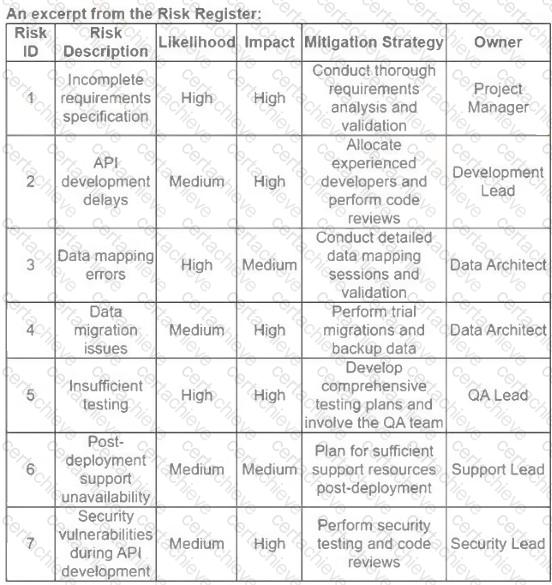
An e-commerce company acquired a tool to customize subject line generation for marketing campaigns. In sprint planning, the team discussed integrating this tool with the customer relationship management system.
Which mitigation strategy is most appropriate to ensure the final product meets the business objectives? (Refer to the Risk Register Exhibit)
Correct Answer & Rationale:
Answer: A
Explanation:
In this case, the risk description for " Incomplete requirements specification " has been identified as a high likelihood and high impact risk. To mitigate this, the most appropriate strategy would be to conduct thorough requirements analysis and validation. This ensures that the integration of the new tool with the customer relationship management system aligns with the business objectives and avoids misunderstandings or gaps in the product requirements, which could cause delays or rework later in the project. This step addresses the core challenge of ensuring the product meets the business needs and integrates smoothly with existing systems.
Question 8
PMI PMI-ACP
QUESTION DESCRIPTION:
During a backlog refinement meeting, a senior team member raises a concern about an epic sizing that requires the use of a new interface for a vendor product. The product owner acknowledges this as a risk. What should the product owner do now?
Correct Answer & Rationale:
Answer: B
Explanation:
The correct answer is B — Create a spike story to determine what needs to be done to use the new interface.
A spike is a special user story designed to address technical uncertainty or risk. It allows the team to explore, research, or prototype solutions within a time-box. Spikes are particularly useful for investigating unknowns such as integration with vendor systems.
PMI Agile Practice Guide:
“Spikes are used for research and exploration. They help teams gain knowledge about technology, functionality, or business domain that is necessary before estimating or implementing a feature.”
(PMI Agile Practice Guide, Section 5.2 – Backlog Refinement)
Mike Griffiths notes:
“Spikes reduce uncertainty and are valuable tools for backlog refinement. They are especially helpful when the team is unsure how to implement a requirement or integrate external components.”
(PMI-ACP Exam Prep, Chapter 3 – Value-Driven Delivery)
Other options:
A may delay addressing the issue until the next monthly meeting.
C defers the issue rather than exploring it.
D assumes outsourcing is the only solution and may remove team ownership.
Answer: B
—
Question 9
PMI PMI-ACP
QUESTION DESCRIPTION:
Two agile teams from different company sites need to work and collaborate on the same project. What is the first action the agile project manager should take in order to ensure a smooth collaboration between the two teams?
Correct Answer & Rationale:
Answer: C
Explanation:
The correct answer is C — Call an onsite meeting where ground rules will be discussed and agreed upon.
When multiple distributed teams begin working together, the first priority is to establish common ground rules, expectations, and working agreements. This sets the foundation for effective communication and collaboration. An initial face-to-face (or virtual face-to-face) meeting is often critical for forming trust and shared norms.
PMI Agile Practice Guide:
“Teams should establish working agreements early in the project. These define expectations for communication, decision-making, and collaboration—especially critical for distributed or cross-functional teams.”
(PMI Agile Practice Guide, Section 4.2 – Collaboration and Communication)
Mike Griffiths:
“Setting ground rules helps build team cohesion, especially in distributed teams. It ensures that all members agree on protocols for meetings, updates, and decision-making.”
(PMI-ACP Exam Prep, Chapter 4 – Team Performance)
Incorrect options:
A is important but typically follows after agreements are in place.
B is routine communication—not the first foundational step.
D supports cohesion but does not establish operational alignment.
Answer: C
—
Question 10
PMI PMI-ACP
QUESTION DESCRIPTION:
What should the team do?
Correct Answer & Rationale:
Answer: C
Explanation:
When overwhelmed by support tickets, the agile approach is to prioritize systemic problem-solving over reactive work. According to the PMI Agile Practice Guide (Section 5.5: Quality and Continuous Improvement) and Mike Griffiths’ PMI-ACP Exam Prep Book (Chapter 7: Problem Detection and Resolution), agile teams should identify root causes rather than just addressing symptoms. By analyzing the backlog, the team can spot patterns and address systemic issues, reducing incoming ticket volume in the long run.
Option C is correct: addressing the root cause improves sustainability and overall efficiency.
Option A leads to burnout and is unsustainable.
Option B ignores prioritization or value.
Option D is not a strategic response—it increases cost without solving the core issue.

Verified by Certified Instructors
This PMI PMI-ACP study pack was audited and verified on September 24, 2026 by Jeff Stanford,. We ensure every technical rationale aligns with real-world enterprise standards.
A Stepping Stone for Enhanced Career Opportunities
Your profile having PMI Agile certification significantly enhances your credibility and marketability in all corners of the world. The best part is that your formal recognition pays you in terms of tangible career advancement. It helps you perform your desired job roles accompanied by a substantial increase in your regular income. Beyond the resume, your expertise imparts you confidence to act as a dependable professional to solve real-world business challenges.
Your success in PMI PMI-ACP certification exam makes your visible and relevant in the fast-evolving tech landscape. It proves a lifelong investment in your career that give you not only a competitive advantage over your non-certified peers but also makes you eligible for a further relevant exams in your domain.
What You Need to Ace PMI Exam PMI-ACP
Achieving success in the PMI-ACP PMI exam requires a blending of clear understanding of all the exam topics, practical skills, and practice of the actual format. There's no room for cramming information, memorizing facts or dependence on a few significant exam topics. It means your readiness for exam needs you develop a comprehensive grasp on the syllabus that includes theoretical as well as practical command.
Here is a comprehensive strategy layout to secure peak performance in PMI-ACP certification exam:
- Develop a rock-solid theoretical clarity of the exam topics
- Begin with easier and more familiar topics of the exam syllabus
- Make sure your command on the fundamental concepts
- Focus your attention to understand why that matters
- Ensure hands-on practice as the exam tests your ability to apply knowledge
- Develop a study routine managing time because it can be a major time-sink if you are slow
- Find out a comprehensive and streamlined study resource for your help
Ensuring Outstanding Results in Exam PMI-ACP!
In the backdrop of the above prep strategy for PMI-ACP PMI exam, your primary need is to find out a comprehensive study resource. It could otherwise be a daunting task to achieve exam success. The most important factor that must be kep in mind is make sure your reliance on a one particular resource instead of depending on multiple sources. It should be an all-inclusive resource that ensures conceptual explanations, hands-on practical exercises, and realistic assessment tools.
Certachieve: A Reliable All-inclusive Study Resource
Certachieve offers multiple study tools to do thorough and rewarding PMI-ACP exam prep. Here's an overview of Certachieve's toolkit:
PMI PMI-ACP PDF Study Guide
This premium guide contains a number of PMI PMI-ACP exam questions and answers that give you a full coverage of the exam syllabus in easy language. The information provided efficiently guides the candidate's focus to the most critical topics. The supportive explanations and examples build both the knowledge and the practical confidence of the exam candidates required to confidently pass the exam. The demo of PMI PMI-ACP study guide pdf free download is also available to examine the contents and quality of the study material.
PMI PMI-ACP Practice Exams
Practicing the exam PMI-ACP questions is one of the essential requirements of your exam preparation. To help you with this important task, Certachieve introduces PMI PMI-ACP Testing Engine to simulate multiple real exam-like tests. They are of enormous value for developing your grasp and understanding your strengths and weaknesses in exam preparation and make up deficiencies in time.
These comprehensive materials are engineered to streamline your preparation process, providing a direct and efficient path to mastering the exam's requirements.
PMI PMI-ACP exam dumps
These realistic dumps include the most significant questions that may be the part of your upcoming exam. Learning PMI-ACP exam dumps can increase not only your chances of success but can also award you an outstanding score.
Top Exams & Certification Providers
New & Trending
- New Released Exams
- Related Exam
- Hot Vendor