
The Salesforce Certified MuleSoft Platform Architect (Mule-Arch-201) (MuleSoft-Platform-Architect-I)
Passing Salesforce Salesforce MuleSoft exam ensures for the successful candidate a powerful array of professional and personal benefits. The first and the foremost benefit comes with a global recognition that validates your knowledge and skills, making possible your entry into any organization of your choice.

MuleSoft-Platform-Architect-I Exam Dumps
- Exam Code: MuleSoft-Platform-Architect-I
- Vendor: Salesforce
- Certifications: Salesforce MuleSoft
- Exam Name: Salesforce Certified MuleSoft Platform Architect (Mule-Arch-201)
Why CertAchieve is Better than Standard MuleSoft-Platform-Architect-I Dumps
In 2026, Salesforce uses variable topologies. Basic dumps will fail you.
| Quality Standard | Generic Dump Sites | CertAchieve Premium Prep |
|---|---|---|
| Technical Explanation | None (Answer Key Only) | Step-by-Step Expert Rationales |
| Syllabus Coverage | Often Outdated (v1.0) | 2026 Updated (Latest Syllabus) |
| Scenario Mastery | Blind Memorization | Conceptual Logic & Troubleshooting |
| Instructor Access | No Post-Sale Support | 24/7 Professional Help |
Customers Passed Exams
10
Success backed by proven exam prep tools
Questions Came Word for Word
95%
Real exam match rate reported by verified users
Average Score in Real Testing Centre
92%
Consistently high performance across certifications
Study Time Saved With CertAchieve
60%
Efficient prep that reduces study hours significantly
Salesforce MuleSoft-Platform-Architect-I Exam Domains Q&A
Certified instructors verify every question for 100% accuracy, providing detailed, step-by-step explanations for each.
Question 1
Salesforce MuleSoft-Platform-Architect-I
QUESTION DESCRIPTION:
A client has several applications running on the Salesforce service cloud. The business requirement for integration is to get daily data changes from Account and Case
Objects. Data needs to be moved to the client ' s private cloud AWS DynamoDB instance as a single JSON and the business foresees only wanting five attributes from the
Account object, which has 219 attributes (some custom) and eight attributes from the Case Object.
What design should be used to support the API/ Application data model?
Correct Answer & Rationale:
Answer: D
Explanation:
Understanding the Requirements:
The business needs to transfer daily data changes from the Salesforce Account and Case objects to AWS DynamoDB in a single JSON format.
Only a subset of attributes (5 from Account and 8 from Case) is required, so it is not necessary to include all 219 attributes of the Account object.
Design Approach:
A System API (SAPI) should be created for each Salesforce object (Account and Case), exposing only the required fields (5 attributes for Account and 8 for Case).
A Process API (PAPI) can be used to aggregate and transform the data from these SAPIs, combining the 13 selected attributes from Account and Case into a single JSON structure for DynamoDB.
Evaluating the Options:
Option A: Mimicking all attributes in the SAPI is inefficient and unnecessary, as only 13 attributes are required.
Option B: Replicating all attributes in DynamoDB is excessive and would result in higher storage and processing costs, which is unnecessary given the requirement for only a subset of attributes.
Option C: Implementing an Enterprise Data Model could be useful in broader data management but is not required here, as the focus is on a lightweight integration.
Option D (Correct Answer): Creating separate entities in SAPI for Account and Case with only the required attributes and using the PAPI to aggregate them into a single JSON is the most efficient and meets the requirements effectively.
Conclusion:
Option D is the best choice as it provides a lightweight, efficient design that meets the requirements by transferring only the necessary attributes and minimizing resource use.
Refer to MuleSoft ' s best practices for API-led connectivity and data modeling to structure SAPIs and PAPIs efficiently.
Question 2
Salesforce MuleSoft-Platform-Architect-I
QUESTION DESCRIPTION:
What best describes the Fully Qualified Domain Names (FQDNs), also known as DNS entries, created when a Mule application is deployed to the CloudHub Shared Worker Cloud?
Correct Answer & Rationale:
Answer: B
Explanation:
Explanation
Correct Answer: The FQDNs are determined by the application name chosen, IRRESPECTIVE of the region
*****************************************
> > When deploying applications to Shared Worker Cloud, the FQDN are always determined by application name chosen.
> > It does NOT matter what region the app is being deployed to.
> > Although it is fact and true that the generated FQDN will have the region included in it (Ex: exp-salesorder-api.au-s1.cloudhub.io), it does NOT mean that the same name can be used when deploying to another CloudHub region.
> > Application name should be universally unique irrespective of Region and Organization and solely determines the FQDN for Shared Load Balancers.
Question 3
Salesforce MuleSoft-Platform-Architect-I
QUESTION DESCRIPTION:
What is the most performant out-of-the-box solution in Anypoint Platform to track transaction state in an asynchronously executing long-running process implemented as a Mule application deployed to multiple CloudHub workers?
Correct Answer & Rationale:
Answer: C
Explanation:
Correct Answer: Persistent Object Store
*****************************************
> > Redis distributed cache is performant but NOT out-of-the-box solution in Anypoint Platform
> > File-storage is neither performant nor out-of-the-box solution in Anypoint Platform
> > java.util.WeakHashMap needs a completely custom implementation of cache from scratch using Java code and is limited to the JVM where it is running. Which means the state in the cache is not worker aware when running on multiple workers. This type of cache is local to the worker. So, this is neither out-of-the-box nor worker-aware among multiple workers on cloudhub. https://www.baeldung.com/java-weakhashmap
> > Persistent Object Store is an out-of-the-box solution provided by Anypoint Platform which is performant as well as worker aware among multiple workers running on CloudHub. https://docs.mulesoft.com/object-store/
So, Persistent Object Store is the right answer.
Question 4
Salesforce MuleSoft-Platform-Architect-I
QUESTION DESCRIPTION:
What best explains the use of auto-discovery in API implementations?
Correct Answer & Rationale:
Answer: A
Explanation:
Explanation
Correct Answer: It makes API Manager aware of API implementations and hence enables it to enforce policies.
*****************************************
> > API Autodiscovery is a mechanism that manages an API from API Manager by pairing the deployed application to an API created on the platform.
> > API Management includes tracking, enforcing policies if you apply any, and reporting API analytics.
> > Critical to the Autodiscovery process is identifying the API by providing the API name and version.
[References:, https://docs.mulesoft.com/api-manager/2.x/api-auto-discovery-new-concept, https://docs.mulesoft.com/api-manager/1.x/api-auto-discovery, https://docs.mulesoft.com/api-manager/2.x/api-auto-discovery-new-concept, , , ]
Question 5
Salesforce MuleSoft-Platform-Architect-I
QUESTION DESCRIPTION:
A company requires Mule applications deployed to CloudHub to be isolated between non-production and production environments. This is so Mule applications deployed to non-production environments can only access backend systems running in their customer-hosted non-production environment, and so Mule applications deployed to production environments can only access backend systems running in their customer-hosted production environment. How does MuleSoft recommend modifying Mule applications, configuring environments, or changing infrastructure to support this type of per-environment isolation between Mule applications and backend systems?
Correct Answer & Rationale:
Answer: D
Explanation:
Explanation
Correct Answer: Create separate Anypoint VPCs for non-production and production environments, then configure connections to the backend systems in the corresponding customer-hosted environments.
*****************************************
> > Creating different Business Groups does NOT make any difference w.r.t accessing the non-prod and prod customer-hosted environments. Still they will be accessing from both Business Groups unless process network restrictions are put in place.
> > We need to modify or couple the Mule Application Implementations with the environment. In fact, we should never implements application coupled with environments by binding them in the properties. Only basic things like endpoint URL etc should be bundled in properties but not environment level access restrictions.
> > IP addresses on CloudHub are dynamic until unless a special static addresses are assigned. So it is not possible to setup firewall rules in customer-hosted infrastrcture. More over, even if static IP addresses are assigned, there could be 100s of applications running on cloudhub and setting up rules for all of them would be a hectic task, non-maintainable and definitely got a good practice.
> > The best practice recommended by Mulesoft (In fact any cloud provider), is to have your Anypoint VPCs seperated for Prod and Non-Prod and perform the VPC peering or VPN tunneling for these Anypoint VPCs to respective Prod and Non-Prod customer-hosted environment networks.
https://docs.mulesoft.com/runtime-manager/virtual-private-cloud
Bottom of Form
Top of Form
Question 6
Salesforce MuleSoft-Platform-Architect-I
QUESTION DESCRIPTION:
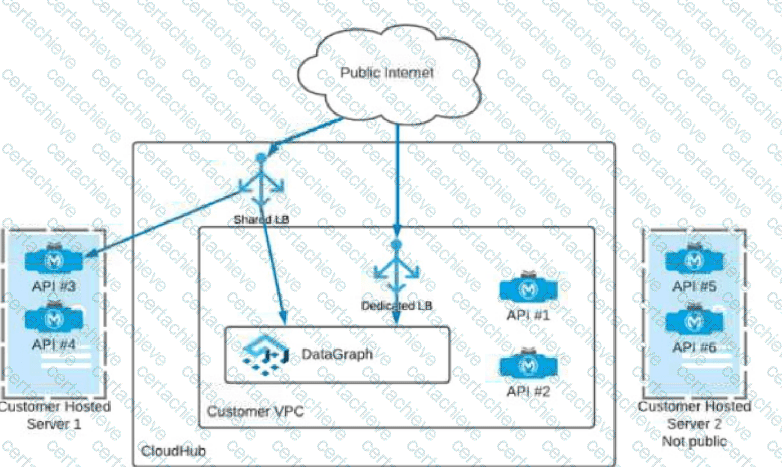
Which APIs can be used with DataGraph to create a unified schema?
Correct Answer & Rationale:
Answer: D
Explanation:
To create a unified schema in MuleSoft ' s DataGraph, APIs must be exposed in a way that allows DataGraph to pull and consolidate data from these APIs into a single schema accessible to consumers. DataGraph provides a federated approach, combining multiple APIs to form a single, unified API endpoint.
In this setup:
APIs 1, 2, 3, and 4 are suitable candidates for DataGraph because they are hosted within the Customer VPC on CloudHub and are accessible either through a Shared Load Balancer (LB) or a Dedicated Load Balancer (DLB). Both of these load balancers provide public access, which is a necessary condition for DataGraph as it must access the APIs to aggregate data.
APIs 5 and 6 are hosted on Customer Hosted Server 2, which is explicitly marked as " Not public " . Since DataGraph requires API access through a publicly reachable endpoint to aggregate them into a unified schema, APIs 5 and 6 cannot be used with DataGraph in this configuration.
APIs 3 and 4 on Customer Hosted Server 1 appear accessible through a Shared LB, implying public accessibility that meets DataGraph’s requirements.
By combining APIs 1, 2, 3, and 4 within DataGraph, you can create a unified schema that enables clients to query data seamlessly from all these APIs as if it were from a single source.
This setup allows for efficient data retrieval and can simplify API consumption by reducing the need to call multiple APIs individually, thus optimizing performance and developer experience.
ReferencesFor more detailed information on setting up and managing unified schemas in DataGraph, refer to the DataWeave documentation and MuleSoft DataGraph resources which provide in-depth guidelines on schema aggregation and API federation.
Question 7
Salesforce MuleSoft-Platform-Architect-I
QUESTION DESCRIPTION:
Once an API Implementation is ready and the API is registered on API Manager, who should request the access to the API on Anypoint Exchange?
Correct Answer & Rationale:
Answer: D
Explanation:
Explanation
Correct Answer: API Consumer
*****************************************
> > API clients are piece of code or programs that use the client credentials of API consumer but does not directly interact with Anypoint Exchange to get the access
> > API consumer is the one who should get registered and request access to API and then API client needs to use those client credentials to hit the APIs
So, API consumer is the one who needs to request access on the API from Anypoint Exchange
Question 8
Salesforce MuleSoft-Platform-Architect-I
QUESTION DESCRIPTION:
A Platinum customer uses the U.S. control plane and deploys applications to CloudHub in Singapore with a default log configuration.
The compliance officer asks where the logs and monitoring data reside?
Correct Answer & Rationale:
Answer: B
Explanation:
For applications deployed on CloudHub in a foreign region (e.g., Singapore), MuleSoft handles log and monitoring data in the region where the control plane resides. This data storage policy is standard for CloudHub deployments to maintain centralized log and monitoring data.
Data Location:
For a U.S.-based control plane, all logs and monitoring data are stored in the United States, regardless of the deployment region.
Although the application itself runs in Singapore, data related to application performance and logs is not localized to the deployment region.
Explanation of Correct Answer (B):
Since the control plane is based in the United States, all operational data like logs and monitoring will also be stored there, ensuring compliance with MuleSoft’s data handling policies.
Explanation of Incorrect Options:
Option A and D are incorrect because MuleSoft does not store logs or monitoring data in the application deployment region when the control plane is located in the United States.
Option C suggests mixed storage, which does not align with MuleSoft’s data policy structure.
ReferencesFor details on data residency in CloudHub deployments, refer to MuleSoft’s documentation on CloudHub control planes and data handling policies.
Question 9
Salesforce MuleSoft-Platform-Architect-I
QUESTION DESCRIPTION:
What is true about the technology architecture of Anypoint VPCs?
Correct Answer & Rationale:
Answer: B
Explanation:
Explanation
Correct Answer: Traffic between Mule applications deployed to an Anypoint VPC and on-premises systems can stay within a private network
*****************************************
> > The private IP address range of an Anypoint VPC is NOT automatically chosen by CloudHub. It is chosen by us at the time of creating VPC using thr CIDR blocks.
CIDR Block: The size of the Anypoint VPC in Classless Inter-Domain Routing (CIDR) notation.
For example, if you set it to 10.111.0.0/24, the Anypoint VPC is granted 256 IP addresses from 10.111.0.0 to 10.111.0.255.
Ideally, the CIDR Blocks you choose for the Anypoint VPC come from a private IP space, and should not overlap with any other Anypoint VPC’s CIDR Blocks, or any CIDR Blocks in use in your corporate network.
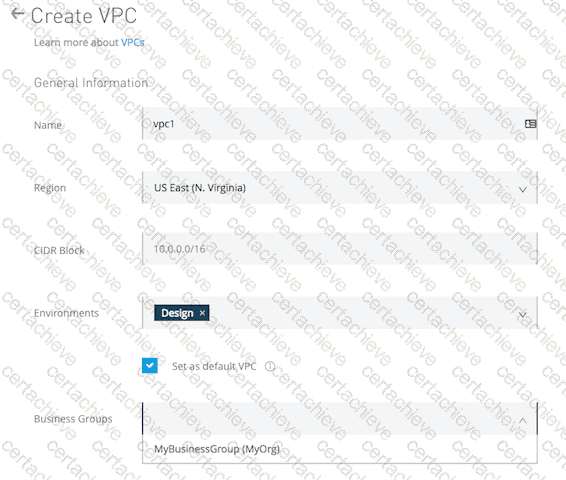
that each CloudHub environment requires a separate Anypoint VPC. Once an Anypoint VPC is created, we can choose a same VPC by multiple environments. However, it is generally a best and recommended practice to always have seperate Anypoint VPCs for Non-Prod and Prod environments.
> > We use Anypoint VPN to link the underlying AWS VPC to an on-premises (non AWS) private network. NOT VPC Peering.
[Reference: https://docs.mulesoft.com/runtime-manager/vpn-about, Only true statement in the given choices is that the traffic between Mule applications deployed to an Anypoint VPC and on-premises systems can stay within a private network., https://docs.mulesoft.com/runtime-manager/vpc-connectivity-methods-concept , , , ]
Question 10
Salesforce MuleSoft-Platform-Architect-I
QUESTION DESCRIPTION:
The implementation of a Process API must change.
What is a valid approach that minimizes the impact of this change on API clients?
Correct Answer & Rationale:
Answer: C
Explanation:
Explanation
Correct Answer: Implement required changes to the Process API implementation so that, whenever possible, the Process API’s RAML definition remains unchanged.
*****************************************
Key requirement in the question is:
> > Approach that minimizes the impact of this change on API clients
Based on above:
> > Updating the RAML definition would possibly impact the API clients if the changes require any thing mandatory from client side. So, one should try to avoid doing that until really necessary.
> > Implementing the changes as a completely different API and then redirectly the clients with 3xx status code is really upsetting design and heavily impacts the API clients.
> > Organisations and IT cannot simply postpone the changes required until all API consumers acknowledge they are ready to migrate to a new Process API or API version. This is unrealistic and not possible.
The best way to handle the changes always is to implement required changes to the API implementations so that, whenever possible, the API’s RAML definition remains unchanged.

Verified by Certified Instructors
This Salesforce MuleSoft-Platform-Architect-I study pack was audited and verified on September 23, 2026 by John Prescott,. We ensure every technical rationale aligns with real-world enterprise standards.
A Stepping Stone for Enhanced Career Opportunities
Your profile having Salesforce MuleSoft certification significantly enhances your credibility and marketability in all corners of the world. The best part is that your formal recognition pays you in terms of tangible career advancement. It helps you perform your desired job roles accompanied by a substantial increase in your regular income. Beyond the resume, your expertise imparts you confidence to act as a dependable professional to solve real-world business challenges.
Your success in Salesforce MuleSoft-Platform-Architect-I certification exam makes your visible and relevant in the fast-evolving tech landscape. It proves a lifelong investment in your career that give you not only a competitive advantage over your non-certified peers but also makes you eligible for a further relevant exams in your domain.
What You Need to Ace Salesforce Exam MuleSoft-Platform-Architect-I
Achieving success in the MuleSoft-Platform-Architect-I Salesforce exam requires a blending of clear understanding of all the exam topics, practical skills, and practice of the actual format. There's no room for cramming information, memorizing facts or dependence on a few significant exam topics. It means your readiness for exam needs you develop a comprehensive grasp on the syllabus that includes theoretical as well as practical command.
Here is a comprehensive strategy layout to secure peak performance in MuleSoft-Platform-Architect-I certification exam:
- Develop a rock-solid theoretical clarity of the exam topics
- Begin with easier and more familiar topics of the exam syllabus
- Make sure your command on the fundamental concepts
- Focus your attention to understand why that matters
- Ensure hands-on practice as the exam tests your ability to apply knowledge
- Develop a study routine managing time because it can be a major time-sink if you are slow
- Find out a comprehensive and streamlined study resource for your help
Ensuring Outstanding Results in Exam MuleSoft-Platform-Architect-I!
In the backdrop of the above prep strategy for MuleSoft-Platform-Architect-I Salesforce exam, your primary need is to find out a comprehensive study resource. It could otherwise be a daunting task to achieve exam success. The most important factor that must be kep in mind is make sure your reliance on a one particular resource instead of depending on multiple sources. It should be an all-inclusive resource that ensures conceptual explanations, hands-on practical exercises, and realistic assessment tools.
Certachieve: A Reliable All-inclusive Study Resource
Certachieve offers multiple study tools to do thorough and rewarding MuleSoft-Platform-Architect-I exam prep. Here's an overview of Certachieve's toolkit:
Salesforce MuleSoft-Platform-Architect-I PDF Study Guide
This premium guide contains a number of Salesforce MuleSoft-Platform-Architect-I exam questions and answers that give you a full coverage of the exam syllabus in easy language. The information provided efficiently guides the candidate's focus to the most critical topics. The supportive explanations and examples build both the knowledge and the practical confidence of the exam candidates required to confidently pass the exam. The demo of Salesforce MuleSoft-Platform-Architect-I study guide pdf free download is also available to examine the contents and quality of the study material.
Salesforce MuleSoft-Platform-Architect-I Practice Exams
Practicing the exam MuleSoft-Platform-Architect-I questions is one of the essential requirements of your exam preparation. To help you with this important task, Certachieve introduces Salesforce MuleSoft-Platform-Architect-I Testing Engine to simulate multiple real exam-like tests. They are of enormous value for developing your grasp and understanding your strengths and weaknesses in exam preparation and make up deficiencies in time.
These comprehensive materials are engineered to streamline your preparation process, providing a direct and efficient path to mastering the exam's requirements.
Salesforce MuleSoft-Platform-Architect-I exam dumps
These realistic dumps include the most significant questions that may be the part of your upcoming exam. Learning MuleSoft-Platform-Architect-I exam dumps can increase not only your chances of success but can also award you an outstanding score.
Top Exams & Certification Providers
New & Trending
- New Released Exams
- Related Exam
- Hot Vendor