
The Salesforce Certified MuleSoft Developer II (Mule-Dev-301) (Salesforce-MuleSoft-Developer-II)
Passing Salesforce Salesforce MuleSoft exam ensures for the successful candidate a powerful array of professional and personal benefits. The first and the foremost benefit comes with a global recognition that validates your knowledge and skills, making possible your entry into any organization of your choice.

Salesforce-MuleSoft-Developer-II Exam Dumps
- Exam Code: Salesforce-MuleSoft-Developer-II
- Vendor: Salesforce
- Certifications: Salesforce MuleSoft
- Exam Name: Salesforce Certified MuleSoft Developer II (Mule-Dev-301)
Why CertAchieve is Better than Standard Salesforce-MuleSoft-Developer-II Dumps
In 2026, Salesforce uses variable topologies. Basic dumps will fail you.
| Quality Standard | Generic Dump Sites | CertAchieve Premium Prep |
|---|---|---|
| Technical Explanation | None (Answer Key Only) | Step-by-Step Expert Rationales |
| Syllabus Coverage | Often Outdated (v1.0) | 2026 Updated (Latest Syllabus) |
| Scenario Mastery | Blind Memorization | Conceptual Logic & Troubleshooting |
| Instructor Access | No Post-Sale Support | 24/7 Professional Help |
Customers Passed Exams
10
Success backed by proven exam prep tools
Questions Came Word for Word
94%
Real exam match rate reported by verified users
Average Score in Real Testing Centre
89%
Consistently high performance across certifications
Study Time Saved With CertAchieve
60%
Efficient prep that reduces study hours significantly
Coverage of Official Salesforce Salesforce-MuleSoft-Developer-II Exam Domains
Our curriculum is meticulously mapped to the Salesforce official blueprint.
Implement Performant and Reliable Mule Applications (27%)
The highest-weighted domain on the advanced developer exam. Architecting high-throughput configurations, implementing durable ObjectStore persistence models across cloud/on-prem nodes, utilizing VM and Anypoint MQ connectors for asynchronous decoupling, parallelizing logic via Scatter-Gather with target compensating transactions, and configuring client-side caching filters.
Implement Maintainable and Modular Applications & Maven Builds (25%)
Deep dive into enterprise DevOps and reuse methodologies. Structuring multi-module Maven projects, standardizing parent POM files, encapsulating reusable logic into shared Mule Plugins or XML SDK libraries, managing dependencies, and building fully automated CI/CD pipeline deployment routines into CloudHub or standalone runtimes.
Secure Data at Rest and in Transit (20%)
Advanced application of cryptographic and transport security mechanisms. Configuring edge and endpoint HTTPS listener criteria, packaging and managing Keystores/Truststores, utilizing the Cryptography module for payload-level transformations (PGP/JCE), and isolating environment-specific properties via secure configuration files.
Implement Monitorable Mule Applications (15%)
Mastering real-time runtime diagnostics and operational visibility. Customizing application health check endpoints for load-balancer target validation, tracking transaction lifecycles using correlation ID persistence, setting up logging aggregators, altering log levels at runtime, and configuring Anypoint Monitoring metrics.
Expose Production-Ready Anypoint Platform-Managed APIs (13%)
Advanced API gateway administration and governance. Designing API versions, applying and tailoring out-of-the-box (OOTB) or custom API policies (Rate Limiting, Client ID Enforcement, JWT Validation), establishing backend auto-discovery tags, and processing secure environment-specific client app access requests.
Salesforce Salesforce-MuleSoft-Developer-II Exam Domains Q&A
Certified instructors verify every question for 100% accuracy, providing detailed, step-by-step explanations for each.
Question 1
Salesforce Salesforce-MuleSoft-Developer-II
QUESTION DESCRIPTION:
Which pattern can a web API use to notify its client of state changes as soon as they occur?
Correct Answer & Rationale:
Answer: A
Explanation:
A web API can use HTTP Webhook to notify its client of state changes as soon as they occur. A webhook is an HTTP callback that allows an API to send real-time notifications to another system or application when an event happens. The client registers a URL with the API where it wants to receive notifications, and then the API sends an HTTP request to that URL with information about the event. References : https://docs.mulesoft.com/connectors/webhook/webhook-connector
Question 2
Salesforce Salesforce-MuleSoft-Developer-II
QUESTION DESCRIPTION:
Which pattern should be used to invoke multiple HTTP APIs in parallel and roll back failed requests in sequence?
Correct Answer & Rationale:
Answer: C
Explanation:
To invoke multiple HTTP APIs in parallel and roll back failed requests in sequence, the developer should use a Scatter-Gather router as a central Saga orchestrator fo r all API requests with compensating actions for failing routes. A Scatter-Gather router executes multiple routes concurrently and aggregates the results. A Saga orchestrator coordinates a series of actions across different services and handles failures by executing compensating actions. Therefore, using a Scatter-Gather router as a Saga orchestrator allows invoking multiple HTTP APIs in parallel and rolling back any failed requests in sequence. References: https://docs.mulesoft.com/mule-runtime/4.3/scatter -gather-concept https://docs.mulesoft.com/mule-runtime/4.3/saga
Question 3
Salesforce Salesforce-MuleSoft-Developer-II
QUESTION DESCRIPTION:
Refer to the exhibit.
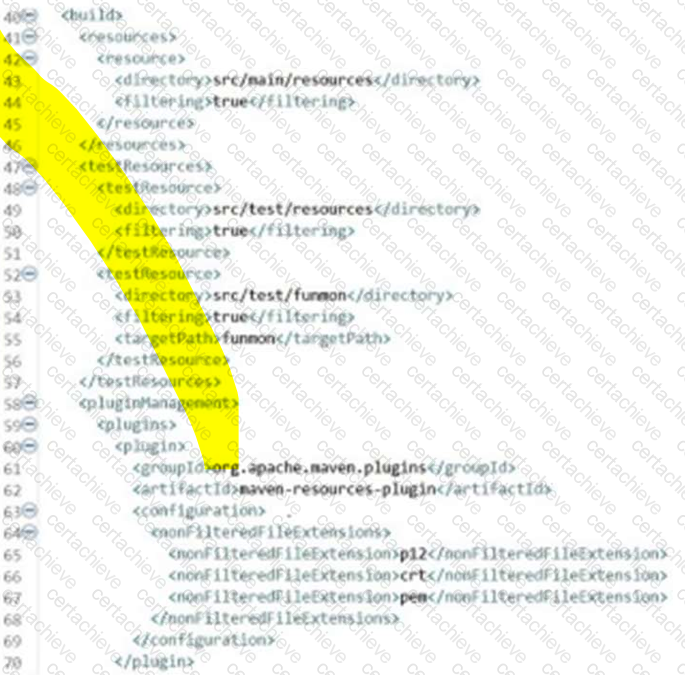
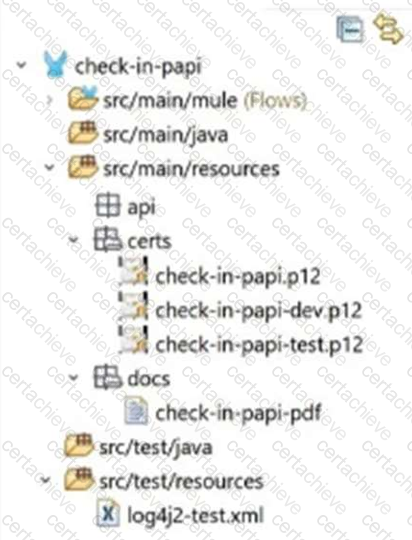
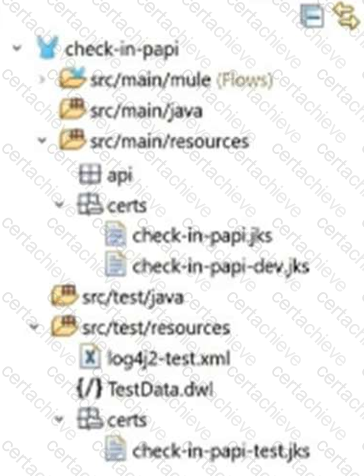
A Mule application pom.xml configures the Maven Resources plugin to exclude parsing binary files in the project’s src/main/resources/certs directory.
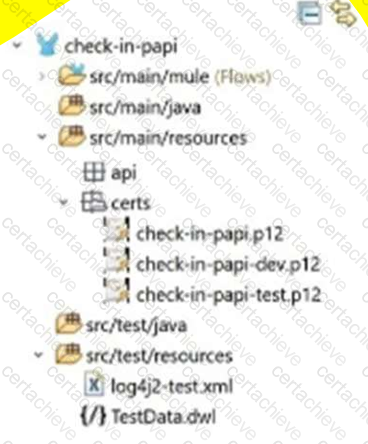
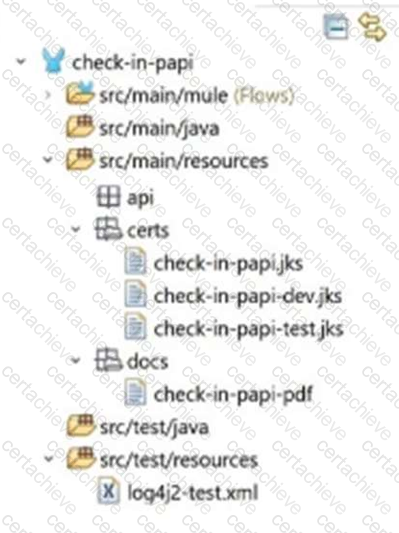
Which configuration of this plugin achieves a successful build?
A)
B)
C)
D)
Correct Answer & Rationale:
Answer: C
Explanation:
To configure the Maven Resources plugin to exclude parsing binary fi les in the project’s src/main/resources/certs directory, option C should be used. This option specifies that any files with .cer or .jks extensions under the certs directory should be excluded from filtering. Filtering is a process of replacing placeholder s with actual values in resource files during the build process. Binary files should not be filtered because they may become corrupted or unusable. References: https://maven.apache.org/plugins/maven-resources-plugin/examples/filter.html https://maven.apache.org/plugins/maven-resources-plugin/examples/include-exclude.html
Question 4
Salesforce Salesforce-MuleSoft-Developer-II
QUESTION DESCRIPTION:
Multiple individual Mute application need to use the Mule Maven plugin to deploy to CloudHub.
The plugin configuration should .. reused where necessary and anything project, specific should be property-based.
Where should the Mule Maven details be configured?
Correct Answer & Rationale:
Answer: A
Explanation:
To reuse Mule Maven plugin configuration across multiple individual Mule applications, the developer should use a parent pom.xml file. A parent pom.xml file defines common configuration for one or more child projects that inherit from it. The developer can specify common properties and dependencies for all child projects in the parent pom.xml file, such as Mule Maven plugin configuration, and then reference them in each child project’s po m.xml file using placeholders. References: https://docs.mulesoft.com/mule-runtime/4.3/mmp-concept#parent-pom https://maven.apache.org/guides/intr oduction/introduction-to-the-pom.html#Project_Inheritance
Question 5
Salesforce Salesforce-MuleSoft-Developer-II
QUESTION DESCRIPTION:
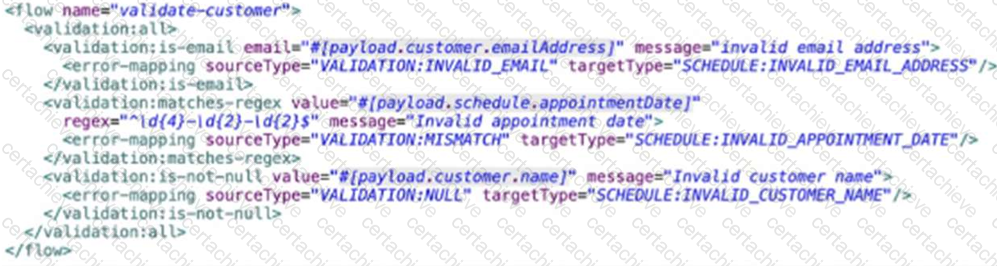
An API has been built to enable scheduling email provider. The front-end system does very little data entry validation, and problems have started to appear in the email that go to patients. A validate-customer’’ flow is added validate the data.
What is he expected behavior of the ‘validate-customer’’ flow?
Correct Answer & Rationale:
Answer: A
Explanation:
The validate -customer flow uses an until-successful scope to validate each field of the customer data. The until-successful scope executes its processors until they succeed or exhausts the maximum number of retries. If any processor fails, it raises an error and stops executing the remaining processors. Therefore, if only the email address is invalid, a VALIDATION.INVALID_EMAIL error is raised and the validation of appointment date and customer name is skipped. References: https://docs.mulesoft.com/mule-runtime/4.3/until-successful-scope
Question 6
Salesforce Salesforce-MuleSoft-Developer-II
QUESTION DESCRIPTION:
A new Mule project has been created in Anypoint Studio with the default settings.
Which file inside the Mule project must be modified before using Maven to successfully deploy the application?
Correct Answer & Rationale:
Answer: C
Explanation:
To use Maven to successfully deploy the application, the developer needs to modify the pom.xml file inside the Mule project. The pom.xml file contains the configuration and dependencies of the Mule application, as well as the deployment information such as the CloudHub region, environment, and worker size. The developer needs to specify these properties in the pom.xml file before using Maven to deploy the application. References: https://docs.mulesoft.com/mule-runtime/4.3/mmp-concept#application-deployment-descriptor
Question 7
Salesforce Salesforce-MuleSoft-Developer-II
QUESTION DESCRIPTION:
A Mule application contain two policies Policy A and Policy A has order1, and Policy B has order 2. Policy A Policy B, and a flow are defined by he configuration below.
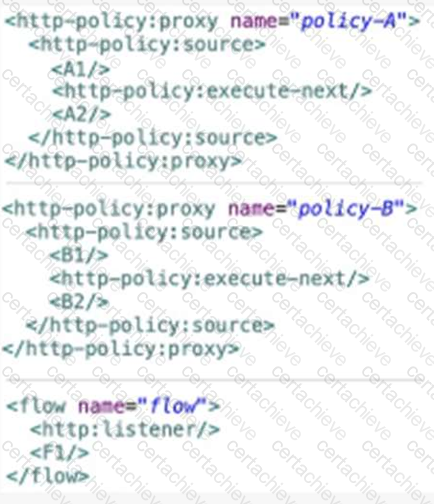
When a HTTP request arrives at the Mule application’s endpoint, what will be the execution order?
Correct Answer & Rationale:
Answer: A
Explanation:
Based on the configuration below, when a HTTP request arrives at the Mule application’s endpoint, the execution order will be A1, B1, F1, B2, A2. This is because policies are executed before and after the API implementation flow according to their order a ttribute. Policy A has order 1, which means it is executed first before Policy B, which has order 2. The flow is executed after both policies are executed before the flow. Then, Policy B is executed after the flow before Policy A is executed after the flow . References: https://docs.mulesoft.com/api-manager/2.x/policies-policy-order
Question 8
Salesforce Salesforce-MuleSoft-Developer-II
QUESTION DESCRIPTION:
A healthcare portal needs to validate the token that it sends to a Mule API. The developer plans to implement a custom policy using the HTTP Policy Transform Extension to match the token received in the header from the heathcare portal.
Which files does the developer need to create in order to package the custom policy?
Correct Answer & Rationale:
Answer: D
Explanation:
To package a custom policy using the HTTP Policy Transform Extension, the developer needs to create an XML template file and a YAML configuration file. The XML template file de fines the policy logic using Mule components and placeholders for user-defined properties. The YAML configuration file defines the metadata of the policy, such as its name, description, category, parameters, and dependencies. References: https://docs.mulesoft.com/api-manager/2.x/http-policy-transform#packaging-the-policy
Question 9
Salesforce Salesforce-MuleSoft-Developer-II
QUESTION DESCRIPTION:
When registering a client application with an existing API instance or API Group instance, what is required to manually approve or reject request access?
Correct Answer & Rationale:
Answer: D
Explanation:
To manually approve or reject request access when registering a client application with an existing API instance or API Group instance, it is required to conf igure the SLA tier for the application and have one of the following roles or permissions: Organization Administrator, API Manager Environment Administrator, or Manage Contracts permission. These roles or permissions allow managing client applications and contracts in API Manager. References: https://docs.mulesoft.com/api-manager/2.x/client-applications#managing-client-applications-and-c ontracts
Question 10
Salesforce Salesforce-MuleSoft-Developer-II
QUESTION DESCRIPTION:
Which statement is true when using XML SDK for creating custom message processors?
Correct Answer & Rationale:
Answer: A
Explanation:
When using XML SDK for creating custom message processors, all operations are public by de fault and can be used by any Mule application that imports them. There is no way to make an operation private or protected in XML SDK. References: https://docs.mulesoft.com/mule-sdk /1.1/xml-sdk#operations

Verified by Certified Instructors
This Salesforce Salesforce-MuleSoft-Developer-II study pack was audited and verified on September 23, 2026 by John Prescott,. We ensure every technical rationale aligns with real-world enterprise standards.
A Stepping Stone for Enhanced Career Opportunities
Your profile having Salesforce MuleSoft certification significantly enhances your credibility and marketability in all corners of the world. The best part is that your formal recognition pays you in terms of tangible career advancement. It helps you perform your desired job roles accompanied by a substantial increase in your regular income. Beyond the resume, your expertise imparts you confidence to act as a dependable professional to solve real-world business challenges.
Your success in Salesforce Salesforce-MuleSoft-Developer-II certification exam makes your visible and relevant in the fast-evolving tech landscape. It proves a lifelong investment in your career that give you not only a competitive advantage over your non-certified peers but also makes you eligible for a further relevant exams in your domain.
What You Need to Ace Salesforce Exam Salesforce-MuleSoft-Developer-II
Achieving success in the Salesforce-MuleSoft-Developer-II Salesforce exam requires a blending of clear understanding of all the exam topics, practical skills, and practice of the actual format. There's no room for cramming information, memorizing facts or dependence on a few significant exam topics. It means your readiness for exam needs you develop a comprehensive grasp on the syllabus that includes theoretical as well as practical command.
Here is a comprehensive strategy layout to secure peak performance in Salesforce-MuleSoft-Developer-II certification exam:
- Develop a rock-solid theoretical clarity of the exam topics
- Begin with easier and more familiar topics of the exam syllabus
- Make sure your command on the fundamental concepts
- Focus your attention to understand why that matters
- Ensure hands-on practice as the exam tests your ability to apply knowledge
- Develop a study routine managing time because it can be a major time-sink if you are slow
- Find out a comprehensive and streamlined study resource for your help
Ensuring Outstanding Results in Exam Salesforce-MuleSoft-Developer-II!
In the backdrop of the above prep strategy for Salesforce-MuleSoft-Developer-II Salesforce exam, your primary need is to find out a comprehensive study resource. It could otherwise be a daunting task to achieve exam success. The most important factor that must be kep in mind is make sure your reliance on a one particular resource instead of depending on multiple sources. It should be an all-inclusive resource that ensures conceptual explanations, hands-on practical exercises, and realistic assessment tools.
Certachieve: A Reliable All-inclusive Study Resource
Certachieve offers multiple study tools to do thorough and rewarding Salesforce-MuleSoft-Developer-II exam prep. Here's an overview of Certachieve's toolkit:
Salesforce Salesforce-MuleSoft-Developer-II PDF Study Guide
This premium guide contains a number of Salesforce Salesforce-MuleSoft-Developer-II exam questions and answers that give you a full coverage of the exam syllabus in easy language. The information provided efficiently guides the candidate's focus to the most critical topics. The supportive explanations and examples build both the knowledge and the practical confidence of the exam candidates required to confidently pass the exam. The demo of Salesforce Salesforce-MuleSoft-Developer-II study guide pdf free download is also available to examine the contents and quality of the study material.
Salesforce Salesforce-MuleSoft-Developer-II Practice Exams
Practicing the exam Salesforce-MuleSoft-Developer-II questions is one of the essential requirements of your exam preparation. To help you with this important task, Certachieve introduces Salesforce Salesforce-MuleSoft-Developer-II Testing Engine to simulate multiple real exam-like tests. They are of enormous value for developing your grasp and understanding your strengths and weaknesses in exam preparation and make up deficiencies in time.
These comprehensive materials are engineered to streamline your preparation process, providing a direct and efficient path to mastering the exam's requirements.
Salesforce Salesforce-MuleSoft-Developer-II exam dumps
These realistic dumps include the most significant questions that may be the part of your upcoming exam. Learning Salesforce-MuleSoft-Developer-II exam dumps can increase not only your chances of success but can also award you an outstanding score.
Top Exams & Certification Providers
New & Trending
- New Released Exams
- Related Exam
- Hot Vendor