
The Certified Energy Manager (CEM) (CEM)
Passing AEE Energy Management exam ensures for the successful candidate a powerful array of professional and personal benefits. The first and the foremost benefit comes with a global recognition that validates your knowledge and skills, making possible your entry into any organization of your choice.


CEM Exam Dumps
- Exam Code: CEM
- Vendor: AEE
- Certifications: Energy Management
- Exam Name: Certified Energy Manager (CEM)
Why CertAchieve is Better than Standard CEM Dumps
In 2026, AEE uses variable topologies. Basic dumps will fail you.
| Quality Standard | Generic Dump Sites | CertAchieve Premium Prep |
|---|---|---|
| Technical Explanation | None (Answer Key Only) | Step-by-Step Expert Rationales |
| Syllabus Coverage | Often Outdated (v1.0) | 2026 Updated (Latest Syllabus) |
| Scenario Mastery | Blind Memorization | Conceptual Logic & Troubleshooting |
| Instructor Access | No Post-Sale Support | 24/7 Professional Help |
Customers Passed Exams
10
Success backed by proven exam prep tools
Questions Came Word for Word
86%
Real exam match rate reported by verified users
Average Score in Real Testing Centre
89%
Consistently high performance across certifications
Study Time Saved With CertAchieve
60%
Efficient prep that reduces study hours significantly
Coverage of Official AEE CEM Exam Domains
Our curriculum is meticulously mapped to the AEE official blueprint.
Energy & Sustainability Policies, Codes, and Standards (8%)
Master global energy trends, ISO 50001 standards, and the impact of decarbonization policies. Focus on the UN Sustainable Development Goals and local energy-efficiency codes.
Energy Audits and Instrumentation (11%)
Deep dive into ASHRAE audit levels (1, 2, and 3) and the use of measurement tools. Master combustion analysis, light level measurement, and data logging for energy signatures.
Energy Accounting and Economics (10%)
Master the Time Value of Money (TVM). Focus on Life Cycle Cost Analysis (LCCA), Net Present Value (NPV), Internal Rate of Return (IRR), and Simple Payback calculations.
Electrical Power Systems and Motors (11%)
Understanding 3-phase systems, power factor correction, and motor efficiency. Focus on calculating savings from Variable Frequency Drives (VFDs) and high-efficiency motor upgrades.
HVAC Systems and Building Envelope (16%)
The highest-weighted domain. Master the vapor compression cycle, psychrometrics, and optimizing chillers/cooling towers. Includes heat gain/loss through the building envelope.
Building Automation and Controls (10%)
Mastering PID loops, DDC systems, and the integration of AI for predictive maintenance. Focus on Internet of Things (IoT) sensors and open-protocol systems like BACnet.
Industrial and Steam Systems (8%)
Core knowledge of boiler efficiency, steam traps, and industrial process optimization. Focus on waste heat recovery and compressed air system leak management.
Renewable Energy and Storage Systems (10%)
Mastering distributed generation, PV system efficiency, and Thermal Energy Storage (TES). Focus on grid-interactive strategies and microgrid implementation.
AEE CEM Exam Domains Q&A
Certified instructors verify every question for 100% accuracy, providing detailed, step-by-step explanations for each.
Question 1
AEE CEM
QUESTION DESCRIPTION:
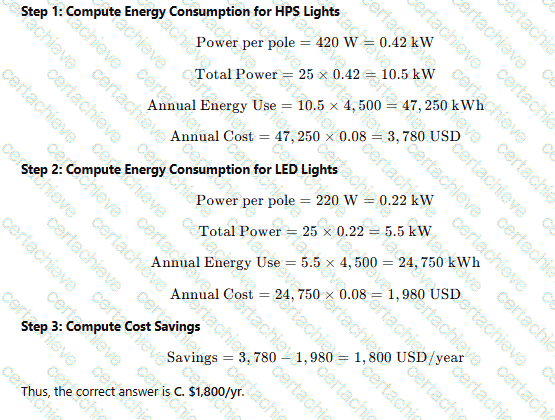
An outdoor parking area has 25 light poles. Each pole has a 420 Watt (ballast included) high-pressure sodium (HPS) luminaire. The parking area lights are illuminated 4,500 hours per year and the electricity cost is $0.08/kWh. What is the annual energy cost reduction if each luminaire is replaced with a 220-Watt (driver included) LED luminaire?
Correct Answer & Rationale:
Answer: C
Explanation:
To determine the annual energy cost savings from switching to LED luminaires:
Question 2
AEE CEM
QUESTION DESCRIPTION:
Which of the following is NOT a typical benefit of performance contracting from the building owner ' s perspective?
Correct Answer & Rationale:
Answer: A
Explanation:
CEM materials clearly state that performance contracting:
Requires detailed audits
Includes complex legal, financial, and M & V structures
Is not quick or simple
All other options are recognized benefits to building owners.
Question 3
AEE CEM
QUESTION DESCRIPTION:
Which of the following is NOT a renewable-energy resource?
SELECT THE CORRECT ANSWER
Correct Answer & Rationale:
Answer: B
Explanation:
Renewable energy resources are naturally replenished on a human timescale. Let ' s evaluate each option:
A. Saw grass:
A biomass resource, renewable through regrowth.
B. Shale gas:
A fossil fuel extracted from shale formations, non-renewable.
C. Geothermal heat:
Energy from Earth ' s internal heat, renewable.
D. Ocean waves:
Mechanical energy from ocean surface waves, renewable.
E. Crop residue:
Organic materials from agriculture, renewable.
Conclusion:
Shale gas is not a renewable energy resource. Therefore, the correct answer is B.
Question 4
AEE CEM
QUESTION DESCRIPTION:
When comparing two similar facilities, you see that the facility with newer, higher-efficiency equipment has a higher energy-use index [EUI] (kJ/m²-yr). What might be the cause?
Correct Answer & Rationale:
Answer: A
Explanation:
1) CEM Principle: Equipment Efficiency ≠ System Performance
The AEE CEM Body of Knowledge stresses that higher-efficiency equipment does not guarantee lower energy use unless systems are:
Properly commissioned
Correctly controlled
Operated as designed
2) Evaluation of Options
A. The facility with the higher EUI is in need of commissioning ✅
Most common cause per CEM case studies: controls, sequences, and integration not optimized.
B. The facility with the lower EUI is in need of commissioning ❌
Lower EUI indicates better performance.
C. The facility with the lower EUI requires a performance contract ❌
No evidence supports this.
D. The facility with the higher efficiency equipment should have a higher EUI ❌
Contradicts energy efficiency principles.
E. The facility with the higher EUI requires a SCADA system ❌
Monitoring alone does not correct poor performance.
CEM Exam Insight
Commissioning ensures that high-efficiency equipment actually delivers expected energy performance.
Question 5
AEE CEM
QUESTION DESCRIPTION:
The International Performance Measurement and Verification Protocol (IPMVP) has how many categories (method options) to determine the performance of an energy- or water-consuming system?
Correct Answer & Rationale:
Answer: C
Explanation:
Comprehensive Detailed Step by Step Explanation with all AEE Energy Manager (CEM) References
The International Performance Measurement and Verification Protocol (IPMVP) defines four standard M & V options used globally and explicitly referenced in CEM training :
Option A: Retrofit isolation – key parameter measurement
Option B: Retrofit isolation – all parameter measurement
Option C: Whole facility measurement
Option D: Calibrated simulation
Question 6
AEE CEM
QUESTION DESCRIPTION:
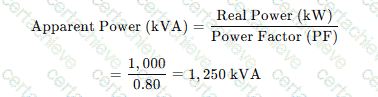
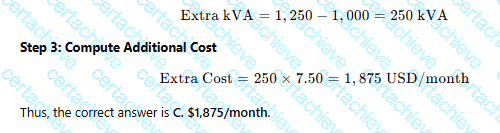
A facility has a monthly peak power demand of 1,000 kW and an average power factor of 80%. The facility pays a demand charge of $7.50/kVA-month. What is the additional cost per month because the power factor is less than 100%?
Correct Answer & Rationale:
Answer: C
Explanation:
To calculate the additional cost due to a power factor of less than 100%, follow these steps:
Step 1: Convert Real Power (kW) to Apparent Power (kVA)
Step 2: Compute Additional kVA Due to Power Factor
Question 7
AEE CEM
QUESTION DESCRIPTION:
What does a manometer measure?
Correct Answer & Rationale:
Answer: A
Explanation:
A manometer is used to measure pressure , particularly in gases and liquids.
Step 1: Analysis of Each Option
Pressure (A): ✅ Correct. Manometers are commonly used in HVAC, industrial, and lab applications.
Volume (B): ❌ Incorrect. Volume is measured using flow meters or tanks.
Distance (C): ❌ Incorrect. Distance is measured using rulers or lasers.
Voltage (D): ❌ Incorrect. Voltage is measured using voltmeters.
Thus, the correct answer is A. Pressure .
Question 8
AEE CEM
QUESTION DESCRIPTION:
Which of the following is NOT included in commissioning documentation?
Correct Answer & Rationale:
Answer: C
Explanation:
Commissioning documentation, per AEE CEM and ASHRAE Guideline 0 , focuses on ensuring systems are designed, installed, operated, and maintained as intended .
Included commissioning documentation typically consists of:
Original facility and equipment design intent (OPR/BOD)
As-built drawings
Equipment control sequence documentation
Operations & Maintenance (O & M) manuals
Financing payment structure reports are related to project finance or performance contracting , not commissioning.
Question 9
AEE CEM
QUESTION DESCRIPTION:
Which of the advantages listed below, makes an ice TES system more preferred over a water TES system, when a load shifting strategy is considered?
Correct Answer & Rationale:
Answer: B
Explanation:
To determine which advantage makes an ice Thermal Energy Storage (TES) system more preferred over a water TES system for a load shifting strategy, we need to evaluate each option based on the principles of thermal energy storage as outlined in the Association of Energy Engineers (AEE) Certified Energy Manager (CEM) training materials. Load shifting involves storing energy (cooling capacity) during off-peak periods and releasing it during peak demand, making storage efficiency and capacity critical. Let’s analyze each option step-by-step.
Step 1: Understand Ice TES vs. Water TES in Load Shifting
Ice TES : Uses the latent heat of fusion of water (ice melting) to store cooling energy. Ice is formed during off-peak hours (e.g., overnight) and melted during peak hours to provide cooling.
Water TES : Uses the sensible heat capacity of water, storing chilled water (typically 4–6°C) to provide cooling.
Load Shifting Goal : Maximize cooling storage in minimal space and cost, shifting electrical demand from peak to off-peak periods.
CEM Reference : CEM materials in the " Thermal Energy Storage " section highlight ice TES for its high energy density and compact storage, contrasted with water TES for simpler operation but larger volume requirements.
Step 2: Evaluate Each Option
Option A: Ice-storage systems operate with a higher coefficient of performance (COP)
Analysis :
COP Definition : COP = (Cooling Output) / (Energy Input). For TES, this relates to the chiller’s efficiency.
Ice TES : Requires chillers to operate at lower temperatures (e.g., -5°C to 0°C) to freeze water, which typically reduces chiller COP (e.g., 3–4) compared to water TES chillers operating at 4–6°C (COP ~5–6).
Reality : Ice TES systems often have a lower COP due to the additional energy needed for phase change, though total system efficiency may improve with load shifting benefits.
CEM Reference : CEM notes that ice TES energy input is higher per unit of cooling due to lower evaporating temperatures, contradicting a " higher COP " claim.
Conclusion : This statement is incorrect and not an advantage for ice TES in load shifting.
Option B: Ice-storage systems require smaller storage tanks since ice has a higher energy storage density
Analysis :
Energy Storage Density :
Ice TES : Relies on latent heat of fusion = 334 kJ/kg (80 kcal/kg or ~144 Btu/lb). This is the energy absorbed/released when water freezes/melts, far exceeding sensible heat.
Water TES : Relies on sensible heat = cp ⋅ Δ T c_p \cdot \Delta T cp ⋅ ΔT, where cp=4.18 kJ/kg\cdotp°C c_p = 4.18 \, \text{kJ/kg·°C} cp=4.18kJ/kg\cdotp°C (1 Btu/lb·°F). For a typical ΔT=10°C\Delta T = 10°CΔT=10°C (e.g., 4°C to 14°C), energy stored = 4.18×10=41.8 kJ/kg 4.18 \times 10 = 41.8 \, \text{kJ/kg} 4.18×10=41.8kJ/kg (~20 Btu/lb).
Comparison : Ice stores ~8 times more energy per kg than water for a 10°C range (334 vs. 41.8 kJ/kg).
Volume Impact : Ice’s density (~917 kg/m³) is slightly less than water (~1000 kg/m³), but the latent heat advantage dominates, reducing required tank volume significantly.
Load Shifting : Smaller tanks mean less space and potentially lower capital costs, a key advantage for peak load management.
CEM Reference : CEM training emphasizes ice TES’s high energy density as a primary reason for its preference in space-constrained load shifting applications.
Conclusion : This statement is correct and a clear advantage for ice TES.
Option C: Water-storage systems require smaller storage tanks since water has a higher density than ice
Analysis :
Density : Water = 1000 kg/m³; Ice = 917 kg/m³. Water is denser, but density alone doesn’t determine storage size in TES.
Energy Storage : As calculated, water’s sensible heat capacity (e.g., 41.8 kJ/kg for 10°C) is much lower than ice’s latent heat (334 kJ/kg). To store the same cooling capacity, water TES requires ~8 times more mass and thus larger tanks (even accounting for density differences).
Implication : Water TES tanks are larger, not smaller, contradicting the statement.
CEM Reference : CEM materials note water TES’s larger volume requirements as a disadvantage compared to ice TES.
Conclusion : This statement is incorrect and not an advantage for ice TES (it favors water TES incorrectly).
Option D: Ice-storage systems require lower maintenance due to lower pumping volume
Analysis :
Pumping Volume : Ice TES often uses glycol or brine solutions to transfer heat at lower temperatures, requiring pumps sized for smaller volumes due to concentrated cooling capacity. Water TES circulates larger volumes of chilled water. However, " lower pumping volume " doesn’t directly translate to " lower maintenance. "
Maintenance : Ice TES systems are more complex (ice-making equipment, heat exchangers), potentially increasing maintenance (e.g., defrost cycles, corrosion from brine). Water TES is simpler, often with lower maintenance needs.
CEM Reference : CEM discusses ice TES complexity as a trade-off for its density advantage, not a maintenance benefit.
Conclusion : This statement is questionable and not a primary advantage for load shifting.
Step 3: Identify the Key Advantage for Load Shifting
Load Shifting Context : The goal is to store maximum cooling capacity efficiently during off-peak hours. Option B (smaller tanks due to higher energy storage density) directly supports this by reducing space and installation costs, a critical factor in TES design per CEM guidelines.
Elimination :
A: Incorrect (lower COP, not higher).
C: Incorrect (water TES tanks are larger).
D: Weak (maintenance isn’t clearly lower; not the primary driver).
B: Correct and relevant.

Verified by Certified Instructors
This AEE CEM study pack was audited and verified on September 23, 2026 by Elon Ashford,. We ensure every technical rationale aligns with real-world enterprise standards.
A Stepping Stone for Enhanced Career Opportunities
Your profile having Energy Management certification significantly enhances your credibility and marketability in all corners of the world. The best part is that your formal recognition pays you in terms of tangible career advancement. It helps you perform your desired job roles accompanied by a substantial increase in your regular income. Beyond the resume, your expertise imparts you confidence to act as a dependable professional to solve real-world business challenges.
Your success in AEE CEM certification exam makes your visible and relevant in the fast-evolving tech landscape. It proves a lifelong investment in your career that give you not only a competitive advantage over your non-certified peers but also makes you eligible for a further relevant exams in your domain.
What You Need to Ace AEE Exam CEM
Achieving success in the CEM AEE exam requires a blending of clear understanding of all the exam topics, practical skills, and practice of the actual format. There's no room for cramming information, memorizing facts or dependence on a few significant exam topics. It means your readiness for exam needs you develop a comprehensive grasp on the syllabus that includes theoretical as well as practical command.
Here is a comprehensive strategy layout to secure peak performance in CEM certification exam:
- Develop a rock-solid theoretical clarity of the exam topics
- Begin with easier and more familiar topics of the exam syllabus
- Make sure your command on the fundamental concepts
- Focus your attention to understand why that matters
- Ensure hands-on practice as the exam tests your ability to apply knowledge
- Develop a study routine managing time because it can be a major time-sink if you are slow
- Find out a comprehensive and streamlined study resource for your help
Ensuring Outstanding Results in Exam CEM!
In the backdrop of the above prep strategy for CEM AEE exam, your primary need is to find out a comprehensive study resource. It could otherwise be a daunting task to achieve exam success. The most important factor that must be kep in mind is make sure your reliance on a one particular resource instead of depending on multiple sources. It should be an all-inclusive resource that ensures conceptual explanations, hands-on practical exercises, and realistic assessment tools.
Certachieve: A Reliable All-inclusive Study Resource
Certachieve offers multiple study tools to do thorough and rewarding CEM exam prep. Here's an overview of Certachieve's toolkit:
AEE CEM PDF Study Guide
This premium guide contains a number of AEE CEM exam questions and answers that give you a full coverage of the exam syllabus in easy language. The information provided efficiently guides the candidate's focus to the most critical topics. The supportive explanations and examples build both the knowledge and the practical confidence of the exam candidates required to confidently pass the exam. The demo of AEE CEM study guide pdf free download is also available to examine the contents and quality of the study material.
AEE CEM Practice Exams
Practicing the exam CEM questions is one of the essential requirements of your exam preparation. To help you with this important task, Certachieve introduces AEE CEM Testing Engine to simulate multiple real exam-like tests. They are of enormous value for developing your grasp and understanding your strengths and weaknesses in exam preparation and make up deficiencies in time.
These comprehensive materials are engineered to streamline your preparation process, providing a direct and efficient path to mastering the exam's requirements.
AEE CEM exam dumps
These realistic dumps include the most significant questions that may be the part of your upcoming exam. Learning CEM exam dumps can increase not only your chances of success but can also award you an outstanding score.
The CEM Exam Dumps included practical customer experience management scenarios and detailed explanations that improved my understanding of service operations and leadership concepts.
Ruby Bennett
Jul 14, 2026
Top Exams & Certification Providers
New & Trending
- New Released Exams
- Related Exam
- Hot Vendor