
The Appian Associate Developer (ACD101)
Passing Appian Associate Developer exam ensures for the successful candidate a powerful array of professional and personal benefits. The first and the foremost benefit comes with a global recognition that validates your knowledge and skills, making possible your entry into any organization of your choice.
ACD101 Exam Dumps
- Exam Code: ACD101
- Vendor: Appian
- Certifications: Associate Developer
- Exam Name: Appian Associate Developer
Why CertAchieve is Better than Standard ACD101 Dumps
In 2026, Appian uses variable topologies. Basic dumps will fail you.
| Quality Standard | Generic Dump Sites | CertAchieve Premium Prep |
|---|---|---|
| Technical Explanation | None (Answer Key Only) | Step-by-Step Expert Rationales |
| Syllabus Coverage | Often Outdated (v1.0) | 2026 Updated (Latest Syllabus) |
| Scenario Mastery | Blind Memorization | Conceptual Logic & Troubleshooting |
| Instructor Access | No Post-Sale Support | 24/7 Professional Help |
Customers Passed Exams
10
Success backed by proven exam prep tools
Questions Came Word for Word
94%
Real exam match rate reported by verified users
Average Score in Real Testing Centre
94%
Consistently high performance across certifications
Study Time Saved With CertAchieve
60%
Efficient prep that reduces study hours significantly
Coverage of Official Appian ACD101 Exam Domains
Our curriculum is meticulously mapped to the Appian official blueprint.
Introduction to the Appian Platform (14%)
Master the platform's high-level architecture and use cases. Focus on identifying Appian resources (Documentation, Appian Community), organizing application structures (Folders, Groups), and understanding capabilities like Process Mining and RPA (Robotic Process Automation) integration.
General Appian Principles (9%)
Understand the core "Low-Code" philosophy. Master the differences between design objects (Decisions, Constants, Sites) and the Appian security model. Focus on Role-Based Access Control (RBAC) and the standard deployment environments (Development, Test, Production).
Data Persistence (13%)
The bedrock of data management. Master the use of Custom Data Types (CDTs) and relational database management. Focus on mapping CDTs to database tables, using Query Entities to read/write data, and updating data models without causing synchronization errors.
Appian Development: Process Models (17%)
Mastering the "Workhorse" of the platform. Focus on designing, debugging, and publishing process models. Deep dive into configuring User Input Tasks, Script Tasks, and Sub-processes. Understand node chaining for synchronous user experiences and managing process variables.
Appian Development: Interface Design (19%)
The highest-weighted domain. Master the SAIL (Self-Assembling Interface Layer) framework. Focus on building responsive interfaces, using Rule Inputs and Local Variables, and implementing complex components like Editable Grids and Pickers while following Appian’s UX best practices.
Appian Development: Records (13%)
Mastering Appian’s "Data Fabric." Focus on configuring Record Types from various data sources. Learn to design Record Lists, Summary Views, and Related Actions. In 2026, this domain emphasizes Codeless Data Modeling and creating record relationships.
Appian Development: Expression Rules (15%)
The "Logic Layer." Master writing efficient expressions using the Appian Expression Language. Focus on manipulating arrays and strings, using core functions, and leveraging Test Cases to ensure rule quality. Learn to implement reusable logic while avoiding performance bottlenecks.
Appian ACD101 Exam Domains Q&A
Certified instructors verify every question for 100% accuracy, providing detailed, step-by-step explanations for each.
Question 1
Appian ACD101
QUESTION DESCRIPTION:
Review the following expression rule:
union(ri!fruit, ri!vegetables)
The rule inputs are configured as text arrays.
What is the expected output?
Correct Answer & Rationale:
Answer: C
Explanation:
The union() function in Appian combines the elements of two or more arrays into a single array, removing any duplicate values. Given that the rule inputs ri!fruit and ri!vegetables are configured as text arrays, the expected output of union(ri!fruit, ri!vegetables) would be an array containing all unique items from both ri!fruit and ri!vegetables , with any duplicates removed. This function is useful for combining lists without repetition, ensuring a clean, unique set of elements.
[References: Appian Documentation - Expression Functions]
Question 2
Appian ACD101
QUESTION DESCRIPTION:
You have two record types: ACME_Student and ACME_Class.
You need to add a many-to-many relationship between these two record types.
What should you do?
Correct Answer & Rationale:
Answer: A
Explanation:
To establish a many-to-many relationship between two record types in Appian, you should create a junction or mapping record type that will handle the many-to-many association. This new record type should have two one-to-many relationships, one to each of the original record types (ACME_Student and ACME_Class). This setup allows each student to be associated with multiple classes and each class to be associated with multiple students.
[References: Appian Documentation - Record Type Relationships]
Question 3
Appian ACD101
QUESTION DESCRIPTION:
You configured a Custom Data Type (CDT), ACME_video. You need to set up a node in your process model to write a new video as a row in the CDT ' s corresponding database table.
Which set of inputs must you configure on your Write to Data Store smart service node?
Correct Answer & Rationale:
Answer: B
Explanation:
When configuring a Write to Data Store Entity smart service node to write a new row to a CDT ' s corresponding database table, you must specify the data store entity where the CDT is stored. Additionally, you need to provide an input of the type that matches the CDT, in this case, an input of type ACME_video, which will contain the data to be written to the database.
[References: Appian Documentation - Write to Data Store Entity Smart Service]
Question 4
Appian ACD101
QUESTION DESCRIPTION:
Which two groups can be set within Application Properties ? (Choose two.)
Correct Answer & Rationale:
Answer: A, C
Explanation:
Within Application Properties in Appian, you can set two groups: Administrators Groups and Users Groups. The Administrators Group is responsible for managing and configuring the application, while the Users Group is designated for end-users who interact with the application ' s functionalities.
References
Appian Documentation: Application Properties
Question 5
Appian ACD101
QUESTION DESCRIPTION:
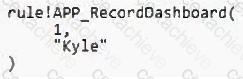
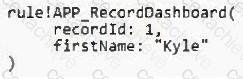
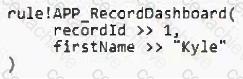
Which code snippet calls the interface APP_RecordDashboard while following best practices for passing in values for " recordId " and " firstName " ?
A)
B)
C)
Correct Answer & Rationale:
Answer: B
Explanation:
The best practice in Appian for passing values into an interface is to use named parameters, which is demonstrated by Option B. Named parameters make the code more readable and maintainable by clearly specifying which parameter each value is being passed to. In this case, the recordId and firstName parameters are clearly being assigned the values 1 and " Kyle " respectively.
References
Appian Documentation: Passing Parameters to Interfaces
Question 6
Appian ACD101
QUESTION DESCRIPTION:
You select the " Generate groups and folders to secure and organize objects " option while creating a new application, Acme, with the prefix ACM.
By default, which two groups are generated by Appian? (Choose two.)
Correct Answer & Rationale:
Answer: A, B
Explanation:
When creating a new application in Appian and opting to generate groups and folders for organization and security, Appian automatically creates specific groups to facilitate application development and management. The default groups include " Administrators " and " Designers " with the application prefix, in this case, ACM. The ACM Administrators group is intended for users who will have full control over the application, including configuration and deployment aspects. The ACM Designers group is designated for users primarily involved in the design and development of the application, granting them necessary permissions to create and modify application components without full administrative privileges.
[References:, Appian Documentation on Application Design: Offers insights into best practices for structuring and securing Appian applications, including the use of groups for effective application management., ]
Question 7
Appian ACD101
QUESTION DESCRIPTION:
Which option best describes the primary purpose of the interface design object?
Correct Answer & Rationale:
Answer: B
Explanation:
The primary purpose of the interface design object in Appian is to provide a method for end users to interact with an Appian application. Interfaces are the user-facing components that allow for the input, display, and manipulation of data within the application, facilitating user engagement and task completion.
References
Appian Documentation: Interface Design
Question 8
Appian ACD101
QUESTION DESCRIPTION:
Which step can be critical in passing information from a form back to a process model?
Correct Answer & Rationale:
Answer: C
Explanation:
The critical step in passing information from a form back to a process model is to configure inputs on the Data tab of a User Input Task. When you create a User Input Task, it includes a form for users to interact with. The data entered into this form can be mapped to process variables via the Data tab configuration. This ensures that the information collected in the form is available to the process for further use.
[References: Appian Documentation - User Input Tasks]
Question 9
Appian ACD101
QUESTION DESCRIPTION:
You received a support ticket where the user claims that nothing happens when they click the button to complete a task. You confirm that the user is assigned to the task.
What is a possible reason for this problem?
Correct Answer & Rationale:
Answer: C
Explanation:
If a user claims that nothing happens when they click a button to complete a task, a possible reason could be that the button was not configured to submit the form. This configuration is essential for triggering the form submission action, which in turn can complete the task or initiate further processes. Without this setup, clicking the button will not result in any action.
References
Appian Documentation: Configuring Buttons in Interfaces
Question 10
Appian ACD101
QUESTION DESCRIPTION:
A customer wants to display a small toolbar with three icons - a " sad face, " a " face with neutral expression, " and a " happy face " - on the bottom of every page in their application.
Users will be instructed to use the icon that best expresses their current experience using the application. This will allow the customer to collect valuable data about users.
Which object type should be called from each page to implement this feature?
Correct Answer & Rationale:
Answer: A
Explanation:
In Appian, interfaces are used to design and render user interface elements, allowing for the creation of custom layouts and components that can interact with users. In this scenario, the toolbar with emotion icons is a UI element that needs to be consistently presented across various pages. Using an interface ensures that these icons can be interactively used by users to express their sentiments, and the data collected can be analyzed for user experience insights. Interfaces are capable of embedding such UI elements and can be invoked or included across multiple pages within an application, making them the ideal choice for this requirement.
[References:, Appian Documentation on Interfaces: Provides detailed guidance on how to design and use interfaces to create user-centric UI components., ]

Verified by Certified Instructors
This Appian ACD101 study pack was audited and verified on September 23, 2026 by John Prescott,. We ensure every technical rationale aligns with real-world enterprise standards.
A Stepping Stone for Enhanced Career Opportunities
Your profile having Associate Developer certification significantly enhances your credibility and marketability in all corners of the world. The best part is that your formal recognition pays you in terms of tangible career advancement. It helps you perform your desired job roles accompanied by a substantial increase in your regular income. Beyond the resume, your expertise imparts you confidence to act as a dependable professional to solve real-world business challenges.
Your success in Appian ACD101 certification exam makes your visible and relevant in the fast-evolving tech landscape. It proves a lifelong investment in your career that give you not only a competitive advantage over your non-certified peers but also makes you eligible for a further relevant exams in your domain.
What You Need to Ace Appian Exam ACD101
Achieving success in the ACD101 Appian exam requires a blending of clear understanding of all the exam topics, practical skills, and practice of the actual format. There's no room for cramming information, memorizing facts or dependence on a few significant exam topics. It means your readiness for exam needs you develop a comprehensive grasp on the syllabus that includes theoretical as well as practical command.
Here is a comprehensive strategy layout to secure peak performance in ACD101 certification exam:
- Develop a rock-solid theoretical clarity of the exam topics
- Begin with easier and more familiar topics of the exam syllabus
- Make sure your command on the fundamental concepts
- Focus your attention to understand why that matters
- Ensure hands-on practice as the exam tests your ability to apply knowledge
- Develop a study routine managing time because it can be a major time-sink if you are slow
- Find out a comprehensive and streamlined study resource for your help
Ensuring Outstanding Results in Exam ACD101!
In the backdrop of the above prep strategy for ACD101 Appian exam, your primary need is to find out a comprehensive study resource. It could otherwise be a daunting task to achieve exam success. The most important factor that must be kep in mind is make sure your reliance on a one particular resource instead of depending on multiple sources. It should be an all-inclusive resource that ensures conceptual explanations, hands-on practical exercises, and realistic assessment tools.
Certachieve: A Reliable All-inclusive Study Resource
Certachieve offers multiple study tools to do thorough and rewarding ACD101 exam prep. Here's an overview of Certachieve's toolkit:
Appian ACD101 PDF Study Guide
This premium guide contains a number of Appian ACD101 exam questions and answers that give you a full coverage of the exam syllabus in easy language. The information provided efficiently guides the candidate's focus to the most critical topics. The supportive explanations and examples build both the knowledge and the practical confidence of the exam candidates required to confidently pass the exam. The demo of Appian ACD101 study guide pdf free download is also available to examine the contents and quality of the study material.
Appian ACD101 Practice Exams
Practicing the exam ACD101 questions is one of the essential requirements of your exam preparation. To help you with this important task, Certachieve introduces Appian ACD101 Testing Engine to simulate multiple real exam-like tests. They are of enormous value for developing your grasp and understanding your strengths and weaknesses in exam preparation and make up deficiencies in time.
These comprehensive materials are engineered to streamline your preparation process, providing a direct and efficient path to mastering the exam's requirements.
Appian ACD101 exam dumps
These realistic dumps include the most significant questions that may be the part of your upcoming exam. Learning ACD101 exam dumps can increase not only your chances of success but can also award you an outstanding score.
Top Exams & Certification Providers
New & Trending
- New Released Exams
- Related Exam
- Hot Vendor
Verified Performance Reports
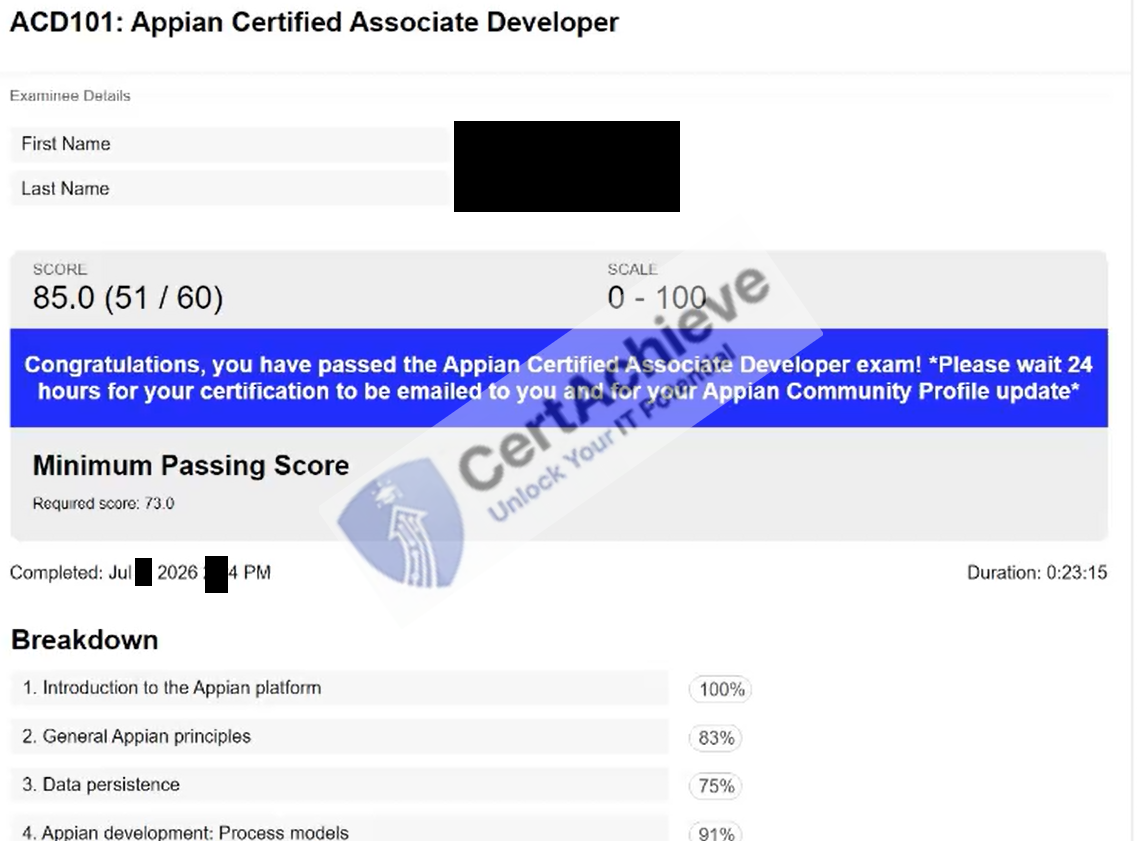
Authentic score reports from candidates who cleared the ACD101 exam.
Verified Case #1
×
![]()