
The HPE Aruba Networking Certified Professional – Switching (HPE7-A08)
Passing HP Aruba Certified Switching Expert exam ensures for the successful candidate a powerful array of professional and personal benefits. The first and the foremost benefit comes with a global recognition that validates your knowledge and skills, making possible your entry into any organization of your choice.


HPE7-A08 Exam Dumps
- Exam Code: HPE7-A08
- Vendor: HP
- Certifications: Aruba Certified Switching Expert
- Exam Name: HPE Aruba Networking Certified Professional – Switching
Why CertAchieve is Better than Standard HPE7-A08 Dumps
In 2026, HP uses variable topologies. Basic dumps will fail you.
| Quality Standard | Generic Dump Sites | CertAchieve Premium Prep |
|---|---|---|
| Technical Explanation | None (Answer Key Only) | Step-by-Step Expert Rationales |
| Syllabus Coverage | Often Outdated (v1.0) | 2026 Updated (Latest Syllabus) |
| Scenario Mastery | Blind Memorization | Conceptual Logic & Troubleshooting |
| Instructor Access | No Post-Sale Support | 24/7 Professional Help |
Customers Passed Exams
10
Success backed by proven exam prep tools
Questions Came Word for Word
91%
Real exam match rate reported by verified users
Average Score in Real Testing Centre
90%
Consistently high performance across certifications
Study Time Saved With CertAchieve
60%
Efficient prep that reduces study hours significantly
Coverage of Official HP HPE7-A08 Exam Domains
Our curriculum is meticulously mapped to the HP official blueprint.
Implementation Planning (18%)
The "Design" foundation. Master the ability to translate customer requirements into a technical wired solution. Focus on selecting the correct hardware from the AOS-CX portfolio (6200, 6300, 8000+ series) and designing for scalability. In 2026, this includes planning for Colorless Ports and determining the appropriate integration points for HPE Aruba Networking Central.
Installation and Configuration (33%)
The "Core" of the exam. This is the highest-weighted domain. Master the configuration of Layer 2 and Layer 3 technologies. Focus on VSX (Virtual Switching Extension) for high availability, OSPF and BGP for routing, and IP Multicast (PIM-SM/SSM). Learn to provision switches via the CLI and Aruba Central, and implement security features like MACsec and advanced ACLs.
Troubleshooting (27%)
The "Resilience" engine. Master the tools and logic required to resolve complex network failures. Focus on identifying and remediating VLAN mismatches, STP loops, and routing protocol issues. In 2026, this domain emphasizes using the Network Automation Engine (NAE) to correlate events and the REST API (JSON) to gather diagnostic data programmatically.
Management, Monitoring, and Optimization (22%)
The "Operational" layer. Master the lifecycle of a live network. Focus on configuration management, auditing, and firmware orchestration via NetEdit and Central. Learn to interpret NAE agents and operational data to optimize performance, ensuring the network meets the high-bandwidth and low-latency demands of modern AI and IoT workloads.
HP HPE7-A08 Exam Domains Q&A
Certified instructors verify every question for 100% accuracy, providing detailed, step-by-step explanations for each.
Question 1
HP HPE7-A08
QUESTION DESCRIPTION:
You’ve rebooted sw-agg2 in a VSX configuration, after which you see this condition (refer to the exhibit):
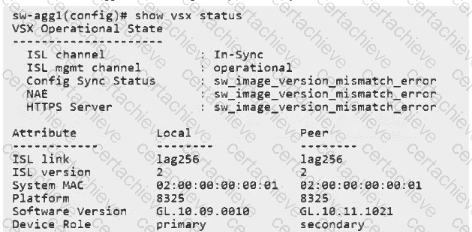
What can you identify based on this output?
Correct Answer & Rationale:
Answer: B
Explanation:
This exhibit highlights a critical operational requirement for Virtual Switching Extension (VSX): Version Consistency.
Analyzing the Exhibit: * The Local Software Version is GL.10.09.0010.
The Peer (sw-agg2) Software Version is GL.10.11.1021.
The Config Sync Status explicitly reports: sw_image_version_mismatch_error.
The Impact of Software Mismatch: The VSX configuration synchronization engine (vsx-sync) requires that both the primary and secondary switches run the exact same version of AOS-CX. When a mismatch is detected, the synchronization of configuration (VLANs, LAGs, etc.) is immediately halted to prevent database corruption or unpredictable behavior.
Incompatible State: While the data plane (traffic forwarding) typically continues to function using the last known good configuration, the control plane " cluster " is effectively in an incompatible mode for management. You cannot make configuration changes on the Primary and expect them to push to the Secondary until the versions are aligned.
Evaluating Other Options:
Option A: Incorrect. The mismatch_error halts all config sync, regardless of whether the specific command exists in both versions.
Option C: A " Live Upgrade " (VSX Orchestration) requires both switches to have access to the same target image and for the sync engine to be healthy. You cannot live upgrade when the sync engine is already in an error state.
Option D: VSX is a distributed forwarding architecture. It does not " forward all traffic " to the primary. Traffic is balanced across MC-LAG links unless a physical failure occurs.
Question 2
HP HPE7-A08
QUESTION DESCRIPTION:
You have configured 802.1X and MAC authentication in an office environment. During testing, you noticed that devices that don’t support 802.1X take a few minutes to receive an IP address. What can you do to improve the connection time for these devices while maintaining a secure configuration?
Correct Answer & Rationale:
Answer: C
Explanation:
In a high-security " Colorless Ports " environment using AOS-CX, we often run both 802.1X (Dot1x) and MAC Authentication (MAC-auth) on the same port to handle a mix of corporate laptops and " dumb " IoT devices (printers, cameras).
The Default Behavior: By default, the switch usually attempts 802.1X first. When a device like a printer is plugged in, it does not have an 802.1X " supplicant " to respond to the switch ' s EAPOL-Request packets. The switch will wait for a series of timeouts and retries (EAPOL timeouts) before it gives up on 802.1X and moves on to the next method (MAC-auth). This waiting period is what causes the " few minutes " delay the user is experiencing.
Auth-Precedence vs. Auth-Priority:
Auth-Precedence: This defines the order in which the switch attempts the authentication methods.
Auth-Priority: This defines which method " wins " if multiple methods succeed (relevant for a PC that might trigger both).
The Solution: By changing the auth-precedence to mac-auth dot1x, the switch immediately captures the device ' s MAC address and sends it to the RADIUS server (like Aruba ClearPass) for authentication.
For a printer, MAC-auth succeeds immediately, and the port is authorized without waiting for 802.1X timeouts.
For a corporate laptop, MAC-auth happens first (granting basic or initial access), and then the 802.1X process can trigger immediately after to provide higher-level " User " access.
Why other options are incorrect:
Option A: Disabling 802.1X removes the security for corporate devices on those ports; it is not a " secure configuration " maintenance.
Option B: Increasing the timeout would make the delay worse, not better.
Option D: There is no specific " MAC auth start value " timer in AOS-CX that would solve a multi-minute delay caused by the 802.1X failure wait.
CLI Example:
Bash
interface 1/1/1
aaa authentication port-access auth-precedence mac-auth dot1x
Question 3
HP HPE7-A08
QUESTION DESCRIPTION:
You are troubleshooting a complex intermittent BGP issue. You need to collect all relevant data and be made aware of the exact time the problem occurs and the moment it occurs.
Which monitoring tool is best suited for this task?
Correct Answer & Rationale:
Answer: D
Explanation:
The Network Analytics Engine (NAE) is the most appropriate tool for troubleshooting an intermittent condition that must be detected and correlated with the exact time of occurrence . NAE runs directly on AOS-CX switches and continuously monitors selected operational resources using programmable agents, rules, and time-series data.
HPE Aruba specifically uses BGP neighbor state as an example of an NAE monitoring use case. An agent can monitor a particular BGP neighbor and automatically execute an action when that neighbor transitions from UP to DOWN. This is especially useful for intermittent failures because the engineer does not need to be watching the CLI when the condition occurs. Aruba Networks
NAE also maintains a built-in time-series database , allowing monitored data to be correlated over time and reviewed around the failure event. Aruba Networks Events generated by NAE contain an explicit timestamp , along with the triggering condition, monitor, time-series resource, and observed value. This provides precise temporal correlation for an intermittent BGP problem. Aruba Networks
Syslog can record events but lacks NAE ' s integrated programmable monitoring and time-series correlation. An SNMP GET is a point-in-time query and can easily miss an intermittent condition. Central provides centralized monitoring, but NAE is specifically designed for real-time, switch-resident event detection and automated troubleshooting data collection .
Study Guide References: Network Analytics Engine; NAE Agents and Scripts; Time-Series Database; BGP Neighbor Monitoring; Event Rules and Automated Actions.
===============
Question 4
HP HPE7-A08
QUESTION DESCRIPTION:
Your customer’s CISO would like to deploy colorless ports across the network. Which will you need to configure to meet this requirement?
Correct Answer & Rationale:
Answer: B
Explanation:
Colorless Ports is a foundational concept in Aruba’s Dynamic Segmentation strategy. It refers to a switch configuration where all access ports are configured identically, and the network identity of the port changes dynamically based on the device that plugs into it.
Role of 802.1X: To achieve a colorless port, the switch must first identify the device or user. 802.1X (Port-based Network Access Control) is the industry-standard method for providing this identification. When a device connects, the switch challenges it for credentials. Based on the response, the RADIUS server tells the switch which " User Role " to apply, which then sets the VLAN, QoS, and ACLs.
Complementary Methods: While 802.1X is the primary answer here, colorless ports also frequently utilize MAC Authentication for devices that do not support 802.1X (like printers).
Evaluating Other Options:
Option A: 802.1Q is the standard for VLAN tagging. While colorless ports use VLANs, 802.1Q is a static trunking/tagging protocol and does not provide the " dynamic " intelligence required for a colorless environment.
Option C: 802.11X is a common " trick " option on exams. 802.11 is the standard for Wireless (Wi-Fi), and there is no specific " 802.11X " protocol used for wired switch port security.
Option D: 802.1AD refers to " QinQ " or double-tagging, used primarily in service provider environments to tunnel customer VLANs. It has no relevance to the colorless port security model.
Question 5
HP HPE7-A08
QUESTION DESCRIPTION:
How would you explain to a new HPE Aruba Networking CX customer how the switch can protect against use cases of malicious DHCP servers and ARP poisoning in the network where client-to-server communication is required?
Correct Answer & Rationale:
Answer: C
Explanation:
To protect a network from Layer 2 man-in-the-middle attacks, AOS-CX switches utilize two closely related security features: DHCP Snooping and Dynamic ARP Protection.
DHCP Snooping: This feature acts as a firewall between untrusted hosts and trusted DHCP servers. When enabled, the switch categorizes ports as either trusted (connected to a legitimate DHCP server or another switch) or untrusted (connected to end-user devices). If a " malicious " DHCP server on an untrusted port attempts to send a DHCP OFFER or ACK message, the switch drops the packet.
The Snooping Binding Table: As a byproduct of monitoring legitimate DHCP exchanges, the switch builds a DHCP Snooping Binding Table. This table is a " source of truth " that maps a client ' s MAC address to its assigned IP address and the specific physical port it is connected to.
Dynamic ARP Protection: ARP poisoning (or spoofing) occurs when an attacker sends fake ARP messages to link their MAC address with the IP address of a legitimate server or gateway. When ARP protection is enabled, the switch intercepts all ARP packets on untrusted ports and validates them against the DHCP Snooping Binding Table. If the MAC-to-IP mapping in the ARP packet does not match the entry in the table, the packet is discarded.
Integration: These two features must work together. Without the binding table created by DHCP Snooping, ARP Protection has no data to validate against. This combination ensures that only the device that legitimately received an IP via DHCP can claim that IP in ARP responses.
Question 6
HP HPE7-A08
QUESTION DESCRIPTION:
In an attempt to clear the switch configuration, you’ve issued the command erase all zeroize. What is the result of this task?
Correct Answer & Rationale:
Answer: D
Explanation:
The command erase all zeroize performs a secure erase on the switch, which deletes all customer data including startup-config and stored credentials. This process can take up to an hour depending on the hardware and storage media.
It does not retain running config (Option A).
It does not restore the factory AOS-CX image (Option B).
Admin credentials are deleted as part of the secure erase (Option C is incorrect).
Therefore, this command securely wipes all data and resets the device.
[References:, , ArubaOS-CX Secure Erase and Factory Reset Guide, , HPE Aruba Switch Maintenance Procedures, , Aruba CX Switch CLI Reference, ]
Question 7
HP HPE7-A08
QUESTION DESCRIPTION:
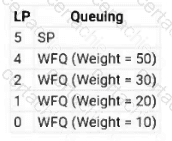
Given the QoS queueing configuration below for a 1000Mbps interface, how much bandwidth will be available to Local Priority 4 traffic if no other traffic type is to be sent?
Correct Answer & Rationale:
Answer: A
Explanation:
Local Priority 4 is assigned to a Weighted Fair Queuing (WFQ) queue with a weight of 50 . The critical point is that a WFQ weight represents a relative allocation when multiple eligible queues are simultaneously contending for bandwidth ; it is not, by itself, a 50% rate limitation.
HPE Aruba describes WFQ as a work-conserving scheduling mechanism . Available interface bandwidth is apportioned among the non-empty WFQ queues according to their relative weights. The bandwidth percentage for a queue is calculated using its weight divided by the sum of the weights of all currently non-empty WFQ queues. Aruba Networks
Here, LP4 is the only queue carrying traffic. Consequently, the effective calculation is:
50 / 50 = 100%
The LP5 strict-priority queue is empty, as are the WFQ queues for LP2, LP1, and LP0. Therefore, none of those queues consumes interface capacity. Because no separate max-bandwidth restriction is shown for LP4, its WFQ queue can consume the entire available line rate. Aruba documentation further confirms that a queue without a configured bandwidth limit is not restricted to its nominal weight percentage. Aruba Networks Developer Hub
On a 1000 Mbps interface , LP4 can therefore use 1000 Mbps when it is the only traffic being transmitted.
Study Guide References: QoS Queue Profiles; Schedule Profiles; Weighted Fair Queuing; Work-Conserving Scheduling; Queue Weights; Strict Priority Queuing.
Question 8
HP HPE7-A08
QUESTION DESCRIPTION:
You are attempting to configure an interface, but you are seeing the error message below. What could explain this?
Access-1(config)# interface 1/1/1
Invalid input: interface
Correct Answer & Rationale:
Answer: C
Explanation:
The error message " Invalid input: interface " typically appears if the switch is managed by HPE Aruba Central, which restricts CLI interface configuration to prevent configuration drift. When managed externally, certain commands are disabled or locked.
Password recovery mode or authorization enabled would not cause this error.
Manager context is not a concept in Aruba CX CLI.
[References:, , Aruba Central Management Mode Documentation, , HPE Aruba Switch CLI Behavior When Centrally Managed, , ArubaOS-CX CLI Access Control Guide, ]
Question 9
HP HPE7-A08
QUESTION DESCRIPTION:
A customer has set global qos trust dscp on an HPE Aruba Networking CX 6300 VSF configuration, which replaced the existing HPE Aruba Networking 5406R VSF. After the change, a video streaming service connected to ports 1/1/20 and 2/1/20, bound to LAG 20, no longer maps to the CoS priority queue mappings used in the old configuration.
What configuration change would enable priority trust on DSCP by default and on traffic that requires CoS?
Correct Answer & Rationale:
Answer: D
Explanation:
To resolve this QoS mapping issue on AOS-CX, you must understand the hierarchy of Trust Levels and how they interact with Link Aggregation Groups (LAGs).
Trust Hierarchy: AOS-CX switches use a " top-down " approach for QoS.
Global Trust: Setting qos trust dscp globally means that, by default, every port on the switch will look at the Layer 3 DSCP markings to determine queue priority.
Interface Override: You can override the global setting on a per-interface basis. If a specific device or service (like the video streaming service in this prompt) relies solely on Layer 2 CoS (802.1p) markings rather than DSCP, the switch will ignore those CoS markings under the global DSCP policy and place the traffic in a default (best-effort) queue.
LAG Configuration Logic: In the AOS-CX architecture, a LAG is a logical interface (interface lag 20).
Configuration parameters for the bundle (such as VLANs, ACLs, and QoS trust) should be applied to the logical LAG interface, not the individual physical member ports (1/1/20 and 2/1/20).
Once applied to the LAG, the settings are automatically inherited by all physical members.
Analyzing the Options:
Option D (Correct): By entering the interface lag 20 context and applying qos trust cos, you are instructing the switch to ignore the global DSCP setting for this specific bundle and instead trust the Layer 2 priority bits. This allows the video service to once again map correctly to the intended priority queues.
Option A: This is unnecessarily complex. Setting the physical member ports to qos trust none and then the LAG to cos is redundant because the LAG configuration overrides the physical port settings in this context.
Option B: qos trust dscp, cos is not a valid AOS-CX command. Unlike the older AOS-S (ProCurve) software which allowed a combined dscp-cos trust, AOS-CX requires you to choose a single trust type (DSCP, CoS, or None) per interface.
Option C: This applies the configuration to the physical ports only. In an AOS-CX VSF/LAG environment, this is considered a configuration error or " best practice " violation, as the logical LAG interface should hold the configuration.
Question 10
HP HPE7-A08
QUESTION DESCRIPTION:
You have recommended that a customer adopt a modern management approach for their new CX switches. Which of these would this include? (Choose two.)
Correct Answer & Rationale:
Answer: A, D
Explanation:
HPE Aruba Networking AOS-CX is a cloud-native, database-driven operating system designed to move away from traditional, " brittle " management methods toward Network Automation and AIOps.
REST API (Option A): In AOS-CX, the entire system state is stored in a database (ASDB). The switch provides a 100% " REST-ful " API, meaning every single feature, configuration, and statistical counter that can be accessed via the CLI can also be accessed programmatically via REST. This allows for modern automation, integration with custom dashboards, and DevOps workflows.
NAE (Network Analytics Engine) (Option D): This is a hallmark " modern " feature of AOS-CX. NAE provides a built-in framework for monitoring and troubleshooting. It uses Python-based agents to monitor the local database for specific events (like a spike in CPU or an OSPF state change) and can take automated actions (like capturing a packet trace or generating a log). It provides a graphical representation of network health directly in the Web UI.
Why other options are incorrect:
Option C (SNMP): While supported, SNMP is considered a legacy protocol. It is relatively slow, lacks security (in v1/v2c), and is typically used for monitoring only, rather than the " modern management " and automation logic found in REST or NAE.
Options B and E: YAML and XML are data serialization formats. While they are used by modern management tools (like Ansible using YAML or NETCONF using XML), they are not management " approaches " or native switch features in the same way that a REST API or an Analytics Engine is.

Verified by Certified Instructors
This HP HPE7-A08 study pack was audited and verified on November 7, 2026 by Radia Davenport,. We ensure every technical rationale aligns with real-world enterprise standards.
A Stepping Stone for Enhanced Career Opportunities
Your profile having Aruba Certified Switching Expert certification significantly enhances your credibility and marketability in all corners of the world. The best part is that your formal recognition pays you in terms of tangible career advancement. It helps you perform your desired job roles accompanied by a substantial increase in your regular income. Beyond the resume, your expertise imparts you confidence to act as a dependable professional to solve real-world business challenges.
Your success in HP HPE7-A08 certification exam makes your visible and relevant in the fast-evolving tech landscape. It proves a lifelong investment in your career that give you not only a competitive advantage over your non-certified peers but also makes you eligible for a further relevant exams in your domain.
What You Need to Ace HP Exam HPE7-A08
Achieving success in the HPE7-A08 HP exam requires a blending of clear understanding of all the exam topics, practical skills, and practice of the actual format. There's no room for cramming information, memorizing facts or dependence on a few significant exam topics. It means your readiness for exam needs you develop a comprehensive grasp on the syllabus that includes theoretical as well as practical command.
Here is a comprehensive strategy layout to secure peak performance in HPE7-A08 certification exam:
- Develop a rock-solid theoretical clarity of the exam topics
- Begin with easier and more familiar topics of the exam syllabus
- Make sure your command on the fundamental concepts
- Focus your attention to understand why that matters
- Ensure hands-on practice as the exam tests your ability to apply knowledge
- Develop a study routine managing time because it can be a major time-sink if you are slow
- Find out a comprehensive and streamlined study resource for your help
Ensuring Outstanding Results in Exam HPE7-A08!
In the backdrop of the above prep strategy for HPE7-A08 HP exam, your primary need is to find out a comprehensive study resource. It could otherwise be a daunting task to achieve exam success. The most important factor that must be kep in mind is make sure your reliance on a one particular resource instead of depending on multiple sources. It should be an all-inclusive resource that ensures conceptual explanations, hands-on practical exercises, and realistic assessment tools.
Certachieve: A Reliable All-inclusive Study Resource
Certachieve offers multiple study tools to do thorough and rewarding HPE7-A08 exam prep. Here's an overview of Certachieve's toolkit:
HP HPE7-A08 PDF Study Guide
This premium guide contains a number of HP HPE7-A08 exam questions and answers that give you a full coverage of the exam syllabus in easy language. The information provided efficiently guides the candidate's focus to the most critical topics. The supportive explanations and examples build both the knowledge and the practical confidence of the exam candidates required to confidently pass the exam. The demo of HP HPE7-A08 study guide pdf free download is also available to examine the contents and quality of the study material.
HP HPE7-A08 Practice Exams
Practicing the exam HPE7-A08 questions is one of the essential requirements of your exam preparation. To help you with this important task, Certachieve introduces HP HPE7-A08 Testing Engine to simulate multiple real exam-like tests. They are of enormous value for developing your grasp and understanding your strengths and weaknesses in exam preparation and make up deficiencies in time.
These comprehensive materials are engineered to streamline your preparation process, providing a direct and efficient path to mastering the exam's requirements.
HP HPE7-A08 exam dumps
These realistic dumps include the most significant questions that may be the part of your upcoming exam. Learning HPE7-A08 exam dumps can increase not only your chances of success but can also award you an outstanding score.
Top Exams & Certification Providers
New & Trending
- New Released Exams
- Related Exam
- Hot Vendor