
The Artificial Intelligence Governance Professional (AIGP)
Passing IAPP Artificial Intelligence Governance exam ensures for the successful candidate a powerful array of professional and personal benefits. The first and the foremost benefit comes with a global recognition that validates your knowledge and skills, making possible your entry into any organization of your choice.

AIGP Exam Dumps
- Exam Code: AIGP
- Vendor: IAPP
- Certifications: Artificial Intelligence Governance
- Exam Name: Artificial Intelligence Governance Professional
Why CertAchieve is Better than Standard AIGP Dumps
In 2026, IAPP uses variable topologies. Basic dumps will fail you.
| Quality Standard | Generic Dump Sites | CertAchieve Premium Prep |
|---|---|---|
| Technical Explanation | None (Answer Key Only) | Step-by-Step Expert Rationales |
| Syllabus Coverage | Often Outdated (v1.0) | 2026 Updated (Latest Syllabus) |
| Scenario Mastery | Blind Memorization | Conceptual Logic & Troubleshooting |
| Instructor Access | No Post-Sale Support | 24/7 Professional Help |
Customers Passed Exams
10
Success backed by proven exam prep tools
Questions Came Word for Word
87%
Real exam match rate reported by verified users
Average Score in Real Testing Centre
94%
Consistently high performance across certifications
Study Time Saved With CertAchieve
60%
Efficient prep that reduces study hours significantly
Coverage of Official IAPP AIGP Exam Domains
Our curriculum is meticulously mapped to the IAPP official blueprint.
Foundations of AI Governance (20%)
Master the "Why" and "Who" of AI oversight. Focus on defining AI types (Generative, Predictive, Agentic) and the core principles of Responsible AI. Learn to build a governance program by identifying key stakeholders, establishing an AI Governance Charter, and integrating AI risks into the existing enterprise risk management (ERM) framework.
Laws, Standards, and Frameworks (25%)
The "Regulatory" pillar. Master the high-impact EU AI Act, including risk classifications (Unacceptable, High, Limited, Minimal). Focus on the NIST AI RMF, ISO/IEC 42001 (AIMS), and the intersection of AI with the GDPR—specifically transparency and the lawful basis for processing training data.
Governing AI Development (30%)
Master the "Design and Build" phase. Focus on the responsibilities of professionals during the AI lifecycle, from data acquisition and licensing to model training and testing. Learn to implement Bias Identification and Mitigation strategies, ensure Explainability (XAI), and conduct Fundamental Rights Impact Assessments (FRIA) for high-risk systems.
Governing AI Deployment and Use (30%)
Master the "Operational" phase. Focus on responsible model selection (Proprietary vs. Open Source) and the governance of Agentic Architectures. Learn to implement continuous monitoring for Model Drift, establish incident response playbooks for AI failures, and manage third-party/vendor risk through robust AI-specific contracts.
IAPP AIGP Exam Domains Q&A
Certified instructors verify every question for 100% accuracy, providing detailed, step-by-step explanations for each.
Question 1
IAPP AIGP
QUESTION DESCRIPTION:
All of the following are penalties and enforcements outlined in the EU Al Act EXCEPT?
Correct Answer & Rationale:
Answer: C
Explanation:
The EU AI Act outlines specific penalties and enforcement mechanisms to ensure compliance with its regulations. Among these, fines for violations of banned AI applications can be as high as €35 million or 7% of the global annual turnover of the offending organization, whichever is higher. Proportional caps on fines are applied to SMEs and startups to ensure fairness. General Purpose AI rules are to apply after a 6-month period as a specific provision to ensure that stakeholders have adequate time to comply. However, there is no provision for an " AI Pact " acting as a transitional bridge until the regulations are fully enacted, making option C the correct answer.
Question 2
IAPP AIGP
QUESTION DESCRIPTION:
CASE STUDY
Please use the following answer the next question:
ABC Corp, is a leading insurance provider offering a range of coverage options to individuals. ABC has decided to utilize artificial intelligence to streamline and improve its customer acquisition and underwriting process, including the accuracy and efficiency of pricing policies.
ABC has engaged a cloud provider to utilize and fine-tune its pre-trained, general purpose large language model (“LLM”). In particular, ABC intends to use its historical customer data—including applications, policies, and claims—and proprietary pricing and risk strategies to provide an initial qualification assessment of potential customers, which would then be routed a human underwriter for final review.
ABC and the cloud provider have completed training and testing the LLM, performed a readiness assessment, and made the decision to deploy the LLM into production. ABC has designated an internal compliance team to monitor the model during the first month, specifically to evaluate the accuracy, fairness, and reliability of its output. After the first month in production, ABC realizes that the LLM declines a higher percentage of women ' s loan applications due primarily to women historically receiving lower salaries than men.
Which of the following is the most important reason to train the underwriters on the model prior to deployment?
Correct Answer & Rationale:
Answer: C
Explanation:
Training underwriters on the model prior to deployment is crucial so they can apply their own judgment to the initial assessment. While AI models can streamline the process, human judgment is still essential to catch nuances that the model might miss or to account for any biases or errors in the model ' s decision-making process.
[Reference: The AIGP Body of Knowledge emphasizes the importance of human oversight in AI systems, particularly in high-stakes areas such as underwriting and loan approvals. Human underwriters can provide a critical review and ensure that the model's assessments are accurate and fair, integrating their expertise and understanding of complex cases., , , ]
Question 3
IAPP AIGP
QUESTION DESCRIPTION:
MULTI-SELECT
Please select 3 of the 5 options below. No partial credit will be given.
Which of the following PETs would be effective in developing AI systems?
Correct Answer & Rationale:
Answer: A, B, E
Explanation:
A, B, and E are the intended privacy-preserving choices. Data minimization limits processing to information that is adequate, relevant, and necessary for the defined purpose, reducing privacy exposure during AI development. Anonymization protects individuals by transforming information so that people are no longer identifiable under the applicable standard. Federated learning is a recognized privacy-enhancing technology that enables models to be trained across distributed datasets without centrally sharing the underlying raw training data. The ICO specifically identifies federated learning and related privacy-preserving methods as useful during AI training and explains the relationship between anonymization and data minimization. Data mapping is primarily a governance and inventory activity used to understand data flows, while data cleansing principally improves data quality by correcting or removing inaccurate, incomplete, or unsuitable records; neither is inherently a PET.
Question 4
IAPP AIGP
QUESTION DESCRIPTION:
Which of the following is NOT a common type of machine learning?
Correct Answer & Rationale:
Answer: B
Explanation:
The common types of machine learning include supervised learning, unsupervised learning, reinforcement learning, and deep learning. Cognitive learning is not a type of machine learning; rather, it is a term often associated with the broader field of cognitive science and psychology. Reference: AIGP BODY OF KNOWLEDGE and standard AI/ML literature.
Question 5
IAPP AIGP
QUESTION DESCRIPTION:
A company developing and deploying its own AI model would perform all of the following steps to monitor and evaluate the model ' s performance EXCEPT?
Correct Answer & Rationale:
Answer: A
Explanation:
While transparency is encouraged,publicly disclosing forecasts of secondary harmsisnot a required or standard practicefor internal performance evaluation. Risk assessments and reporting typically remaininternal or shared with regulators.
From theAI Governance in Practice Report 2025:
“Organizations must assess secondary risks… but disclosure is subject to context, regulatory requirements, and risk management discretion.” (p. 30)
Question 6
IAPP AIGP
QUESTION DESCRIPTION:
CASE STUDY
Please use the following to answer the next question:
You have recently assumed the role of AI Governance leader for a California-based medical technology company. The organization primarily serves hospitals and has recently expanded to include walk-in clinics located within local pharmacies.
The company ' s core business focuses on diagnostic assistance powered by a large language model LLM and back-office process optimization using Agentic AI, including chatbots, medical record request handling, scheduling and billing.
In preparation for its next round of funding, the board has asked you to prepare an AI Risk report to demonstrate to investors how the company is addressing AI-related risks. In preparing the report you learn that last year the company generated 30 million dollars in gross revenue across the US, EU, India, and South Korea and that vendors are engaged for various activities, including model testing and providing third-party AI solutions for chatbots.
Which of the following responses is least likely to meet mandatory transparency requirements in any of the applicable laws?
Correct Answer & Rationale:
Answer: C
Explanation:
The correct answer is C because simply publishing a general AI policy or code of conduct does not satisfy specific transparency obligations required by AI regulations. Transparency requirements focus on providing clear, context-specific disclosures to affected individuals about how AI is being used, particularly when it directly impacts them. For example, notifying users when they are interacting with an AI system or labeling AI-generated content are explicit transparency measures aligned with regulatory expectations. The AI Governance in Practice Report highlights that transparency includes informing users when they interact with AI systems and providing meaningful information about outputs and system behavior . Model cards and labels support system-level and output-level transparency, while real-time notices ensure user awareness. In contrast, a general policy link lacks immediacy, specificity, and user relevance, making it insufficient for mandatory transparency compliance.
Question 7
IAPP AIGP
QUESTION DESCRIPTION:
Which of the following deployments of generative Al best respects intellectual property rights?
Correct Answer & Rationale:
Answer: B
Explanation:
Respecting intellectual property rights means adhering to licensing terms and ensuring that generated content complies with these terms. A system that categorizes and applies filters based on licensing terms ensures that content is used legally and ethically, respecting the rights of content creators. While providing attribution is important, categorization and application of filters based on licensing terms are more directly tied to compliance with intellectual property laws. This principle is elaborated in the IAPP AIGP Body of Knowledge sections on intellectual property and compliance.
Question 8
IAPP AIGP
QUESTION DESCRIPTION:
A Canadian company is developing an Al solution to evaluate candidates in the course of job interviews.
Before offering the Al solution in the EU market, the company must take all of the following steps EXCEPT?
Correct Answer & Rationale:
Answer: A
Explanation:
Before offering an AI solution in the EU market, a Canadian company must take several steps to comply with the EU AI Act. These steps include establishing a risk and quality management system (B), engaging a third-party auditor to perform a bias audit (C), and drawing up technical documentation and instructions for use (D). However, there is no requirement to register the AI solution in a public EU database (A). This registration step is not specified as part of the compliance requirements under the EU AI Act for such solutions.
Question 9
IAPP AIGP
QUESTION DESCRIPTION:
Why is it important that conformity requirements are satisfied before an AI system is released into production?
Correct Answer & Rationale:
Answer: D
Explanation:
The correct answer is D because conformity requirements are primarily intended to ensure that AI systems meet applicable legal, regulatory, and safety standards before deployment. AI governance frameworks, including the EU AI Act and international standards, require conformity assessments to verify that systems are safe, reliable, and compliant with risk management, documentation, and performance obligations. These assessments help identify and mitigate risks prior to market release, particularly for high-risk AI systems that may impact individuals’ rights, health, or safety. Conformity ensures accountability, transparency, and trustworthiness, which are central principles of responsible AI governance. The other options relate to usability or technical considerations, but they do not address the primary purpose of conformity assessments, which is regulatory compliance and risk mitigation prior to deployment.
Question 10
IAPP AIGP
QUESTION DESCRIPTION:
CASE STUDY
Please use the following answer the next question:
XYZ Corp., a premier payroll services company that employs thousands of people globally, is embarking on a new hiring campaign and wants to implement policies and procedures to identify and retain the best talent. The new talent will help the company ' s product team expand its payroll offerings to companies in the healthcare and transportation sectors, including in Asia.
It has become time consuming and expensive for HR to review all resumes, and they are concerned that human reviewers might be susceptible to bias.
Address these concerns, the company is considering using a third-party Al tool to screen resumes and assist with hiring. They have been talking to several vendors about possibly obtaining a third-party Al-enabled hiring solution, as long as it would achieve its goals and comply with all applicable laws.
The organization has a large procurement team that is responsible for the contracting of technology solutions. One of the procurement team ' s goals is to reduce costs, and it often prefers lower-cost solutions. Others within the company are responsible for integrating and deploying technology solutions into the organization ' s operations in a responsible, cost-effective manner.
The organization is aware of the risks presented by Al hiring tools and wants to mitigate them. It also questions how best to organize and train its existing personnel to use the Al hiring tool responsibly. Their concerns are heightened by the fact that relevant laws vary across jurisdictions and continue to change.
If XYZ does not deploy and use the Al hiring tool responsibly in the United States, its liability would likely increase under all of the following laws EXCEPT?
Correct Answer & Rationale:
Answer: B
Explanation:
In the United States, the use of AI hiring tools must comply with anti-discrimination laws, accessibility laws, and privacy laws to avoid increasing liability. Anti-discrimination laws (A) ensure that hiring practices do not unlawfully discriminate against protected classes. Accessibility laws (C) require that hiring tools are accessible to all applicants, including those with disabilities. Privacy laws (D) govern the handling of personal data during the hiring process. Product liability laws (B), however, typically apply to the safety and reliability of physical products and would not generally increase liability specifically related to the responsible use of AI hiring tools in the employment context.

Verified by Certified Instructors
This IAPP AIGP study pack was audited and verified on September 23, 2026 by Hilary Beaumont,. We ensure every technical rationale aligns with real-world enterprise standards.
A Stepping Stone for Enhanced Career Opportunities
Your profile having Artificial Intelligence Governance certification significantly enhances your credibility and marketability in all corners of the world. The best part is that your formal recognition pays you in terms of tangible career advancement. It helps you perform your desired job roles accompanied by a substantial increase in your regular income. Beyond the resume, your expertise imparts you confidence to act as a dependable professional to solve real-world business challenges.
Your success in IAPP AIGP certification exam makes your visible and relevant in the fast-evolving tech landscape. It proves a lifelong investment in your career that give you not only a competitive advantage over your non-certified peers but also makes you eligible for a further relevant exams in your domain.
What You Need to Ace IAPP Exam AIGP
Achieving success in the AIGP IAPP exam requires a blending of clear understanding of all the exam topics, practical skills, and practice of the actual format. There's no room for cramming information, memorizing facts or dependence on a few significant exam topics. It means your readiness for exam needs you develop a comprehensive grasp on the syllabus that includes theoretical as well as practical command.
Here is a comprehensive strategy layout to secure peak performance in AIGP certification exam:
- Develop a rock-solid theoretical clarity of the exam topics
- Begin with easier and more familiar topics of the exam syllabus
- Make sure your command on the fundamental concepts
- Focus your attention to understand why that matters
- Ensure hands-on practice as the exam tests your ability to apply knowledge
- Develop a study routine managing time because it can be a major time-sink if you are slow
- Find out a comprehensive and streamlined study resource for your help
Ensuring Outstanding Results in Exam AIGP!
In the backdrop of the above prep strategy for AIGP IAPP exam, your primary need is to find out a comprehensive study resource. It could otherwise be a daunting task to achieve exam success. The most important factor that must be kep in mind is make sure your reliance on a one particular resource instead of depending on multiple sources. It should be an all-inclusive resource that ensures conceptual explanations, hands-on practical exercises, and realistic assessment tools.
Certachieve: A Reliable All-inclusive Study Resource
Certachieve offers multiple study tools to do thorough and rewarding AIGP exam prep. Here's an overview of Certachieve's toolkit:
IAPP AIGP PDF Study Guide
This premium guide contains a number of IAPP AIGP exam questions and answers that give you a full coverage of the exam syllabus in easy language. The information provided efficiently guides the candidate's focus to the most critical topics. The supportive explanations and examples build both the knowledge and the practical confidence of the exam candidates required to confidently pass the exam. The demo of IAPP AIGP study guide pdf free download is also available to examine the contents and quality of the study material.
IAPP AIGP Practice Exams
Practicing the exam AIGP questions is one of the essential requirements of your exam preparation. To help you with this important task, Certachieve introduces IAPP AIGP Testing Engine to simulate multiple real exam-like tests. They are of enormous value for developing your grasp and understanding your strengths and weaknesses in exam preparation and make up deficiencies in time.
These comprehensive materials are engineered to streamline your preparation process, providing a direct and efficient path to mastering the exam's requirements.
IAPP AIGP exam dumps
These realistic dumps include the most significant questions that may be the part of your upcoming exam. Learning AIGP exam dumps can increase not only your chances of success but can also award you an outstanding score.
The AIGP Exam Questions were professionally written and covered AI governance, ethical AI frameworks, privacy, and compliance concepts comprehensively. The explanations made complex topics easier to learn.
Benjamin Hayes
Jun 24, 2026
Top Exams & Certification Providers
New & Trending
- New Released Exams
- Related Exam
- Hot Vendor
Verified Performance Reports
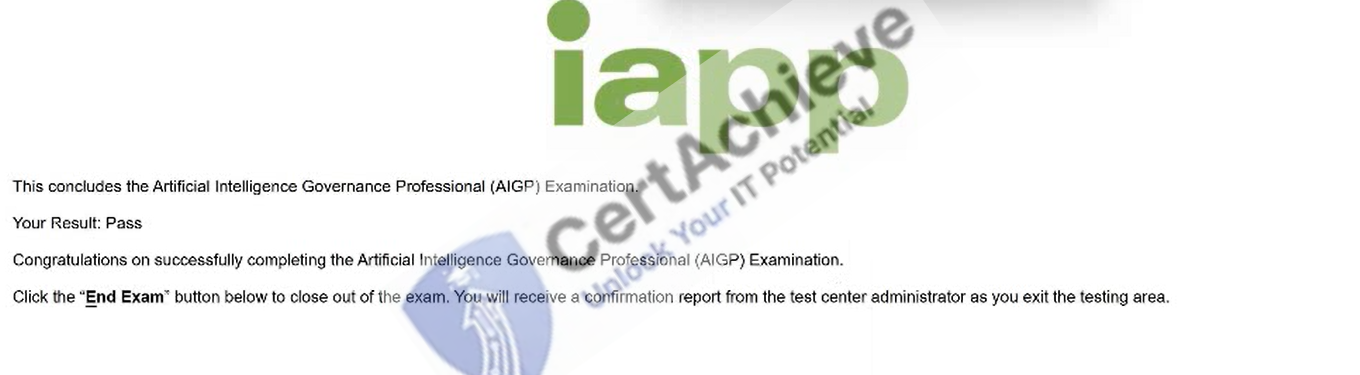
Authentic score reports from candidates who cleared the AIGP exam.
Verified Case #1
×
![]()