
The Certified in Risk and Information Systems Control (CRISC)
Passing Isaca Isaca Certification exam ensures for the successful candidate a powerful array of professional and personal benefits. The first and the foremost benefit comes with a global recognition that validates your knowledge and skills, making possible your entry into any organization of your choice.


CRISC Exam Dumps
- Exam Code: CRISC
- Vendor: Isaca
- Certifications: Isaca Certification
- Exam Name: Certified in Risk and Information Systems Control
Why CertAchieve is Better than Standard CRISC Dumps
In 2026, Isaca uses variable topologies. Basic dumps will fail you.
| Quality Standard | Generic Dump Sites | CertAchieve Premium Prep |
|---|---|---|
| Technical Explanation | None (Answer Key Only) | Step-by-Step Expert Rationales |
| Syllabus Coverage | Often Outdated (v1.0) | 2026 Updated (Latest Syllabus) |
| Scenario Mastery | Blind Memorization | Conceptual Logic & Troubleshooting |
| Instructor Access | No Post-Sale Support | 24/7 Professional Help |
Customers Passed Exams
10
Success backed by proven exam prep tools
Questions Came Word for Word
86%
Real exam match rate reported by verified users
Average Score in Real Testing Centre
91%
Consistently high performance across certifications
Study Time Saved With CertAchieve
60%
Efficient prep that reduces study hours significantly
Isaca CRISC Exam Domains Q&A
Certified instructors verify every question for 100% accuracy, providing detailed, step-by-step explanations for each.
Question 1
Isaca CRISC
QUESTION DESCRIPTION:
A key performance indicator (KPI) has been established to monitor the number of software changes that fail and must be re-implemented. An increase in the KPI indicates an ineffective:
Correct Answer & Rationale:
Answer: B
Explanation:
Software change failures typically reflect weaknesses inpreventive controls, such as code reviews, approval workflows, and test procedures. Preventive controls are designed to ensure defect-free changes before they reach production. An increase in failed changes indicates these safeguards are not functioning properly. Corrective controls respond after failures, not before them. Administrative controls (policies and standards) guide behavior but do not directly prevent implementation errors. Deterrent controls are intended to discourage malicious behavior, not prevent unintentional change failures. Therefore, ineffective preventive controls are the root cause indicated by the KPI trend.
[Reference:CRISC Review Manual – Control Types (preventive vs corrective vs detective)., ========================================, ]
Question 2
Isaca CRISC
QUESTION DESCRIPTION:
When outsourcing a business process to a cloud service provider, it is MOST important to understand that:
Correct Answer & Rationale:
Answer: D
Explanation:
According to the FIC Article by FSCA, accountable institutions remain fully accountable, responsible and liable for any compliance failures that may result from or be associated with an outsourcing arrangement and as such, liability and/or culpability for non-compliance with the FIC Act obligations cannot be transferred to a third-party service provider2. Therefore, even if a business process is outsourced to a cloud service provider, the organization still has the ultimate responsibility and accountability for the risk associated with the outsourced process. The other options are not correct, as they imply that the cloud service provider can take over the accountability or responsibility for the risk, or that the organization can mitigate the risk by acquiring insurance, which is not the case.
Question 3
Isaca CRISC
QUESTION DESCRIPTION:
Which of the following controls will BEST detect unauthorized modification of data by a database administrator?
Correct Answer & Rationale:
Answer: B
Explanation:
Unauthorized modification of data by a database administrator is a security risk that involves altering, deleting, or inserting data on a database without proper authorization or approval, by a person who has privileged access to the database, such as a database administrator12.
The best control to detect unauthorized modification of data by a database administrator is to review database activity logs, which are records that capture and store the details and history ofthe transactions or activities that are performed on the database, such as who, what, when, where, and how34.
Reviewing database activity logs is the best control because it provides evidence and visibility of the database operations, and enables the detection and reporting of any deviations, anomalies, or issues that may indicate unauthorized modification of data by a database administrator34.
Reviewing database activity logs is also the best control because it supports the accountability and auditability of the database operations, and facilitates the investigation and resolution of any unauthorized modification of data by a database administrator34.
The other options are not the best controls, but rather possible measures or techniques that may supplement or enhance the review of database activity logs. For example:
Reviewing database access rights is a measure that involves verifying and validating the permissions and privileges that are granted or revoked to the users or roles who can access or modify the data on the database56. However, this measure is not the best control because it does not directly detect unauthorized modification of data by a database administrator, especially if the database administrator has legitimate access rights to the data56.
Comparing data to input records is a technique that involves matching and reconciling the data on the database with the original or source data that are entered or imported into the database, and identifying and correcting any discrepancies or errors78. However, this technique is not the best control because it does not directly detect unauthorized modification of data by a database administrator, especially if the input records are also modified or compromised78.
Reviewing changes to edit checks is a technique that involves examining and evaluating the modifications or updates to the edit checks, which are rules or validations that are applied to the data on the database to ensure their accuracy, completeness, andconsistency9 . However, this technique is not the best control because it does not directly detect unauthorized modification of data by a database administrator, especially if the edit checks are bypassed or disabled9 . References =
1: Database Security: Attacks and Solutions | SpringerLink2
2: Unauthorised Modification of Data With Intent to Cause Impairment3
3: Database Activity Monitoring - Wikipedia4
4: Database Activity Monitoring (DAM) | Imperva5
5: Database Access Control - Wikipedia6
6: Database Access Control: Best Practices for Database Security7
7: Data Reconciliation - Wikipedia8
8: Data Reconciliation and Gross Error Detection9
9: Edit Check - Wikipedia
Edit Checks: A Data Quality Tool
Question 4
Isaca CRISC
QUESTION DESCRIPTION:
Which of the following is the MOST effective way to incorporate stakeholder concerns when developing risk scenarios?
Correct Answer & Rationale:
Answer: A
Explanation:
The most effective way to incorporate stakeholder concerns when developing risk scenarios is to evaluate the risk impact. Risk impact is the extent of the potential consequences or losses that may result from arisk event. Evaluating the risk impact involves considering the stakeholder concerns, expectations, and perspectives, as they may have different views on the value of the assets, the severity of the threats, and the acceptability of the outcomes. Evaluating the risk impact can help to ensure that the risk scenarios reflect the stakeholder interests and priorities, and that the risk responses are aligned with the stakeholder objectives. Establishing key performance indicators (KPIs), conducting internal audits, and creating quarterly risk reports are not as effective as evaluating the risk impact, as they are not directly related to the development of risk scenarios, and may not capture the stakeholder concerns adequately. References = CRISC Review Manual, 6th Edition, ISACA, 2015, page 50.
Question 5
Isaca CRISC
QUESTION DESCRIPTION:
When assessing the maturity level of an organization’s risk management framework, which of the following should be of GREATEST concern to a risk practitioner?
Correct Answer & Rationale:
Answer: C
Explanation:
Senior management involvement is a critical driver for the success of any risk management program. Without their engagement, there is a lack of strategic oversight, resource allocation, and prioritization of risk management initiatives, directly impacting the organization ' s ability to meet risk objectives. This is emphasized in theGovernance Principlesof CRISC.
Question 6
Isaca CRISC
QUESTION DESCRIPTION:
An IT license audit has revealed that there are several unlicensed copies of co be to:
Correct Answer & Rationale:
Answer: C
Explanation:
An IT license audit is a process that verifies the compliance of the IT software and hardware assets with the licensing agreements and regulations. An IT license audit can reveal the existence of unlicensed copies of software, which can expose the enterprise to legal, financial, and reputational risks. The best course of action in such a situation is to report the issue to management so that appropriate action can be taken. Management can then decide on the most suitable risk response strategy, such as procuring the necessary licenses, uninstalling the unlicensed software, or negotiating with the software vendor. Reporting the issue to managementcan also help to prevent further violations, identify the root causes, and implement corrective and preventive measures. The other options are not the best course of action, as they may not address the issue effectively, efficiently, or ethically. References = Risk and Information Systems Control Study Manual, 7th Edition, Chapter 4, Section 4.2.1.1, pp. 156-157.
Question 7
Isaca CRISC
QUESTION DESCRIPTION:
The BEST key performance indicator (KPI) to measure the effectiveness of the security patching process is the percentage of patches installed:
Correct Answer & Rationale:
Answer: B
Explanation:
The best key performance indicator (KPI) to measure the effectiveness of the security patching process is the percentage of patches installed successfully within the expected time frame. This KPI can help to evaluate how well the security patching process meets the predefined objectives and standards, and how timely the patches are applied to reduce the risk exposure. The percentage of patches installed by the security administration team, successfully during the first attempt, or without causing an unplanned system outage are other possible KPIs, but they are not as relevant as the percentage of patches installed successfully within the expected time frame. References = ISACA Certified in Risk and Information Systems Control (CRISC) Certification Exam Question and Answers, question 7; CRISC Review Manual, 6th Edition, page 202.
Question 8
Isaca CRISC
QUESTION DESCRIPTION:
Which of the following BEST enforces access control for an organization that uses multiple cloud technologies?
Correct Answer & Rationale:
Answer: C
Explanation:
A cloud access security broker (CASB) solution is the best way to enforce access control for an organization that uses multiple cloud technologies, as it provides a centralized and consistent platform to manage and monitor the access to various cloud services and applications. A CASB solution can help to implement and enforce the enterprise’s access policies and standards, as well as to detect and prevent unauthorized or malicious access attempts. Senior management support of cloud adoption strategies, creation of a cloud access risk management policy, and expansion of security information and event management (SIEM) to cloud services are not the best ways to enforce access control for an organization that uses multiple cloud technologies, as they do not provide the technical capabilities or tools to manage and monitor the access to various cloud services and applications. References = CRISC by Isaca Actual Free Exam Q & As, question 210; CRISC: Certified in Risk & Information Systems Control Sample Questions, question 210.
Question 9
Isaca CRISC
QUESTION DESCRIPTION:
Correct Answer & Rationale:
Answer: B
Explanation:
The identification of advanced persistent threats (APTs) is best supported by timely and relevant external information. Reviewing information from threat intelligence sources enables the organization to detect emerging threats quickly and accurately, reducing the mean time to identify APTs. While internal audits and KRIs are important, they typically focus on internal controls and risk monitoring rather than external threat detection. Thorough documentation of risk scenarios supports risk assessment but does not directly reduce detection time. Therefore, leveraging threat intelligence is the most effective approach for early identification of sophisticated threats.
Question 10
Isaca CRISC
QUESTION DESCRIPTION:
Which of the following BEST mitigates the risk of violating privacy laws when transferring personal information lo a supplier?
Correct Answer & Rationale:
Answer: B
Explanation:
Contractually obligating the supplier to follow privacy laws is the best way to mitigate the risk of violating privacy laws when transferring personal information to a supplier, because it ensures that the supplier is legally bound to comply with the applicable laws and regulations that protect the privacy and security of the personal information. This also creates a clear accountability andliability for the supplier in case of a privacy breach, and defines the rights and obligations of both parties in relation to the personal information. The other options are not the best ways to mitigate the risk of violating privacy laws, although they may also be helpful in reducing the likelihood or impact of a privacy breach. Encrypting the data while in transit to the supplier, requiring independent audits of the supplier’s control environment, and utilizing blockchain during the data transfer are examples of technical or assurance controls that aim to protect the confidentiality, integrity, and availability of the personal information, but they do not address the legal or contractual aspects of the privacy laws. References = CRISC: Certified in Risk & Information Systems Control Sample Questions

Verified by Certified Instructors
This Isaca CRISC study pack was audited and verified on September 23, 2026 by Bruce Kensington,. We ensure every technical rationale aligns with real-world enterprise standards.
A Stepping Stone for Enhanced Career Opportunities
Your profile having Isaca Certification certification significantly enhances your credibility and marketability in all corners of the world. The best part is that your formal recognition pays you in terms of tangible career advancement. It helps you perform your desired job roles accompanied by a substantial increase in your regular income. Beyond the resume, your expertise imparts you confidence to act as a dependable professional to solve real-world business challenges.
Your success in Isaca CRISC certification exam makes your visible and relevant in the fast-evolving tech landscape. It proves a lifelong investment in your career that give you not only a competitive advantage over your non-certified peers but also makes you eligible for a further relevant exams in your domain.
What You Need to Ace Isaca Exam CRISC
Achieving success in the CRISC Isaca exam requires a blending of clear understanding of all the exam topics, practical skills, and practice of the actual format. There's no room for cramming information, memorizing facts or dependence on a few significant exam topics. It means your readiness for exam needs you develop a comprehensive grasp on the syllabus that includes theoretical as well as practical command.
Here is a comprehensive strategy layout to secure peak performance in CRISC certification exam:
- Develop a rock-solid theoretical clarity of the exam topics
- Begin with easier and more familiar topics of the exam syllabus
- Make sure your command on the fundamental concepts
- Focus your attention to understand why that matters
- Ensure hands-on practice as the exam tests your ability to apply knowledge
- Develop a study routine managing time because it can be a major time-sink if you are slow
- Find out a comprehensive and streamlined study resource for your help
Ensuring Outstanding Results in Exam CRISC!
In the backdrop of the above prep strategy for CRISC Isaca exam, your primary need is to find out a comprehensive study resource. It could otherwise be a daunting task to achieve exam success. The most important factor that must be kep in mind is make sure your reliance on a one particular resource instead of depending on multiple sources. It should be an all-inclusive resource that ensures conceptual explanations, hands-on practical exercises, and realistic assessment tools.
Certachieve: A Reliable All-inclusive Study Resource
Certachieve offers multiple study tools to do thorough and rewarding CRISC exam prep. Here's an overview of Certachieve's toolkit:
Isaca CRISC PDF Study Guide
This premium guide contains a number of Isaca CRISC exam questions and answers that give you a full coverage of the exam syllabus in easy language. The information provided efficiently guides the candidate's focus to the most critical topics. The supportive explanations and examples build both the knowledge and the practical confidence of the exam candidates required to confidently pass the exam. The demo of Isaca CRISC study guide pdf free download is also available to examine the contents and quality of the study material.
Isaca CRISC Practice Exams
Practicing the exam CRISC questions is one of the essential requirements of your exam preparation. To help you with this important task, Certachieve introduces Isaca CRISC Testing Engine to simulate multiple real exam-like tests. They are of enormous value for developing your grasp and understanding your strengths and weaknesses in exam preparation and make up deficiencies in time.
These comprehensive materials are engineered to streamline your preparation process, providing a direct and efficient path to mastering the exam's requirements.
Isaca CRISC exam dumps
These realistic dumps include the most significant questions that may be the part of your upcoming exam. Learning CRISC exam dumps can increase not only your chances of success but can also award you an outstanding score.
Top Exams & Certification Providers
New & Trending
- New Released Exams
- Related Exam
- Hot Vendor
Verified Performance Reports
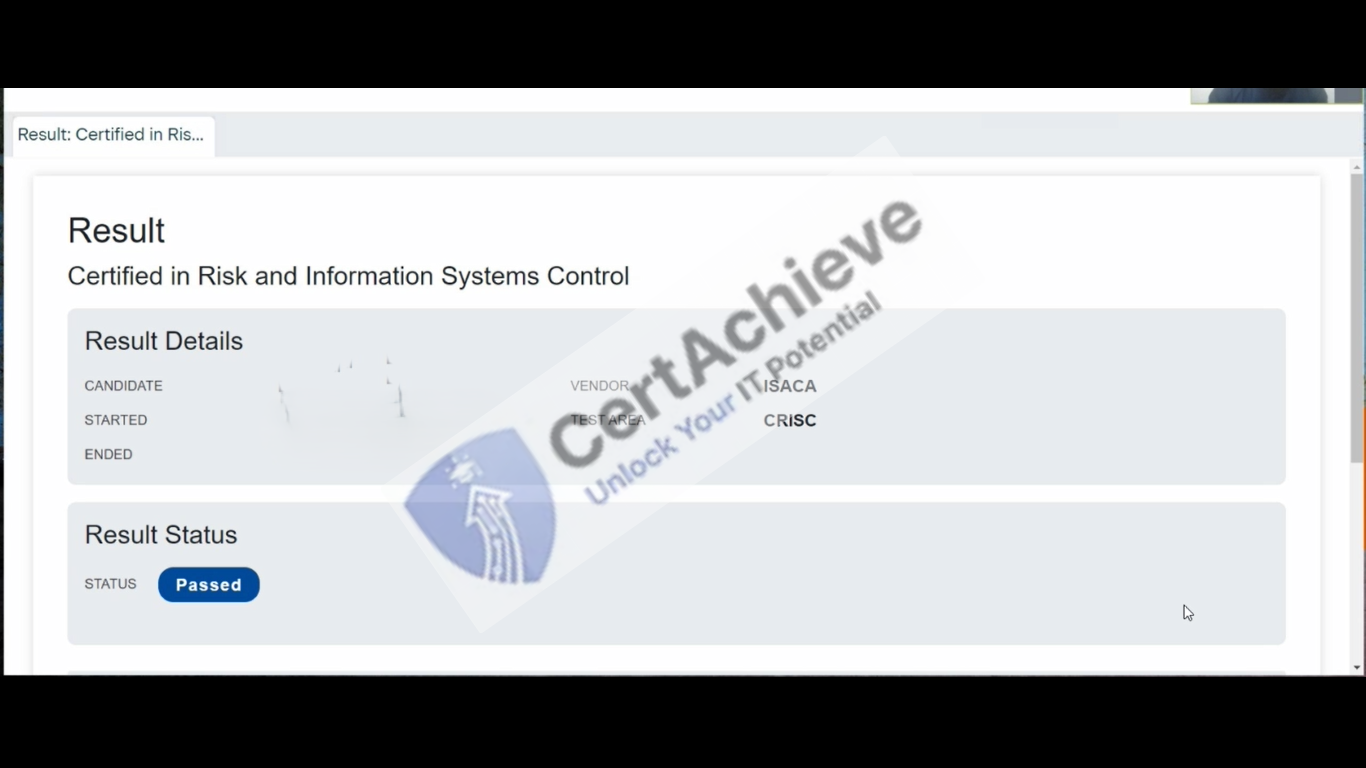
Authentic score reports from candidates who cleared the CRISC exam.
Verified Case #1
×
![]()