
The Network Security Essentials for Locally-Managed Fireboxes (Network-Security-Essentials)
Passing WatchGuard Locally-Managed Fireboxes exam ensures for the successful candidate a powerful array of professional and personal benefits. The first and the foremost benefit comes with a global recognition that validates your knowledge and skills, making possible your entry into any organization of your choice.


Network-Security-Essentials Exam Dumps
- Exam Code: Network-Security-Essentials
- Vendor: WatchGuard
- Certifications: Locally-Managed Fireboxes
- Exam Name: Network Security Essentials for Locally-Managed Fireboxes
Why CertAchieve is Better than Standard Network-Security-Essentials Dumps
In 2026, WatchGuard uses variable topologies. Basic dumps will fail you.
| Quality Standard | Generic Dump Sites | CertAchieve Premium Prep |
|---|---|---|
| Technical Explanation | None (Answer Key Only) | Step-by-Step Expert Rationales |
| Syllabus Coverage | Often Outdated (v1.0) | 2026 Updated (Latest Syllabus) |
| Scenario Mastery | Blind Memorization | Conceptual Logic & Troubleshooting |
| Instructor Access | No Post-Sale Support | 24/7 Professional Help |
Customers Passed Exams
10
Success backed by proven exam prep tools
Questions Came Word for Word
91%
Real exam match rate reported by verified users
Average Score in Real Testing Centre
85%
Consistently high performance across certifications
Study Time Saved With CertAchieve
60%
Efficient prep that reduces study hours significantly
WatchGuard Network-Security-Essentials Exam Domains Q&A
Certified instructors verify every question for 100% accuracy, providing detailed, step-by-step explanations for each.
Question 1
WatchGuard Network-Security-Essentials
QUESTION DESCRIPTION:
You want to send traffic from the Internet to your internal web server through the Firebox. You see the traffic is allowed in Traffic Monitor, but the web server cannot be reached. You use the TCP Dump Diagnostic Task and collect this information from the Firebox interface connected to the web server. What could cause the problem? (Select two.)
Correct Answer & Rationale:
Answer: A, E
Explanation:
Comprehensive Technical Explanation:
When Traffic Monitor verifies that inbound traffic is allowed and a TCP Dump capture on the internal interface confirms the Firebox transmitted the translated SYN packets toward the web server, the Firebox has completed its ingress policy evaluation and packet forwarding. If the client cannot establish a connection, the failure points to the destination host or its local return path:
1. Host-based firewall software: A local firewall running on the server (such as Windows Defender Firewall or iptables) may be discarding incoming TCP SYN packets on port 80/443 from external IP addresses (Option A).
2. Misconfigured default gateway on the server: When the server attempts to reply with a TCP SYN-ACK, it must send the response back through the Firebox so the Firebox can un-NAT the packet. If the server's default gateway is missing, invalid, or pointed to a different router, the return packet bypasses the Firebox or is dropped, breaking the three-way handshake (Option E).
Option B is eliminated because Traffic Monitor already confirmed the connection was allowed. Option C is incorrect because inbound access uses Static NAT, not Dynamic NAT. Option D is incorrect because an IP on the Blocked Sites list would be denied at the external interface before entering the internal network.
[Reference: WatchGuard Network Security Essentials — Networking, Policies, and NAT: Inbound Server Publishing Troubleshooting and Packet Capture Analysis., ――――――――――――――――――――――――――――――――――――――――――――――――――――――――――]
Question 2
WatchGuard Network-Security-Essentials
QUESTION DESCRIPTION:
If the Firebox does not have a feature key installed, which of these statements are true? (Select three.)
Correct Answer & Rationale:
Answer: A, B, E
Explanation:
Comprehensive Technical Explanation:
A Firebox feature key is a cryptographically signed text file issued by WatchGuard that activates the Fireware operating system, unlocks licensed user limits, defines interface counts, and enables licensed security subscription services. When a Firebox boots in a factory-default state or operates without a feature key installed, strict licensing enforcement rules apply:
1. Fireware restricts outbound Internet access: only one concurrent internal user can connect out to the Internet at a time (Option E).
2. The administrator cannot upgrade the Firebox OS version, as valid maintenance and software upgrade authorization are licensed via the feature key (Option A).
3. None of the subscription services (such as Gateway AntiVirus, IPS, WebBlocker, Application Control, or spamBlocker) can be configured or enabled (Option B).
However, administrators are permitted to run the Web Setup Wizard (Option C) to establish initial administrative connectivity, and they can save local system configuration changes (such as interface IPs and admin passphrases) to the Firebox hardware (refuting Option D).
[Reference: WatchGuard Network Security Essentials — Administration and Setup: Firebox Feature Keys, Licensing Enforcement, and Device Activation., ――――――――――――――――――――――――――――――――――――――――――――――――――――――――――]
Question 3
WatchGuard Network-Security-Essentials
QUESTION DESCRIPTION:
A Firebox backup image includes certificates that were previously imported to the Firebox.
Correct Answer & Rationale:
Answer: A
Explanation:
Comprehensive Technical Explanation:
A Firebox backup image (.fbi file) provides an exact, cryptographic, binary snapshot of the appliance's complete operating state at the moment of creation. Unlike an export of a standard configuration file (.xml) created in Policy Manager—which retains only structural XML policy definitions, aliases, and general network configurations—a backup image encapsulates the full device flash file system.
This comprehensive snapshot includes:
1. The running Fireware operating system version.
2. The active configuration file (firewall.xml).
3. The installed WatchGuard Feature Key.
4. Local user account databases and administrative credentials.
5. All installed and imported public and private X.509 security certificates (such as web server certificates, intermediate and root CA chains, and the Firebox Proxy Authority certificate and private key used for HTTPS deep inspection).
Because the backup image archives the private keys along with the imported certificates, restoring a backup image completely re-establishes all VPN Phase 1/2 cryptographic trust relationships and SSL/TLS inspection authority without requiring administrators to manually re-import PKI certificates.
[Reference: WatchGuard Network Security Essentials — Administration and Setup: Backup and Restore Operations vs. XML Configuration Export., ――――――――――――――――――――――――――――――――――――――――――――――――――――――――――]
Question 4
WatchGuard Network-Security-Essentials
QUESTION DESCRIPTION:
You can add your Firebox to WatchGuard Cloud but continue to manage it locally. When you do this, what additional features does WatchGuard Cloud provide for your locally-managed Firebox? (Select two.)
Correct Answer & Rationale:
Answer: B, E
Explanation:
Comprehensive Technical Explanation:
WatchGuard Cloud supports two deployment models for Firebox appliances: cloud-managed and locally-managed (with Cloud Visibility/Reporting). When an administrator retains local management (using Policy Manager or Fireware Web UI) and connects the Firebox to WatchGuard Cloud, the cloud platform operates as an advanced visibility, reporting, and firmware lifecycle management extension. Specifically, it provides Cloud Visibility, which delivers executive dashboards, Log Search, and interactive reports based on aggregated log data (Option E), along with live device health status indicators (CPU, memory, interface status). Additionally, WatchGuard Cloud enables administrators to centrally schedule Firebox OS firmware upgrades outside business hours directly from the cloud console (Option B). Automatic unprompted firmware updates (Option A) are not performed without scheduled administrative authorization. Real-time live packet streaming/traffic data (Option C) and full cloud-managed policy orchestration/correlation (Option D) require full cloud management or local FSM tools.
[Reference: WatchGuard Network Security Essentials — Administration and Setup: WatchGuard Cloud Integration for Locally-Managed Fireboxes & Cloud Visibility., ――――――――――――――――――――――――――――――――――――――――――――――――――――――――――]
Question 5
WatchGuard Network-Security-Essentials
QUESTION DESCRIPTION:
When you migrate a configuration file from one Firebox to a new Firebox, which settings transfer to the new device? (Select two.)
Correct Answer & Rationale:
Answer: A, C
Explanation:
Comprehensive Technical Explanation:
When migrating a configuration from one Firebox to a different model or serial number using Policy Manager (by saving the configuration file XML directly to the new appliance), Fireware migrates all configuration rules and administrative user databases. Specifically, all configured Firewall Policies (Option C) and locally defined Management Users / Administrative Roles (Option A) transfer seamlessly. Conversely, hardware-bound and appliance-specific parameters do not transfer automatically:
- Feature Keys (Option E) cannot transfer because feature keys are bound mathematically to a specific hardware serial number; the new Firebox must download its own dedicated feature key.
- Locally imported Certificates and private keys (Option B) are stored in the appliance's local cryptographic storage rather than the portable .xml policy configuration, requiring re-importation or deployment via a backup image restore on identical hardware. While general static IP/DNS settings defined within Network Configuration do transfer in standard Policy Manager .xml files, exam certification standards specifically designate management users and policies as the primary preserved components.
[Reference: WatchGuard Network Security Essentials — Administration and Setup: Configuration File Management, Hardware Migration, and Device Replacement., ――――――――――――――――――――――――――――――――――――――――――――――――――――――――――]
Question 6
WatchGuard Network-Security-Essentials
QUESTION DESCRIPTION:
To accurately detect applications over an HTTPS connection with Application Control, you must enable content inspection in the HTTPS proxy.
Correct Answer & Rationale:
Answer: B
Explanation:
Comprehensive Technical Explanation:
While enabling HTTPS content inspection allows deeper visibility into specific sub-actions within an encrypted session (such as differentiating between viewing a Facebook post versus uploading an attachment), Application Control does not strictly require content inspection to identify and manage the majority of HTTPS-based applications.
Application Control operates by evaluating multiple connection attributes. For encrypted TLS/HTTPS streams, Application Control can inspect unencrypted handshake metadata, including:
- The Server Name Indication (SNI) extension passed in cleartext during the TLS Client Hello message.
- The subject Common Name (CN) and alternative names presented in the destination server's digital certificate during the server hello phase.
- Destination IP addresses and behavioral connection characteristics.
Using these unencrypted TLS handshake indicators, Application Control can identify and apply Allow or Drop actions to hundreds of distinct applications (e.g., streaming services, social media, collaboration platforms) without requiring full TLS decryption and certificate re-signing. Because Application Control functions effectively for application identification without enabling content inspection, the statement is False.
[Reference: WatchGuard Network Security Essentials — Networking, Policies, and NAT: Application Control Architecture, TLS Handshake Parsing, and Inspection Modes., ――――――――――――――――――――――――――――――――――――――――――――――――――――――――――]
Question 7
WatchGuard Network-Security-Essentials
QUESTION DESCRIPTION:
You can run TCP Dump directly from the Firebox.
Correct Answer & Rationale:
Answer: A
Explanation:
Comprehensive Technical Explanation:
Fireware OS provides built-in network packet capture capabilities powered by TCP Dump, accessible directly on the appliance through multiple management interfaces. In Fireware Web UI, administrators can navigate to System Status > Diagnostic Tasks, select the TCP Dump task, specify the target interface (e.g., eth0, eth1), apply standard libpcap packet filter expressions (such as host 10.0.1.50 and port 80), and initiate a live capture directly on the device hardware.
Similarly, in Firebox System Manager (FSM), navigating to View > Diagnostic Tasks provides full access to run TCP Dump, capture packets in real time, and view or download the capture as a standard .cap / .pcap file for Wireshark analysis. Because this capture tool executes natively on the Firebox operating system without requiring an external inline tap or port mirror, the statement is True.
[Reference: WatchGuard Network Security Essentials — Monitoring, Logging, and Reporting: Diagnostic Tasks and Integrated Packet Capture (TCP Dump)., ――――――――――――――――――――――――――――――――――――――――――――――――――――――――――]
Question 8
WatchGuard Network-Security-Essentials
QUESTION DESCRIPTION:
Before packets are examined by Default Threat Protection, they are processed by firewall policies in top-down order.
Correct Answer & Rationale:
Answer: B
Explanation:
Comprehensive Technical Explanation:
Fireware OS enforces a defined, low-level packet processing pipeline where incoming packets traverse multiple protective inspection stages before reaching the user-defined policy table. Default Threat Protection (which includes Default Packet Handling, Blocked Ports, Blocked Sites, and Flood/Dos Protections) operates at the lowest ingress layers of the network stack.
When a packet arrives at an interface, Fireware immediately performs sanity checks:
1. It validates IP headers for anomalies, malformed headers, and spoofed addresses.
2. It checks whether the source IP address matches the dynamic or static Blocked Sites list.
3. It evaluates whether the packet constitutes a port scan, address probe, or flood attack under Default Packet Handling.
4. It verifies whether the destination port is on the Blocked Ports list.
Only after a packet successfully passes these Default Threat Protection threshold evaluations is it forwarded to the stateful firewall engine to be matched against firewall policies in top-down sequential order. If Default Threat Protection drops a packet, it never reaches policy evaluation. Therefore, the statement that packets are processed by policies before Default Threat Protection is False.
[Reference: WatchGuard Network Security Essentials — Networking, Policies, and NAT: Fireware Packet Processing Architecture and Threat Protection Order., ――――――――――――――――――――――――――――――――――――――――――――――――――――――――――]
Question 9
WatchGuard Network-Security-Essentials
QUESTION DESCRIPTION:
What type of NAT enables clients on a private network to connect to servers on the Internet? (Select one.)
Correct Answer & Rationale:
Answer: B
Explanation:
Comprehensive Technical Explanation:
Dynamic NAT is the standard address translation protocol utilized across Fireware OS to permit internal private clients (configured with RFC 1918 addresses such as 10.0.0.0/8, 172.16.0.0/12, or 192.168.0.0/16) to establish outbound connections to servers located across the public Internet. Because RFC 1918 private addresses cannot be routed across global Internet backbones, the Firebox replaces the private source IP address and source port in outbound IP headers with the Firebox external interface IP address and an ephemeral source port.
The Firebox tracks these translations in its state table. When the external internet server transmits response packets back to the Firebox public IP and assigned port, Fireware translates the destination address back to the appropriate internal client IP. Static NAT (Option A) is reserved for inbound port forwarding to publish internal servers; NAT Loopback (Option C) facilitates internal client connectivity to locally hosted public resources; and Hairpin NAT (Option D) is a generic vendor term for NAT loopback.
[Reference: WatchGuard Network Security Essentials — Networking, Policies, and NAT: Dynamic NAT Configuration and Address Translation Architecture., ――――――――――――――――――――――――――――――――――――――――――――――――――――――――――]
Question 10
WatchGuard Network-Security-Essentials
QUESTION DESCRIPTION:
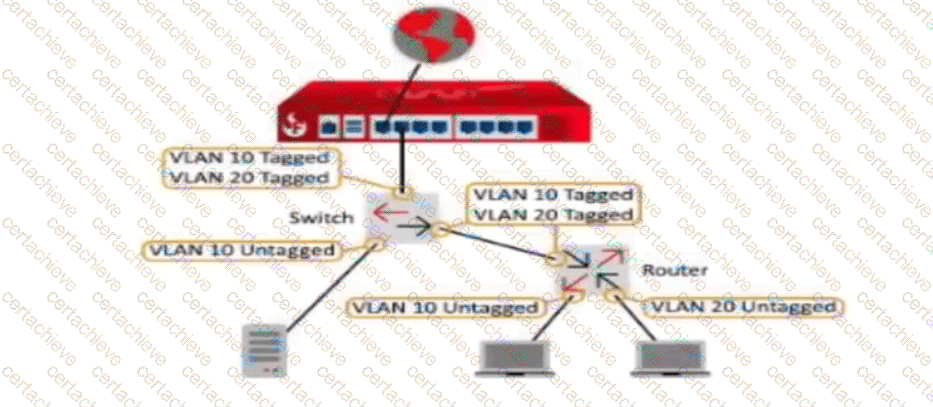
You have an existing network infrastructure built out that uses tagged and untagged VLAN networks. Based on the diagram below, which VLANs must you add to the Firebox interface? (Select one.)
Correct Answer & Rationale:
Answer: B
Explanation:
Comprehensive Technical Explanation:
Under 802.1Q VLAN encapsulation standards, an Ethernet interface can send and receive frames that carry a 4-byte 802.1Q VLAN tag (tagged) or carry no tag header (untagged). When connecting a Firebox interface to an intermediate managed network switch over an 802.1Q trunk link carrying multiple virtual networks, the interface configuration on the Firebox must match the trunk configuration on the switch port.
The topology diagram shows the physical link between the Firebox and the switch carrying:
- VLAN 10 Tagged
- VLAN 20 Tagged
Because the switch forwards frames for both VLAN 10 and VLAN 20 across that uplink with IEEE 802.1Q headers intact, the Firebox physical interface must be configured as a member of VLAN 10 (Tagged) and VLAN 20 (Tagged). This ensures the Fireware network driver processes 802.1Q tags, demultiplexes incoming frames to their respective virtual VLAN sub-interfaces (vlan10 and vlan20), and tags outbound return traffic appropriately.
[Reference: WatchGuard Network Security Essentials — Networking, Policies, and NAT: VLAN Configuration, 802.1Q Tagging, and Trunk Interfaces., ――――――――――――――――――――――――――――――――――――――――――――――――――――――――――]

Verified by Certified Instructors
This WatchGuard Network-Security-Essentials study pack was audited and verified on November 7, 2026 by Bruce Kensington,. We ensure every technical rationale aligns with real-world enterprise standards.
A Stepping Stone for Enhanced Career Opportunities
Your profile having Locally-Managed Fireboxes certification significantly enhances your credibility and marketability in all corners of the world. The best part is that your formal recognition pays you in terms of tangible career advancement. It helps you perform your desired job roles accompanied by a substantial increase in your regular income. Beyond the resume, your expertise imparts you confidence to act as a dependable professional to solve real-world business challenges.
Your success in WatchGuard Network-Security-Essentials certification exam makes your visible and relevant in the fast-evolving tech landscape. It proves a lifelong investment in your career that give you not only a competitive advantage over your non-certified peers but also makes you eligible for a further relevant exams in your domain.
What You Need to Ace WatchGuard Exam Network-Security-Essentials
Achieving success in the Network-Security-Essentials WatchGuard exam requires a blending of clear understanding of all the exam topics, practical skills, and practice of the actual format. There's no room for cramming information, memorizing facts or dependence on a few significant exam topics. It means your readiness for exam needs you develop a comprehensive grasp on the syllabus that includes theoretical as well as practical command.
Here is a comprehensive strategy layout to secure peak performance in Network-Security-Essentials certification exam:
- Develop a rock-solid theoretical clarity of the exam topics
- Begin with easier and more familiar topics of the exam syllabus
- Make sure your command on the fundamental concepts
- Focus your attention to understand why that matters
- Ensure hands-on practice as the exam tests your ability to apply knowledge
- Develop a study routine managing time because it can be a major time-sink if you are slow
- Find out a comprehensive and streamlined study resource for your help
Ensuring Outstanding Results in Exam Network-Security-Essentials!
In the backdrop of the above prep strategy for Network-Security-Essentials WatchGuard exam, your primary need is to find out a comprehensive study resource. It could otherwise be a daunting task to achieve exam success. The most important factor that must be kep in mind is make sure your reliance on a one particular resource instead of depending on multiple sources. It should be an all-inclusive resource that ensures conceptual explanations, hands-on practical exercises, and realistic assessment tools.
Certachieve: A Reliable All-inclusive Study Resource
Certachieve offers multiple study tools to do thorough and rewarding Network-Security-Essentials exam prep. Here's an overview of Certachieve's toolkit:
WatchGuard Network-Security-Essentials PDF Study Guide
This premium guide contains a number of WatchGuard Network-Security-Essentials exam questions and answers that give you a full coverage of the exam syllabus in easy language. The information provided efficiently guides the candidate's focus to the most critical topics. The supportive explanations and examples build both the knowledge and the practical confidence of the exam candidates required to confidently pass the exam. The demo of WatchGuard Network-Security-Essentials study guide pdf free download is also available to examine the contents and quality of the study material.
WatchGuard Network-Security-Essentials Practice Exams
Practicing the exam Network-Security-Essentials questions is one of the essential requirements of your exam preparation. To help you with this important task, Certachieve introduces WatchGuard Network-Security-Essentials Testing Engine to simulate multiple real exam-like tests. They are of enormous value for developing your grasp and understanding your strengths and weaknesses in exam preparation and make up deficiencies in time.
These comprehensive materials are engineered to streamline your preparation process, providing a direct and efficient path to mastering the exam's requirements.
WatchGuard Network-Security-Essentials exam dumps
These realistic dumps include the most significant questions that may be the part of your upcoming exam. Learning Network-Security-Essentials exam dumps can increase not only your chances of success but can also award you an outstanding score.
Top Exams & Certification Providers
New & Trending
- New Released Exams
- Related Exam
- Hot Vendor