
The Aruba Certified Campus Access Professional Exam (HPE7-A01)
Passing HP Aruba Certified Professional - Campus Access exam ensures for the successful candidate a powerful array of professional and personal benefits. The first and the foremost benefit comes with a global recognition that validates your knowledge and skills, making possible your entry into any organization of your choice.

HPE7-A01 Exam Dumps
- Exam Code: HPE7-A01
- Vendor: HP
- Certifications: Aruba Certified Professional - Campus Access
- Exam Name: Aruba Certified Campus Access Professional Exam
Why CertAchieve is Better than Standard HPE7-A01 Dumps
In 2026, HP uses variable topologies. Basic dumps will fail you.
| Quality Standard | Generic Dump Sites | CertAchieve Premium Prep |
|---|---|---|
| Technical Explanation | None (Answer Key Only) | Step-by-Step Expert Rationales |
| Syllabus Coverage | Often Outdated (v1.0) | 2026 Updated (Latest Syllabus) |
| Scenario Mastery | Blind Memorization | Conceptual Logic & Troubleshooting |
| Instructor Access | No Post-Sale Support | 24/7 Professional Help |
Customers Passed Exams
10
Success backed by proven exam prep tools
Questions Came Word for Word
86%
Real exam match rate reported by verified users
Average Score in Real Testing Centre
93%
Consistently high performance across certifications
Study Time Saved With CertAchieve
60%
Efficient prep that reduces study hours significantly
Coverage of Official HP HPE7-A01 Exam Domains
Our curriculum is meticulously mapped to the HP official blueprint.
Network Stack & Connectivity (12%)
Master the foundational "Plumbing." Focus on the deep differentiation between 802.11, 802.1, and 802.3 technologies. Learn to deploy and verify complex connectivity architectures, including link aggregation (LACP), interface redundancy, and the nuances of the OSI model within an Aruba-driven enterprise environment.
Resiliency, Switching & Virtualization (22%)
The "Availability" core. Master the implementation of Virtual Switching Extension (VSX) and Virtual Switch Forwarding (VSF) for high-availability access and aggregation. Focus on Layer 2/3 switching technologies, managing loop prevention (MSTP/RPVST+), and ensuring sub-second failover in critical campus backbones.
WLAN & Wireless Orchestration (17%)
Master the "Airwaves." Focus on RF attributes, band steering, and complex SSID configurations. Learn to build wireless infrastructures based on specific customer requirements, optimizing for roaming performance and managing the seamless transition of users across a high-density campus WLAN.
Advanced Routing (13%)
Master the "Traffic Path." Focus on implementing OSPF (Open Shortest Path First) topologies, Policy-Based Routing (PBR), and Virtual Routing and Forwarding (VRF). Learn to manage route propagation and troubleshoot path selection to ensure efficient data flow between campus segments and the core.
Security & Authentication (17%)
The "Identity" pillar. Master the implementation of 802.1X, RADIUS integration, and EAP-TLS for secure onboarding. Focus on Dynamic Segmentation, role-based access control (RBAC), and securing both WLAN and LAN edge ports against unauthorized access and lateral threats.
Ops, Troubleshooting & Performance (19%)
Master "Lifecycle Management." Focus on monitoring via NAE (Network Analytics Engine) agents and UXI sensors. Learn to use APIs for automated configuration and master deep-dive troubleshooting across wired and wireless segments, utilizing QoS to prioritize mission-critical voice and video traffic.
HP HPE7-A01 Exam Domains Q&A
Certified instructors verify every question for 100% accuracy, providing detailed, step-by-step explanations for each.
Question 1
HP HPE7-A01
QUESTION DESCRIPTION:
Your customer is having connectivity issues with a newly-deployed Microbranch group The access points in this group are online in Aruba Central, but no VPN tunnels are forming.
What is the most likely cause of this issue?
Correct Answer & Rationale:
Answer: C
Explanation:
This is the most likely cause of the issue where the access points in a Microbranch group are online in Aruba Central, but no VPN tunnels are forming. A Microbranch group is a group that contains both APs and Gateways and allows them to form VPN tunnels for secure communication. The VPN tunnels use GRE (Generic Routing Encapsulation) as the encapsulation protocol and IPSec as the encryption protocol. If there is a firewall blocking GRE traffic between the AP and the gateway, the VPN tunnels cannot be established. The other options are incorrect because they either do not affect the VPN tunnel formation or do not apply to a Microbranch group. References: https://www.arubanetworks.com/techdocs/ArubaOS_86_Web_Help/Content/arubaos-solutions/gateways/microbranch.htm https://www.arubanetworks.com/assets/tg/TB_ArubaGateway.pdf
Question 2
HP HPE7-A01
QUESTION DESCRIPTION:
What is enabled by LLDP-MED? (Select two.)
Correct Answer & Rationale:
Answer: A, B
Explanation:
These are two benefits enabled by LLDP-MED (Link Layer Discovery Protocol - Media Endpoint Discovery). LLDP-MED is an extension of LLDP that provides additional capabilities for network devices such as VoIP phones and APs. One of the capabilities is to automatically configure voice VLANs for VoIP phones, which allows them to be placed in a separate VLAN from data devices and receive QoS and security policies. Another capability is to request power as needed from PoE-enabled switch ports, which allows APs to adjust their power consumption and performance based on the available power budget. The other options are incorrect because they are either not enabled by LLDP-MED or not related to LLDP-MED. References: https://www.arubanetworks.com/techdocs/ArubaOS_86_Web_Help/Content/arubaos-solutions/wlan-qos/lldp-med.htm https://www.arubanetworks.com/techdocs/ArubaOS_86_Web_Help/Content/arubaos-solutions/wlan-rf/poe.htm
Question 3
HP HPE7-A01
QUESTION DESCRIPTION:
How do you allow a new VLAN 100 between VSX pair inter-switch-link 256 for port 1/45 and 2/45?
Correct Answer & Rationale:
Answer: C
Explanation:
To allow a new VLAN 100 between VSX pair inter-switch-link 256 for port 1/45 and 2/45, you need to use the command vlan trunk allowed 100 in LAG256. This will add VLAN 100 to the list of allowed VLANs on the trunk port LAG256, which is part of the inter-switch-link between VSX peers. The other options are incorrect because they either do not use the correct command or do not specify the correct port or VLAN. References: https://www.arubanetworks.com/techdocs/AOS-CX/10.04/HTML/5200-6728/bk01-ch07.html https://www.arubanetworks.com/techdocs/AOS-CX/10.04/HTML/5200-6728/bk01-ch02.html
Question 4
HP HPE7-A01
QUESTION DESCRIPTION:
The administrator notices that wired guest users that have exceeded their bandwidth limit are not being disconnected Access Tracker in ClearPass indicates a disconnect CoA message is being sent to the AOS-CX switch.
An administrator has performed the following configuration

What is the most likely cause of this issue?
Correct Answer & Rationale:
Answer: D
Explanation:
Change of Authorization (CoA) is a feature that allows ClearPass Policy Manager (CPPM) to send messages to network devices such as switches to change the authorization state of a user session. CoA requires that both CPPM and the network device support this feature and have it enabled. For AOS-CX switches, CoA must be globally enabled using the command radius-server coa enable. If CoA is not enabled on the switch, the disconnect CoA message from CPPM will be ignored and the user session will not be terminated. References: https://www.arubanetworks.com/techdocs/ClearPass/6.7/PolicyManager/index.htm#CPPM_UserGuide/Admin/ChangeOfAuthorization.htm https://techhub.hpe.com/eginfolib/Aruba/OS-CX_10.04/5200-6692/GUID-9B8F6E8F-9C7A-4F0D-AE7B-9D8E6C5B6A7F.html
Question 5
HP HPE7-A01
QUESTION DESCRIPTION:
What is used to retrieve data stored in a Management Information Base (MIS)?
Correct Answer & Rationale:
Answer: A
Explanation:
The correct answer is A. SNMPv3.
SNMPv3 is a protocol that is used to retrieve data stored in a Management Information Base (MIB), which is a database of managed objects in a network. SNMPv3 provides security and access control features that are not available in earlier versions of SNMP. SNMPv3 can also use encryption to protect the data from unauthorized access or modification.
According to the Aruba Certified Professional – Campus Access document1, one of the skills that this certification validates is:
Implement and Analyze the output from common network monitoring tools
Configure Port Mirroring to collect PCAPs
Configure NAE agents 9.4
Configure UXI sensors for internal and external tests
Describe how API scan be used to configure, manage, monitor, and troubleshoot your network
The document also mentions that the candidate should have a distinguished understanding of different protocols across vendors, which implies that they should be familiar with SNMPv3 and how it can be used to access MIB data.
Question 6
HP HPE7-A01
QUESTION DESCRIPTION:
Due to a shipping error, five (5) Aruba AP-515S and one (1) Aruba CX 6300 were sent directly to your new branch office You have configured a new group persona for the new branch office devices in Central, but you do not know their MAC addresses or serial numbers The office manager is instructed via text message on their smartphone to onboard all the new hardware into Aruba Central
What application must the office manager use on their phone to complete this task?
Correct Answer & Rationale:
Answer: D
Explanation:
Aruba Installer App is a mobile app that simplifies site installations and enables network connectivity for Aruba devices. The app allows the user to scan the barcode of the device and add it to the network using Aruba Central. The app also automates importing Aruba devices into Aruba NetEdit for intelligent configuration management and continuous conformance validation
Question 7
HP HPE7-A01
QUESTION DESCRIPTION:
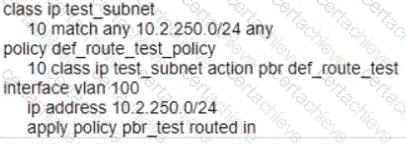
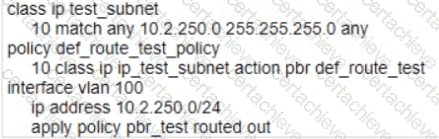
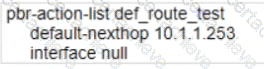
You are configuring Policy Based Routing (PBR) for a subnet that will be used to test a new default route for your network Traffic originating from 10.2.250.0/24 should use a new default route to 10.1.1.253. Other non-default routes for this subnet should not be affected by this change.
What are two parts of the solution for these requirements? (Select two.)
A)

B)
C)
D)
E)

Correct Answer & Rationale:
Answer: C, E
Explanation:
Two parts of the solution for these requirements are Option C and Option E.
Option C is a part of the solution because it defines a policy-based routing action list named route_test, which specifies the next hop IP address as 10.1.1.253 for the matching traffic. This is the new default route that the user wants to use for the subnet 10.2.250.0/24. The interface null parameter indicates that the traffic will be routed to the next hop without using a specific interface1.
Option E is a part of the solution because it applies the policy-based routing action list route_test to the VLAN interface 250, which has an IP address of 10.2.250.1/24. This is the subnet that the user wants to test the new default route for. The apply policy command enables policy-based routing on the interface and associates it with the action list2.
Option A is not a part of the solution because it defines a policy-based routing action list named route_test, but does not specify the next hop IP address as 10.1.1.253, which is the new default route that the user wants to use. Instead, it specifies a next hop IP address of 10.1.1.254, which is different from the requirement.
Option B is not a part of the solution because it defines a policy-based routing action list named route_test, but does not specify any next hop IP address at all, which is necessary for policy-based routing to work. Instead, it specifies an interface null parameter without any IP address, which is invalid.
Option D is not a part of the solution because it applies the policy-based routing action list route_test to the VLAN interface 200, which has an IP address of 10.2.200.1/24. This is not the subnet that the user wants to test the new default route for, but a different subnet that should not be affected by this change.
Question 8
HP HPE7-A01
QUESTION DESCRIPTION:
You are deploying Aruba CX 6300 ' s with the customers requirement to only allow one (1) VoIP phone and one (1) device.
The following local role gets assigned to the phone
port-access rote VoIP device-traffic-class voice
What set of commands best fits this requirement?
Correct Answer & Rationale:
Answer: C
Explanation:
Aruba CX 6300 switches support various features to control the port access for different types of devices, such as client mode, device mode, and multidomain mode. These features can help limit the number of clients that can connect to a port and prevent unauthorized devices from accessing the network.
This is because option C shows how to configure the client limit and the auth-mode for a specific port using the interface command and the aaa authentication port-access command. The client limit specifies the maximum number of clients that can connect to a port. The auth-mode specifies the authentication mode for the port. In this case, option C sets both parameters to multi-domain mode, which allows only one voice device and one data device to be authenticated on a port
https://www.arubanetworks.com/techdocs/AOS-CX/10.10/HTML/monitoring_6300-6400/Content/Chp_LEDs/fro-pan-led-630.htm 2: https://www.arubanetworks.com/products/switches/6300-series/ 3: https://www.arubanetworks.com/techdocs/AOS-CX/10.11/HTML/security_6200-6300-6400/Content/Chp_Port_acc/Port_acc_gen_cmds/aaa-aut-por-acc-aut-mod-fl-109.htm
Question 9
HP HPE7-A01
QUESTION DESCRIPTION:
In a CX 6300 24G, how does a server DAC behave in the port by default for interface 1/1/26?
Correct Answer & Rationale:
Answer: C
Explanation:
In the AOS-CX behavior covered by this Campus Access question, an HPE Compute/Server DAC is treated as an unsupported transceiver product when it is not specifically included in the supported Aruba CX transceiver matrix. HPE Aruba ' s AOS-CX Fundamentals documentation explicitly identifies HPE-branded products intended for HPE Compute Servers or Storage as examples of products classified as unsupported for AOS-CX switching platforms. Aruba Networking
The AOS-CX mechanism for permitting such devices is Unsupported Transceiver Mode (UT-mode) , controlled using the global:
allow-unsupported-transceiver
command. The command permits unsupported optical transceivers, DACs, and AOCs to establish connections on supported interfaces. Aruba Networking
Therefore, for the certification scenario, the Server DAC connected to interface 1/1/26 requires allow-unsupported-transceiver to be enabled, making C the intended answer. Simply stating that the port remains disabled describes the consequence when unsupported-transceiver operation is not permitted, but C identifies the actual configuration requirement.
Be aware that Aruba has changed default UT-mode behavior in later AOS-CX releases, so this question should be interpreted according to the course/exam software context rather than assuming every current release behaves identically. Aruba Networking
Study Guide Topics: CX 6300 Interfaces, DAC Support, Unsupported Transceiver Mode, Transceiver Compatibility, allow-unsupported-transceiver.
Question 10
HP HPE7-A01
QUESTION DESCRIPTION:
When setting up an Aruba CX VSX pair, which information does the Inter-Switch Link Protocol configuration use in the configuration created?
Correct Answer & Rationale:
Answer: B
Explanation:
The information that the Inter-Switch Link Protocol configuration uses in the configuration created is B. MAC tables.
The Inter-Switch Link Protocol (ISL) is a protocol that enables the synchronization of data and state information between two VSX peer switches. The ISL uses a version control mechanism and provides backward compatibility regarding VSX synchronization capabilities. The ISL can span long distances (transceiver dependent) and supports different speeds, such as 10G, 25G, 40G, or 100G1.
One of the data components that the ISL synchronizes is the MAC table, which is a database that stores the MAC addresses of the devices connected to the switch and the corresponding ports or VLANs. The ISL ensures that both VSX peers have the same MAC table entries and can forward traffic to the correct destination2. The ISL also synchronizes other data components, such as ARP table, LACP states for VSX LAGs, and MSTP states2.

Verified by Certified Instructors
This HP HPE7-A01 study pack was audited and verified on November 7, 2026 by Radia Davenport,. We ensure every technical rationale aligns with real-world enterprise standards.
A Stepping Stone for Enhanced Career Opportunities
Your profile having Aruba Certified Professional - Campus Access certification significantly enhances your credibility and marketability in all corners of the world. The best part is that your formal recognition pays you in terms of tangible career advancement. It helps you perform your desired job roles accompanied by a substantial increase in your regular income. Beyond the resume, your expertise imparts you confidence to act as a dependable professional to solve real-world business challenges.
Your success in HP HPE7-A01 certification exam makes your visible and relevant in the fast-evolving tech landscape. It proves a lifelong investment in your career that give you not only a competitive advantage over your non-certified peers but also makes you eligible for a further relevant exams in your domain.
What You Need to Ace HP Exam HPE7-A01
Achieving success in the HPE7-A01 HP exam requires a blending of clear understanding of all the exam topics, practical skills, and practice of the actual format. There's no room for cramming information, memorizing facts or dependence on a few significant exam topics. It means your readiness for exam needs you develop a comprehensive grasp on the syllabus that includes theoretical as well as practical command.
Here is a comprehensive strategy layout to secure peak performance in HPE7-A01 certification exam:
- Develop a rock-solid theoretical clarity of the exam topics
- Begin with easier and more familiar topics of the exam syllabus
- Make sure your command on the fundamental concepts
- Focus your attention to understand why that matters
- Ensure hands-on practice as the exam tests your ability to apply knowledge
- Develop a study routine managing time because it can be a major time-sink if you are slow
- Find out a comprehensive and streamlined study resource for your help
Ensuring Outstanding Results in Exam HPE7-A01!
In the backdrop of the above prep strategy for HPE7-A01 HP exam, your primary need is to find out a comprehensive study resource. It could otherwise be a daunting task to achieve exam success. The most important factor that must be kep in mind is make sure your reliance on a one particular resource instead of depending on multiple sources. It should be an all-inclusive resource that ensures conceptual explanations, hands-on practical exercises, and realistic assessment tools.
Certachieve: A Reliable All-inclusive Study Resource
Certachieve offers multiple study tools to do thorough and rewarding HPE7-A01 exam prep. Here's an overview of Certachieve's toolkit:
HP HPE7-A01 PDF Study Guide
This premium guide contains a number of HP HPE7-A01 exam questions and answers that give you a full coverage of the exam syllabus in easy language. The information provided efficiently guides the candidate's focus to the most critical topics. The supportive explanations and examples build both the knowledge and the practical confidence of the exam candidates required to confidently pass the exam. The demo of HP HPE7-A01 study guide pdf free download is also available to examine the contents and quality of the study material.
HP HPE7-A01 Practice Exams
Practicing the exam HPE7-A01 questions is one of the essential requirements of your exam preparation. To help you with this important task, Certachieve introduces HP HPE7-A01 Testing Engine to simulate multiple real exam-like tests. They are of enormous value for developing your grasp and understanding your strengths and weaknesses in exam preparation and make up deficiencies in time.
These comprehensive materials are engineered to streamline your preparation process, providing a direct and efficient path to mastering the exam's requirements.
HP HPE7-A01 exam dumps
These realistic dumps include the most significant questions that may be the part of your upcoming exam. Learning HPE7-A01 exam dumps can increase not only your chances of success but can also award you an outstanding score.
Top Exams & Certification Providers
New & Trending
- New Released Exams
- Related Exam
- Hot Vendor