
The Certified Business Analysis Professional (CBAP)
Passing IIBA Certified Business Analysis Professional exam ensures for the successful candidate a powerful array of professional and personal benefits. The first and the foremost benefit comes with a global recognition that validates your knowledge and skills, making possible your entry into any organization of your choice.


CBAP Exam Dumps
- Exam Code: CBAP
- Vendor: IIBA
- Certifications: Certified Business Analysis Professional
- Exam Name: Certified Business Analysis Professional
Why CertAchieve is Better than Standard CBAP Dumps
In 2026, IIBA uses variable topologies. Basic dumps will fail you.
| Quality Standard | Generic Dump Sites | CertAchieve Premium Prep |
|---|---|---|
| Technical Explanation | None (Answer Key Only) | Step-by-Step Expert Rationales |
| Syllabus Coverage | Often Outdated (v1.0) | 2026 Updated (Latest Syllabus) |
| Scenario Mastery | Blind Memorization | Conceptual Logic & Troubleshooting |
| Instructor Access | No Post-Sale Support | 24/7 Professional Help |
Customers Passed Exams
10
Success backed by proven exam prep tools
Questions Came Word for Word
93%
Real exam match rate reported by verified users
Average Score in Real Testing Centre
91%
Consistently high performance across certifications
Study Time Saved With CertAchieve
60%
Efficient prep that reduces study hours significantly
IIBA CBAP Exam Domains Q&A
Certified instructors verify every question for 100% accuracy, providing detailed, step-by-step explanations for each.
Question 1
IIBA CBAP
QUESTION DESCRIPTION:
A business analyst (BA) is working on a payment system (PS) implementation. A set of systems which should interact with a new system has been identified. The business analyst defined that a user with role of " Supervisor " in the PS must pass a two-factor authentication before an execution of the functions: " Change system parameters " and " Set up new supervisor. " A user must have the role of " Supervisor " to use the standard functions " Send mail notification " or " Send SMS notification " .
The BA defined the following use cases:
• " Change system parameters "
• " Setup new supervisor "
• " Send mail notification "
• " Send SMS notification "
• " Send notification "
• " Pass a two-factor authentication "
The BA wants to create a Use Case diagram.
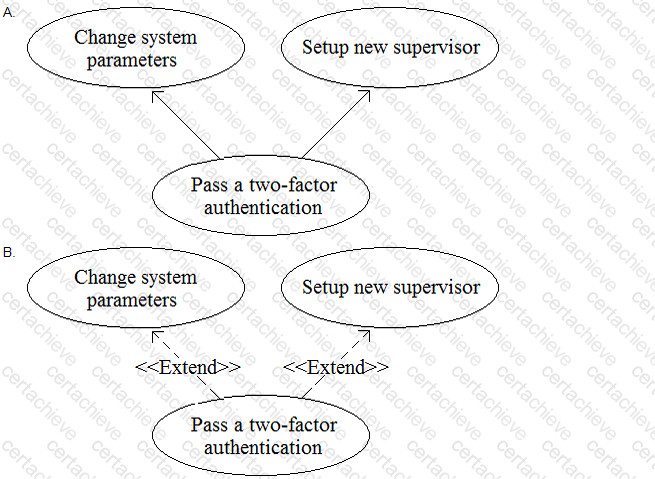
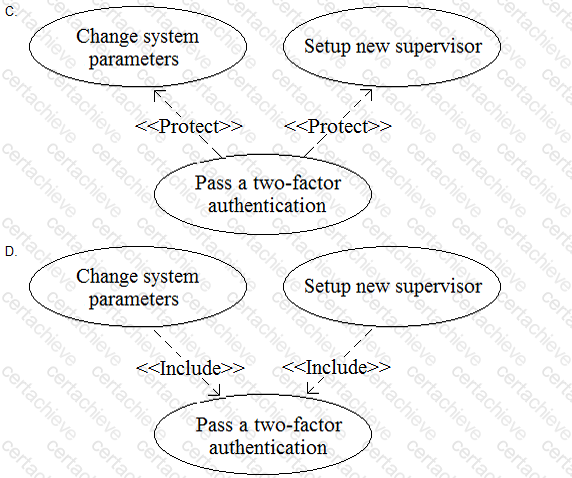
What standard relationship should be defined between " Change system parameters " , " Setup new supervisor " and " Pass a two-factor authentication " ?
Correct Answer & Rationale:
Answer: D
Explanation:
Option D shows the correct use of the include relationship between the three use cases. This means that the “Pass a two-factor authentication” use case is a mandatory part of both the “Change system parameters” and the “Setup new supervisor” use cases, and it always occurs whenever either of them is executed. The arrow points from the base use case to the included use case, as per the UML notation. Option C is incorrect because it uses the protect relationship, which is a non-standard extension of the UML notation. It indicates that the “Pass a two-factor authentication” use case is a s ecurity requirement for the other two use cases, but it does not specify how or when it is executed. Options A and B are incorrect because they use the extend relationship, which means that the “Pass a two-factor authentication” use case is an optional ext ension of the other two use cases, and it only occurs under certain conditions. This does not reflect the requirement that the two-factor authentication is mandatory for both functions. References :
[A Guide to the Business Analysis Body of Knowledge (BABOK Guide), Version 3], Chapter 10: Techniques, pp. 424-425.
[UML 2.5 Specification], Chapter 18: Use Cases, pp. 637-638.
Question 2
IIBA CBAP
QUESTION DESCRIPTION:
A popular department store chain wants to make computer upgrades as well as conduct a major remodeling effort to increase revenue to all their 100 stores over the next 2 years. The remodeling will occur in two phases. The two phases are required at each store and can be completed in any order, but each phase must be fully completed before the next phase can begin. Phase 1 will take approximately 32 weeks and will not require a store to be temporarily closed. Phase 2 will take approximately 20 weeks and will require a store to be temporarily closed.
In order to keep inventory level and total revenue for the department store chain at an operational level, 75% of the stores must remain open to the public at all times. Against the board of director ' s advice, the Chief
Executive Officer (CEO) made a decision to start and complete the top 25 revenue-producing stores in the first year to get those stores remodeled and fully operational.
A business analyst (BA) has been brought in to help with planning the project and gathering requirements. Based on the CEO ' s executive decision, which risk tolerance attitude is the CEO exhibiting?
Correct Answer & Rationale:
Answer: A
Explanation:
The CEO’s executive dec ision to start and complete the top 25 revenue-producing stores in the first year shows a risk-seeking or risk-taking attitude. This means that the CEO is willing to accept higher risks for higher rewards, and sees risks as opportunities rather than threat s. The CEO is not avoiding, mitigating, or neutral to the risks involved in the remodeling project, but rather embracing them and pursuing them aggressively. This may result in increased revenue and customer satisfaction, but also exposes the organization to potential losses and disruptions. References :
Risk Attitude in Project Management: Definition, Types & Example , Web Article, August 2022
Risk Appetite vs. Risk Tolerance: What is the Difference? , Web Article, October 2022
CBAP / CCBA Certified Business Analysis Study Guide, 2nd Edition , Chapter 3: Strategy Analysis, p. 95-96
Certified Business Analysis Professional™ (CBAP®) Specialization , Course 3: Business Analysis: Strategy Analysis, Week 1: Strategy Analysis Overview, Video: Risk Analysis
Question 3
IIBA CBAP
QUESTION DESCRIPTION:
An insurance company wants to increase sales by 15% and customer retention by 10% within 1 calendar year.
Various strategies to achieve this were considered and a restructure to the existing pricing model is selected to help achieve these goals.
A business analyst (BA) works with stakeholders such as actuaries, product specialists, sales staff, risk managers, and underwriters who agree to applying varying levels of discounts to customers based on:
• Total annual premium the customer has with the company (Financial worth)
• Time with the insurance company (Loyalty)
Various financial models are considered but the stakeholders agree that an initial applicable discount is determined based on the customer ' s overall premium:
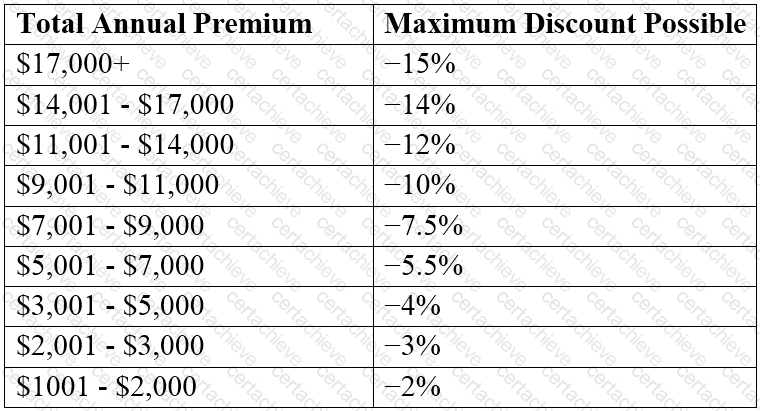
The percentage of the maximum possible discount available to the customer is adjusted based on time with the company:
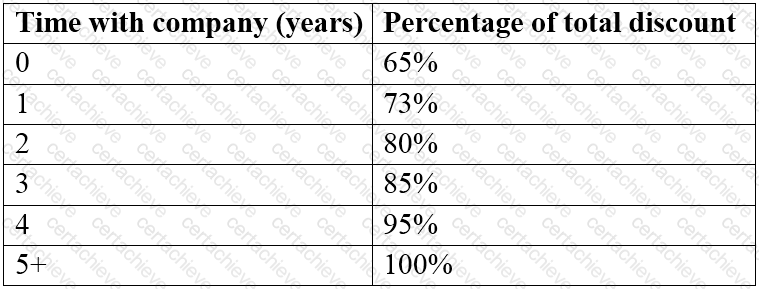
If within the first six months, customer retention increased by 5 % and sales increased by 6%, then when will the desired sales and retention goals be achieved assuming the trend continues at the same pace?
Correct Answer & Rationale:
Answer: D
Explanation:
The question asks about the time required to achieve the desired sales and retention goals, given the current rate of increase. To answer this question, we need to use the formula for compound growth rate, which is:
Final value = Initial value x (1 + Growth rate) ^ Number of periods
We can apply this formula to both sales and retention, using the given values and solving for the number of periods. For sales, we have:
1.15 = 1 x (1 + 0.06) ^ Number of periods
Taking the natural logarithm of both sides, we get:
ln(1.15) = ln(1 + 0.06) x Number of periods
Dividing by ln(1 + 0.06), we get:
Number of periods = ln(1.15) / ln(1 + 0.06)
Using a calculator, we get:
Number of periods = 2.29
Since each period is six months, we multiply by 6 to get the number of months:
Number of months = 2.29 x 6
Number of months = 13.74
Rounding up to the nearest whole number, we get:
Number of months = 14
Therefore, it will take 14 months, or about 18 months, to achieve the sales goal.
For retention, we have:
1.1 = 1 x (1 + 0.05) ^ Number of periods
Repeating the same steps as above, we get:
Number of periods = ln(1.1) / ln(1 + 0.05)
Number of periods = 1.86
Number of months = 1.86 x 6
Number of months = 11.16
Rounding up to the nearest whole number, we get:
Number of months = 12
Therefore, it will take 12 months, or 1 year, to achieve the retention goal.
References :
CBAP / CCBA Certified Business Analysis Study Guide, 2nd Edition , Chapter 5: So lution Assessment and Validation, p. 211-212
Certified Business Analysis Professional™ (CBAP®) Specialization , Course 4: Business Analysis: Solution Eva luation, Week 2: Solution Performance Assessment, Video: Solution Performance Metrics
Compound Growth Rate Calculator
Question 4
IIBA CBAP
QUESTION DESCRIPTION:
A very large insurer of General Liability and Property Damage insurance has an upward trend of increased claims over the past 5 years.
The Risk Control Area for that company has just completed a 12 month Pilot of a new improved Risk Control Site.
The purpose of the site is to help their customers manage their exposures and ideally prevent them from having claims There were 100 customers that were part of the Pilot that represented 25 different industries. The business goals were to increase use of the site and provide tools to help customer awareness of their exposures, so that they may reduce existing exposures and ultimately reduce claims.
The sites Features were as follows:
* Improvements to the search engine to all customers to search for articles, tools and services on the site
* A checklist function that allow customer to create their own unique Checklists or utilize a sample provided by ABC company to use daily, weekly etc for an area of their facility.
* A promotion feature - where Risk preventing Articles, and tools on the site are marketed toward a customer.
* A profile section allowing for Customer Name, Address and contact Phone number.
Alter the 12 month pilot the business sponsor received an assessment of what was working and what was not. The Assessment of the pilot revealed overall site activity had significantly increased, however only 5% of the time the promotions were viewed. And the most shocking was that total claims increased by nearly 20% for these 100 customers during the pilot period. The business sponsor was perplexed as he had an expectation of reduced claims and at least for 30% viewing of promotions since the project team had spent a lot of careful time and effort on this feature. A BA was assigned to do further analysis regarding the low use of the promotions and why claims were not being reduced.
Regarding the use of promotions the BA looked into other similar companies to see what they did differently to get their customer to look at their promotions. The BA found that similar companies had promotions that targeted the industry the customer was in so it was more relevant to them and they were more interested to view the promotion. In addition the BA sent out a survey to all 100 pilot customers asking probing questions about what they thought of the site and if they felt it had decreased their exposure to risk sufficiently. The Survey responses came back with raving positive comments and providing examples of how the site had been helping in the reduction of claims from the customer ' s perspective. In addition the survey also revealed insight that the customers found the promotion often irrelevant to their industry.
The BA asked for a dump of all documentation of the 1000 claims that were filed over the 12 month pilot period. The BA found the nearly 90% of the claim filed were all in one region of the country and were all for property damage related to several severe winter storms in the region and the claims were nearly all unavoidable by the customers. The BA brought all this analysis back to the business sponsor and made the recommendation to the business sponsor to require the customer to select 1 of 25 industries in their profile. This would in turn allow for the ability to show industry specific promotions and promote search results relative to a customer ' s industry to be sorted at the top giving the customer a more personalized experience.
What was the business sponsor looking to validate about the use of promotions?
Correct Answer & Rationale:
Answer: B
Explanation:
Performance variance is the difference between the actual and expected results of a business activity or process. In this case, the business sponsor expected that the promotions would be viewed by at least 30% of the customers and that they would help reduce claims. However, the actual results showed that only 5% of the customers viewed the promotions and that claims increased by 20%. The business sponsor wanted to understand the reasons for this discrepancy and how to improve the effectiveness of the promotions.
Question 5
IIBA CBAP
QUESTION DESCRIPTION:
A non-profit utility company has 900 employees, a majority of whom are hourly employees and must track their time using a paper based process. A few years ago, the Director of Human Resources purchased a software system to eliminate the current paper-based time reporting process. No requirements specific to the utility company were defined prior to the purchase. A team was formed to implement the software During implementation process, the team discovered the software lacked functionality and was not robust enough to support the general ledger requirements The company stopped the effort and incurred a $500,000 USD loss on the cost of the software.
This year, the Director of Finance requested that a team investigate the current paper-based time reporting process and recommend solutions. The Director of Finance feels that the Director of Human Resources must be involved as a critical stakeholder. The Director of Human Resources is still bitter about the last effort because the process stopped ' .
Which of the following is included in performing a stakeholder analysis?
Correct Answer & Rationale:
Answer: C
Explanation:
According to the CBAP competencies, one of the skills required for business analysis planning and monitoring is to guide practice in performing stakeholder analysi s 1 . Stakeholder analysis is the process of identifying and assessing the needs, inte rests, and influence of stakeholders on a project or initiative 2 . One of the outputs of stakeholder analysis is a stakeholder list, which identifies the key stakeholders and their roles, responsibilities, and expectations 3 . A stakeholder list can also include information on the potential risks and issues that may arise from stakeholder in volvement or lack thereof 4 . Therefore, developing a risk plan to anticipate negative behavior from the Director of Human Resources is a valid act ivity that is included in performing a stakeholder analysis. This can help the team to mitigate the impact of the Director’s bitterness and resistance on the project’s success.
The other options are not included in performing a stakeholder analysis. Compar ing the expertise of the Director of Human Resources to other stakeholders is not relevant to the stakeholder analysis process, as it does not help to understand the Director’s needs, interests, or influence. Recommending excluding the Director of Human Re sources as a stakeholder is not a good practice, as it may create more conflict and resentment, and ignore the Director’s legitimate role and authority in the project. Implementing all of the Director of Human Resources suggestions to relieve tension is no t a realistic or effective strategy, as it may compromise the quality and feasibility of the project, and disregard the needs and interests of other stakeholders. References :
1 : CBAP Competencies - International Institute of Business Analysis
2 : BABOK Guide v3, Section 2.2.2: Conduct Stakeholder Analysis
3 : BABOK Guide v3, Section 2.2.2.3: Outputs
4 : CBAP / CCBA Certified Business Analysis Study Guide, Chapter 3: Business Analysis Planning and Monitoring, p. 83
Question 6
IIBA CBAP
QUESTION DESCRIPTION:
A leading software manufacturing company has appointed a business analyst (BA) to ensure that requirements are managed effectively and efficiently. The BA discovered some missing functionality as well as some implemented functionality which are not supported by requirements.
Which of the following tasks did the BA use to discover the issues?
Correct Answer & Rationale:
Answer: D
Explanation:
Tracing requirements is a task that involves identifying and documenting the relationships am ong requirements, stakeholders, solution components, and other artifacts. Tracing requirements can help the BA to discover the issues of missing or unsupported functionality, as it allows the BA to track the origin, allocation, dependencies, and impact of each requirement. By tracing requirements, the BA can ensure that the requirements are aligned with the business need and objectives, and that they are implemented and verified in the solution. The other options are not the tasks that the BA used to discov er the issues, as they are more related to the definition, elicitation, or evaluation of the requirements, rather than the tracing of the requirements. References : Task: Trace Requirements , CBAP / CCBA Certified Business Analysis Study Guide , 2nd Edition , BABOK Guide
Question 7
IIBA CBAP
QUESTION DESCRIPTION:
An organization is trying to streamline its current processes to improve performance and reduce costs. A business analyst (BA) conducted a process improvement workshop and identified the following issues as the top three items to be addressed:
1: There are multiple teams to define systems, functionality, and content, in many instances, multiple teams are defining the same Functionalities while other functionalities are not being defined at all. leading to unclear understanding of business requirements
2: Product specification forms are published each year. A comparison tool is used to evaluate specification differences between yearly releases; but does not adequately identify changes between versions and needs to be improved.
3: Training consists of a new team member shadowing a seasoned team member. There are no written training materials or formal training sources therefore training is inconsistent and not meeting the needs of the organization.
The BA learns that formal training programs are not often devised for teams as small and diverse as this team, but still believes it is a viable solution to the training need. What type of analysis would help the BA gain approval to proceed with creating this type of training program for this team?
Correct Answer & Rationale:
Answer: B
Explanation:
The type of analysis that would help the BA gain approval to proceed with creating this type of training program for this team is cost benefit analysis, as this is a technique that helps to compare the expected costs and benefits of a proposed solution or change. Cost benefit analysis can help the BA to demonstrate the value and feasibility of the training program, as well as the potential risks and impacts of no t implementing it. By showing the positive return on investment and the alignment with the business objectives and needs, the BA can persuade the decision makers and stakeholders to approve the training program. References : The answer can be verified from the following sources:
A Guide to the Business Analysis Body of Knowledge® (BABOK® Guide) Version 3, Chapter 7: Strategy Analysis, p. 232-233; Chapter 10: Cost Benefit Analysis, p. 352-355.
Business Analysis for Practitioners: A Practice Guide , Chapter 6: Solution Evaluation, p. 159-160.
Question 8
IIBA CBAP
QUESTION DESCRIPTION:
A software development company is in the process of creating a new product for their customer base. It has been several years since such a project has been initiated and the organization has created a new team to own and develop the product. The project team will be evaluated by the successful adoption of the product, which will be developed over the next 12 months.
The team ' s business analyst (BA) has analyzed the current state in partnership with the product owner and has been meeting with senior management to identify the goals that need to be attained. A broad view of the business has been analyzed in order to have an understanding of how the company is currently providing value to its customer base.
After the BA completed the initial analysis, the information is reviewed with leadership. At this point in the project, what will the BA be presenting?
Correct Answer & Rationale:
Answer: D
Explanation:
After completing the initial analysis, the BA will be presenting the expected benefits of the project to the leadership. This is because the BA has already analyzed the current state, the problem domain, and the business objectives of the project, and has identified the value proposition for the customer base. The expected benefits are the measurable outcomes that will indicate the success of the project and the achievement of the business objectives. They will also help to justify the investment and resources required for the project. The expected benefits should be aligned with the strategic goals of the organization and the needs of the stakeholders.
The other options are not correct because they are not the focus of the initial analysis. The project timeline, deliverables, and resource staffing are more related to the planning and execution phases of the project, and they depend on the scope and requirements of the project, w hich are not yet defined at this point. The BA will be involved in these aspects later in the project, but they are not the primary outputs of the initial analysis. References :
[A Guide to the Business Analysis Body of Knowledge (BABOK Guide), Version 3], Chapter 3: Business Analysis Planning and Monitoring, pp. 36-37, 42-43; Chapter 6: Strategy Analysis, pp. 130-131, 134-135, 140-141.
[Business Analysis for Practitioners: A Practice Guide], Chapter 3: Needs Assessment, pp. 41-42, 46-47; Chapter 4: Business Analysis Planning, pp. 67-68, 72-73.
Question 9
IIBA CBAP
QUESTION DESCRIPTION:
A business analyst (BA) has been given a defect during user acceptance testing. After analyzing the defect, the BA determines it is a change in the requirement.
What does the BA need to do to assess the change?
Correct Answer & Rationale:
Answer: D
Explanation:
A change in the requirement is a situation where the r equirement is different from what was originally agreed upon by the stakeholders. This can happen due to various reasons, such as changing business needs, stakeholder feedback, regulatory changes, or technical constraints. To assess the change, the BA need s to conduct an impact analysis using traceability, which is a technique that involves identifying and documenting the relationships among requirements, stakeholders, solution components, and other artifacts. Traceability can help the BA to determine the s cope, cost, schedule, quality, and risk implications of the change, and to communicate them to the relevant stakeholders for approval or rejection. The other options are not the best actions for assessing the change, as they are more suitable for different purposes, such as closing a defect that is not a defect, evaluating the potential threats and opportunities of the change, or finding the underlying cause of the defect. References : CBAP Handbook , CBAP Study Guide , BABOK Guide
Question 10
IIBA CBAP
QUESTION DESCRIPTION:
A financial institution engaged in mortgage lending has embarked on a business process improvement initiative to eliminate the activities that hinder growth to ultimately improve the success rate of its mortgage business. As a benchmark for identification, the institution is keen on improving any business process that has less than a 75% success rate. The institution has appointed a business analyst (BA) to review the business transactions for the processes of origination, payments, and closures, as well as identify opportunities for improvements and recommend solutions.
The BA has collected the following information over the last three months pertaining to these business processes:
• All the business processes are at their maximum capacity in terms of the current number of transactions.
• Each business process has a certain number of rejects and the reasons for rejection include documentation, verification, collateral, and funding. Funding rejects occur when the bank ' s customers have failed to make payment of their mortgage processing fee or mortgage closure payment.
The BA has also recommended the use of documentation checklists as a solution to eliminate the documentation rejects.

Assuming the BA ' s recommendation to be true, what will be the new success rate of the mortgage closure process?
Correct Answer & Rationale:
Answer: A
Explanation:
The new success rate of the mortgage closure process can be calculated by subtracting the percentage of total rejects from 100%. The current success rate is 80%, which means the current percentage of total rejects is 20%. If the documentation rejects (10% of the total transactions) are eliminated by the use of documentation checklists, there wo uld be no documentation rejects remaining. This would decrease the percentage of total rejects to (20% - 10%) = 10%. Therefore, the new success rate would be (100% - 10%) = 90%. References : The answer and explanation are derived based on logical reasoning and calculations from the data provided in the question, as well as the following sources:
Process Improvement Steps - Process Improvement Guide - Planview , Web Article, January 202 3
7 Types of Process Improvement Methodologies [2023] • Asana , Web Article, January 2023
Certified Business Analysis Professional™ (CBAP®) Specialization , Online Course, December 2023

Verified by Certified Instructors
This IIBA CBAP study pack was audited and verified on September 23, 2026 by Jeff Stanford,. We ensure every technical rationale aligns with real-world enterprise standards.
A Stepping Stone for Enhanced Career Opportunities
Your profile having Certified Business Analysis Professional certification significantly enhances your credibility and marketability in all corners of the world. The best part is that your formal recognition pays you in terms of tangible career advancement. It helps you perform your desired job roles accompanied by a substantial increase in your regular income. Beyond the resume, your expertise imparts you confidence to act as a dependable professional to solve real-world business challenges.
Your success in IIBA CBAP certification exam makes your visible and relevant in the fast-evolving tech landscape. It proves a lifelong investment in your career that give you not only a competitive advantage over your non-certified peers but also makes you eligible for a further relevant exams in your domain.
What You Need to Ace IIBA Exam CBAP
Achieving success in the CBAP IIBA exam requires a blending of clear understanding of all the exam topics, practical skills, and practice of the actual format. There's no room for cramming information, memorizing facts or dependence on a few significant exam topics. It means your readiness for exam needs you develop a comprehensive grasp on the syllabus that includes theoretical as well as practical command.
Here is a comprehensive strategy layout to secure peak performance in CBAP certification exam:
- Develop a rock-solid theoretical clarity of the exam topics
- Begin with easier and more familiar topics of the exam syllabus
- Make sure your command on the fundamental concepts
- Focus your attention to understand why that matters
- Ensure hands-on practice as the exam tests your ability to apply knowledge
- Develop a study routine managing time because it can be a major time-sink if you are slow
- Find out a comprehensive and streamlined study resource for your help
Ensuring Outstanding Results in Exam CBAP!
In the backdrop of the above prep strategy for CBAP IIBA exam, your primary need is to find out a comprehensive study resource. It could otherwise be a daunting task to achieve exam success. The most important factor that must be kep in mind is make sure your reliance on a one particular resource instead of depending on multiple sources. It should be an all-inclusive resource that ensures conceptual explanations, hands-on practical exercises, and realistic assessment tools.
Certachieve: A Reliable All-inclusive Study Resource
Certachieve offers multiple study tools to do thorough and rewarding CBAP exam prep. Here's an overview of Certachieve's toolkit:
IIBA CBAP PDF Study Guide
This premium guide contains a number of IIBA CBAP exam questions and answers that give you a full coverage of the exam syllabus in easy language. The information provided efficiently guides the candidate's focus to the most critical topics. The supportive explanations and examples build both the knowledge and the practical confidence of the exam candidates required to confidently pass the exam. The demo of IIBA CBAP study guide pdf free download is also available to examine the contents and quality of the study material.
IIBA CBAP Practice Exams
Practicing the exam CBAP questions is one of the essential requirements of your exam preparation. To help you with this important task, Certachieve introduces IIBA CBAP Testing Engine to simulate multiple real exam-like tests. They are of enormous value for developing your grasp and understanding your strengths and weaknesses in exam preparation and make up deficiencies in time.
These comprehensive materials are engineered to streamline your preparation process, providing a direct and efficient path to mastering the exam's requirements.
IIBA CBAP exam dumps
These realistic dumps include the most significant questions that may be the part of your upcoming exam. Learning CBAP exam dumps can increase not only your chances of success but can also award you an outstanding score.
Top Exams & Certification Providers
New & Trending
- New Released Exams
- Related Exam
- Hot Vendor