
The Enterprise Routing and Switching - Professional (JNCIP-ENT) (JN0-650)
Passing Juniper JNCIP-ENT exam ensures for the successful candidate a powerful array of professional and personal benefits. The first and the foremost benefit comes with a global recognition that validates your knowledge and skills, making possible your entry into any organization of your choice.


JN0-650 Exam Dumps
- Exam Code: JN0-650
- Vendor: Juniper
- Certifications: JNCIP-ENT
- Exam Name: Enterprise Routing and Switching - Professional (JNCIP-ENT)
Why CertAchieve is Better than Standard JN0-650 Dumps
In 2026, Juniper uses variable topologies. Basic dumps will fail you.
| Quality Standard | Generic Dump Sites | CertAchieve Premium Prep |
|---|---|---|
| Technical Explanation | None (Answer Key Only) | Step-by-Step Expert Rationales |
| Syllabus Coverage | Often Outdated (v1.0) | 2026 Updated (Latest Syllabus) |
| Scenario Mastery | Blind Memorization | Conceptual Logic & Troubleshooting |
| Instructor Access | No Post-Sale Support | 24/7 Professional Help |
Customers Passed Exams
10
Success backed by proven exam prep tools
Questions Came Word for Word
91%
Real exam match rate reported by verified users
Average Score in Real Testing Centre
94%
Consistently high performance across certifications
Study Time Saved With CertAchieve
60%
Efficient prep that reduces study hours significantly
Coverage of Official Juniper JN0-650 Exam Domains
Our curriculum is meticulously mapped to the Juniper official blueprint.
OSPF (25%)
Master advanced multi-area OSPFv2 and OSPFv3 operations. Focus on LSA types (1 through 7), SPF algorithm logic, route summarization, and configuring virtual links to ensure enterprise backbone stability.
BGP (15%)
Master BGP in the enterprise. Focus on path selection attributes (Local Pref, MED, AS-Path), implementing route reflection to scale the iBGP core, and using BGP communities for advanced traffic engineering.
IS-IS (15%)
Understand link-state routing for high-scale internal networks. Focus on Level 1 and Level 2 adjacencies, TLVs, wide metrics, and route leaking between levels to optimize data plane reachability.
Advanced Layer 2 Switching & EVPN-VXLAN (25%)
The core of modern enterprise fabrics. Master VLAN translation, Q-in-Q tunneling, and EVPN-VXLAN control and data planes. Focus on Symmetric IRB, ESI multi-homing, and mac-learning optimization.
IP Multicast (10%)
Master one-to-many traffic delivery. Focus on PIM-SM and PIM-SSM, IGMP versions, and the RPF check process. Understand how to troubleshoot multicast routing in complex enterprise topologies.
Class of Service - CoS (10%)
Master traffic prioritization for voice and video. Focus on BA and Fixed classifiers, rewrite rules, schedulers, and drop profiles (WRED). Ensure end-to-end QoS across the Junos enterprise infrastructure.
Juniper JN0-650 Exam Domains Q&A
Certified instructors verify every question for 100% accuracy, providing detailed, step-by-step explanations for each.
Question 1
Juniper JN0-650
QUESTION DESCRIPTION:
You are adding a new QFX Series switch to an EVPN-VXLAN IP fabric.
In this scenario, which two statements are correct? (Choose two.)
Correct Answer & Rationale:
Answer: A, C
Explanation:
When integrating a QFX Series switch into an EVPN-VXLAN IP fabric, specific BGP and EVPN hierarchy configurations are required to establish the control and data planes:
EVPN Encapsulation (Option A): In Junos OS, the encapsulation vxlan statement must be explicitly configured under the protocols evpn hierarchy. This defines that the EVPN control plane will use VXLAN as the data plane encapsulation method rather than MPLS.
BGP Address Family (Option C): EVPN uses Multiprotocol BGP (MP-BGP) to distribute reachability information. For the control plane to function, you must enable the EVPN signaling address family under the BGP protocol using the command set protocols bgp group < name > family evpn signaling.
Incorrect Options: Option B is incorrect because family vpls is used for traditional VPLS signaled by BGP, not for EVPN-VXLAN. Option D is incorrect because while the loopback interface must be reachable, it is typically advertised via an IGP (like OSPF or IS-IS) to provide the underlay connectivity that BGP then rides upon; BGP itself does not " advertise " the loopback to establish the initial peerings.
Question 2
Juniper JN0-650
QUESTION DESCRIPTION:
Exhibit.
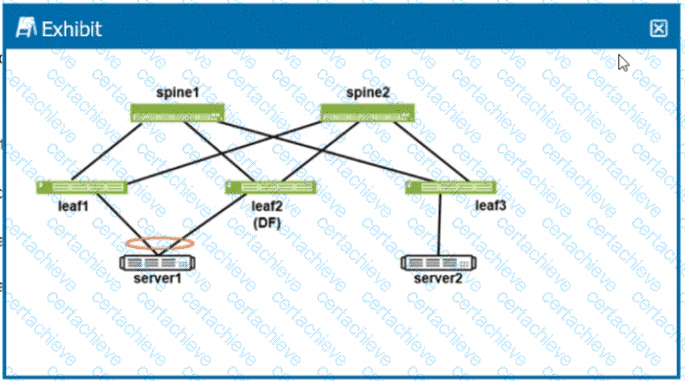
Referring to the exhibit. Ieaf2 is elected the designated forwarder
Which two statements are correct if server2 generates a broadcast frame*? (Choose two.)
Correct Answer & Rationale:
Answer: A, C
Explanation:
The exhibit illustrates an EVPN-VXLAN fabric using multi-homing. Server1 is dual-homed to Leaf1 and Leaf2 using an Ethernet Segment Identifier (ESI) in an active-active or active-standby configuration. Server2 is single-homed to Leaf3.
In EVPN environments, specific mechanisms are used to prevent loops and duplicate traffic when dealing with Broadcast, Unknown Unicast, and Multicast (BUM) traffic:
Broadcast Propagation (Option A): When Server2 (connected to Leaf3) generates a broadcast frame, Leaf3 encapsulates this traffic into a VXLAN tunnel and forwards it to all other VTEPs (Virtual Tunnel End Points) that participate in that specific Virtual Network Instance (VNI). Therefore, both Leaf1 and Leaf2 will receive the broadcast frame from the core fabric.
Designated Forwarder (DF) Election (Option C): To prevent a multi-homed device (like Server1) from receiving duplicate copies of the same broadcast frame from multiple leaf switches, EVPN utilizes a Designated Forwarder (DF). For a given ESI, only one leaf switch is elected as the DF.
The exhibit explicitly states that Leaf2 is the Designated Forwarder.
According to the Junos EVPN implementation, only the DF is responsible for decapsulating BUM traffic received from the core and forwarding it to the local access segment.
While Leaf1 receives the frame (Option A), it will see that it is not the DF for that segment and will drop the frame rather than forwarding it to Server1. This ensures Server1 receives exactly one copy of the broadcast, delivered by Leaf2.
Option B is incorrect because in a standard ingress replication or multicast-based underlay, all VTEPs in the VNI receive the broadcast.
Option D is incorrect because Leaf1 is the non-designated forwarder (non-DF) for this segment and is prohibited from forwarding BUM traffic to the ESI.
Question 3
Juniper JN0-650
QUESTION DESCRIPTION:
Exhibit.
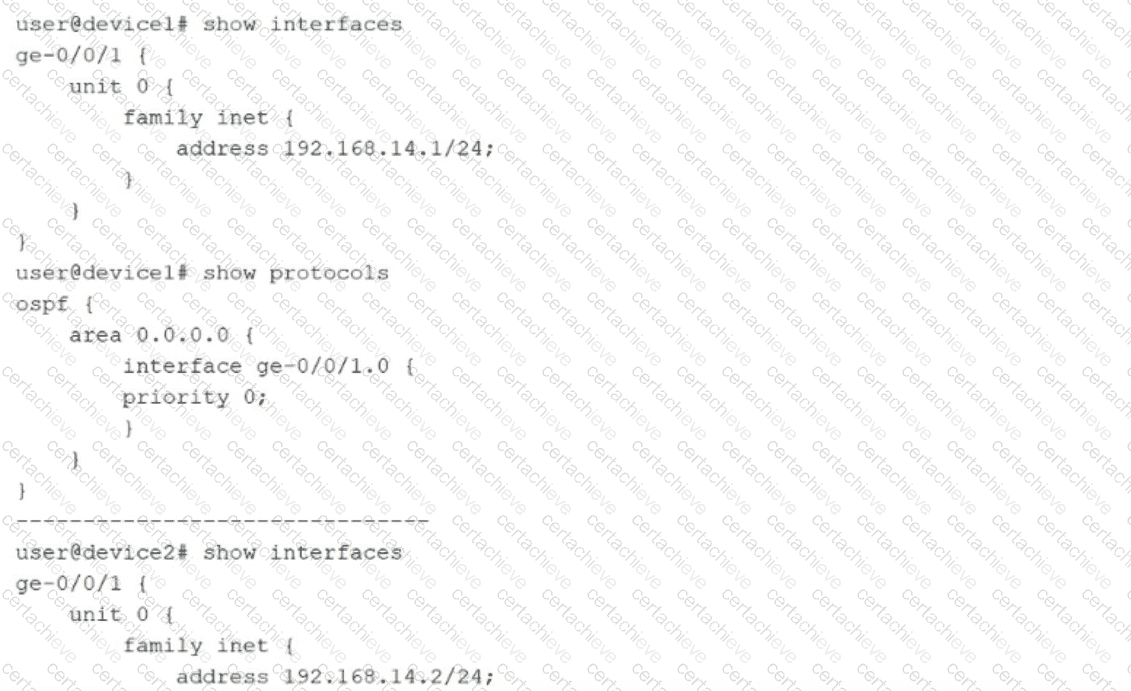
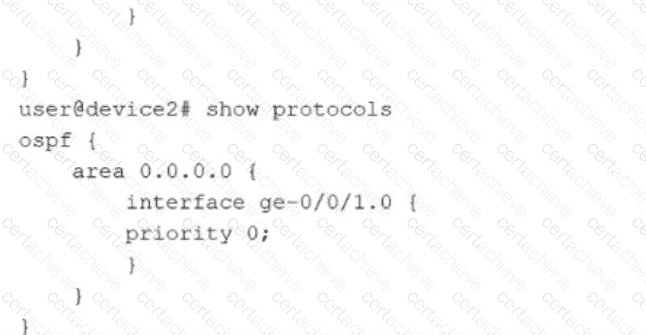
Referring to the exhibit, which statement is correct?
Correct Answer & Rationale:
Answer: C
Explanation:
In OSPF, the election of a Designated Router (DR) and a Backup Designated Router (BDR) is mandatory on broadcast and non-broadcast multi-access (NBMA) network types to manage link-state database synchronization efficiently.
The exhibit shows that both device1 and device2 have their OSPF interface priority explicitly set to 0. According to the Junos OS 24.4 OSPF implementation:
Ineligibility (Priority 0): A router with a priority of 0 is strictly ineligible to be elected as a DR or BDR for that segment.
No Election Possible: When every router on a broadcast segment has a priority of 0, the election process cannot complete because there are no eligible candidates to fill the required roles.
State Behavior (Stuck in 2-Way): In OSPF adjacency formation, the 2-Way state indicates that bidirectional communication has been established (each router has seen itself in the other ' s Hello packets). However, to progress to the Exstart and Exchange states on a multi-access network, routers must first identify a DR and BDR.
Result: Since neither router can become the DR, they both wait indefinitely for a third party (with priority > 0) to take the lead. Consequently, the OSPF adjacency will be stuck in the 2-Way state. Adjacencies only reach the Full state with the DR and BDR; routers in a " DROther " role remain in 2-Way with each other.
Option A and D are incorrect because the router ID (IP address) only acts as a tiebreaker if priorities are equal and greater than 0. Option B is incorrect because routers cannot reach the Exstart state (where they negotiate master/slave for database exchange) without first having a DR/BDR elected.
Question 4
Juniper JN0-650
QUESTION DESCRIPTION:
You are troubleshooting a multicast deployment in a network. Some multicast groups operate in PIM-ASM mode and others operate in PIM-SSM mode. While troubleshooting, you note the following:
- The network uses IGMPv2 for some segments and IGMPv3 for others.
- For group 232.1.1.1, receivers know the exact source IP of the multicast sender
- For group 239.10.10.10. receivers do not know the source address in advance.
Which two statements correctly describe the operational differences between these two modes in Junos OS? (Choose two.)
Correct Answer & Rationale:
Answer: A, D
Explanation:
Junos OS 24.4 handles multicast traffic using two distinct models based on whether the source is known in advance.
Knowledge and Sources (Option A): PIM-ASM (Any Source Multicast) is designed for " many-to-many " communication where receivers join a group ($*,G$) and rely on a Rendezvous Point (RP) to discover active sources. In contrast, PIM-SSM (Source-Specific Multicast) is for " one-to-many " scenarios where receivers must already know the exact source IP ($S,G$) before joining.
Protocol and RP Logic (Option D): PIM-SSM bypasses the RP entirely. It relies on IGMPv3 messages from the host, which explicitly include both the source address and the group address. This allows the last-hop router to build a Shortest Path Tree (SPT) directly toward the source immediately.
Register Process (Option B): While PIM-ASM does use registers, it is the First-Hop Router (Designated Router on the source segment) that sends the register to the RP, not the receiver ' s DR.
RP Role (Option C): This is exactly backwards; PIM-ASM requires an RP for source discovery, whereas PIM-SSM does not use one at all.
Question 5
Juniper JN0-650
QUESTION DESCRIPTION:
Exhibit
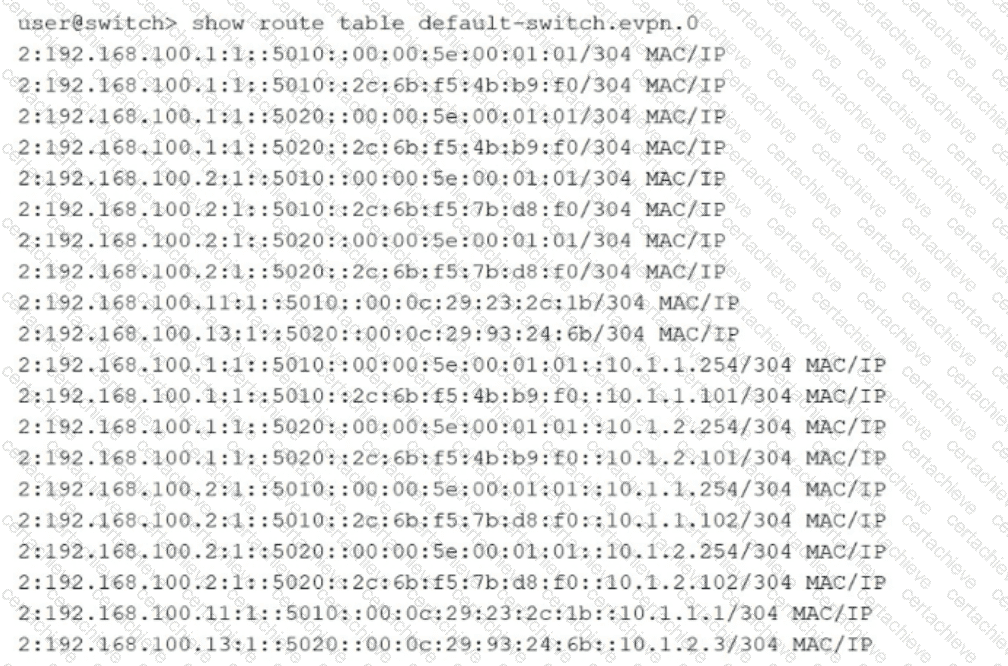
Referring to the exhibit output, which statement is correct?
Correct Answer & Rationale:
Answer: C
Explanation:
The exhibit displays the default-switch.evpn.0 routing table, which is used on Juniper leaf devices to store EVPN Type 2 (MAC/IP) routes.
Route Distinguisher (Option C): In EVPN, the Route Distinguisher (RD) is an 8-byte prefix added to a route to make it unique within the BGP control plane. The RD format in the exhibit is < IP-Address > : < Identifier > .
For example, the prefix 2:192.168.100.1:1::5010::... indicates an EVPN Type 2 route (2:) where 192.168.100.1:1 is the Route Distinguisher.
This RD identifies the specific routing instance on the originating VTEP that advertised the MAC/IP address.
Option A is incorrect: The RD 192.168.100.2:1 does not necessarily mean the host device has that IP; it means the originating switch has that router ID/IP used for its RD.
Option B is incorrect: While the RD often incorporates the router ID, the RD itself is the full string (e.g., 192.168.100.1:1), which is distinct from the raw Router ID used in the BGP summary.
Option D is incorrect: Looking at the entries for 10.1.1.1 and 10.1.2.3, they are associated with different identifiers in the RD strings (5010 and 5020 respectively), which typically map to different VNIs or bridge domains.
Question 6
Juniper JN0-650
QUESTION DESCRIPTION:
You want to implement a system in your network to simplify VLAN management that can also dynamically create and prune VLANs. How would you accomplish this task?
Correct Answer & Rationale:
Answer: C
Explanation:
To simplify VLAN management and automate the creation and pruning of VLANs across a network, Juniper utilizes the Multiple VLAN Registration Protocol (MVRP).
MVRP on Trunk Interfaces (Option C): MVRP is the IEEE 802.1ak standard that replaces the older, proprietary GVRP. It is designed to run on trunk interfaces between switches.
Dynamic Creation: When a VLAN is added to one switch, MVRP advertises its existence to neighboring switches. If those switches need to reach that VLAN, they can dynamically create it in their database.
Pruning: If a switch no longer has any active ports or downstream neighbors interested in a specific VLAN, it stops advertising that VLAN on its trunks. This " prunes " the VLAN traffic from those links, saving bandwidth.
Incorrect Options: Option A and B are incorrect because GVRP is legacy and no longer the recommended protocol for modern Junos deployments. Option D is incorrect because MVRP is meant for inter-switch trunk links to manage the fabric, not for edge access ports where VLAN membership is usually static.
Question 7
Juniper JN0-650
QUESTION DESCRIPTION:
Your OSPF network consists of a mix of 1GbE and 10GbE interfaces. By default, all interfaces have the same cost in your OSPF network. You are asked to ensure that the 10GbE interfaces are more preferred when available
In this scenario, which two statements would accomplish this behavior? (Choose two.)
Correct Answer & Rationale:
Answer: A, D
Explanation:
OSPF determines the best path to a destination by calculating the metric (cost) of each link. By default, Junos OS uses a reference bandwidth of 100 Mbps to calculate this cost using the formula:
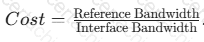
When the reference bandwidth is left at the default 100 Mbps, any interface with a speed of 100 Mbps or higher (including 1 GbE and 10 GbE) is assigned a cost of 1 because the minimum OSPF cost is 1. This results in equal-cost paths, preventing the router from preferring the faster 10 GbE link.
To ensure 10 GbE interfaces are preferred, you must create a cost differential:
Option A (Reference Bandwidth): By increasing the reference bandwidth to 10G (or higher), the calculation changes. For a 10 GbE link, the cost becomes $10,000 / 10,000 = 1$. For a 1 GbE link, the cost becomes $10,000 / 1,000 = 10$. Since OSPF prefers the path with the lowest cumulative cost, the 10 GbE link is now preferred.
Option D (Manual Metric): You can manually override the automatic cost calculation by assigning a higher metric specifically to the 1 GbE interfaces. If a 1 GbE interface is manually set to a cost of 50 and the 10 GbE interface remains at 1 (or is set to a lower value), the router will prioritize the 10 GbE path.
Option B is incorrect because a higher metric makes a path less preferred. Option C is incorrect because a 1G reference bandwidth would still result in both 1 GbE and 10 GbE interfaces having a cost of 1.
Question 8
Juniper JN0-650
QUESTION DESCRIPTION:
Exhibit
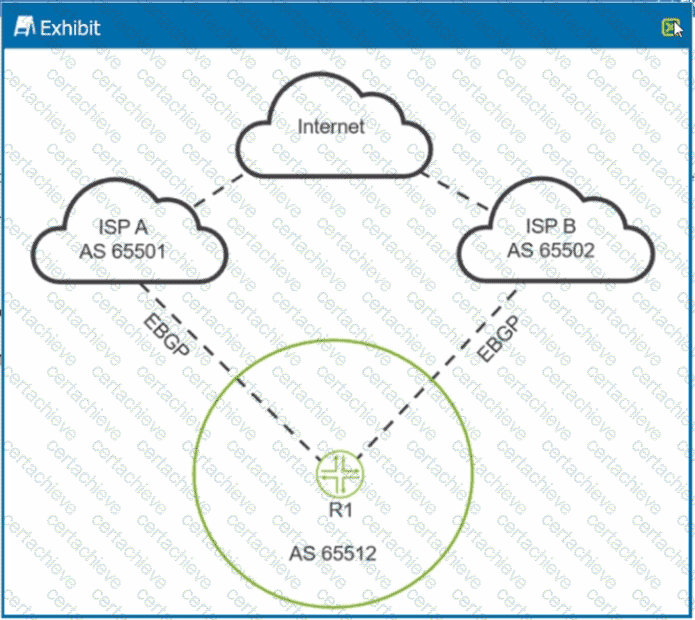
You are receiving the same BGP Internet routes on R1 from both upstream ISPs. You are asked to load-balance traffic destined to the Internet across both ISPs.
Referring to the exhibit, which BGP solution should you use?
Correct Answer & Rationale:
Answer: B
Explanation:
In standard BGP operations, a router typically selects only one " best path " for a given destination prefix and installs that single path into the forwarding table. To utilize multiple paths for traffic forwarding (load-balancing), specific multipath features must be enabled.
BGP Multipath: This feature allows a router to install multiple equal-cost paths into the routing and forwarding tables. However, by default, BGP multipath requires that all candidate paths have the same neighboring Autonomous System (AS).
Multipath Multiple-AS (Option B): In the exhibit, R1 is receiving routes from ISP A (AS 65501) and ISP B (AS 65502). Since these are two different neighboring ASs, the standard multipath feature is not sufficient. You must use the multipath multiple-as statement under the BGP group or neighbor hierarchy. This tells Junos to consider paths as equal even if they originate from different neighboring ASs, provided all other BGP path selection attributes (Local Preference, AS Path length, Origin, MED, etc.) are identical.
Why other options are incorrect: * Option A (multihop) is used for peering with routers that are not directly connected.
Option C (prefix limit) is a security and stability feature to limit the number of prefixes received from a neighbor.
Option D (damping) is used to penalize unstable, " flapping " routes to prevent constant routing table churn.
Configuration Example for Junos OS 24.4: To implement this on R1, you would use the following configuration:
set protocols bgp group < group-name > multipath multiple-as
Question 9
Juniper JN0-650
QUESTION DESCRIPTION:
A modified deficit round-robin scheduler is defined by which two variables? (Choose two.)
Correct Answer & Rationale:
Answer: A, C
Explanation:
In Junos OS Class of Service (CoS), a scheduler is the mechanism used to assign resources to the various egress queues on an interface. Specifically, when utilizing a modified deficit round-robin (MDRR) or weighted round-robin algorithm to service these queues, the scheduler ' s behavior is defined by two primary variables:
Transmit Rate (Option A): This variable defines the minimum guaranteed bandwidth for a queue. In the context of a deficit round-robin algorithm, the transmit rate serves as the weight for the queue. Queues with higher transmit rates receive a larger " quantum " of data they can send during each round-robin cycle compared to queues with lower rates.
Buffer Size (Option C): This variable defines the amount of memory (buffer space) allocated to the queue. It ensures that the queue can hold a certain amount of delayed traffic during periods of congestion to prevent immediate packet drops. The buffer size can be configured as a percentage of the total interface buffer or as a temporal value.
Why other options are incorrect:
Layer 2 and Layer 3 fields (Options B & D): These fields are utilized by classifiers (Behavior Aggregate or Multifield) to identify and group traffic into forwarding classes. They are used before the scheduling process begins and do not define the resource allocation of the scheduler itself.
Question 10
Juniper JN0-650
QUESTION DESCRIPTION:
Which two EVPN types advertise an ESI without advertising a MAC address? (Choose two.)
Correct Answer & Rationale:
Answer: A, D
Explanation:
In an EVPN-VXLAN environment, different BGP route types serve distinct purposes in building the control plane. The Ethernet Segment Identifier (ESI) is a unique 10-byte identifier used to represent a multi-homed segment.
Type 1: Ethernet Auto-Discovery (A-D) Route (Option A): This route type is essential for multi-homing scenarios. It carries the ESI to support features like fast convergence and aliasing. By advertising an A-D route per Ethernet Segment, a PE tells other routers that it is connected to that specific ESI. It does not carry individual host MAC addresses; instead, it provides a " mass withdraw " mechanism to quickly update paths if the entire segment goes down.
Type 4: Ethernet Segment Route (Option D): This route is used exclusively for Designated Forwarder (DF) election. It advertises the existence of an ESI and the ES-Import Route Target to all other PE routers. This allows PE routers connected to the same multi-homed segment to discover each other automatically and elect a DF to handle BUM traffic. Like Type 1, it focuses on the segment identity and does not include MAC addresses.
Type 2: MAC/IP Advertisement Route (Option B): This is the primary route used for host reachability. It must include a MAC address (and optionally an IP). While it also includes the ESI to indicate which segment the host is behind, its primary function is MAC advertisement.
Type 3: Inclusive Multicast Ethernet Tag Route (Option C): This route is used for VTEP discovery and building the replication list for BUM traffic. It identifies the VTEP ' s IP and the VNI, but it does not carry the ESI or MAC addresses.

Verified by Certified Instructors
This Juniper JN0-650 study pack was audited and verified on September 23, 2026 by Radia Davenport,. We ensure every technical rationale aligns with real-world enterprise standards.
A Stepping Stone for Enhanced Career Opportunities
Your profile having JNCIP-ENT certification significantly enhances your credibility and marketability in all corners of the world. The best part is that your formal recognition pays you in terms of tangible career advancement. It helps you perform your desired job roles accompanied by a substantial increase in your regular income. Beyond the resume, your expertise imparts you confidence to act as a dependable professional to solve real-world business challenges.
Your success in Juniper JN0-650 certification exam makes your visible and relevant in the fast-evolving tech landscape. It proves a lifelong investment in your career that give you not only a competitive advantage over your non-certified peers but also makes you eligible for a further relevant exams in your domain.
What You Need to Ace Juniper Exam JN0-650
Achieving success in the JN0-650 Juniper exam requires a blending of clear understanding of all the exam topics, practical skills, and practice of the actual format. There's no room for cramming information, memorizing facts or dependence on a few significant exam topics. It means your readiness for exam needs you develop a comprehensive grasp on the syllabus that includes theoretical as well as practical command.
Here is a comprehensive strategy layout to secure peak performance in JN0-650 certification exam:
- Develop a rock-solid theoretical clarity of the exam topics
- Begin with easier and more familiar topics of the exam syllabus
- Make sure your command on the fundamental concepts
- Focus your attention to understand why that matters
- Ensure hands-on practice as the exam tests your ability to apply knowledge
- Develop a study routine managing time because it can be a major time-sink if you are slow
- Find out a comprehensive and streamlined study resource for your help
Ensuring Outstanding Results in Exam JN0-650!
In the backdrop of the above prep strategy for JN0-650 Juniper exam, your primary need is to find out a comprehensive study resource. It could otherwise be a daunting task to achieve exam success. The most important factor that must be kep in mind is make sure your reliance on a one particular resource instead of depending on multiple sources. It should be an all-inclusive resource that ensures conceptual explanations, hands-on practical exercises, and realistic assessment tools.
Certachieve: A Reliable All-inclusive Study Resource
Certachieve offers multiple study tools to do thorough and rewarding JN0-650 exam prep. Here's an overview of Certachieve's toolkit:
Juniper JN0-650 PDF Study Guide
This premium guide contains a number of Juniper JN0-650 exam questions and answers that give you a full coverage of the exam syllabus in easy language. The information provided efficiently guides the candidate's focus to the most critical topics. The supportive explanations and examples build both the knowledge and the practical confidence of the exam candidates required to confidently pass the exam. The demo of Juniper JN0-650 study guide pdf free download is also available to examine the contents and quality of the study material.
Juniper JN0-650 Practice Exams
Practicing the exam JN0-650 questions is one of the essential requirements of your exam preparation. To help you with this important task, Certachieve introduces Juniper JN0-650 Testing Engine to simulate multiple real exam-like tests. They are of enormous value for developing your grasp and understanding your strengths and weaknesses in exam preparation and make up deficiencies in time.
These comprehensive materials are engineered to streamline your preparation process, providing a direct and efficient path to mastering the exam's requirements.
Juniper JN0-650 exam dumps
These realistic dumps include the most significant questions that may be the part of your upcoming exam. Learning JN0-650 exam dumps can increase not only your chances of success but can also award you an outstanding score.
I passed the JN0-650 exam after using these accurate Practice Questions. The explanations helped me understand data center deployment, automation, and network management topics clearly.
Zoe Cooper
Jun 7, 2026
Top Exams & Certification Providers
New & Trending
- New Released Exams
- Related Exam
- Hot Vendor