
The Enterprise Routing and Switching Specialist (JNCIS-ENT) (JN0-351)
Passing Juniper JNCIS-ENT exam ensures for the successful candidate a powerful array of professional and personal benefits. The first and the foremost benefit comes with a global recognition that validates your knowledge and skills, making possible your entry into any organization of your choice.


JN0-351 Exam Dumps
- Exam Code: JN0-351
- Vendor: Juniper
- Certifications: JNCIS-ENT
- Exam Name: Enterprise Routing and Switching Specialist (JNCIS-ENT)
Why CertAchieve is Better than Standard JN0-351 Dumps
In 2026, Juniper uses variable topologies. Basic dumps will fail you.
| Quality Standard | Generic Dump Sites | CertAchieve Premium Prep |
|---|---|---|
| Technical Explanation | None (Answer Key Only) | Step-by-Step Expert Rationales |
| Syllabus Coverage | Often Outdated (v1.0) | 2026 Updated (Latest Syllabus) |
| Scenario Mastery | Blind Memorization | Conceptual Logic & Troubleshooting |
| Instructor Access | No Post-Sale Support | 24/7 Professional Help |
Customers Passed Exams
10
Success backed by proven exam prep tools
Questions Came Word for Word
94%
Real exam match rate reported by verified users
Average Score in Real Testing Centre
88%
Consistently high performance across certifications
Study Time Saved With CertAchieve
60%
Efficient prep that reduces study hours significantly
Coverage of Official Juniper JN0-351 Exam Domains
Our curriculum is meticulously mapped to the Juniper official blueprint.
Layer 2 Switching, VLANs & Spanning Tree
The "Campus" foundation. Master the mechanics of bridging, frame processing, and VLAN tagging (802.1Q). Focus on inter-VLAN routing using IRB interfaces. Deep dive into Spanning Tree Protocol (STP) variants, specifically RSTP and MSTP. Learn to secure the topology using BPDU Protection, Root Protection, and Loop Protection to ensure a loop-free, redundant environment.
Layer 2 Security & Firewall Filters
The "Access" layer. Master the methodologies for securing the local link. Focus on DHCP Snooping, Dynamic ARP Inspection (DAI), and IP Source Guard. Understand the application of MACsec for link-layer encryption and the use of Layer 2 Firewall Filters to control transit and exception traffic. Learn to mitigate broadcast storms using Storm Control policies.
OSPF, IS-IS & BGP Routing Protocols
The "Backbone" engine. This is the most technically dense area of the exam. Master OSPFv2/v3 (multi-area, LSA types, and DR/BDR election) and the nuances of IS-IS levels. For BGP, focus on the path selection process, attribute manipulation (Local Pref, MED, AS-Path), and the differences between IBGP and EBGP peerings. Learn to apply complex Routing Policies to control route advertisement and acceptance.
Protocol-Independent Routing & Tunnels
The "Connectivity" core. Master the configuration of static, aggregate, and generated routes. Focus on Load Balancing and Filter-Based Forwarding (FBF). Understand the implementation of IP Tunneling using GRE and IP-IP encapsulation to solve reachability issues across heterogeneous networks. Learn to manage "Martian" addresses and RIB groups for multi-table routing scenarios.
High Availability (HA) & Virtual Chassis
The "Resilience" domain. Master the tools that keep the network running during hardware failures. Focus on Virtual Chassis technology, Link Aggregation Groups (LAG), and Redundant Trunk Groups (RTG). Learn to implement non-disruptive failover using GRES (Graceful RE Switchover), NSR (Nonstop Active Routing), and VRRP for gateway redundancy.
Juniper JN0-351 Exam Domains Q&A
Certified instructors verify every question for 100% accuracy, providing detailed, step-by-step explanations for each.
Question 1
Juniper JN0-351
QUESTION DESCRIPTION:
You are asked to explore adding BGP route reflectors to allow for increased scale in your core network. Which statement is correct in this scenario?
Correct Answer & Rationale:
Answer: B
Explanation:
A route reflector is a BGP router that is allowed to break the iBGP loop avoidance rule and advertise routes received from an iBGP peer to another iBGP peer under specific conditions 1 . A route reflector can have three types of peerings: EBGP neighbor, IBGP client neighbor, and IBGP non-client neighbor 2 . A cluster is a group of route reflectors and their clients that are fully meshed 3 . The cluster ID is a 4-byte value that identifies the route reflector cluster and is carried in the ORIGINATOR_ID attribute of the BGP update message 4 . The cluster ID is used to prevent routing loops among route reflectors and their clients. If a route reflector receives a route with its own cluster ID, it discards the route 5 . Therefore, the cluster ID is required to prevent routing loops when using route reflectors.
[References:, 1: What is BGP Route Reflector - Explanation & Discussion (Cisco Example), 2: BGP Route Reflector - NetworkLessons.com, 3: BGP Route Reflectors (RR) - Cisco Community, 4: Junos OS Routing Protocols Library for Routing Devices, 5: Junos OS Routing Protocols Library for Routing Devices, , ]
Question 2
Juniper JN0-351
QUESTION DESCRIPTION:
Which statement about the default action of MAC limiting is true when the number of MAC addresses has hit the limit set?
Correct Answer & Rationale:
Answer: B
Explanation:
According to the Juniper documentation 1 , MAC limiting is a feature that enhances port security by limiting the number of MAC addresses that can be learned within a VLAN. When the MAC limit is exceeded, the switch can perform different actions, such as ignoring, dropping, logging, shutting down, or disabling the offending port. The default action is to drop the packets with new MAC addresses and log a message 2 . Therefore, the correct answer is B.
The other options are not correct because:
A. The switch will not shut down the offending port for five minutes by default. This is a configurable action, but not the default one 2 .
C. The switch will not flood traffic out of all ports for the offending MAC address by default. This is a possible consequence of ignoring the packets with new MAC addresses, but not the default action 2 .
D. The switch will not shut down MAC learning on the offending port for five minutes by default. This is another configurable action, but not the default one 2 .
[References: Understanding MAC Limiting and MAC Move Limiting | Junos OS, Configuring MAC Limiting | Junos OS, , ]
Question 3
Juniper JN0-351
QUESTION DESCRIPTION:
Which two statements are correct about using firewall filters on EX Series switches? (Choose two.)
Correct Answer & Rationale:
Answer: A, C
Explanation:
A is correct because you can deploy only stateless firewall filters on an EX Series switch. A stateless firewall filter is a filter that evaluates each packet individually based on the header information, such as source and destination addresses, protocol, and port numbers 1 . A stateless firewall filter does not keep track of the state or context of a packet flow, such as the sequence number, flags, or session information 1 . EX Series switches support only stateless firewall filters, which are also called access control lists (ACLs) or packet filters 2 .
C is correct because you can apply firewall filters to both Layer 2 and Layer 3 traffic on an EX Series switch. Layer 2 traffic is traffic that is switched within a VLAN or a bridge domain, while Layer 3 traffic is traffic that is routed between VLANs or networks 3 . EX Series switches support three types of firewall filters: port (Layer 2) firewall filters, VLAN firewall filters, and router (Layer 3) firewall filters 4 . You can apply these filters to different interfaces and directions to control the traffic entering or exiting the switch.
Question 4
Juniper JN0-351
QUESTION DESCRIPTION:
Exhibit
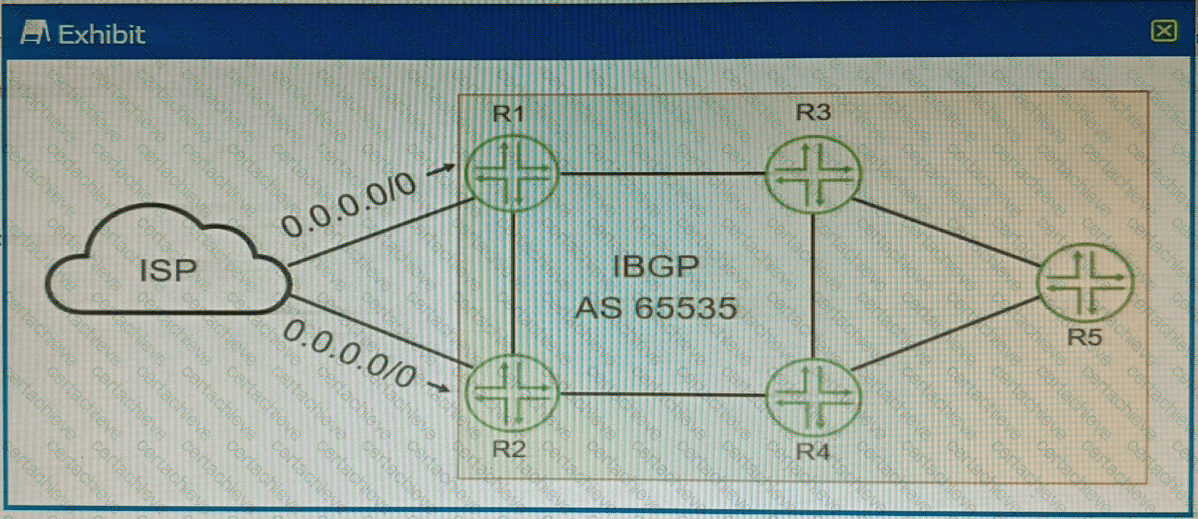
Your ISP is announcing a default route to both R1 and R2. You want your network routers to forward all Internet traffic through the R1 device
Which BGP attribute would you use?
Correct Answer & Rationale:
Answer: C
Explanation:
The BGP attribute that you would use to forward all Internet traffic through the R1 device is the local preference 1 .
The local preference is an attribute that is used within an autonomous system (AS) and exchanged between iBGP routers 1 . It is used to select an exit point from the AS 1 . The path with the highest local preference is preferred 1 . By setting a higher local preference for the routes received from R1, you can make R1 the preferred exit point for all Internet traffic 1 .
Question 5
Juniper JN0-351
QUESTION DESCRIPTION:
You are asked to create a default route that will be advertised to your internal OSPF neighbors. You have three upstream connections to the Internet and you must ensure that when available, all traffic uses ISP1 as your primary connection and only uses ISP2 and ISP3 when ISP1 is not available.
Which solution should you implement in this scenario?
Correct Answer & Rationale:
Answer: A
Explanation:
The solution that should be implemented in this scenario is to create a default generate route that includes an import policy to match BGP routes from ISP1 and assign a preference value of four or less. This way, the default route will be advertised to the internal OSPF neighbors only when there is a BGP route from ISP1 in the routing table, and it will have a higher preference than any other default route from ISP2 or ISP3. If ISP1 is not available, the default generate route will be withdrawn and the traffic will use the next available default route from ISP2 or ISP3.
Option A is incorrect because creating a default static route with ISP1’s address as the next hop while specifying the addresses for ISP2 and ISP3 as qualified next hops with a preference value of six or higher will not ensure that the default route is advertised to the internal OSPF neighbors only when ISP1 is available. The default static route will always be in the routing table regardless of the availability of ISP1, and it will have a lower preference than any other default route from ISP2 or ISP3.
Option C is incorrect because creating a default static route with each neighbor address as the next hop will not ensure that all traffic uses ISP1 as the primary connection and only uses ISP2 and ISP3 when ISP1 is not available. The default static route will always be in the routing table regardless of the availability of ISP1, and it will load balance the traffic among the three ISPs.
Option D is incorrect because creating a default aggregated route will not ensure that the default route is advertised to the internal OSPF neighbors only when ISP1 is available. The default aggregated route will always be in the routing table regardless of the availability of ISP1, and it will not have any preference value associated with it. References:
Enterprise Routing and Switching, Specialist (JNCIS-ENT) - Juniper Networks
Enterprise Routing and Switching, Specialist (JNCIS-ENT) - Juniper Networks
Question 6
Juniper JN0-351
QUESTION DESCRIPTION:
Which two BGP attributes must be supported by all BGP implementations and must be included in every update? (Choose two.)
Correct Answer & Rationale:
Answer: A, C
Explanation:
BGP attributes are properties that BGP uses for route advertisement, path selection, and loop prevention 1 . There are four categories of BGP attributes 1 2 3 :
Well-known mandatory: Must be recognized by all BGP routers, present in all BGP updates, and passed on to other BGP routers 1 2 3 .
Well-known discretionary: Supported by all BGP implementations, and are optionally included in BGP updates 1 .
Optional transitive: May not be supported by all implementations of BGP 1 .
Optional non-transitive: May not be supported by all implementations of BGP 1 .
The well-known mandatory attributes must be supported by all BGP implementations and must be included in every update 1 2 3 . These include the AS path and next hop attributes 2 3 . Therefore, options A and C are correct.
Question 7
Juniper JN0-351
QUESTION DESCRIPTION:
Exhibit.
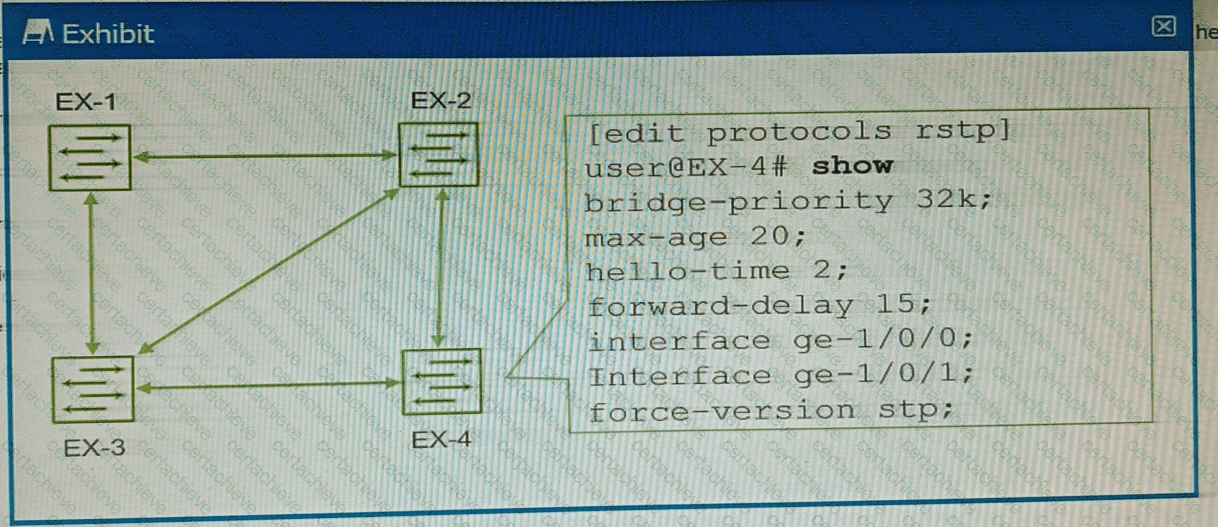
You have configured the four EX Series switches with RSTP, as shown in the exhibit. You discover that whenever a link between switches goes up or down, the switches take longer than expected for RSTP to converge, using the default settings.
In this scenario, which action would solve the delay in RSTP convergence?
Correct Answer & Rationale:
Answer: B
Explanation:
The exhibit shows the configuration of RSTP on EX-4, which has the command force-version stp . This command forces the switch to use the legacy STP protocol instead of RSTP, even though the switch supports RSTP 1 . This means that EX-4 will not be able to take advantage of the faster convergence and enhanced features of RSTP, such as edge ports, link type, and proposal/agreement sequence 2 .
The other switches in the network are likely to be running RSTP, as it is the default protocol for EX Series switches 3 . Therefore, there will be a compatibility issue between EX-4 and the other switches, which will result in longer convergence times and suboptimal performance. The switch will also generate a warning message that says “Warning: STP version mismatch with neighbor” when it receives a BPDU from a RSTP neighbor 1 .
To solve this problem, the force-version command must be removed from EX-4, so that it can run RSTP natively and interoperate with the other switches in the network. This will enable faster convergence and better stability for the network topology. To remove the command, you can use the delete protocols rstp force-version command in configuration mode 1 .
Question 8
Juniper JN0-351
QUESTION DESCRIPTION:
Which statement is correct about the IS-IS ISO NET address?
Correct Answer & Rationale:
Answer: B
Explanation:
An ISO NET address is a type of network address used by the IS-IS routing protocol. It identifies a point of connection to the network, such as a router interface, and is also called a Network Service Access Point (NSAP) 1 .
An ISO NET address consists of three parts: an area ID, a system ID, and a selector 2 . The area ID identifies the IS-IS area to which the device belongs. The system ID uniquely identifies the device within the area. The selector identifies a specific service or function on the device, such as routing or management 2 .
An ISO NET address must be unique for each device in the network, because it is used by IS-IS to establish adjacencies, exchange routing information, and compute shortest paths 2 . If two devices have the same ISO NET address, they will not be able to communicate with each other or with other devices in the network. Therefore, it is important to assign different ISO NET addresses to each device in the network.
Question 9
Juniper JN0-351
QUESTION DESCRIPTION:
Which three protocols support BFD? (Choose three.)
Correct Answer & Rationale:
Answer: B, C, D
Explanation:
BFD is a protocol that can be used to quickly detect failures in the forwarding path between two adjacent routers or switches. BFD can be integrated with various routing protocols and link aggregation protocols to provide faster convergence and fault recovery.
According to the Juniper Networks documentation, the following protocols support BFD on Junos OS devices 1 :
BGP: BFD can be used to monitor the connectivity between BGP peers and trigger a session reset if a failure is detected. BFD can be configured for both internal and external BGP sessions, as well as for IPv4 and IPv6 address families 2 .
OSPF: BFD can be used to monitor the connectivity between OSPF neighbors and trigger a state change if a failure is detected. BFD can be configured for both OSPFv2 and OSPFv3 protocols, as well as for point-to-point and broadcast network types 3 .
LACP: BFD can be used to monitor the connectivity between LACP members and trigger a link state change if a failure is detected. BFD can be configured for both active and passive LACP modes, as well as for static and dynamic LAGs 4 .
Other protocols that support BFD on Junos OS devices are:
IS-IS: BFD can be used to monitor the connectivity between IS-IS neighbors and trigger a state change if a failure is detected. BFD can be configured for both level 1 and level 2 IS-IS adjacencies, as well as for point-to-point and broadcast network types.
RIP: BFD can be used to monitor the connectivity between RIP neighbors and trigger a route update if a failure is detected. BFD can be configured for both RIP version 1 and version 2 protocols, as well as for IPv4 and IPv6 address families.
VRRP: BFD can be used to monitor the connectivity between VRRP routers and trigger a priority change if a failure is detected. BFD can be configured for both VRRP version 2 and version 3 protocols, as well as for IPv4 and IPv6 address families.
The protocols that do not support BFD on Junos OS devices are:
RSTP: RSTP is a spanning tree protocol that provides loop prevention and rapid convergence in layer 2 networks. RSTP does not use BFD to detect link failures, but relies on its own hello mechanism that sends BPDU packets every 2 seconds by default.
FTP: FTP is an application layer protocol that is used to transfer files between hosts over a TCP connection. FTP does not use BFD to detect connection failures, but relies on TCP’s own retransmission and timeout mechanisms.
[References:, 1: [Configuring Bidirectional Forwarding Detection] 2: [Configuring Bidirectional Forwarding Detection for BGP] 3: [Configuring Bidirectional Forwarding Detection for OSPF] 4: [Configuring Bidirectional Forwarding Detection for Link Aggregation Control Protocol] : [Configuring Bidirectional Forwarding Detection for IS-IS] : [Configuring Bidirectional Forwarding Detection for RIP] : [Configuring Bidirectional Forwarding Detection for VRRP] : [Understanding Rapid Spanning Tree Protocol] : [Understanding FTP], ]
Question 10
Juniper JN0-351
QUESTION DESCRIPTION:
You implemented the MAC address limit feature with the shutdown action on all interfaces on your switch.
In this scenario, which statement is correct when a violation occurs?
Correct Answer & Rationale:
Answer: A
Explanation:
When the MAC address limit feature with the shutdown action is implemented on a switch, if a violation occurs, the interface is disabled and a system log entry is generated 1 . If the switch has been configured with the port-error-disable statement, the disabled interface recovers automatically upon expiration of the specified disable timeout 1 . However, if the switch has not been configured for auto-recovery from port error disabled conditions, you must manually clear the violation by running the clear ethernet-switching port-error command for the interface to send and receive traffic again 1 . This explanation is based on the Enterprise Routing and Switching Specialist (JNCIS-ENT) documents and learning resources available at Juniper Networks 1 .

Verified by Certified Instructors
This Juniper JN0-351 study pack was audited and verified on September 23, 2026 by Radia Davenport,. We ensure every technical rationale aligns with real-world enterprise standards.
A Stepping Stone for Enhanced Career Opportunities
Your profile having JNCIS-ENT certification significantly enhances your credibility and marketability in all corners of the world. The best part is that your formal recognition pays you in terms of tangible career advancement. It helps you perform your desired job roles accompanied by a substantial increase in your regular income. Beyond the resume, your expertise imparts you confidence to act as a dependable professional to solve real-world business challenges.
Your success in Juniper JN0-351 certification exam makes your visible and relevant in the fast-evolving tech landscape. It proves a lifelong investment in your career that give you not only a competitive advantage over your non-certified peers but also makes you eligible for a further relevant exams in your domain.
What You Need to Ace Juniper Exam JN0-351
Achieving success in the JN0-351 Juniper exam requires a blending of clear understanding of all the exam topics, practical skills, and practice of the actual format. There's no room for cramming information, memorizing facts or dependence on a few significant exam topics. It means your readiness for exam needs you develop a comprehensive grasp on the syllabus that includes theoretical as well as practical command.
Here is a comprehensive strategy layout to secure peak performance in JN0-351 certification exam:
- Develop a rock-solid theoretical clarity of the exam topics
- Begin with easier and more familiar topics of the exam syllabus
- Make sure your command on the fundamental concepts
- Focus your attention to understand why that matters
- Ensure hands-on practice as the exam tests your ability to apply knowledge
- Develop a study routine managing time because it can be a major time-sink if you are slow
- Find out a comprehensive and streamlined study resource for your help
Ensuring Outstanding Results in Exam JN0-351!
In the backdrop of the above prep strategy for JN0-351 Juniper exam, your primary need is to find out a comprehensive study resource. It could otherwise be a daunting task to achieve exam success. The most important factor that must be kep in mind is make sure your reliance on a one particular resource instead of depending on multiple sources. It should be an all-inclusive resource that ensures conceptual explanations, hands-on practical exercises, and realistic assessment tools.
Certachieve: A Reliable All-inclusive Study Resource
Certachieve offers multiple study tools to do thorough and rewarding JN0-351 exam prep. Here's an overview of Certachieve's toolkit:
Juniper JN0-351 PDF Study Guide
This premium guide contains a number of Juniper JN0-351 exam questions and answers that give you a full coverage of the exam syllabus in easy language. The information provided efficiently guides the candidate's focus to the most critical topics. The supportive explanations and examples build both the knowledge and the practical confidence of the exam candidates required to confidently pass the exam. The demo of Juniper JN0-351 study guide pdf free download is also available to examine the contents and quality of the study material.
Juniper JN0-351 Practice Exams
Practicing the exam JN0-351 questions is one of the essential requirements of your exam preparation. To help you with this important task, Certachieve introduces Juniper JN0-351 Testing Engine to simulate multiple real exam-like tests. They are of enormous value for developing your grasp and understanding your strengths and weaknesses in exam preparation and make up deficiencies in time.
These comprehensive materials are engineered to streamline your preparation process, providing a direct and efficient path to mastering the exam's requirements.
Juniper JN0-351 exam dumps
These realistic dumps include the most significant questions that may be the part of your upcoming exam. Learning JN0-351 exam dumps can increase not only your chances of success but can also award you an outstanding score.
Top Exams & Certification Providers
New & Trending
- New Released Exams
- Related Exam
- Hot Vendor