
The Microsoft Azure DevOps Solutions (AZ-400)
Passing Microsoft Microsoft Azure exam ensures for the successful candidate a powerful array of professional and personal benefits. The first and the foremost benefit comes with a global recognition that validates your knowledge and skills, making possible your entry into any organization of your choice.

AZ-400 Exam Dumps
- Exam Code: AZ-400
- Vendor: Microsoft
- Certifications: Microsoft Azure
- Exam Name: Microsoft Azure DevOps Solutions
Why CertAchieve is Better than Standard AZ-400 Dumps
In 2026, Microsoft uses variable topologies. Basic dumps will fail you.
| Quality Standard | Generic Dump Sites | CertAchieve Premium Prep |
|---|---|---|
| Technical Explanation | None (Answer Key Only) | Step-by-Step Expert Rationales |
| Syllabus Coverage | Often Outdated (v1.0) | 2026 Updated (Latest Syllabus) |
| Scenario Mastery | Blind Memorization | Conceptual Logic & Troubleshooting |
| Instructor Access | No Post-Sale Support | 24/7 Professional Help |
Customers Passed Exams
10
Success backed by proven exam prep tools
Questions Came Word for Word
85%
Real exam match rate reported by verified users
Average Score in Real Testing Centre
93%
Consistently high performance across certifications
Study Time Saved With CertAchieve
60%
Efficient prep that reduces study hours significantly
Coverage of Official Microsoft AZ-400 Exam Domains
Our curriculum is meticulously mapped to the Microsoft official blueprint.
Configure Processes and Communications (15%)
The "People and Culture" layer. Master the implementation of agile work management using Azure Boards and GitHub Projects. Focus on designing documentation strategies (Wikis/Readmes), configuring communication integrations (Teams/Slack), and establishing traceability from requirement to code to deployment.
Design and Implement Source Control (20%)
The foundation of the pipeline. Master complex Git branching strategies (Trunk-based, GitFlow). In 2026, this domain focuses heavily on GitHub Advanced Security, managing large repositories, and implementing "InnerSource" patterns across the enterprise to promote code reuse and collaboration.
Design and Implement Build and Release (45%)
The highest-weighted domain. Master the transition from Azure Pipelines to GitHub Actions. Focus on designing multi-stage pipelines, managing secrets (Key Vault/GitHub Secrets), and implementing deployment patterns like Blue/Green, Canary, and Progressive Exposure. Understand how to manage dependencies using Azure Artifacts and GitHub Packages.
Develop a Site Reliability Engineering (SRE) Strategy (15%)
The "Stability" domain. Master the implementation of Infrastructure as Code (IaC) using Bicep, Terraform, and Helm charts. Focus on automating post-deployment configuration, managing environment drift, and implementing "self-healing" infrastructure using Azure Automation and Logic Apps.
Develop an Instrumentation Strategy (15%)
The "Visibility" layer. Master the integration of Azure Monitor and Application Insights. Focus on defining critical metrics (SLIs/SLOs), configuring proactive alerting, and implementing distributed tracing to identify bottlenecks in microservices architectures. Learn to utilize Log Analytics for deep-dive root cause analysis.
Microsoft AZ-400 Exam Domains Q&A
Certified instructors verify every question for 100% accuracy, providing detailed, step-by-step explanations for each.
Question 1
Microsoft AZ-400
QUESTION DESCRIPTION:
You need to perform the GitHub code migration. The solution must support the planned changes for the DevOps environment.
What should you use?
Correct Answer & Rationale:
Answer: A
Explanation:
Woodgrove Bank plans to implement the following changes to the DevOps environment:
Migrate all the source code from TFS1 to GitHub.
The Git-TFS tool is a two-way bridge between Team Foundation Version Control and Git, and can be used to perform a migration.
[Reference:, https://docs.microsoft.com/en-us/devops/develop/git/migrate-from-tfvc-to-git, , ]
Question 2
Microsoft AZ-400
QUESTION DESCRIPTION:
You need to meet the technical requirements for controlling access to Azure DevOps.
What should you use?
Correct Answer & Rationale:
Answer: B
Explanation:
Scenario: Access to Azure DevOps must be restricted to specific IP addresses.
Azure DevOps is authenticated through Azure Active Directory. You can use Azure AD ' s conditional access to prevent logins from certain geographies and address ranges.
[Reference:, https://www.rebeladmin.com/2018/08/step-step-guide-configure-location-based-conditional-access-policies/, ]
Question 3
Microsoft AZ-400
QUESTION DESCRIPTION:
You need to configure Azure Pipelines to control App2 builds.
Which authentication method should you use?
Correct Answer & Rationale:
Answer: D
Explanation:
Scenario: Deploy App2 to an Azure virtual machine named VM1.
A personal access token (PAT) is used as an alternate password to authenticate into Azure DevOps.
[Reference:, https://docs.microsoft.com/en-us/azure/devops/organizations/accounts/use-personal-access-tokens-to-authenticate, ]
Question 4
Microsoft AZ-400
QUESTION DESCRIPTION:
Your company uses a Git repository in Azure Repos lo manage the source code of a web application. The master branch is protected from direct updates. Developers work on new features in the topic branches.
Because of the high volume of requested features, it is difficult to follow the history of the changes to the master branch.
You need to enforce a pull request merge strategy. The strategy must meet the following requirements:
• Consolidate commit histories
• Merge tie changes into a tingle commit
Which merge strategy should you use in the branch policy?
Correct Answer & Rationale:
Answer: C
Explanation:
Squash merging is a merge option that allows you to condense the Git history of topic branches when you complete a pull request. Instead of each commit on the topic branch being added to the history of the default branch, a squash merge takes all the file changes and adds them to a single new commit on the default branch.
A simple way to think about this is that squash merge gives you just the file changes, and a regular merge gives you the file changes and the commit history.
Note: Squash merging keeps your default branch histories clean and easy to follow without demanding any workflow changes on your team. Contributors to the topic branch work how they want in the topic branch, and the default branches keep a linear history through the use of squash merges. The commit history of a master branch updated with squash merges will have one commit for each merged branch. You can step through this history commit by commit to find out exactly when work was done.
[References: https://docs.microsoft.com/en-us/azure/devops/repos/git/merging-with-squash, ]
Question 5
Microsoft AZ-400
QUESTION DESCRIPTION:
You have an Azure DevOps project named Project1 and an Azure subscription named Sub1.
You need to prevent releases from being deployed unless the releases comply with the Azure Policy rules assigned to Sub1.
What should you do in the release pipeline of Project1?
Correct Answer & Rationale:
Answer: B
Explanation:
You can check policy compliance with gates.
You can extend the approval process for the release by adding a gate. Gates allow you to configure automated calls to external services, where the results are used to approve or reject a deployment.
You can use gates to ensure that the release meets a wide range or criteria, without requiring user intervention.
[Reference:, https://docs.microsoft.com/en-us/azure/devops/pipelines/release/deploy-using-approvals, , ]
Question 6
Microsoft AZ-400
QUESTION DESCRIPTION:
Note: This question is part of a series of questions that present the same scenario. Each question in the series contains a unique solution that might meet the stated goals. Some question sets might have more than one correct solution, while others might not have a correct solution.
After you answer a question in this section, you will NOT be able to return to it. As a result, these questions will not appear in the review screen.
You have an Azure DevOps project.
Your build process creates several artifacts.
You need to deploy the artifacts to on-premises servers.
Solution: You deploy a Docker build to an on-premises server. You add a Download Build Artifacts task to the deployment pipeline.
Does this meet the goal?
Correct Answer & Rationale:
Answer: B
Explanation:
Instead you should deploy an Azure self-hosted agent to an on-premises server.
Note: To build your code or deploy your software using Azure Pipelines, you need at least one agent.
If your on-premises environments do not have connectivity to a Microsoft-hosted agent pool (which is typically the case due to intermediate firewalls), you ' ll need to manually configure a self-hosted agent on on-premises computer(s).
[References:, https://docs.microsoft.com/en-us/azure/devops/pipelines/agents/agents?view=azure-devops, , ]
Question 7
Microsoft AZ-400
QUESTION DESCRIPTION:
Your company has 60 developers who are assigned to four teams. Each team has 15 members.
The company uses an agile development methodology.
You need to structure the work of the development teams so that each team owns their respective work while working together to reach a common goal.
Which parts of the taxonomy should you enable the team to perform autonomously?
Correct Answer & Rationale:
Answer: A
Explanation:
A feature typically represents a shippable component of software.
Features, examples:
Add view options to the new work hub
Add mobile shopping cart
Support text alerts
Refresh the web portal with new look and feel
User Stories and Tasks are used to track work. Teams can choose how they track bugs, either as requirements or as tasks
[Reference:, https://docs.microsoft.com/en-us/azure/devops/boards/backlogs/define-features-epics, , https://docs.microsoft.com/en-us/azure/devops/boards/work-items/about-work-items, , , ]
Question 8
Microsoft AZ-400
QUESTION DESCRIPTION:
Note: This question is part of a series of questions that present the same scenario. Each question in the series contains a unique solution that might meet the stated goals. Some question sets might have more than one correct solution, while others might not have a correct solution.
After you answer a question in this section, you will NOT be able to return to it. As a result, these
questions will not appear in the review screen.
You need to recommend an integration strategy for the build process of a Java application. The solution must
meet the following requirements:
The builds must access an on-premises dependency management system.
The build outputs must be stored as Server artifacts in Azure DevOps.
The source code must be stored in a Git repository in Azure DevOps.
Solution: Configure an Octopus Tentacle on an on-premises machine. Use the Package Application task in the build pipeline.
Does this meet the goal?
Correct Answer & Rationale:
Answer: A
Explanation:
Octopus Deploy is an automated deployment server that makes it easy to automate deployment of ASP.NET web applications, Java applications, NodeJS application and custom scripts to multiple environments.
Octopus can be installed on various platforms including Windows, Mac and Linux. It can also be integrated with most version control tools including VSTS and GIT.
When you deploy software to Windows servers, you need to install Tentacle, a lightweight agent service, on your Windows servers so they can communicate with the Octopus server.
When defining your deployment process, the most common step type will be a package step. This step deploys your packaged application onto one or more deployment targets.
When deploying a package you will need to select the machine role that the package will be deployed to.
[References:, https://octopus.com/docs/deployment-examples/package-deployments, , https://explore.emtecinc.com/blog/octopus-for-automated-deployment-in-devops-models, ]
Question 9
Microsoft AZ-400
QUESTION DESCRIPTION:
Your company uses Service Now for incident management.
You develop an application that runs on Azure.
The company needs to generate a ticket in Service Now when the application fails to authenticate.
Which Azure Log Analytics solution should you use?
Correct Answer & Rationale:
Answer: B
Explanation:
The IT Service Management Connector (ITSMC) allows you to connect Azure and a supported IT Service Management (ITSM) product/service.
ITSMC supports connections with the following ITSM tools:
ServiceNow
System Center Service Manager
Provance
Cherwell
With ITSMC, you can
Create work items in ITSM tool, based on your Azure alerts (metric alerts, Activity Log alerts and Log Analytics alerts).
Optionally, you can sync your incident and change request data from your ITSM tool to an Azure Log Analytics workspace.
[References: https://docs.microsoft.com/en-us/azure/azure-monitor/platform/itsmc-overview]
Question 10
Microsoft AZ-400
QUESTION DESCRIPTION:
You are building an ASP.NET Core application.
You plan to create an application utilization baseline by capturing telemetry data.
You need to add code to the application to capture the telemetry data. The solution must minimize the costs of storing the telemetry data.
Which two actions should you perform? Each correct answer presents part of the solution.
NOTE: Each correct selection is worth one point.
Correct Answer & Rationale:
Answer: C, E
Explanation:
" Fixed-rate sampling reduces the volume of telemetry sent from both your ASP.NET or ASP.NET Core or Java server and from your users ' browsers. You set the rate. The client and server will synchronize their sampling so that, in Search, you can navigate between related page views and requests. " https://docs.micro soft.com/en-us/azure/azure-monitor/app/sampling
https://docs.microsoft.com/en -us/a zure/a zure-monitor/app/asp -net-core
https://docs.microsoft.com/en-us/azure/azure-monitor/app/sampling#co nfiguring-adapti ve-sampling-for- aspnet-core-applications

Verified by Certified Instructors
This Microsoft AZ-400 study pack was audited and verified on September 23, 2026 by Martin Carlisle,. We ensure every technical rationale aligns with real-world enterprise standards.
A Stepping Stone for Enhanced Career Opportunities
Your profile having Microsoft Azure certification significantly enhances your credibility and marketability in all corners of the world. The best part is that your formal recognition pays you in terms of tangible career advancement. It helps you perform your desired job roles accompanied by a substantial increase in your regular income. Beyond the resume, your expertise imparts you confidence to act as a dependable professional to solve real-world business challenges.
Your success in Microsoft AZ-400 certification exam makes your visible and relevant in the fast-evolving tech landscape. It proves a lifelong investment in your career that give you not only a competitive advantage over your non-certified peers but also makes you eligible for a further relevant exams in your domain.
What You Need to Ace Microsoft Exam AZ-400
Achieving success in the AZ-400 Microsoft exam requires a blending of clear understanding of all the exam topics, practical skills, and practice of the actual format. There's no room for cramming information, memorizing facts or dependence on a few significant exam topics. It means your readiness for exam needs you develop a comprehensive grasp on the syllabus that includes theoretical as well as practical command.
Here is a comprehensive strategy layout to secure peak performance in AZ-400 certification exam:
- Develop a rock-solid theoretical clarity of the exam topics
- Begin with easier and more familiar topics of the exam syllabus
- Make sure your command on the fundamental concepts
- Focus your attention to understand why that matters
- Ensure hands-on practice as the exam tests your ability to apply knowledge
- Develop a study routine managing time because it can be a major time-sink if you are slow
- Find out a comprehensive and streamlined study resource for your help
Ensuring Outstanding Results in Exam AZ-400!
In the backdrop of the above prep strategy for AZ-400 Microsoft exam, your primary need is to find out a comprehensive study resource. It could otherwise be a daunting task to achieve exam success. The most important factor that must be kep in mind is make sure your reliance on a one particular resource instead of depending on multiple sources. It should be an all-inclusive resource that ensures conceptual explanations, hands-on practical exercises, and realistic assessment tools.
Certachieve: A Reliable All-inclusive Study Resource
Certachieve offers multiple study tools to do thorough and rewarding AZ-400 exam prep. Here's an overview of Certachieve's toolkit:
Microsoft AZ-400 PDF Study Guide
This premium guide contains a number of Microsoft AZ-400 exam questions and answers that give you a full coverage of the exam syllabus in easy language. The information provided efficiently guides the candidate's focus to the most critical topics. The supportive explanations and examples build both the knowledge and the practical confidence of the exam candidates required to confidently pass the exam. The demo of Microsoft AZ-400 study guide pdf free download is also available to examine the contents and quality of the study material.
Microsoft AZ-400 Practice Exams
Practicing the exam AZ-400 questions is one of the essential requirements of your exam preparation. To help you with this important task, Certachieve introduces Microsoft AZ-400 Testing Engine to simulate multiple real exam-like tests. They are of enormous value for developing your grasp and understanding your strengths and weaknesses in exam preparation and make up deficiencies in time.
These comprehensive materials are engineered to streamline your preparation process, providing a direct and efficient path to mastering the exam's requirements.
Microsoft AZ-400 exam dumps
These realistic dumps include the most significant questions that may be the part of your upcoming exam. Learning AZ-400 exam dumps can increase not only your chances of success but can also award you an outstanding score.
Top Exams & Certification Providers
New & Trending
- New Released Exams
- Related Exam
- Hot Vendor
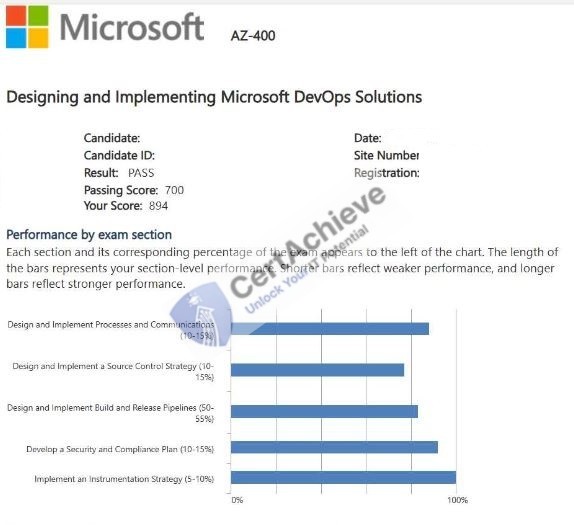
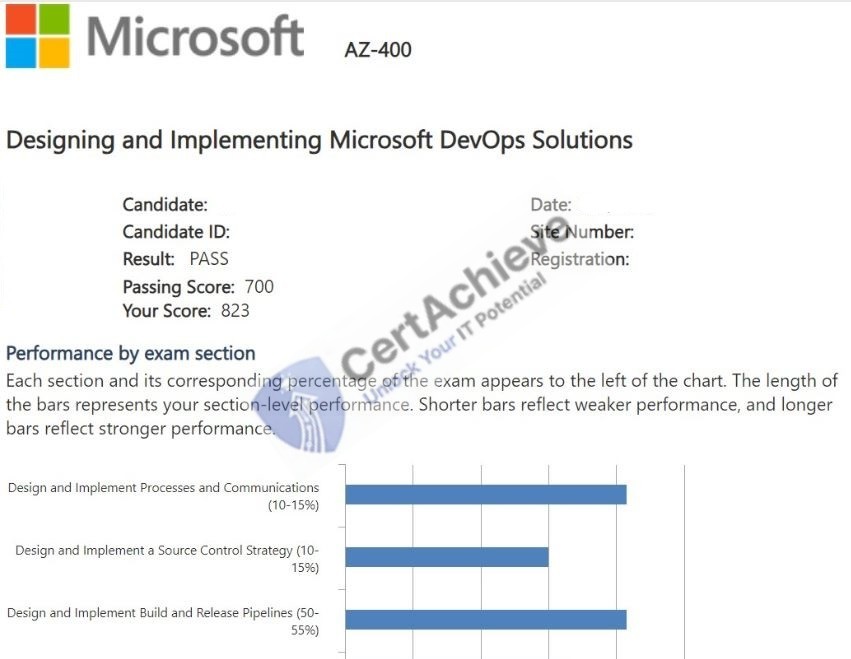
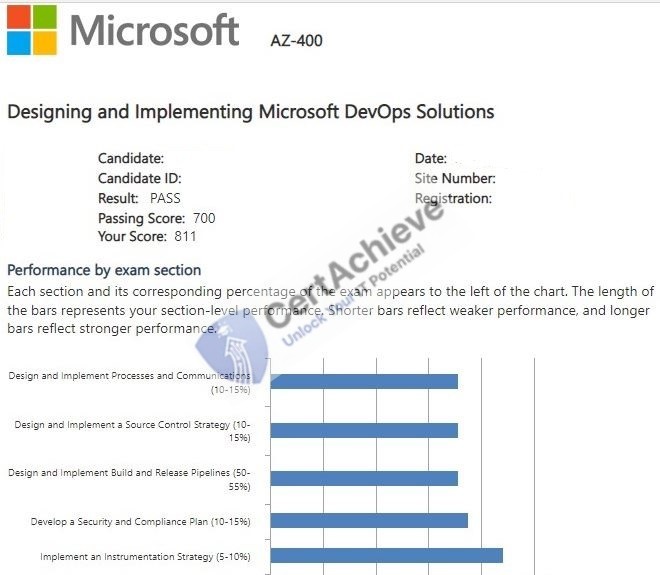
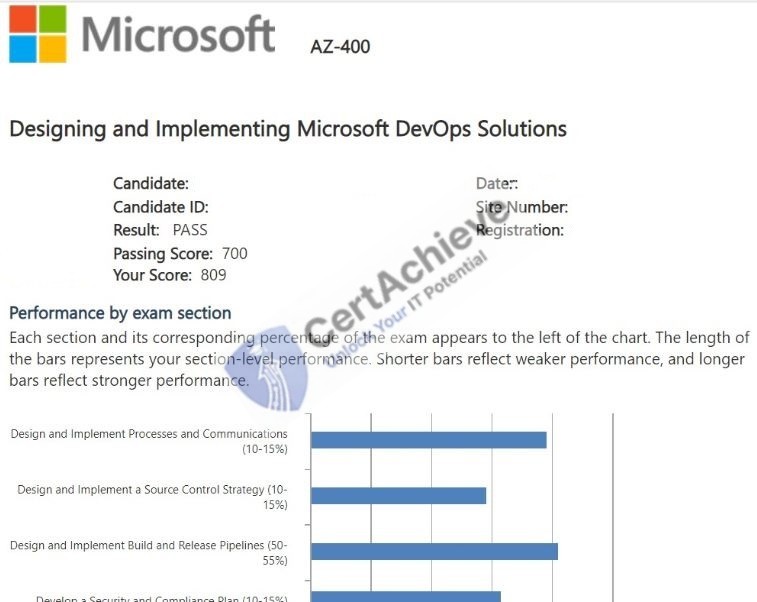
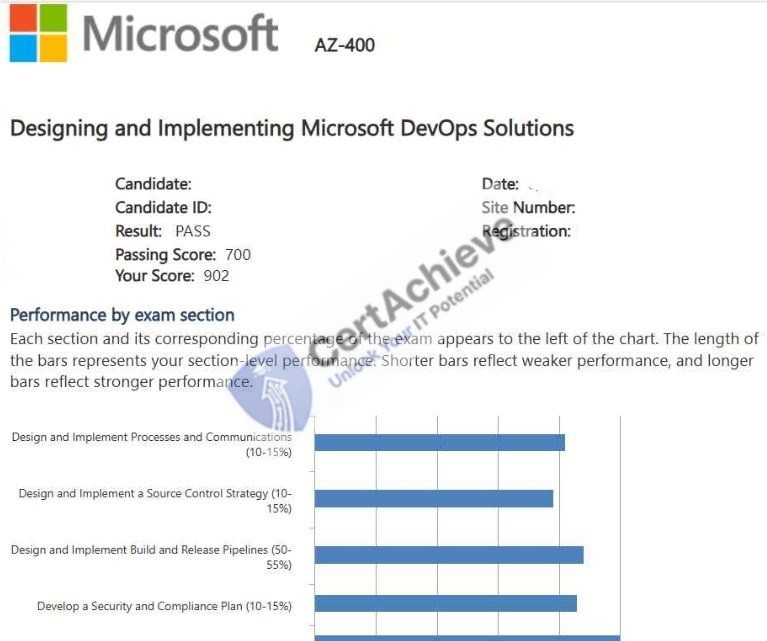
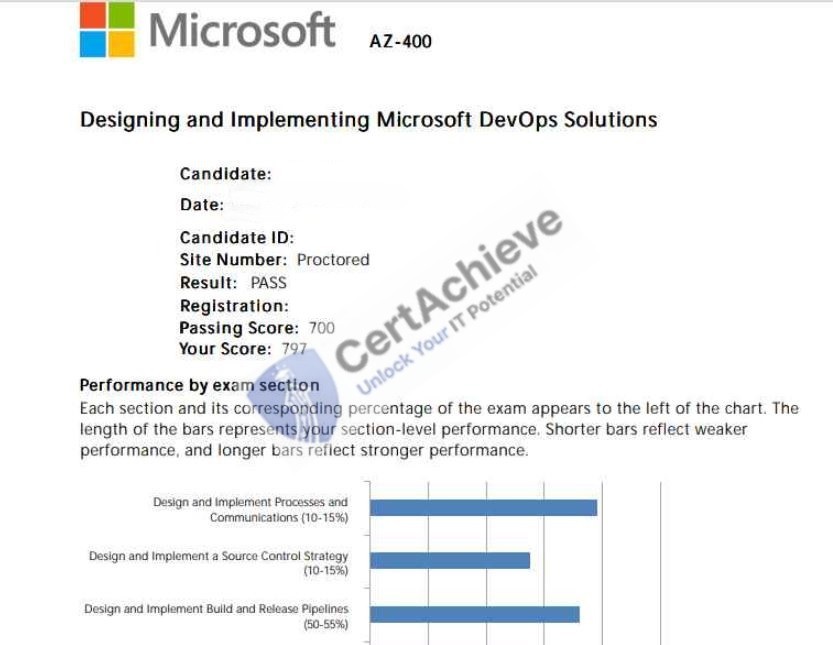
Verified Performance Reports
Authentic score reports from candidates who cleared the AZ-400 exam.
Verified Case #1
Verified Case #2
Verified Case #3
Verified Case #4
Verified Case #5
Verified Case #6
×
![]()