
The Nokia Border Gateway Protocol Fundamentals for Services (4A0-114)
Passing Nokia Nokia Network Routing Specialist II (NRS II) exam ensures for the successful candidate a powerful array of professional and personal benefits. The first and the foremost benefit comes with a global recognition that validates your knowledge and skills, making possible your entry into any organization of your choice.


4A0-114 Exam Dumps
- Exam Code: 4A0-114
- Vendor: Nokia
- Certifications: Nokia Network Routing Specialist II (NRS II)
- Exam Name: Nokia Border Gateway Protocol Fundamentals for Services
Why CertAchieve is Better than Standard 4A0-114 Dumps
In 2026, Nokia uses variable topologies. Basic dumps will fail you.
| Quality Standard | Generic Dump Sites | CertAchieve Premium Prep |
|---|---|---|
| Technical Explanation | None (Answer Key Only) | Step-by-Step Expert Rationales |
| Syllabus Coverage | Often Outdated (v1.0) | 2026 Updated (Latest Syllabus) |
| Scenario Mastery | Blind Memorization | Conceptual Logic & Troubleshooting |
| Instructor Access | No Post-Sale Support | 24/7 Professional Help |
Customers Passed Exams
10
Success backed by proven exam prep tools
Questions Came Word for Word
95%
Real exam match rate reported by verified users
Average Score in Real Testing Centre
87%
Consistently high performance across certifications
Study Time Saved With CertAchieve
60%
Efficient prep that reduces study hours significantly
Nokia 4A0-114 Exam Domains Q&A
Certified instructors verify every question for 100% accuracy, providing detailed, step-by-step explanations for each.
Question 1
Nokia 4A0-114
QUESTION DESCRIPTION:
Which of the following route reflection rules is NOT followed by a route reflector?
Correct Answer & Rationale:
Answer: D
Explanation:
Route reflectors (RR) follow specific rules for propagating routes to prevent routing loops and ensure efficient route distribution within an Autonomous System (AS).
Here are the rules that a route reflector follows:
If the best route is received from an eBGP peer, it propagates the route to all iBGP peers.
If the best route is received from an eBGP peer, it propagates the route to all eBGP peers.
If the best route is received from a client, it propagates the route to all iBGP peers, including other clients and non-clients.
If the best route is received from a non-client, it propagates the route to all clients.
The statement " If the best route is received from a client, do not propagate to eBGP peers. " is NOT followed by a route reflector. In fact, if the best route is received from a client, it is propagated to both eBGP and iBGP peers as required.
References :
Nokia Border Gateway Protocol Fundamentals documentation, Section 5.3 on Route Reflector Rules and Propagation.
Question 2
Nokia 4A0-114
QUESTION DESCRIPTION:
Click the exhibit.
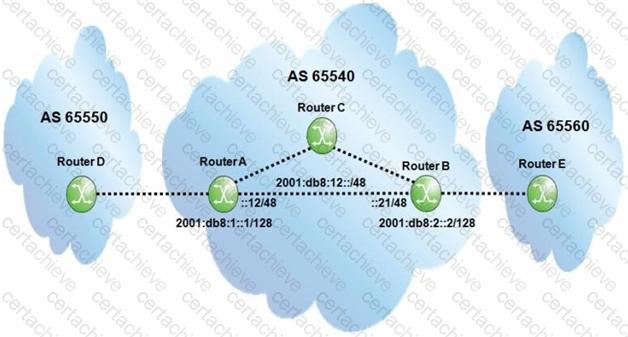
Assuming the network is IPv6 only, which of the following configurations on the Nokia
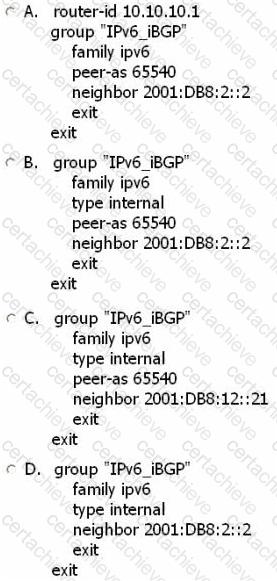
7750 SR router A can establish an IPv6 BGP session to router B?
Correct Answer & Rationale:
Answer: C
Explanation:
IPv6 BGP Session Requirements : To establish an IPv6 BGP session, the configuration must include the IPv6 addresses of the neighbors and the appropriate family settings.
Option Analysis :
Option A : Incorrect. The configuration does not match typical BGP IPv6 configuration standards for Nokia routers.
Option B : Incorrect. The configuration is incomplete for establishing an IPv6 BGP session.
Option C : Correct. The configuration includes the appropriate neighbor IPv6 address and family settings required to establish an IPv6 BGP session.
Option D : Incorrect. The configuration has errors or missing components needed for a proper IPv6 BGP session.
Conclusion : Option C provides the correct configuration necessary to establish an IPv6 BGP session between router A and router B.
References:
Nokia Border Gateway Protocol Fundamentals
Nokia 7750 SR OS BGP Configuration Guide
Question 3
Nokia 4A0-114
QUESTION DESCRIPTION:
Which of the following statements about a distributed EVPN VPRN service is FALSE?
Correct Answer & Rationale:
Answer: B
Explanation:
A distributed EVPN VPRN service acts as a router for IP packets between customer sites.
It does require two types of interfaces: one towards customer sites (CEs) and another towards the EVPN VPLS for backhaul connectivity.
The configured route target (RT) helps PE routers identify relevant BGP updates.
MP-BGP with the EVPN address family is used to populate the routing table.
Therefore, the statement " It requires two types of interfaces, one towards customer sites and one towards the backhaul VPLS. " is FALSE because the backhaul VPLS reference should instead pertain to VPRN backhaul routing.
References :
Nokia Border Gateway Protocol Fundamentals documentation, Section 9.2 on EVPN VPRN interface requirements and configuration.
Question 4
Nokia 4A0-114
QUESTION DESCRIPTION:
Which of the following statements about BGP peering sessions is FALSE?
Correct Answer & Rationale:
Answer: C
Explanation:
Step by Step Comprehensive Detailed Explanation The statement " eBGP peers have to be adjacent to each other " is false. eBGP peers usually are directly connected to ensure reliable and straightforward communication. However, eBGP multihop allows BGP to establish a session with eBGP peers that are not directly connected by setting the multihop parameter.
A. True : BGP peers need IP reachability between them.
B. True : iBGP peers can be non-adjacent.
C. False : eBGP peers do not necessarily have to be directly connected if multihop is configured.
D. True : BGP peers can be configured with different AS numbers.
References Nokia Border Gateway Protocol Fundamentals, Chapter on eBGP and iBGP Configurations.
Question 5
Nokia 4A0-114
QUESTION DESCRIPTION:
Which of the following statements about EVPN services is FALSE?
Correct Answer & Rationale:
Answer: B
Explanation:
Ethernet VPN (EVPN) services provide advanced features for layer-2 and layer-3 connectivity among customer sites. Here are key points about EVPN:
A. True : The goal of an EVPN service is to provide layer-2 or layer-3 connectivity among two or more customer sites.
B. False : A local layer-2 EVPN service is not referred to as a backhaul VPLS. Backhaul VPLS is a different service concept used to transport layer-2 traffic over a layer-3 network.
C. True : The same BGP address family (EVPN) can be used to populate the forwarding database of an EVPN VPLS and the route table of an EVPN VPRN.
D. True : EVPN services support signaling for the use of MPLS and VXLAN tunnels.
References Nokia Border Gateway Protocol Fundamentals, Chapter on EVPN Services.
Question 6
Nokia 4A0-114
QUESTION DESCRIPTION:
Which of the following is considered a best practice for BGP address planning?
Correct Answer & Rationale:
Answer: B
Explanation:
Best Practices for BGP Address Planning:
Proper address planning ensures efficient and reliable BGP operations.
It involves using specific addresses for BGP sessions and advertising appropriate routes.
Analyzing the Options:
A. Advertising external networks into IGP: Not recommended as it can lead to IGP table bloating and instability.
B. Using system addresses for setting up iBGP sessions: This is considered a best practice. System addresses (loopback addresses) are stable and do not change even if the physical interface goes down, ensuring session stability.
C. Exporting the networks associated with the external links of eBGP peers into BGP: This is normal practice but not directly related to address planning best practices.
D. Optimizing BGP route table by exporting IGP routes into BGP: Typically, you would do the opposite (importing BGP routes into IGP selectively).
Conclusion:
Using system addresses (loopback addresses) for setting up iBGP sessions is a widely accepted best practice. It enhances the reliability and stability of the BGP sessions.
References
Nokia Border Gateway Protocol (BGP) Fundamentals documentation
Best practices in BGP design and implementation
Network stability and reliability considerations in BGP configurations
Question 7
Nokia 4A0-114
QUESTION DESCRIPTION:
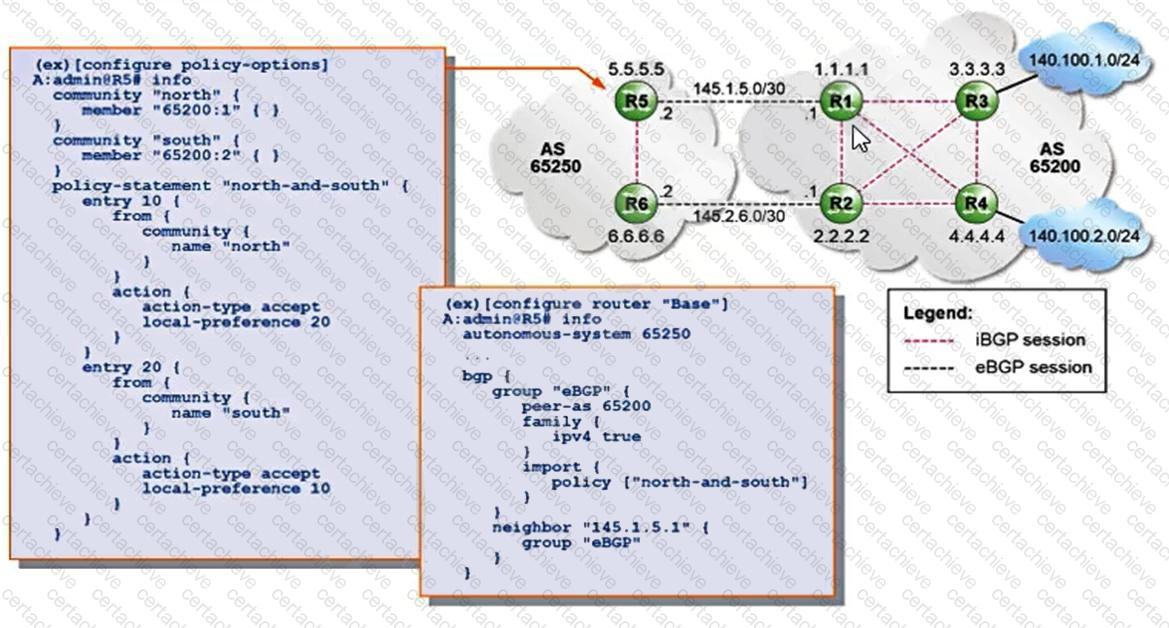
In the diagram, the BGP import policy " north-and-south " is applied to router R5. Router R1 advertises the prefix 140.100.1.0/24 with a community set to " 65200:1 " . Which of the following statements about how router R5 processes the received route update for prefix 140.100.1.0/24 is TRUE?
Correct Answer & Rationale:
Answer: B
Explanation:
The BGP import policy " north-and-south " on R5 checks the community attribute of incoming routes.
If the community matches " 65200:1 " , it sets the local preference to 20.
Since R1 advertises the prefix 140.100.1.0/24 with a community of " 65200:1 " , R5 will apply the policy action.
Therefore, the prefix ' s local preference is set to 20.
References :
Nokia Border Gateway Protocol Fundamentals documentation, Section 5.2 on BGP policies.
Question 8
Nokia 4A0-114
QUESTION DESCRIPTION:
A router in AS 65100 receives three routes for 138.120.0.0/16. The first route has an AS Path of 65200 65400 65300 and a local preference of 150. The second route has an AS Path of 65200 65300 and a local preference of 100. The third route has an AS Path of 65600 65300 and a local preference of 100. Which route will appear in the RIB-out?
Correct Answer & Rationale:
Answer: A
Explanation:
Local Preference Comparison : Local preference is the first criterion BGP uses to select the best path. The higher the local preference, the more preferred the route. Here, the first route has a local preference of 150, while the other two routes have a local preference of 100.
Best Path Selection : Since the first route has the highest local preference (150), it will be preferred over the other two routes regardless of the AS Path length or any other attributes.
RIB-Out : The RIB-Out (Routing Information Base - Outbound) contains the routes selected for advertisement to peers. As only the best path is advertised, only the first route with the highest local preference will be included in the RIB-Out.
References:
Nokia Border Gateway Protocol Fundamentals
RFC 4271 - A Border Gateway Protocol 4 (BGP-4)
Question 9
Nokia 4A0-114
QUESTION DESCRIPTION:
Which of the following statements about IPv6 Link-Local addresses is FALSE?
Correct Answer & Rationale:
Answer: D
Explanation:
IPv6 Link-Local addresses are specific types of addresses used within a single local network segment. Here are key points about IPv6 Link-Local addresses:
A. True : Every physical interface running IPv6 is assigned a Link-Local address automatically.
B. True : Link-Local addresses are only valid for communication within the same broadcast domain (i.e., the local link).
C. True : They all have the same 64-bit subnet prefix ( FE80::/64 ).
The false statement is:
D. False : The interface ID for Link-Local addresses is not derived from the interface’s IPv4 address. Instead, it is typically generated from the interface’s MAC address or using a random number.
References Nokia Border Gateway Protocol Fundamentals, Chapter on IPv6 Addressing.
Question 10
Nokia 4A0-114
QUESTION DESCRIPTION:
An autonomous system has 7 routers configured with BGP. How many iBGP sessions are required for a fully meshed configuration?
Correct Answer & Rationale:
Answer: C
Explanation:
Full Mesh Requirement : In a BGP network, to ensure that all BGP routers within the same autonomous system (AS) have complete reachability, each router must establish an iBGP session with every other router in the AS.
Calculating the Number of iBGP Sessions :
The formula to calculate the number of iBGP sessions required in a fully meshed configuration is ???? ( ???? −1)2 2 n ( n −1) , where ???? n is the number of routers.
For an autonomous system with 7 routers, we substitute ???? =7 n =7 into the formula.
Applying the Formula :
7(7−1)2=7×62=422=21 27(7−1) = 27×6 = 242 =21
Explanation :
Each of the 7 routers needs to establish a session with every other router, but each session is counted only once. Therefore, we divide the product of the total routers and one less than the total routers by 2 to avoid double-counting.
This results in a total of 21 iBGP sessions.
References:
Nokia Border Gateway Protocol Fundamentals
Standard BGP configuration guidelines and best practices

Verified by Certified Instructors
This Nokia 4A0-114 study pack was audited and verified on September 23, 2026 by Radia Davenport,. We ensure every technical rationale aligns with real-world enterprise standards.
A Stepping Stone for Enhanced Career Opportunities
Your profile having Nokia Network Routing Specialist II (NRS II) certification significantly enhances your credibility and marketability in all corners of the world. The best part is that your formal recognition pays you in terms of tangible career advancement. It helps you perform your desired job roles accompanied by a substantial increase in your regular income. Beyond the resume, your expertise imparts you confidence to act as a dependable professional to solve real-world business challenges.
Your success in Nokia 4A0-114 certification exam makes your visible and relevant in the fast-evolving tech landscape. It proves a lifelong investment in your career that give you not only a competitive advantage over your non-certified peers but also makes you eligible for a further relevant exams in your domain.
What You Need to Ace Nokia Exam 4A0-114
Achieving success in the 4A0-114 Nokia exam requires a blending of clear understanding of all the exam topics, practical skills, and practice of the actual format. There's no room for cramming information, memorizing facts or dependence on a few significant exam topics. It means your readiness for exam needs you develop a comprehensive grasp on the syllabus that includes theoretical as well as practical command.
Here is a comprehensive strategy layout to secure peak performance in 4A0-114 certification exam:
- Develop a rock-solid theoretical clarity of the exam topics
- Begin with easier and more familiar topics of the exam syllabus
- Make sure your command on the fundamental concepts
- Focus your attention to understand why that matters
- Ensure hands-on practice as the exam tests your ability to apply knowledge
- Develop a study routine managing time because it can be a major time-sink if you are slow
- Find out a comprehensive and streamlined study resource for your help
Ensuring Outstanding Results in Exam 4A0-114!
In the backdrop of the above prep strategy for 4A0-114 Nokia exam, your primary need is to find out a comprehensive study resource. It could otherwise be a daunting task to achieve exam success. The most important factor that must be kep in mind is make sure your reliance on a one particular resource instead of depending on multiple sources. It should be an all-inclusive resource that ensures conceptual explanations, hands-on practical exercises, and realistic assessment tools.
Certachieve: A Reliable All-inclusive Study Resource
Certachieve offers multiple study tools to do thorough and rewarding 4A0-114 exam prep. Here's an overview of Certachieve's toolkit:
Nokia 4A0-114 PDF Study Guide
This premium guide contains a number of Nokia 4A0-114 exam questions and answers that give you a full coverage of the exam syllabus in easy language. The information provided efficiently guides the candidate's focus to the most critical topics. The supportive explanations and examples build both the knowledge and the practical confidence of the exam candidates required to confidently pass the exam. The demo of Nokia 4A0-114 study guide pdf free download is also available to examine the contents and quality of the study material.
Nokia 4A0-114 Practice Exams
Practicing the exam 4A0-114 questions is one of the essential requirements of your exam preparation. To help you with this important task, Certachieve introduces Nokia 4A0-114 Testing Engine to simulate multiple real exam-like tests. They are of enormous value for developing your grasp and understanding your strengths and weaknesses in exam preparation and make up deficiencies in time.
These comprehensive materials are engineered to streamline your preparation process, providing a direct and efficient path to mastering the exam's requirements.
Nokia 4A0-114 exam dumps
These realistic dumps include the most significant questions that may be the part of your upcoming exam. Learning 4A0-114 exam dumps can increase not only your chances of success but can also award you an outstanding score.
Top Exams & Certification Providers
New & Trending
- New Released Exams
- Related Exam
- Hot Vendor