
The Certified Implementation Specialist - Data Foundations (CMDB and CSDM) (CIS-DF)
Passing ServiceNow CIS-Data Foundations (CMDB and CSDM) exam ensures for the successful candidate a powerful array of professional and personal benefits. The first and the foremost benefit comes with a global recognition that validates your knowledge and skills, making possible your entry into any organization of your choice.


CIS-DF Exam Dumps
- Exam Code: CIS-DF
- Vendor: ServiceNow
- Certifications: CIS-Data Foundations (CMDB and CSDM)
- Exam Name: Certified Implementation Specialist - Data Foundations (CMDB and CSDM)
Why CertAchieve is Better than Standard CIS-DF Dumps
In 2026, ServiceNow uses variable topologies. Basic dumps will fail you.
| Quality Standard | Generic Dump Sites | CertAchieve Premium Prep |
|---|---|---|
| Technical Explanation | None (Answer Key Only) | Step-by-Step Expert Rationales |
| Syllabus Coverage | Often Outdated (v1.0) | 2026 Updated (Latest Syllabus) |
| Scenario Mastery | Blind Memorization | Conceptual Logic & Troubleshooting |
| Instructor Access | No Post-Sale Support | 24/7 Professional Help |
Customers Passed Exams
10
Success backed by proven exam prep tools
Questions Came Word for Word
90%
Real exam match rate reported by verified users
Average Score in Real Testing Centre
89%
Consistently high performance across certifications
Study Time Saved With CertAchieve
60%
Efficient prep that reduces study hours significantly
ServiceNow CIS-DF Exam Domains Q&A
Certified instructors verify every question for 100% accuracy, providing detailed, step-by-step explanations for each.
Question 1
ServiceNow CIS-DF
QUESTION DESCRIPTION:
A CMDB Administrator has been tasked with gathering information for a presentation to leadership. The Administrator needs to provide Duplicate CI, Orphan CI, and Stale CI metrics.
Which scorecard provides this information on the CMDB Health Dashboard?
Correct Answer & Rationale:
Answer: B
Explanation:
In Data Foundations, “Insight” is about using health metrics to understand whether the CMDB is trustworthy and operationally usable. The CMDB Health Dashboard organizes health into scorecards that group related checks. When leadership asks for Duplicate CIs, Orphan CIs, and Stale CIs, they are asking about the CMDB’s ongoing hygiene and adherence to governance expectations—not simply whether fields are filled in.
These three metrics align best with Compliance because they represent whether CI records comply with rules that keep the CMDB clean and current over time:
Duplicate CIs indicate the identification and governance controls are not consistently preventing multiple records for the same real-world item.
Orphan CIs indicate relationship governance gaps—records exist without expected relationships or context, reducing their operational value and often signaling incomplete ingestion or lifecycle control issues.
Stale CIs indicate lifecycle management gaps—records are not being updated, attested, retired, or archived appropriately, which increases risk and noise in operational processes.
By contrast, Completeness focuses on whether required attributes are populated (owners, support group, environment, etc.). Correctness focuses on whether values and relationships are accurate and logically valid. While duplicates/orphans/stale can affect correctness indirectly, the dashboard’s grouping for these hygiene and lifecycle-oriented measures is best represented by Compliance, which is why B is the correct answer.
Question 2
ServiceNow CIS-DF
QUESTION DESCRIPTION:
The CMDB Configuration Manager is using the CI Class Manager to define group ownership of CI classes and needs to leverage the ownership value specified in the CI Class Manager.
When creating a CMDB Data Manager policy, which group reference field should be set?
Correct Answer & Rationale:
Answer: B
Explanation:
In ServiceNow CMDB governance, the CI Class Manager allows administrators to assign ownership and accountability at the class level. This ownership is used by governance tools—especially CMDB Data Manager—to automatically determine who receives tasks and actions related to data lifecycle management.
The group reference field that aligns with class ownership and is consumed by CMDB Data Manager policies is the Managed By Group. This field represents the team responsible for the technical stewardship and lifecycle management of CIs within that class.
When CMDB Data Manager executes policies such as retention, archival, or cleanup, it uses the Managed By Group to assign tasks to the appropriate data owners. This ensures governance actions are routed to the correct accountable team without manual intervention.
Approval Group, Support Group, and Change Group serve different purposes. Approval Group is used for workflow approvals, Support Group is used for operational ticket routing, and Change Group supports Change Management governance. None of these reflect data ownership at the class level.
Therefore, to leverage CI class ownership defined in the CI Class Manager within CMDB Data Manager policies, the correct field is Managed By Group, making Option B the verified answer.
Question 3
ServiceNow CIS-DF
QUESTION DESCRIPTION:
Which ServiceNow feature provides predefined integrations specifically designed to simplify integration with external systems?
Correct Answer & Rationale:
Answer: D
Explanation:
Service Graph Connectors are predefined, vendor-specific integrations that import and synchronize external data with the ServiceNow CMDB. They are generally delivered through the ServiceNow Store and use standardized mappings, supported class models, source tracking, and Identification and Reconciliation Engine processing. This reduces the amount of custom scripting and transformation logic required to integrate third-party platforms.
Agent Client Collector is an agent-based inventory and telemetry collection mechanism. IRE identifies incoming CIs and controls how authorized sources update CMDB attributes, but it is an underlying data-processing engine rather than a packaged external-system integration. Service Mapping discovers and models Application Service dependencies; it is not a library of predefined third-party connectors.
The Data Foundations material describes Service Graph Connectors as prebuilt Store integration solutions requiring minimal customization. It also identifies them as the preferred method for third-party CI ingestion when minimizing technical debt and maintaining upgrade compatibility are priorities.
=========
Question 4
ServiceNow CIS-DF
QUESTION DESCRIPTION:
A Configuration Manager needs to enable a CMDB Data Manager policy to remove records from a CI class while retaining the ability to restore them within a specified period.
Which policy type should the Configuration Manager create?
Correct Answer & Rationale:
Answer: A
Explanation:
Archive is the correct policy type because the requirement is not permanent removal; it is controlled removal with the ability to restore records within a defined retention period. In CMDB Data Manager, archive policies support CMDB data lifecycle governance by moving eligible CI records out of active operational use while preserving them for recovery, audit, or historical review. This is different from Delete, which is used when records should be removed permanently and restoration is not the intended governance outcome. Certification is used to validate specific CI attributes, not remove records. Retire changes or manages lifecycle state but does not satisfy the specific requirement to remove records while preserving restore capability. Therefore, when the objective is to reduce active CMDB volume while retaining recoverability, the correct Data Manager policy type is Archive.
Question 5
ServiceNow CIS-DF
QUESTION DESCRIPTION:
A CMDB Manager wants to improve data quality using the CMDB Health Dashboard.
What needs to happen to generate CMDB health scores?
Correct Answer & Rationale:
Answer: A
Explanation:
In ServiceNow, the CMDB Health Dashboard does not calculate health scores in real time by default. Instead, health scores are generated and refreshed by scheduled calculation jobs that evaluate CI data against defined health rules across the dimensions of completeness, correctness, and compliance.
To generate and maintain CMDB health scores, the scheduled jobs for CMDB Health must be active. These jobs periodically scan the CMDB, apply health rules (for example, required attributes populated, lifecycle status compliance, certification results), and calculate scores that are displayed on the dashboard and scorecards. Without these scheduled jobs running, the dashboard cannot produce current or meaningful health metrics.
Option B is incorrect because CMDB health scoring is not automatic or real-time; it depends on scheduled processing. Option C is also incorrect because CMDB Health is part of the core CMDB/Data Foundations capability in ServiceNow and does not require a separate “CMDB health calculation” plugin to be installed in modern implementations.
Activating and maintaining these scheduled jobs ensures that health scores remain accurate, trendable over time, and useful for governance decisions. This is a foundational requirement for using the CMDB Health Dashboard as a data quality improvement tool.
Therefore, the correct answer is A – The scheduled jobs for the CMDB Health Dashboard must be activated.
Question 6
ServiceNow CIS-DF
QUESTION DESCRIPTION:
The CMDB Configuration Management team has successfully developed a healthy and trusted CMDB. They have integrated discovered infrastructure data, accurately referenced non-discoverable data (such as change and support group information), and made the CMDB service-aware using Service Mapping.
Which field on an Incident form is automatically populated after a CI is selected that references an appropriate support group?
Correct Answer & Rationale:
Answer: C
Explanation:
In a mature CMDB implementation within ServiceNow, CI operational attributes are leveraged to automate ITSM workflows. One of the most important outcomes of accurate Configuration Management is automatic incident routing.
When a CI is selected on an Incident record, ServiceNow evaluates the CI’s Support Group attribute. If populated correctly, the platform automatically copies this value into the Assignment Group field on the Incident. This ensures incidents are routed to the correct resolver group without manual triage, reducing mean time to resolution (MTTR).
The Support Group is a CI attribute, not an incident field that drives workflow directly. The Assignment Group is the operational field used by Incident Management to assign ownership. Managed by Group, Approval Group, and Change Group are used in other governance and lifecycle contexts and are not auto-populated during incident creation.
This behavior is a direct result of Data Foundations best practices: maintaining accurate CI-to-support-group relationships to enable automation and consistency across ITSM processes.
Therefore, the correct answer is C – Assignment Group.
Question 7
ServiceNow CIS-DF
QUESTION DESCRIPTION:
A CMDB Administrator needs to import external data into the CMDB. To reduce the risk of creating duplicates and prevent updates from unauthorized sources, it must be ensured that the Identification and Reconciliation Engine (IRE) is not bypassed.
What is the recommended method to import data into the CMDB utilizing the Identification and Reconciliation API?
Correct Answer & Rationale:
Answer: A
Explanation:
In ServiceNow, protecting CMDB data quality during ingestion is a core Data Foundations principle. The Identification and Reconciliation Engine (IRE) is designed to ensure that CI records are uniquely identified, merged correctly, and protected from unauthorized overwrites. Any ingestion method that bypasses IRE introduces a high risk of duplicates and data corruption.
IntegrationHub ETL is the recommended method because it is natively designed to work with the Identification and Reconciliation API. When properly configured, IntegrationHub ETL ensures that incoming data is processed through IRE, applying identification rules, reconciliation rules, and source precedence. This allows multiple data sources to coexist safely while maintaining CMDB integrity.
Option B (Table API) is explicitly discouraged for CMDB ingestion because it writes directly to CMDB tables and bypasses IRE entirely, making it one of the most common causes of duplicate and conflicting CI records. While REST and SOAP APIs are powerful, they are not safe for CMDB ingestion unless they explicitly invoke the IRE API, which most generic table integrations do not.
Option C (Import Sets and Transform Maps) can be configured to call IRE, but this requires additional scripting and strict governance. Because of this complexity and higher risk of misconfiguration, it is not the recommended approach when safer, purpose-built options exist.
Therefore, IntegrationHub ETL is the verified and best-practice answer, making Option A correct.
Question 8
ServiceNow CIS-DF
QUESTION DESCRIPTION:
A CMDB Administrator is using the CMDB Data Foundations Dashboard and identifies an issue that needs to be addressed by using a playbook.
Which types of documentation can the Administrator expect to be provided in a playbook?
(Choose two options.)
Correct Answer & Rationale:
Answer: B, C
Explanation:
A CMDB Data Foundations Dashboard playbook provides a Problem Overview and information about likely Root Causes . The Problem Overview explains the deficient metric, why the condition matters, and the operational or governance risks created by poor performance. The Root Cause material helps administrators identify why the condition exists, such as incomplete source data, incorrect transformations, missing ownership, inappropriate class usage, or weak governance controls.
The guide describes these playbooks as structured, prescriptive guidance for identifying root causes, assessing ingestion and governance gaps, and applying appropriate corrective actions.
Playbooks may recommend analysis, correction, reporting, and governance activities, but they do not normally provide fully automated remediation scripts that should be executed without review. “Problem Analysis” is not the named documentation component tested here; analysis is instead performed through the recommended remediation plays.
=========
Question 9
ServiceNow CIS-DF
QUESTION DESCRIPTION:
Which ServiceNow Store application is used to import data from different sources into the CMDB?
Correct Answer & Rationale:
Answer: B
Explanation:
IntegrationHub ETL is a ServiceNow data-ingestion application used to extract data from external sources, transform it through defined mappings, and load it into the CMDB. Its Robust Transform Engine provides a guided, low-code mechanism for mapping source data to appropriate CMDB classes, attributes, and relationships.
A major Data Foundations advantage of IntegrationHub ETL is its integration with the Identification and Reconciliation Engine. Incoming records can be processed through identification and reconciliation rules so that existing CIs are updated correctly, duplicate creation is reduced, and source-authority controls are respected.
Agent Client Collector is used to gather inventory and telemetry from devices through an installed endpoint agent. Service Mapping builds Application Service topology and dependency relationships; it is not the general ETL application for importing data from multiple external sources.
The guide identifies IntegrationHub ETL as the recommended method for importing external data through the Identification and Reconciliation API when a dedicated Service Graph Connector is not the applicable solution.
Question 10
ServiceNow CIS-DF
QUESTION DESCRIPTION:
User endpoint devices are imported into the CMDB and populate the Assigned to [assigned_to] field on the Computer [cmdb_ci_computer] CI. The Asset team requests that Configuration Analysts populate the Assigned to field on the related Asset.
What action does a Configuration Analyst take to achieve this in an automated way?
Correct Answer & Rationale:
Answer: C
Explanation:
Data Foundations strongly encourages using out-of-box synchronization mechanisms rather than custom scripting whenever possible, to reduce technical debt and improve upgrade safety. In this scenario, endpoint data is being ingested into the CI record, and the Asset team needs the corresponding Asset record kept in sync automatically for their asset management processes.
The recommended approach is to use Asset CI Field Mapping, which is designed specifically to map and synchronize fields between an Asset and its related CI. Creating or updating a mapping rule for “Assigned to” allows the platform to replicate the value in a controlled, supportable way without writing scripts. This approach aligns with best practices: standard configuration, clear governance, and minimal custom code.
Option B (a scripted business rule) can work technically, but it introduces maintenance risk, testing overhead, and potential upgrade fragility—exactly the kind of technical debt Data Foundations warns against when an OOTB capability exists. Option A (dot-walking) changes the user experience and does not truly populate the Asset field; it only displays a derived value and may not meet Asset team needs for reporting, exports, integrations, or lifecycle workflows that expect the Asset field to be set. Therefore, the best automated and best-practice solution is Asset CI Field Mapping.

Verified by Certified Instructors
This ServiceNow CIS-DF study pack was audited and verified on September 23, 2026 by John Prescott,. We ensure every technical rationale aligns with real-world enterprise standards.
A Stepping Stone for Enhanced Career Opportunities
Your profile having CIS-Data Foundations (CMDB and CSDM) certification significantly enhances your credibility and marketability in all corners of the world. The best part is that your formal recognition pays you in terms of tangible career advancement. It helps you perform your desired job roles accompanied by a substantial increase in your regular income. Beyond the resume, your expertise imparts you confidence to act as a dependable professional to solve real-world business challenges.
Your success in ServiceNow CIS-DF certification exam makes your visible and relevant in the fast-evolving tech landscape. It proves a lifelong investment in your career that give you not only a competitive advantage over your non-certified peers but also makes you eligible for a further relevant exams in your domain.
What You Need to Ace ServiceNow Exam CIS-DF
Achieving success in the CIS-DF ServiceNow exam requires a blending of clear understanding of all the exam topics, practical skills, and practice of the actual format. There's no room for cramming information, memorizing facts or dependence on a few significant exam topics. It means your readiness for exam needs you develop a comprehensive grasp on the syllabus that includes theoretical as well as practical command.
Here is a comprehensive strategy layout to secure peak performance in CIS-DF certification exam:
- Develop a rock-solid theoretical clarity of the exam topics
- Begin with easier and more familiar topics of the exam syllabus
- Make sure your command on the fundamental concepts
- Focus your attention to understand why that matters
- Ensure hands-on practice as the exam tests your ability to apply knowledge
- Develop a study routine managing time because it can be a major time-sink if you are slow
- Find out a comprehensive and streamlined study resource for your help
Ensuring Outstanding Results in Exam CIS-DF!
In the backdrop of the above prep strategy for CIS-DF ServiceNow exam, your primary need is to find out a comprehensive study resource. It could otherwise be a daunting task to achieve exam success. The most important factor that must be kep in mind is make sure your reliance on a one particular resource instead of depending on multiple sources. It should be an all-inclusive resource that ensures conceptual explanations, hands-on practical exercises, and realistic assessment tools.
Certachieve: A Reliable All-inclusive Study Resource
Certachieve offers multiple study tools to do thorough and rewarding CIS-DF exam prep. Here's an overview of Certachieve's toolkit:
ServiceNow CIS-DF PDF Study Guide
This premium guide contains a number of ServiceNow CIS-DF exam questions and answers that give you a full coverage of the exam syllabus in easy language. The information provided efficiently guides the candidate's focus to the most critical topics. The supportive explanations and examples build both the knowledge and the practical confidence of the exam candidates required to confidently pass the exam. The demo of ServiceNow CIS-DF study guide pdf free download is also available to examine the contents and quality of the study material.
ServiceNow CIS-DF Practice Exams
Practicing the exam CIS-DF questions is one of the essential requirements of your exam preparation. To help you with this important task, Certachieve introduces ServiceNow CIS-DF Testing Engine to simulate multiple real exam-like tests. They are of enormous value for developing your grasp and understanding your strengths and weaknesses in exam preparation and make up deficiencies in time.
These comprehensive materials are engineered to streamline your preparation process, providing a direct and efficient path to mastering the exam's requirements.
ServiceNow CIS-DF exam dumps
These realistic dumps include the most significant questions that may be the part of your upcoming exam. Learning CIS-DF exam dumps can increase not only your chances of success but can also award you an outstanding score.
The CIS-DF Exam Dumps helped me understand digital forensics, incident response, and cybersecurity investigation procedures. The explanations were detailed and beginner-friendly.
Lily Bennett
Jun 5, 2026
Top Exams & Certification Providers
New & Trending
- New Released Exams
- Related Exam
- Hot Vendor
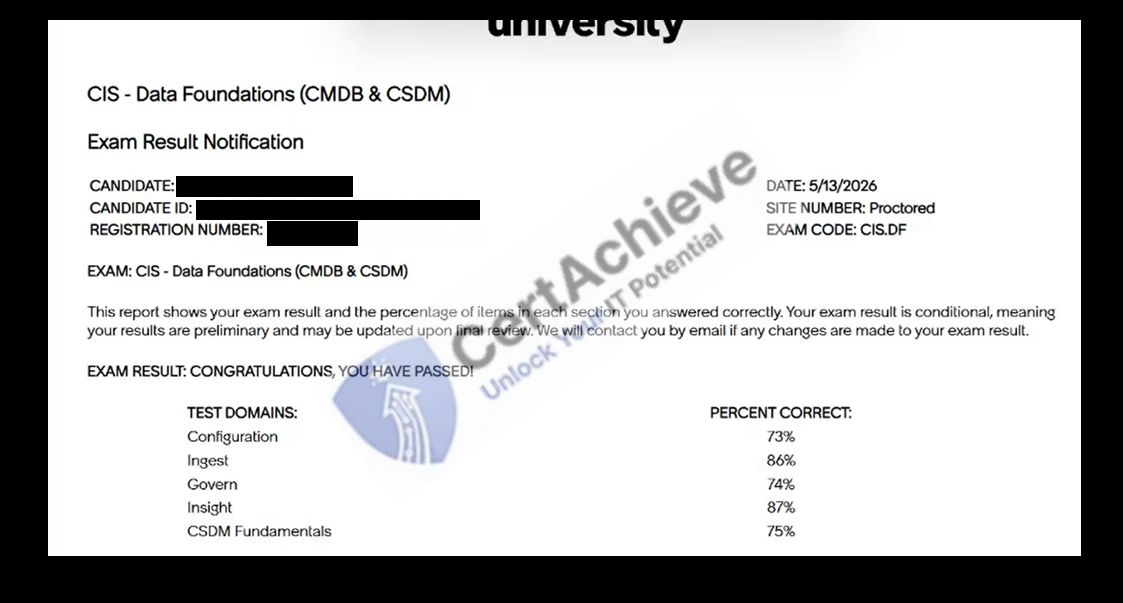
Verified Performance Reports
Authentic score reports from candidates who cleared the CIS-DF exam.
Verified Case #1
×
![]()