
The NetApp Storage Installation Engineer - ONTAP Professional Exam (NS0-185)
Passing Netapp NCSIE ONTAP exam ensures for the successful candidate a powerful array of professional and personal benefits. The first and the foremost benefit comes with a global recognition that validates your knowledge and skills, making possible your entry into any organization of your choice.


NS0-185 Exam Dumps
- Exam Code: NS0-185
- Vendor: Netapp
- Certifications: NCSIE ONTAP
- Exam Name: NetApp Storage Installation Engineer - ONTAP Professional Exam
Why CertAchieve is Better than Standard NS0-185 Dumps
In 2026, Netapp uses variable topologies. Basic dumps will fail you.
| Quality Standard | Generic Dump Sites | CertAchieve Premium Prep |
|---|---|---|
| Technical Explanation | None (Answer Key Only) | Step-by-Step Expert Rationales |
| Syllabus Coverage | Often Outdated (v1.0) | 2026 Updated (Latest Syllabus) |
| Scenario Mastery | Blind Memorization | Conceptual Logic & Troubleshooting |
| Instructor Access | No Post-Sale Support | 24/7 Professional Help |
Customers Passed Exams
10
Success backed by proven exam prep tools
Questions Came Word for Word
85%
Real exam match rate reported by verified users
Average Score in Real Testing Centre
94%
Consistently high performance across certifications
Study Time Saved With CertAchieve
60%
Efficient prep that reduces study hours significantly
Coverage of Official Netapp NS0-185 Exam Domains
Our curriculum is meticulously mapped to the Netapp official blueprint.
Storage Concepts & NetApp Fundamentals
The "Foundational" layer. Master the basics of modern storage architecture. Focus on the differences between SAN (Block) and NAS (File) protocols (NFS, SMB, iSCSI, FC). Understand NetApp’s unique approach to data integrity, including RAID-DP and RAID-TEC, and the physical components that make up a storage grid, from NVMe drives to shelf connectivity.
NetApp ONTAP Basics
The "Operating System" core. This is the heart of the associate level. Master the logical hierarchy of ONTAP: Aggregates, Storage Virtual Machines (SVMs), and FlexVol volumes. Focus on the efficiency features that made NetApp famous: Deduplication, Compression, and Compaction. Learn how LIFs (Logical Interfaces) provide the networking "glue" that allows data to remain accessible even during hardware maintenance.
NetApp Hybrid Cloud Solutions
The "Cloud" engine. Master the integration of on-premises storage with the public cloud. Focus on Cloud Volumes ONTAP (CVO) and native services like Azure NetApp Files and FSx for NetApp ONTAP. In 2026, this domain emphasizes FabricPool (Cloud Tiering)—the automated process of moving "cold" data to low-cost object storage (S3/Blob) while keeping "hot" data on high-performance local flash.
Data Protection & Management Tools
The "Safety & Control" layer. Master the tools that keep data safe and accessible. Focus on NetApp’s "Snap" family: Snapshot (local point-in-time copies), SnapMirror (remote replication), and SnapRestore. Learn to navigate the management plane using NetApp BlueXP (formerly Cloud Manager) and Active IQ Unified Manager to monitor cluster health and predictive performance.
Netapp NS0-185 Exam Domains Q&A
Certified instructors verify every question for 100% accuracy, providing detailed, step-by-step explanations for each.
Question 1
Netapp NS0-185
QUESTION DESCRIPTION:
Where is user data (file access) written to by default?
Correct Answer & Rationale:
Answer: D
Explanation:
User data in ONTAP is written to volumes owned by Storage Virtual Machines (SVMs) . Root aggregates and root volumes are reserved for system metadata and ONTAP operations. Mailbox disks store HA metadata only.
Therefore, user data is written to an SVM volume .
Question 2
Netapp NS0-185
QUESTION DESCRIPTION:
You are expanding an existing cluster that uses BES-53248 cluster interconnect switches. You connected the new controllers to ports 0/17 through 0/20. However, you are unable to join the new nodes to the cluster.
Which action must be taken to solve the problem?
Correct Answer & Rationale:
Answer: C
Explanation:
Broadcom BES-53248 cluster interconnect switches require a Reference Configuration File (RCF) to define supported port roles, speeds, breakout behavior, ISLs, and node-facing ports. By default, only a subset of ports is enabled for cluster connectivity. Ports 0/17 through 0/20 are not active for node connections unless explicitly configured by the correct RCF.
When new controllers are cabled to ports that are not enabled or correctly configured for cluster interconnect traffic, the ONTAP nodes cannot establish cluster LIF communication and therefore cannot join the cluster. Installing the correct RCF configures these ports with the required VLANs, MTU, flow control, and speed settings so that cluster traffic can pass.
A license file is not required for basic cluster interconnect functionality. The Cluster Switch Health Monitor (CSHM) configuration file enables monitoring, not port functionality. Rebooting controllers does not resolve switch-side configuration issues.
Therefore, installing the reference configuration file is the required corrective action.
Question 3
Netapp NS0-185
QUESTION DESCRIPTION:
You create a new CIFS data LIF with the default failover group. In this scenario, where will the new LIF fail over if the node that owns the new LIF panics?
Correct Answer & Rationale:
Answer: D
Explanation:
Default failover groups are defined by broadcast domains . Therefore, the LIF fails over to any operational port in the broadcast domain.
Question 4
Netapp NS0-185
QUESTION DESCRIPTION:
You have to disable a switch that is connected to a port on your FAS2750. You notice that the LIFs that are associated with this port are migrated to a port that is not expected.
In this scenario, what would cause this behavior?
Correct Answer & Rationale:
Answer: B
Explanation:
In ONTAP, LIF failover target selection is controlled by failover groups and failover policies . A key installation and validation concept is that ONTAP uses broadcast domains to simplify and automate failover-group membership. Specifically, ONTAP documents that when you create a broadcast domain, ONTAP automatically creates a failover group with the same name and manages it so that as ports are added or removed from the broadcast domain, they are also added or removed from the associated failover group.
Because of this coupling, if a LIF “moves to a port that is not expected,” the most direct and common cause is that the broadcast domain contains ports that do not belong there (or ports that should be in a different broadcast domain/IPspace). When the original port goes down (for example, because you disabled the connected switch), ONTAP looks for eligible failover targets in the LIF’s assigned failover group. If the broadcast domain was defined too broadly or incorrectly, the failover group will also be too broad, and ONTAP may pick a port that appears valid per configuration but is “unexpected” from the design intent.
Option C (“There are no online ports within the same failover group”) would more commonly result in no valid failover target (and therefore an outage) rather than a clean migration to an unexpected port; ONTAP even warns that without a valid target, an outage occurs during failover verification. Option A is too generic and does not specifically explain why a different port becomes a valid target. Option D is not a typical ONTAP networking root cause for LIF migration behavior.
Therefore, the behavior is best explained by an incorrectly configured broadcast domain.
Question 5
Netapp NS0-185
QUESTION DESCRIPTION:
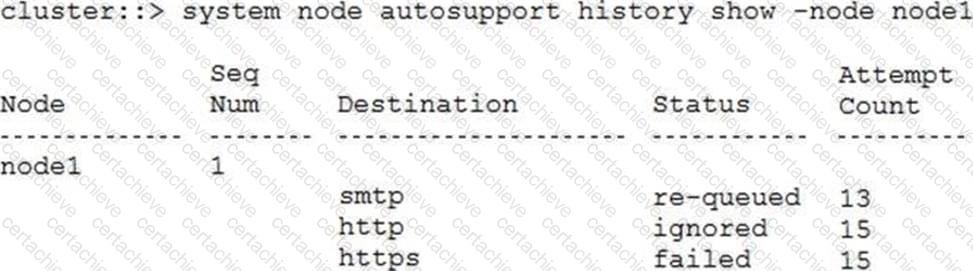
You configured AutoSupport and are trying to send a full AutoSupport message to NetApp. You use the autosupport history show command and see the output shown in the exhibit.
The customer confirms that the AutoSupport settings are correct.
Which two actions will solve this issue? (Choose two.)
Correct Answer & Rationale:
Answer: C, D
Explanation:
The AutoSupport history output shows multiple transport attempts using SMTP, HTTP, and HTTPS , with SMTP being re-queued, HTTP ignored, and HTTPS failed. This indicates that AutoSupport is enabled and functioning at the configuration level, but the delivery mechanism is being blocked or restricted by the customer’s network infrastructure.
SMTP failures commonly occur when mail servers block large attachments or require explicit whitelisting of sending systems. Since full AutoSupport messages include large log bundles, mail servers often reject or delay these messages unless the sending nodes are explicitly allowed. Therefore, whitelisting the nodes on the mail server directly addresses the SMTP delivery issue.
Additionally, NetApp installation best practices recommend HTTPS as the preferred AutoSupport transport protocol because it bypasses mail server limitations and is more reliable for large payloads. Switching the transport protocol to HTTPS avoids SMTP attachment-size restrictions entirely and ensures successful delivery when outbound HTTPS access is allowed.
Enabling AutoSupport on both nodes is not relevant because the output confirms AutoSupport is already active. Excluding nodes from attachment-size limits is not a supported ONTAP action.
Thus, the two correct actions are to change the transport protocol to HTTPS and whitelist the nodes on the mail server .
Question 6
Netapp NS0-185
QUESTION DESCRIPTION:
You are installing a new six-node ONTAP 9.8 cluster. You have completed the initial configuration of the cluster interconnect switches and the ONTAP cluster.
In this scenario, which feature should you enable?
Correct Answer & Rationale:
Answer: B
Explanation:
After completing the initial configuration of a multi-node ONTAP cluster and its cluster interconnect switches, NetApp installation best practices require enabling proactive monitoring of the cluster network. The Cluster Switch Health Monitor (CSHM) is the ONTAP feature designed specifically for this purpose.
CSHM continuously monitors the health of supported cluster switches by collecting information such as switch configuration, port status, firmware versions, cabling, and error conditions. It validates this information against NetApp-supported configurations and best practices. When deviations or risks are detected, CSHM generates alerts and EMS messages that allow administrators to take corrective action before cluster communication is affected.
Cluster switch logging alone does not provide health analysis or proactive validation; it only records switch events. IPv6 is not required or recommended for cluster interconnect networks in standard ONTAP installations. Data Center Bridging (DCB) is used for specific Ethernet storage protocols and is not applicable to ONTAP cluster interconnect networks.
Therefore, enabling the cluster switch health monitor is the correct and required post-installation step.
Question 7
Netapp NS0-185
QUESTION DESCRIPTION:
After you install an AFF A700 2-node cluster with DS224C shelves, Config Advisor reports that your SAS cabling is in mixed-path HA. You expected the SAS cabling be in quad-path HA.
You physically verify the LED status on the controllers and the shelves and notice no irregularities. However, a reboot of the SAS expander does not change the output.
In this scenario, what should you do next?
Correct Answer & Rationale:
Answer: C
Explanation:
This is a post-install validation and troubleshooting scenario for SAS shelf cabling. ONTAP hardware installation guidance distinguishes between multipath/tri-path and quad-path configurations based on how shelves are cabled. For shelves with IOM12/IOM12B modules, quad-path configurations require double-wide shelf-to-shelf connectivity: first using the standard connections (IOM ports 3 and 1) and then adding double-wide connections (IOM ports 4 and 2). If quad-path HA is intended but Config Advisor reports mixed-path HA , then ONTAP’s view of the end-to-end SAS topology does not match the expected double-wide design.
The question states LEDs look normal and rebooting the SAS expander did not change the status. That reduces the likelihood of a transient expander condition and shifts focus to physical seating/connection integrity . In installation practice, a common next corrective step is to re-seat the SAS I/O modules (IOMs on the shelf side or SAS modules/adapters on the controller side depending on platform architecture). Reseating is a controlled, practical action to address partial lane connectivity, marginal contacts, or module insertion issues that can still present as “connected” at an LED level but result in ONTAP detecting fewer active paths than expected.
Option D is incorrect because multipath HA is not “the only” supported method on such platforms; ONTAP documentation explicitly describes quad-path (“double-wide”) cabling rules and steps. Option B (disconnect and rerun Config Advisor) is destructive and does not correct the underlying condition; it is more of a diagnostic reset than a validated next fix step, and it risks creating additional variables. Option A (open a case and power off shelves) is premature given there is a clear, standard physical remediation action remaining.
Therefore, the correct next step is to re-seat the SAS IO modules of the affected controller.
Question 8
Netapp NS0-185
QUESTION DESCRIPTION:
Exhibit.
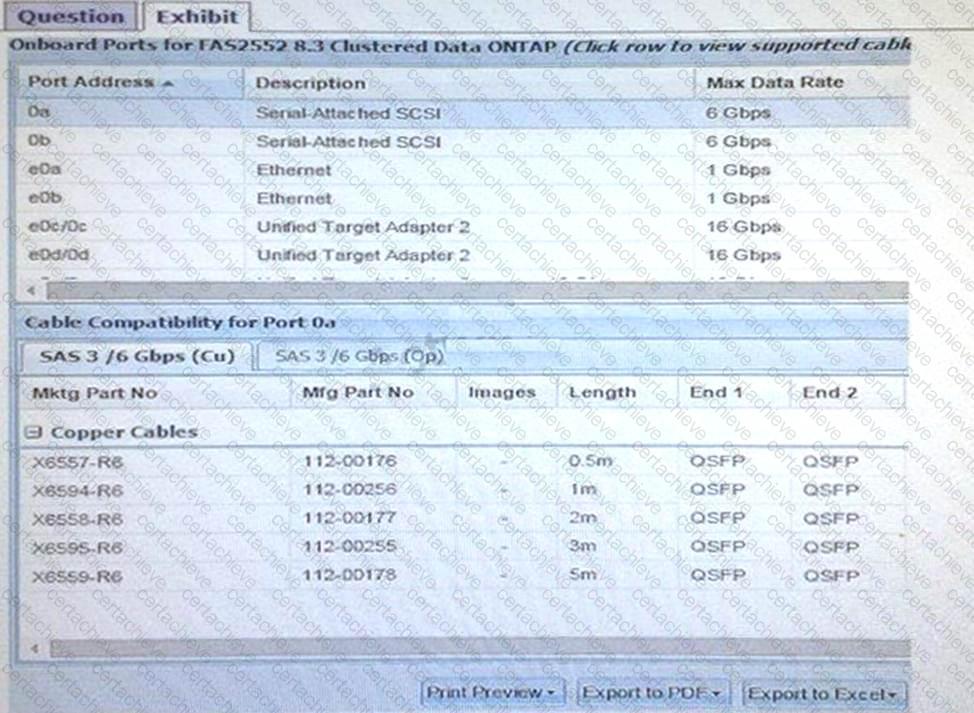
You are installing a FAS2254 and a DS2246 disk shelf at a customer's site. The controller and disk shelf must be racked in separate rows in the data center due to available space.
The customer wants you to use two of the 20-meter copper SAS cables to make connections. Referring to the exhibit, which statement is correct?
Correct Answer & Rationale:
Answer: C
Explanation:
This question tests installation cabling constraints and supported cabling media for SAS connectivity. The key issue is distance: the customer wants to use 20-meter copper SAS cables between a controller and a shelf that are installed in separate rows.
NetApp hardware cabling guidance indicates that when long distance SAS connectivity is required, the supported approach is to use SAS optical cabling (for applicable platforms and shelf/IOM combinations). The ONTAP hardware systems documentation describes “mini-SAS HD SAS optical cable rules,” noting that optical AOC SAS cables are available in lengths up to 50 meters for controller-to-stack and shelf-to-shelf connections in supported configurations. This highlights a critical installation principle: long SAS runs are addressed with optical , not copper.
The documentation also establishes that SAS cabling within a stack must be consistent (all copper or all optical) and that mixed approaches have specific constraints. While the excerpt emphasizes optical rules (because optical is the mechanism for long distance), it implicitly reinforces that copper has practical distance limitations and is not the long-distance solution.
Therefore, if the customer insists on copper SAS, the correct guidance is that the controller and disk shelf must be closer together to remain within supported copper SAS distance limits and to ensure signal integrity and supported operation. Option B is incorrect because simply “obtaining” 20-meter copper SAS cables does not make the configuration supported. Option D is incorrect because Ethernet adapters do not replace SAS for shelf connectivity. Option A is nonsensical in this context because SAS shelf connectivity cannot be replaced by a “wireless adapter” as a supported installation practice.
Thus, the correct answer is C : if copper cables are to be used, the devices must be closer together; otherwise the supported solution is to use a supported SAS optical approach.
Question 9
Netapp NS0-185
QUESTION DESCRIPTION:
You installed a new 2-node FAS500f ONTAP 9.8 switchless cluster that serves NAS volumes to both NFSv4.1 and SMB clients. The host operating systems have full flow control enabled on their data ports.
In this scenario, which two flow control settings would you verify? (Choose two.)
Correct Answer & Rationale:
Answer: C, D
Explanation:
Flow control configuration is an important validation step in ONTAP SAN and NAS environments, especially in switchless cluster designs. NetApp documentation clearly differentiates flow control requirements between data networks and cluster networks.
For data network ports, full flow control must be enabled when hosts are configured with full flow control. This ensures proper congestion management and prevents packet loss during high-throughput NAS operations such as NFSv4.1 and SMB traffic. Matching flow control settings between hosts and storage data ports is a best practice explicitly stated in NetApp installation guidance.
In contrast, cluster network ports must have flow control disabled. The cluster network is highly sensitive to latency and congestion, and enabling flow control on cluster interconnect ports can introduce delays that negatively affect cluster quorum, node communication, and overall stability. NetApp explicitly requires flow control to be disabled on cluster network interfaces.
Enabling flow control on cluster ports or disabling it on data ports would violate NetApp-supported configurations and can lead to performance degradation or cluster communication issues.
Therefore, the two correct settings to verify are:
Data network ports have full flow control enabled
Cluster network ports have full flow control disabled
This makes C and D the correct answers.
Question 10
Netapp NS0-185
QUESTION DESCRIPTION:
A customer is asked to install a new AFF ASA A700 system. During the installation, the customer asks if ONTAP 9.8 is supported with their host’s OS version running Windows 2016.
In this scenario, which NetApp tool would verify supportability?
Correct Answer & Rationale:
Answer: D
Explanation:
Verifying interoperability between ONTAP versions, storage platforms, host operating systems, protocols, and host utilities is a mandatory step in NetApp solution assessment and installation planning. The Interoperability Matrix Tool (IMT) is the authoritative NetApp resource used to confirm whether a specific combination of components is supported.
In this scenario, the customer needs to verify that ONTAP 9.8 is supported with Windows Server 2016 on an AFF ASA A700 system. IMT allows administrators to search by storage OS version, platform model, host OS, protocol (iSCSI, FC, NVMe), and host utilities to ensure the configuration is supported.
ONTAP System Manager is used for system administration, not supportability validation. Active IQ Unified Manager focuses on monitoring and performance. Active IQ OneCollect is used for data collection, not compatibility verification.
Therefore, the correct tool is the Interoperability Matrix Tool .

Verified by Certified Instructors
This Netapp NS0-185 study pack was audited and verified on September 23, 2026 by Radia Davenport,. We ensure every technical rationale aligns with real-world enterprise standards.
A Stepping Stone for Enhanced Career Opportunities
Your profile having NCSIE ONTAP certification significantly enhances your credibility and marketability in all corners of the world. The best part is that your formal recognition pays you in terms of tangible career advancement. It helps you perform your desired job roles accompanied by a substantial increase in your regular income. Beyond the resume, your expertise imparts you confidence to act as a dependable professional to solve real-world business challenges.
Your success in Netapp NS0-185 certification exam makes your visible and relevant in the fast-evolving tech landscape. It proves a lifelong investment in your career that give you not only a competitive advantage over your non-certified peers but also makes you eligible for a further relevant exams in your domain.
What You Need to Ace Netapp Exam NS0-185
Achieving success in the NS0-185 Netapp exam requires a blending of clear understanding of all the exam topics, practical skills, and practice of the actual format. There's no room for cramming information, memorizing facts or dependence on a few significant exam topics. It means your readiness for exam needs you develop a comprehensive grasp on the syllabus that includes theoretical as well as practical command.
Here is a comprehensive strategy layout to secure peak performance in NS0-185 certification exam:
- Develop a rock-solid theoretical clarity of the exam topics
- Begin with easier and more familiar topics of the exam syllabus
- Make sure your command on the fundamental concepts
- Focus your attention to understand why that matters
- Ensure hands-on practice as the exam tests your ability to apply knowledge
- Develop a study routine managing time because it can be a major time-sink if you are slow
- Find out a comprehensive and streamlined study resource for your help
Ensuring Outstanding Results in Exam NS0-185!
In the backdrop of the above prep strategy for NS0-185 Netapp exam, your primary need is to find out a comprehensive study resource. It could otherwise be a daunting task to achieve exam success. The most important factor that must be kep in mind is make sure your reliance on a one particular resource instead of depending on multiple sources. It should be an all-inclusive resource that ensures conceptual explanations, hands-on practical exercises, and realistic assessment tools.
Certachieve: A Reliable All-inclusive Study Resource
Certachieve offers multiple study tools to do thorough and rewarding NS0-185 exam prep. Here's an overview of Certachieve's toolkit:
Netapp NS0-185 PDF Study Guide
This premium guide contains a number of Netapp NS0-185 exam questions and answers that give you a full coverage of the exam syllabus in easy language. The information provided efficiently guides the candidate's focus to the most critical topics. The supportive explanations and examples build both the knowledge and the practical confidence of the exam candidates required to confidently pass the exam. The demo of Netapp NS0-185 study guide pdf free download is also available to examine the contents and quality of the study material.
Netapp NS0-185 Practice Exams
Practicing the exam NS0-185 questions is one of the essential requirements of your exam preparation. To help you with this important task, Certachieve introduces Netapp NS0-185 Testing Engine to simulate multiple real exam-like tests. They are of enormous value for developing your grasp and understanding your strengths and weaknesses in exam preparation and make up deficiencies in time.
These comprehensive materials are engineered to streamline your preparation process, providing a direct and efficient path to mastering the exam's requirements.
Netapp NS0-185 exam dumps
These realistic dumps include the most significant questions that may be the part of your upcoming exam. Learning NS0-185 exam dumps can increase not only your chances of success but can also award you an outstanding score.
Top Exams & Certification Providers
New & Trending
- New Released Exams
- Related Exam
- Hot Vendor