
The NetApp Certified Hybrid Cloud Administrator Professional Exam (NS0-304)
Passing Netapp Hybrid Cloud Administrator exam ensures for the successful candidate a powerful array of professional and personal benefits. The first and the foremost benefit comes with a global recognition that validates your knowledge and skills, making possible your entry into any organization of your choice.


NS0-304 Exam Dumps
- Exam Code: NS0-304
- Vendor: Netapp
- Certifications: Hybrid Cloud Administrator
- Exam Name: NetApp Certified Hybrid Cloud Administrator Professional Exam
Why CertAchieve is Better than Standard NS0-304 Dumps
In 2026, Netapp uses variable topologies. Basic dumps will fail you.
| Quality Standard | Generic Dump Sites | CertAchieve Premium Prep |
|---|---|---|
| Technical Explanation | None (Answer Key Only) | Step-by-Step Expert Rationales |
| Syllabus Coverage | Often Outdated (v1.0) | 2026 Updated (Latest Syllabus) |
| Scenario Mastery | Blind Memorization | Conceptual Logic & Troubleshooting |
| Instructor Access | No Post-Sale Support | 24/7 Professional Help |
Customers Passed Exams
10
Success backed by proven exam prep tools
Questions Came Word for Word
85%
Real exam match rate reported by verified users
Average Score in Real Testing Centre
94%
Consistently high performance across certifications
Study Time Saved With CertAchieve
60%
Efficient prep that reduces study hours significantly
Netapp NS0-304 Exam Domains Q&A
Certified instructors verify every question for 100% accuracy, providing detailed, step-by-step explanations for each.
Question 1
Netapp NS0-304
QUESTION DESCRIPTION:
An administrator wants to protect Kubernetes-based applications across both on-premises and the cloud. The backup must be application aware and protect all components and data for the application. The administrator wants to use SnapMirror for disaster recovery.
Which product should the administrator use?
Correct Answer & Rationale:
Answer: B
Explanation:
Astra Control Service is the appropriate NetApp product for protecting Kubernetes-based applications across both on-premises and cloud environments. Astra Control Service is designed to provide application-aware data management, which means it understands the structure and dependencies of Kubernetes applications and can manage them holistically. This includes backup and recovery, application cloning, and dynamic scaling.
While SnapMirror could be used for disaster recovery by replicating data at the storage layer, it does not inherently understand or manage the Kubernetes application layer directly. SnapCenter is primarily focused on traditional data management for enterprise applications on NetApp storage and does not cater specifically to Kubernetes environments. Cloud Backup Service is for backup to the cloud and also does not provide the Kubernetes application awareness required in this scenario.
Thus, Astra Control Service, which integrates deeply with Kubernetes, allows administrators to manage, protect, and move containerized applications and their data across multiple environments, making it the best fit for the described requirements. For detailed information on Astra Control Service's capabilities with Kubernetes applications, refer to the official NetApp Astra Control Service documentation.
Question 2
Netapp NS0-304
QUESTION DESCRIPTION:
An administrator must configure a fan-out SnapMirror architecture from an on-premises, four-node cluster to highly available instances of Cloud Volumes ONTAP (CVO) in both Azure and GCP.
How many Intercluster LIFs are required to connect the three clusters?
Correct Answer & Rationale:
Answer: C
Explanation:
When configuring a fan-out SnapMirror architecture from an on-premises four-node cluster to highly available instances of Cloud Volumes ONTAP (CVO) in both Azure and GCP, you will need to establish intercluster LIFs (Logical Interface) to connect the three clusters. Here's the breakdown:
Intercluster LIFs per Node: Typically, at least one intercluster LIF is required per node in a cluster to facilitate SnapMirror replication. This is necessary for network communication dedicated to data replication between clusters.
Total LIFs Calculation:
On-premises four-node cluster: 4 LIFs (one per node)
Each CVO instance in Azure and GCP: Assuming each is a two-node setup, 4 LIFs per CVO instance (2 nodes x 2 LIFs each for redundancy and high availability).
Total LIFs = 4 (on-prem) + 4 (Azure CVO) + 4 (GCP CVO) = 12 LIFs.
Redundancy and Availability: Given the critical nature of maintaining connectivity for HA instances in both Azure and GCP, configuring two LIFs per node in the cloud environments ensures redundancy and enhances reliability.
This setup ensures that each node in every cluster can maintain an independent connection for data replication, vital for a robust and efficient fan-out architecture. For further guidance on configuring SnapMirror and intercluster LIFs, consult the NetApp documentation on SnapMirror configuration: NetApp SnapMirror Documentation.
Question 3
Netapp NS0-304
QUESTION DESCRIPTION:
Refer to the exhibit.
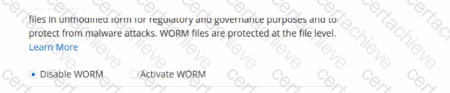
An administrator is deploying the latest version of CVO via BlueXP. What will be the result of leaving the option disabled?
Correct Answer & Rationale:
Answer: D
Explanation:
In the context of deploying Cloud Volumes ONTAP (CVO) via BlueXP, if the administrator chooses to leave the WORM (Write Once Read Many) option disabled, the default behavior for newly created volumes will be as non-SnapLock volumes. Here’s what this implies:
Non-SnapLock Volumes: Leaving the WORM feature disabled means that new volumes will not be created with the SnapLock compliance feature activated. SnapLock is used to ensure data immutability for compliance and regulatory purposes, protecting files from being altered or deleted before a predetermined retention period expires.
Volume Configuration Flexibility: Administrators will have the option to activate SnapLock or other data protection features on a per-volume basis in the future if needed, but this would need to be explicitly configured.
Impact on Data Management: This choice affects how data is managed in terms of compliance and security. Without SnapLock enabled by default, the volumes will operate under standard data management policies, which do not include immutability protections.
For more information on the implications of enabling or disabling SnapLock and how it affects volume creation in Cloud Volumes ONTAP, please refer to the NetApp BlueXP and SnapLock documentation: NetApp SnapLock Documentation.
Question 4
Netapp NS0-304
QUESTION DESCRIPTION:
An outbound Internet connection is not available to send AutoSupport messages. BlueXP has automatically configured the Cloud Volumes ONTAP systems to use the Connector as a proxy server. The Connector requires an inbound connection on port 3128.
What must the administrator do?
Correct Answer & Rationale:
Answer: B
Explanation:
When BlueXP has configured Cloud Volumes ONTAP systems to use the Connector as a proxy server, and the Connector requires an inbound connection on port 3128, the necessary action is to modify the associated security group. Here's what to do:
Identify Security Group: Determine which security group is associated with the Cloud Volumes ONTAP or the Connector instance.
Modify Security Group Rules: Update the security group rules to allow inbound traffic on port 3128. This is crucial to enable the Connector to receive connections as a proxy server for sending AutoSupport messages.
Apply and Verify Changes: After updating the security group, apply the changes and verify that the Connector can successfully transmit AutoSupport messages through the specified port.
For guidance on configuring security groups in AWS, consult the AWS documentation or the specific guidelines provided by your cloud provider: AWS Security Groups Documentation .
Question 5
Netapp NS0-304
QUESTION DESCRIPTION:
An administrator is configuring a Red Hat Enterprise Linux system as a Workload Security Agent and wants to make sure that it meets requirements.
Which two changes should the administrator make to the system? (Choose two.)
Correct Answer & Rationale:
Answer: A, D
Explanation:
When configuring a Red Hat Enterprise Linux system as a Workload Security Agent, there are specific system requirements and preparations needed to ensure compatibility and functionality of the security agent. Among the potential adjustments:
Disable SELinux : Security-Enhanced Linux (SELinux) can interfere with the operation of various security agents due to its strict access controls. Disabling SELinux may be recommended by certain security applications to ensure they can function without restrictions. This should be carefully considered in the context of overall system security policies.
Install the unzip application : Many security agents require unzip to extract and install necessary files. Ensuring that unzip is installed on the system can facilitate the installation and updating of the security agent.
Install the ansible-core application and Disable the system firewall are not typically required or recommended universally for configuring a Workload Security Agent:
Ansible-core is used for automation and configuration management but is not a prerequisite for most security agents unless specifically stated.
Disabling the system firewall can significantly reduce the system's security posture and is generally not advisable unless specifically required by the security agent, and even then, such advice should be critically evaluated.
For specific guidelines and requirements, the installation documentation of the Workload Security Agent should be consulted.
Question 6
Netapp NS0-304
QUESTION DESCRIPTION:
An administrator cannot create a new volume in Azure NetApp Files. The administrator receives an error that the DNS server is not available. What should the administrator do?
Correct Answer & Rationale:
Answer: A
Explanation:
When an administrator receives an error that the DNS server is not available while trying to create a new volume in Azure NetApp Files, the first action should be to confirm that the network security groups allow connectivity. Here’s the process:
Check Network Security Group Rules: Verify that the network security group (NSG) associated with the subnet where Azure NetApp Files is located has rules that allow traffic to and from the DNS server, specifically permitting DNS query traffic (typically over port 53 for both TCP and UDP).
Adjust NSG Settings if Necessary: If the current NSG rules are restrictive and do not allow DNS traffic, modify them to include the necessary allowances for DNS resolution.
Test Connectivity: After updating the NSG settings, retry the volume creation to see if the DNS issue has been resolved.
For guidance on managing NSGs in Azure, consult the Azure documentation: Azure Network Security Groups .
Question 7
Netapp NS0-304
QUESTION DESCRIPTION:
An administrator needs to monitor their storage and compute resources in their hyperscaler and their private data center. Which tool meets this requirement?
Correct Answer & Rationale:
Answer: C
Explanation:
To monitor storage and compute resources across both a hyperscaler and a private data center, BlueXP Observability is the appropriate tool. This part of the BlueXP suite offers a unified view of infrastructure health, performance, and capacity. Here’s the benefit of using BlueXP Observability:
Unified Monitoring: BlueXP Observability provides a single pane of glass for monitoring resources, regardless of their location—whether in the cloud or on-premises. This includes real-time data on performance, capacity utilization, and system health.
Cross-Environment Support: It supports various environments, making it suitable for hybrid deployments. This capability allows administrators to have a holistic view of their entire infrastructure.
Alerts and Metrics: The tool offers customizable alerts and detailed metrics that help in proactive management and troubleshooting of storage and compute resources.
BlueXP Observability's extensive capabilities in monitoring and managing diverse IT environments make it an ideal choice for enterprises that operate across multiple platforms.
For more information on how to utilize BlueXP Observability for infrastructure monitoring, refer to the NetApp BlueXP documentation: NetApp BlueXP Documentation.
Question 8
Netapp NS0-304
QUESTION DESCRIPTION:
An administrator has iSCSI LUNs on an AWS FSxN instance. The administrator is unable to mount the LUNs from a Linux host in the same AWS region. The Linux host is in a different VPC than FSxN.
What must the administrator configure to resolve this issue?
Correct Answer & Rationale:
Answer: D
Explanation:
If an administrator has iSCSI LUNs on an AWS FSxN instance and is unable to mount these LUNs from a Linux host in the same AWS region due to the host being in a different Virtual Private Cloud (VPC), the solution is to configure VPC peering. Here’s the process:
VPC Peering Setup: VPC peering allows two VPCs to communicate with each other as if they are in the same network. This enables the Linux host to connect to the AWS FSxN instance across different VPCs.
Configuration Steps: To set up VPC peering, the administrator must create a peering connection between the two VPCs in the AWS Management Console, and then update the route tables in each VPC to allow traffic to and from each other.
Mounting iSCSI LUNs: Once VPC peering is configured, the network route will be established, allowing the Linux host to successfully mount the iSCSI LUNs located on the FSxN instance.
For guidance on setting up VPC peering in AWS, consult the AWS documentation: AWS VPC Peering Guide .
Question 9
Netapp NS0-304
QUESTION DESCRIPTION:
An administrator needs to move several volumes that contain iSCSI LUNs from an ONTAP AFF cluster to CVO. Which method should be used?
Correct Answer & Rationale:
Answer: A
Explanation:
To move several volumes containing iSCSI LUNs from an ONTAP AFF cluster to Cloud Volumes ONTAP (CVO), the most appropriate method is using SnapMirror. Here’s the process:
Utilizing SnapMirror for LUN Migration: SnapMirror is NetApp’s replication technology that is ideally suited for efficiently transferring data between ONTAP systems, including from AFF to CVO. It is capable of handling complex data structures like iSCSI LUNs, ensuring data integrity and consistency during the transfer.
Configuration of SnapMirror: Set up a SnapMirror relationship between the source AFF cluster and the destination CVO instance. This involves configuring the SnapMirror policy, scheduling the replication, and initializing the transfer of data.
Advantages for iSCSI LUNs: SnapMirror maintains the layout and attributes of the iSCSI LUNs during replication, which is crucial for ensuring that the storage is ready for immediate use upon completion of the replication to the CVO environment.
For step-by-step instructions on configuring and using SnapMirror for transferring iSCSI LUNs, consult the NetApp documentation on SnapMirror: NetApp SnapMirror Documentation.
Question 10
Netapp NS0-304
QUESTION DESCRIPTION:
An administrator wants to automate the configuration of SnapMirror policies between cloud and on-premises deployments in AWS using Ansible. What must the administrator do first?
Correct Answer & Rationale:
Answer: C
Explanation:
To automate the configuration of SnapMirror policies between cloud and on-premises deployments in AWS using Ansible, the administrator needs to begin by installing the NetApp ONTAP collection from Ansible Galaxy. This collection contains modules specifically designed to manage NetApp ONTAP storage systems, including the management of SnapMirror configurations. Here are the steps to do this:
Installation of ONTAP Collection: Open your command line interface and run the command ansible-galaxy collection install netapp.ontap . This command pulls the ONTAP collection from Ansible Galaxy, which includes all necessary modules for managing NetApp ONTAP, including SnapMirror.
Configuration of Ansible Environment: Ensure that your Ansible environment is set up to connect to both your AWS environment and the on-premises NetApp ONTAP systems. This typically involves configuring the appropriate credentials and network settings in your Ansible playbooks and inventory files.
Writing Ansible Playbooks: With the ONTAP collection installed, you can now write Ansible playbooks that utilize the SnapMirror modules to automate the configuration of SnapMirror policies as required.
For further information on using the NetApp ONTAP Ansible collection, please refer to the official documentation available at: NetApp ONTAP Ansible Collection Documentation.

Verified by Certified Instructors
This Netapp NS0-304 study pack was audited and verified on September 23, 2026 by Radia Davenport,. We ensure every technical rationale aligns with real-world enterprise standards.
A Stepping Stone for Enhanced Career Opportunities
Your profile having Hybrid Cloud Administrator certification significantly enhances your credibility and marketability in all corners of the world. The best part is that your formal recognition pays you in terms of tangible career advancement. It helps you perform your desired job roles accompanied by a substantial increase in your regular income. Beyond the resume, your expertise imparts you confidence to act as a dependable professional to solve real-world business challenges.
Your success in Netapp NS0-304 certification exam makes your visible and relevant in the fast-evolving tech landscape. It proves a lifelong investment in your career that give you not only a competitive advantage over your non-certified peers but also makes you eligible for a further relevant exams in your domain.
What You Need to Ace Netapp Exam NS0-304
Achieving success in the NS0-304 Netapp exam requires a blending of clear understanding of all the exam topics, practical skills, and practice of the actual format. There's no room for cramming information, memorizing facts or dependence on a few significant exam topics. It means your readiness for exam needs you develop a comprehensive grasp on the syllabus that includes theoretical as well as practical command.
Here is a comprehensive strategy layout to secure peak performance in NS0-304 certification exam:
- Develop a rock-solid theoretical clarity of the exam topics
- Begin with easier and more familiar topics of the exam syllabus
- Make sure your command on the fundamental concepts
- Focus your attention to understand why that matters
- Ensure hands-on practice as the exam tests your ability to apply knowledge
- Develop a study routine managing time because it can be a major time-sink if you are slow
- Find out a comprehensive and streamlined study resource for your help
Ensuring Outstanding Results in Exam NS0-304!
In the backdrop of the above prep strategy for NS0-304 Netapp exam, your primary need is to find out a comprehensive study resource. It could otherwise be a daunting task to achieve exam success. The most important factor that must be kep in mind is make sure your reliance on a one particular resource instead of depending on multiple sources. It should be an all-inclusive resource that ensures conceptual explanations, hands-on practical exercises, and realistic assessment tools.
Certachieve: A Reliable All-inclusive Study Resource
Certachieve offers multiple study tools to do thorough and rewarding NS0-304 exam prep. Here's an overview of Certachieve's toolkit:
Netapp NS0-304 PDF Study Guide
This premium guide contains a number of Netapp NS0-304 exam questions and answers that give you a full coverage of the exam syllabus in easy language. The information provided efficiently guides the candidate's focus to the most critical topics. The supportive explanations and examples build both the knowledge and the practical confidence of the exam candidates required to confidently pass the exam. The demo of Netapp NS0-304 study guide pdf free download is also available to examine the contents and quality of the study material.
Netapp NS0-304 Practice Exams
Practicing the exam NS0-304 questions is one of the essential requirements of your exam preparation. To help you with this important task, Certachieve introduces Netapp NS0-304 Testing Engine to simulate multiple real exam-like tests. They are of enormous value for developing your grasp and understanding your strengths and weaknesses in exam preparation and make up deficiencies in time.
These comprehensive materials are engineered to streamline your preparation process, providing a direct and efficient path to mastering the exam's requirements.
Netapp NS0-304 exam dumps
These realistic dumps include the most significant questions that may be the part of your upcoming exam. Learning NS0-304 exam dumps can increase not only your chances of success but can also award you an outstanding score.
Top Exams & Certification Providers
New & Trending
- New Released Exams
- Related Exam
- Hot Vendor