
The HCIA-Datacom V2.0 (H12-811_V2.0)
Passing Huawei HCIA-Datacom exam ensures for the successful candidate a powerful array of professional and personal benefits. The first and the foremost benefit comes with a global recognition that validates your knowledge and skills, making possible your entry into any organization of your choice.


H12-811_V2.0 Exam Dumps
- Exam Code: H12-811_V2.0
- Vendor: Huawei
- Certifications: HCIA-Datacom
- Exam Name: HCIA-Datacom V2.0
Why CertAchieve is Better than Standard H12-811_V2.0 Dumps
In 2026, Huawei uses variable topologies. Basic dumps will fail you.
| Quality Standard | Generic Dump Sites | CertAchieve Premium Prep |
|---|---|---|
| Technical Explanation | None (Answer Key Only) | Step-by-Step Expert Rationales |
| Syllabus Coverage | Often Outdated (v1.0) | 2026 Updated (Latest Syllabus) |
| Scenario Mastery | Blind Memorization | Conceptual Logic & Troubleshooting |
| Instructor Access | No Post-Sale Support | 24/7 Professional Help |
Customers Passed Exams
10
Success backed by proven exam prep tools
Questions Came Word for Word
93%
Real exam match rate reported by verified users
Average Score in Real Testing Centre
87%
Consistently high performance across certifications
Study Time Saved With CertAchieve
60%
Efficient prep that reduces study hours significantly
Coverage of Official Huawei H12-811_V2.0 Exam Domains
Our curriculum is meticulously mapped to the Huawei official blueprint.
Data Communication & Network Basics (8%)
Master foundational data transport mechanisms. Topics cover the OSI reference framework, TCP/IP protocol stack layer parameters, basic data encapsulation flows, and the foundational roles of structural routers and switches.
Building an IP Interconnection & Interworking Network (27%)
Deep dive into enterprise Layer 3 architectures and logic. Master IPv4 addressing design structures, VLSM subnetting calculations, static routing overrides, OSPF link-state database routing (LSDB synchronization, Hello parameters, neighbor states), and foundational VRP CLI syntax logic.
Ethernet Switching Network Construction (28%)
The highest-weight domain on the exam, focusing on Layer 2 campus fabrics. Master MAC address table learning and aging rules, STP loop avoidance algorithms (root bridge elections, port role choices, convergence parameters), Eth-Trunk link aggregation controls (manual and LACP negotiation), and configuring Access/Trunk/Hybrid VLAN encapsulation boundaries.
Cybersecurity Infrastructure & Network Access Controls (8%)
Implementing basic edge protection mechanisms. Configuring basic and advanced Access Control Lists (ACL rules), implementing Network Address Translation patterns (Static NAT, Dynamic NAT, PAT / Easy IP), and configuring basic AAA access control paradigms.
Network Services, Applications & System Management (14%)
Mastering core infrastructure protocols and operations management tracking. This domain combines essential services (DHCP address pooling, DNS resolution, FTP/TFTP operations) with WLAN basics (802.11 standards, CAPWAP control tunnels, AP positioning), WAN technologies (PPP/PPPoE, basic MPLS concepts), and operational O&M tools (SNMP monitoring, Syslog tracking).
Next-Generation Infrastructure: IPv6, SDN & Automation (15%)
Evaluating modern enterprise technology evolution paths. Deep dive into IPv6 header fields, neighbor discovery protocols, basic stateless address autoconfiguration (SLAAC), foundational SDN controller topologies, and automation logic using Python scripting wrappers.
Huawei H12-811_V2.0 Exam Domains Q&A
Certified instructors verify every question for 100% accuracy, providing detailed, step-by-step explanations for each.
Question 1
Huawei H12-811_V2.0
QUESTION DESCRIPTION:
Assume that you cannot configure an IP address for GE1/0/1 on a Huawei switch. Which of the following commands can you run in the interface view to resolve this problem?
Correct Answer & Rationale:
Answer: B
Explanation:
On Huawei switches, a physical Ethernet interface usually works as a Layer 2 switch port by default. A Layer 2 interface cannot be assigned an IP address directly. If an administrator wants to configure an IP address on such an interface, the interface must first be converted into a Layer 3 interface. The command used for this is undo portswitch, so option B is correct.
After this command is executed, the interface no longer behaves as a Layer 2 switching port and can then support Layer 3 features such as direct IP address configuration. Options A, C, and D are all Layer 2 port-type commands used to configure the interface as a trunk, access, or hybrid port. These commands do not solve the problem because they keep the interface operating at Layer 2. HCIA-Datacom emphasizes the difference between Layer 2 switching interfaces and Layer 3 routed interfaces on switches. Understanding when to use undo portswitch is important in campus network deployment, especially when configuring routed uplinks, management interfaces, or inter-device Layer 3 links on switches.
Question 2
Huawei H12-811_V2.0
QUESTION DESCRIPTION:
R1 has two equal-cost routes to 10.0.12.0/24 after the following commands are configured.
[R1] ip route-static 10.0.12.0 24 10.0.12.2 preference 60
[R1] ip route-static 10.0.12.0 24 10.0.21.2 preference 60

Correct Answer & Rationale:
Answer: B
Explanation:
The source key marks this statement TRUE, but the topology makes that answer technically incorrect. R1 is shown with interface address 10.0.12.1/24, which automatically installs a directly connected route to 10.0.12.0/24. On Huawei VRP, a direct route has preference 0, whereas a static route has preference 60 unless another value is configured. The two commands do configure two static routes with the same preference, and equal-preference static routes can support load balancing when they are the best routes to a destination. Here, however, both static routes are for the same prefix that R1 already owns as a connected network. The direct route has a higher priority because its preference value is smaller, so it is selected in the active IP routing table instead of the two preference-60 static routes. Therefore the assertion that R1 has two active equal-cost routes to 10.0.12.0/24 is FALSE as the question and exhibit are written. The verified answer is B, and the original source key A should be corrected.
Question 3
Huawei H12-811_V2.0
QUESTION DESCRIPTION:
On a switched network where STP is enabled on all devices, when a downstream device detects a topology change, it continuously sends configuration BPDUs to the upstream device until the root bridge is informed of the topology change.
Correct Answer & Rationale:
Answer: B
Explanation:
This statement is false. In classic STP, when a non-root switch detects a topology change, it does not continuously send configuration BPDUs upstream to notify the root bridge. Instead, it sends a Topology Change Notification (TCN) BPDU toward the root bridge through its root port. Each upstream switch acknowledges the TCN and forwards it further until it reaches the root bridge.
After the root bridge receives the topology change notification, the root bridge sets the Topology Change (TC) flag in its configuration BPDUs, and those configuration BPDUs are then propagated throughout the network. Therefore, topology-change notification and normal configuration BPDU transmission are different functions. The statement is wrong because it confuses TCN BPDUs with configuration BPDUs, and also inaccurately describes the notification behavior. HCIA-Datacom requires learners to distinguish between these BPDU types and understand how STP reacts to topology changes by accelerating MAC address aging and informing the network through the root bridge. This process helps the Layer 2 topology converge and reduces long-lasting forwarding inconsistencies after a link or port-state change.
Question 4
Huawei H12-811_V2.0
QUESTION DESCRIPTION:
When a Huawei network device functions as an FTP server, which of the following are possible causes of an FTP client failing to log in to the FTP server? (Select all that apply)
Correct Answer & Rationale:
Answer: A, B, C, D
Explanation:
All four options are possible causes of FTP login failure, so the correct answer is A, B, C, and D.
Option A is correct because if the FTP server function is not enabled on the Huawei device, the device cannot provide FTP services and the client cannot log in. Option B is also correct because if the authorized directory is not specified for the FTP user, the user may not be able to complete login or access file services properly, depending on the FTP user configuration requirements. Option C is correct because an FTP user account must be configured with the required username and password; otherwise, authentication cannot succeed. Option D is also correct because if the network between the FTP client and the device is unreachable, the client cannot establish the FTP connection at all.
In HCIA-Datacom troubleshooting, FTP login failure is usually checked from four aspects: service enablement, user configuration, permission or directory authorization, and network connectivity. This question tests standard remote maintenance troubleshooting logic for file transfer services on Huawei network devices.
Question 5
Huawei H12-811_V2.0
QUESTION DESCRIPTION:
The IPv6 header is also called a fixed header, which contains eight fields. The total length of the fixed header is 40 bytes. Which of the following fields does an IPv6 header include?
Correct Answer & Rationale:
Answer: A, B, C
Explanation:
The IPv6 basic header has a fixed length of 40 bytes and contains eight fields: Version, Traffic Class, Flow Label, Payload Length, Next Header, Hop Limit, Source Address, and Destination Address. The Source IPv6 Address is therefore part of the IPv6 header. Hop Limit is also present and serves a function comparable to the IPv4 TTL field by limiting how many Layer 3 forwarding hops a packet can traverse. Next Header identifies the type of extension header or upper-layer protocol that follows the IPv6 basic header. A source MAC address is not part of the IPv6 header. MAC addresses belong to the data-link-layer frame header, such as an Ethernet header, and are relevant only to the current Layer 2 segment. As an IPv6 packet is routed, Ethernet source and destination MAC addresses can change from hop to hop while the IPv6 source and destination addresses normally remain unchanged end to end. Therefore A, B, and C are IPv6 header fields, while D is not. The correct answer is A, B, and C.
Question 6
Huawei H12-811_V2.0
QUESTION DESCRIPTION:
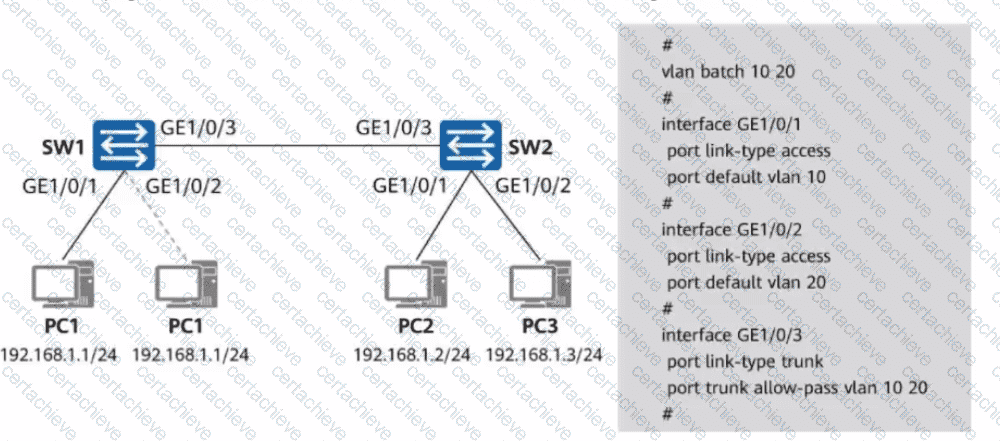
The administrator performs the configuration shown in the figure on SW1 and SW2. Initially, PC1 is connected to GE1/0/1 of SW1. After the network is stable, the administrator pings the IP addresses of PC2 and PC3 from PC1. Later, the administrator connects PC1 to GE1/0/2 of SW1. After the network is stable, the administrator pings the IP addresses of PC2 and PC3 from PC1. Which of the following statements is false about this scenario?
Correct Answer & Rationale:
Answer: A
Explanation:
The exhibit assigns SW1 GE1/0/1 to VLAN 10 and GE1/0/2 to VLAN 20, while the trunk between SW1 and SW2 carries the required VLANs. When PC1 is connected to GE1/0/1, its untagged frames are classified into VLAN 10. PC2 is also in VLAN 10, so PC1 can communicate with PC2 at Layer 2, whereas PC3 is in VLAN 20 and is separated by the VLAN boundary. SW1 learns PC1 ' s source MAC address together with VLAN 10 and ingress interface GE1/0/1. When PC1 is moved to GE1/0/2, its untagged frames are now placed in VLAN 20. After MAC relearning occurs, PC1 can communicate with PC3, which is also in VLAN 20, but not directly with PC2 in VLAN 10 unless Layer 3 inter-VLAN routing is provided. Consequently, statement A is false because PC1 is not isolated from both hosts after the move; it can communicate with PC3.
Question 7
Huawei H12-811_V2.0
QUESTION DESCRIPTION:
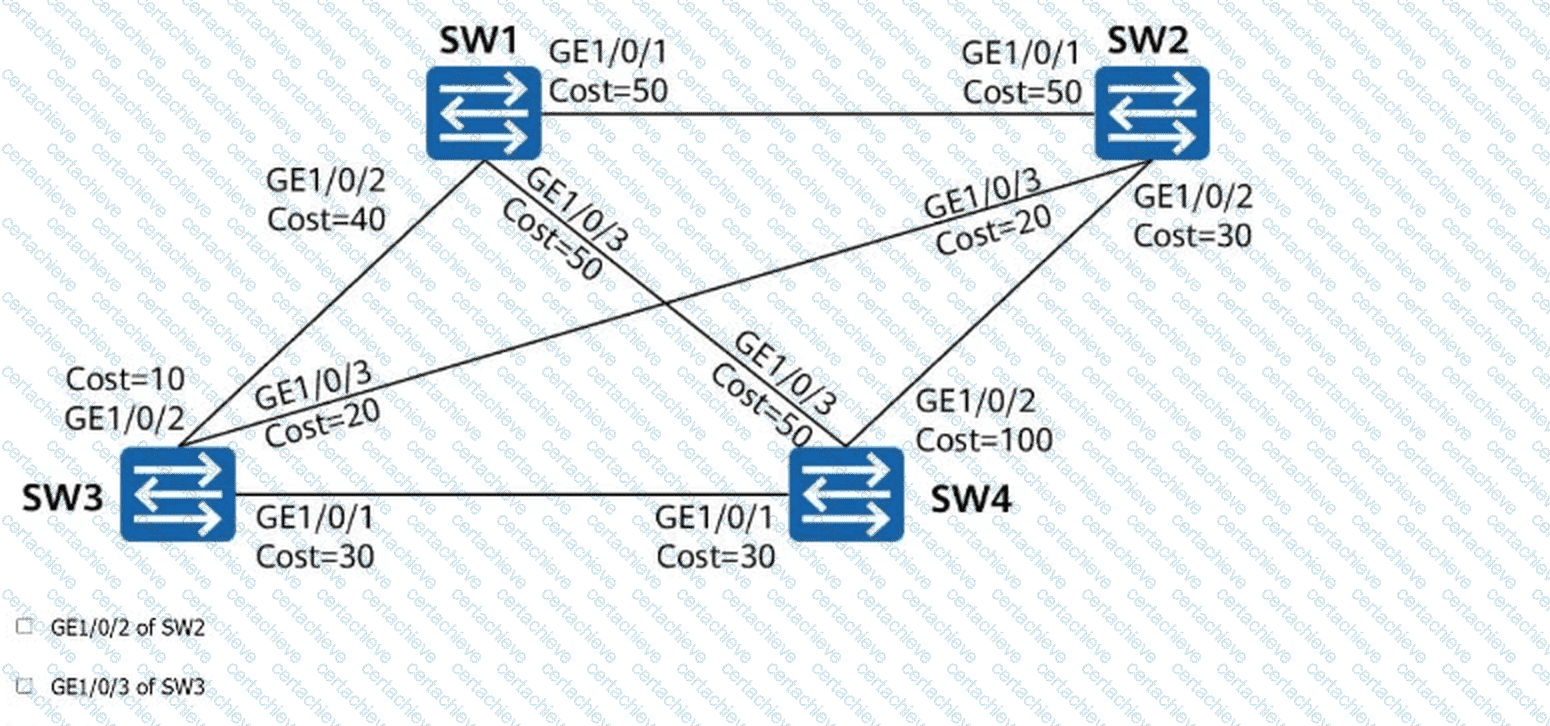
On the switched network shown in the figure, STP is enabled on all devices. SW1 is the root bridge. The port costs are shown in the figure. Other parameters retain the default values. After the network is stable, which of the following ports are not root ports? (Select all that apply)
Correct Answer & Rationale:
Answer: A, B, D
Explanation:
STP selects one root port on each non-root bridge based on the lowest accumulated path cost toward the root bridge.
SW1 is the root bridge, so SW3 selects GE1/0/2 as its root port because the direct path to SW1 has a cost of 10. Therefore, GE1/0/3 on SW3 is not a root port.
SW2 can reach the root through SW3 with a total cost of 30, which is lower than its direct path cost of 50. Consequently, GE1/0/3 on SW2 becomes its root port, while GE1/0/1 and GE1/0/2 do not.
SW4 selects GE1/0/1 toward SW3 because that path provides a total root cost of 40.
Therefore, option C identifies a root port, whereas A, B, and D identify ports that are not root ports.
================
Question 8
Huawei H12-811_V2.0
QUESTION DESCRIPTION:
According to the following routing table, it can be inferred that the IP address of VLANIF 2 on R1 is 10.0.12.1/24.
[R1] display ip routing-table
Proto: Protocol Pre: Preference
Route Flags: R - relay, D - download to fib, T - to vpn-instance, B - black hole route
Routing Table : public
Destinations : 10 Routes : 10
Destination/Mask Proto Pre Cost Flags NextHop Interface
10.0.12.0/24 Direct 0 0 D 10.0.12.1 Vlanif2
10.0.12.1/32 Direct 0 0 D 127.0.0.1 Vlanif2
10.0.12.255/32 Direct 0 0 D 127.0.0.1 Vlanif2
10.0.21.0/24 Direct 0 0 D 10.0.21.1 Vlanif3
10.0.21.1/32 Direct 0 0 D 127.0.0.1 Vlanif3
10.0.21.255/32 Direct 0 0 D 127.0.0.1 Vlanif3
Correct Answer & Rationale:
Answer: A
Explanation:
This statement is true. From the routing table, the entry 10.0.12.0/24 Direct ... NextHop 10.0.12.1 Interface Vlanif2 indicates that the network 10.0.12.0/24 is directly connected through Vlanif2, and the local interface address associated with that directly connected network is 10.0.12.1.
This conclusion is further supported by the host route 10.0.12.1/32 Direct ... 127.0.0.1 Vlanif2, which represents the local IP address of the interface itself. On Huawei devices, when an IP address is configured on an interface, the routing table commonly generates a direct route to the connected network, a host route to the interface IP itself, and sometimes a host route to the broadcast address where applicable in IPv4. Therefore, from the displayed entries, it can indeed be inferred that VLANIF 2 has the IP address 10.0.12.1/24. HCIA-Datacom uses these routing-table characteristics to help learners identify connected interfaces, local addresses, and route origins during troubleshooting and route analysis on routers and Layer 3 switches.
Question 9
Huawei H12-811_V2.0
QUESTION DESCRIPTION:
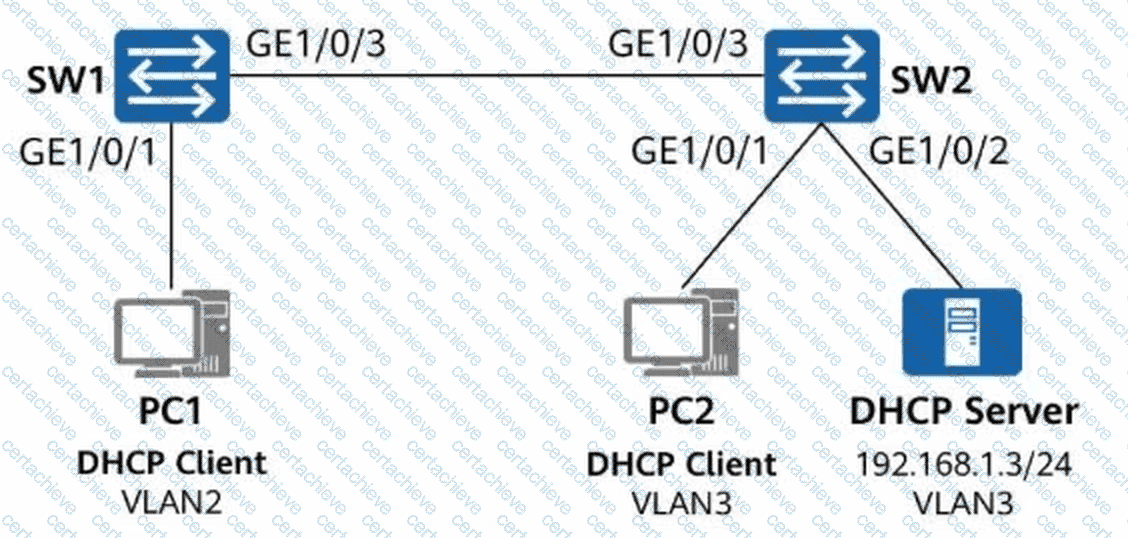
On the network shown in the figure, GE1/0/1 of SW1 is an access interface and its PVID is VLAN 2. GE1/0/1 and GE1/0/2 of SW2 are access interfaces and their PVIDs are VLAN 3. The interfaces connecting SW1 and SW2 are trunk interfaces that allow packets from VLAN 2 and VLAN 3 to pass through and retain the default PVID.
The administrator finds that PC2 can dynamically obtain an IP address from the DHCP server, but PC1 cannot. The administrator determines that a possible cause is that PC1 and the DHCP server are in different broadcast domains.
Correct Answer & Rationale:
Answer: A
Explanation:
DHCP automatically assigns IP configuration parameters to network clients. During initial address acquisition, a DHCP client broadcasts a DHCPDISCOVER message to locate available DHCP servers.
Ethernet switches normally forward these broadcasts only within the originating VLAN.
In this scenario, PC1 belongs to VLAN 2, while PC2 and the DHCP server belong to VLAN 3. The trunk connection permits traffic from both VLANs but maintains their Layer 2 isolation.
Therefore, DHCP broadcasts generated by PC1 in VLAN 2 cannot directly reach the DHCP server in VLAN 3.
PC2 can obtain an address because it shares the DHCP server ' s broadcast domain.
Communication between these VLANs would require Layer 3 forwarding, and DHCP relay functionality would normally be required to forward DHCP requests across the VLAN boundary.
Consequently, the administrator ' s explanation is correct.
================
Question 10
Huawei H12-811_V2.0
QUESTION DESCRIPTION:
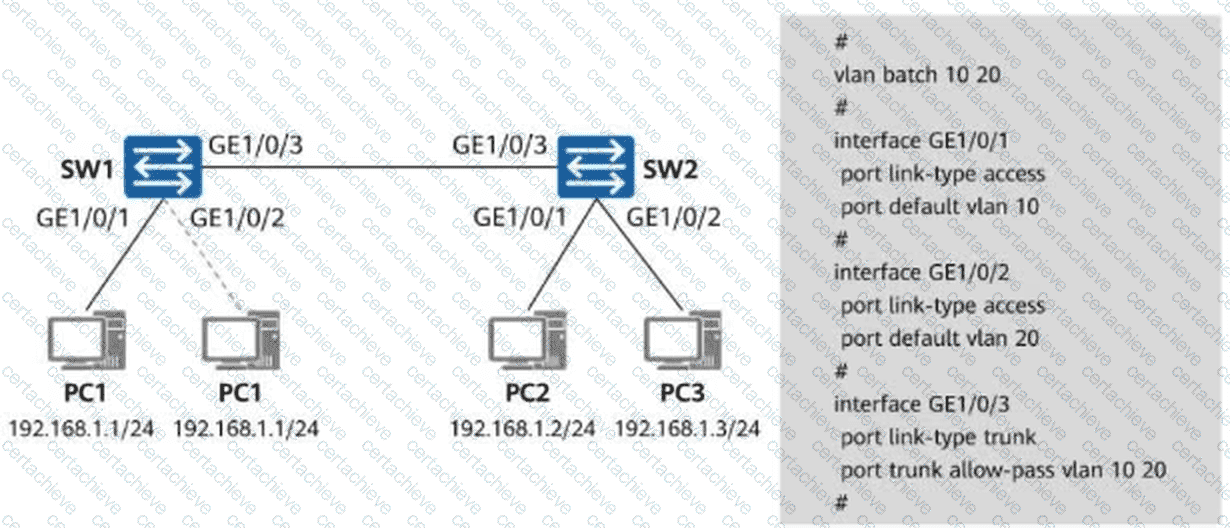
The administrator performs the configuration shown in the figure on SW1 and SW2. Initially, PC1 is connected to GE1/0/1 of SW1. After the network is stable, the administrator pings the IP addresses of PC2 and PC3 from PC1.
Later, the administrator connects PC1 to GE1/0/2 of SW1. After the network is stable, the administrator pings the IP addresses of PC2 and PC3 from PC1.
Which of the following statements is false about this scenario? (Select all that apply)
Correct Answer & Rationale:
Answer: B, D
Explanation:
The switch configuration places GE1/0/1 in VLAN 10 and GE1/0/2 in VLAN 20. The inter-switch trunk carries both VLANs.
Initially, PC1 connects through GE1/0/1, placing its traffic in VLAN 10. It can therefore communicate with PC2, which belongs to the same VLAN.
After PC1 moves to GE1/0/2, its traffic belongs to VLAN 20. Consequently, PC1 can communicate with PC3 rather than PC2.
Statement B is false because PC1 can still reach PC3 after the interface change.
Statement D is also false because dynamic MAC address learning associates the source MAC address, VLAN ID, and ingress interface identifier. It does not create the stated mapping using the interface ' s own MAC address.
Statements A and C correctly describe the expected Layer 2 communication.
================
A Stepping Stone for Enhanced Career Opportunities
Your profile having HCIA-Datacom certification significantly enhances your credibility and marketability in all corners of the world. The best part is that your formal recognition pays you in terms of tangible career advancement. It helps you perform your desired job roles accompanied by a substantial increase in your regular income. Beyond the resume, your expertise imparts you confidence to act as a dependable professional to solve real-world business challenges.
Your success in Huawei H12-811_V2.0 certification exam makes your visible and relevant in the fast-evolving tech landscape. It proves a lifelong investment in your career that give you not only a competitive advantage over your non-certified peers but also makes you eligible for a further relevant exams in your domain.
What You Need to Ace Huawei Exam H12-811_V2.0
Achieving success in the H12-811_V2.0 Huawei exam requires a blending of clear understanding of all the exam topics, practical skills, and practice of the actual format. There's no room for cramming information, memorizing facts or dependence on a few significant exam topics. It means your readiness for exam needs you develop a comprehensive grasp on the syllabus that includes theoretical as well as practical command.
Here is a comprehensive strategy layout to secure peak performance in H12-811_V2.0 certification exam:
- Develop a rock-solid theoretical clarity of the exam topics
- Begin with easier and more familiar topics of the exam syllabus
- Make sure your command on the fundamental concepts
- Focus your attention to understand why that matters
- Ensure hands-on practice as the exam tests your ability to apply knowledge
- Develop a study routine managing time because it can be a major time-sink if you are slow
- Find out a comprehensive and streamlined study resource for your help
Ensuring Outstanding Results in Exam H12-811_V2.0!
In the backdrop of the above prep strategy for H12-811_V2.0 Huawei exam, your primary need is to find out a comprehensive study resource. It could otherwise be a daunting task to achieve exam success. The most important factor that must be kep in mind is make sure your reliance on a one particular resource instead of depending on multiple sources. It should be an all-inclusive resource that ensures conceptual explanations, hands-on practical exercises, and realistic assessment tools.
Certachieve: A Reliable All-inclusive Study Resource
Certachieve offers multiple study tools to do thorough and rewarding H12-811_V2.0 exam prep. Here's an overview of Certachieve's toolkit:
Huawei H12-811_V2.0 PDF Study Guide
This premium guide contains a number of Huawei H12-811_V2.0 exam questions and answers that give you a full coverage of the exam syllabus in easy language. The information provided efficiently guides the candidate's focus to the most critical topics. The supportive explanations and examples build both the knowledge and the practical confidence of the exam candidates required to confidently pass the exam. The demo of Huawei H12-811_V2.0 study guide pdf free download is also available to examine the contents and quality of the study material.
Huawei H12-811_V2.0 Practice Exams
Practicing the exam H12-811_V2.0 questions is one of the essential requirements of your exam preparation. To help you with this important task, Certachieve introduces Huawei H12-811_V2.0 Testing Engine to simulate multiple real exam-like tests. They are of enormous value for developing your grasp and understanding your strengths and weaknesses in exam preparation and make up deficiencies in time.
These comprehensive materials are engineered to streamline your preparation process, providing a direct and efficient path to mastering the exam's requirements.
Huawei H12-811_V2.0 exam dumps
These realistic dumps include the most significant questions that may be the part of your upcoming exam. Learning H12-811_V2.0 exam dumps can increase not only your chances of success but can also award you an outstanding score.
Top Exams & Certification Providers
New & Trending
- New Released Exams
- Related Exam
- Hot Vendor