
The HCIP-Datacom-Core Technology V1.0 (H12-821_V1.0)
Passing Huawei HCIP-Datacom exam ensures for the successful candidate a powerful array of professional and personal benefits. The first and the foremost benefit comes with a global recognition that validates your knowledge and skills, making possible your entry into any organization of your choice.


H12-821_V1.0 Exam Dumps
- Exam Code: H12-821_V1.0
- Vendor: Huawei
- Certifications: HCIP-Datacom
- Exam Name: HCIP-Datacom-Core Technology V1.0
Why CertAchieve is Better than Standard H12-821_V1.0 Dumps
In 2026, Huawei uses variable topologies. Basic dumps will fail you.
| Quality Standard | Generic Dump Sites | CertAchieve Premium Prep |
|---|---|---|
| Technical Explanation | None (Answer Key Only) | Step-by-Step Expert Rationales |
| Syllabus Coverage | Often Outdated (v1.0) | 2026 Updated (Latest Syllabus) |
| Scenario Mastery | Blind Memorization | Conceptual Logic & Troubleshooting |
| Instructor Access | No Post-Sale Support | 24/7 Professional Help |
Customers Passed Exams
10
Success backed by proven exam prep tools
Questions Came Word for Word
85%
Real exam match rate reported by verified users
Average Score in Real Testing Centre
95%
Consistently high performance across certifications
Study Time Saved With CertAchieve
60%
Efficient prep that reduces study hours significantly
Coverage of Official Huawei H12-821_V1.0 Exam Domains
Our curriculum is meticulously mapped to the Huawei official blueprint.
OSPF & IS-IS Advanced Routing (22%)
The "Intra-Domain" foundation. Master the advanced mechanics of OSPFv2/v3 and IS-IS (Intermediate System to Intermediate System). Focus on multi-area design, LSA types, and route summarization. In 2026, this domain emphasizes fast convergence techniques like LFA (Loop-Free Alternate) and OSPF/IS-IS extensions required for Segment Routing.
BGP Path Selection & Optimization (20%)
The "Inter-Domain" engine. Master the BGP (Border Gateway Protocol) attributes and path selection process. Focus on Route Reflectors, Confederations, and advanced community attributes. Learn to design resilient BGP policies for multi-homed enterprise gateways, ensuring optimal ingress and egress traffic flow while preventing the creation of transit AS scenarios.
Network Reliability & Routing Control (15%)
The "Stability" layer. Master the implementation of BFD (Bidirectional Forwarding Detection) and VRRP. Focus on routing policy tools (Route-Policy, Filter-policy, IP-Prefix List) to manipulate traffic paths. Learn to architect "Self-Healing" networks that can switch paths in under 50ms using hardware-level fast-reroute (FRR) technologies.
MPLS & Segment Routing (18%)
The "Label-Switching" core. Master the deployment of MPLS (Multi-Protocol Label Switching) and LDP. In 2026, this domain places a massive focus on SR-MPLS and SRv6. Understand the transition from traditional Tunneling to "Source Routing," where the path is encoded in the packet header, drastically reducing the state maintained in the network core.
IPv6 Evolution & Transition (12%)
The "Modern" protocol layer. Master the IPv6 address architecture, ICMPv6, and Neighbor Discovery (ND). Focus on transition technologies like 6to4, ISATAP, and Dual-Stack. In 2026, the focus is on IPv6-Only core architectures and the use of IPv6 extension headers to support network programmability and telemetry.
Network Management & SDN (13%)
The "Automation" layer. Master the concepts of SDN (Software Defined Networking) and the role of the iMaster NCE controller. Focus on NETCONF, YANG, and SNMP protocols for network orchestration. Learn to manage network quality using Telemetry and NQA (Network Quality Analyzer) to provide real-time visibility into the user experience.
Huawei H12-821_V1.0 Exam Domains Q&A
Certified instructors verify every question for 100% accuracy, providing detailed, step-by-step explanations for each.
Question 1
Huawei H12-821_V1.0
QUESTION DESCRIPTION:
An enterprise administrator configures route summarization on ASBRs to reduce the number of inter-area Type 3 LSAs, which in turn reduces the routing table size and improves device resource utilization.
Correct Answer & Rationale:
Answer: A
Explanation:
Comprehensive and Detailed Step-by-Step Explanation:
OSPF Route Summarization:
Route summarization combines multiple specific routes into a single summary route. This reduces the number of LSAs advertised between OSPF areas, especially Type 3 LSAs.
Benefits of Route Summarization:
Reduces the size of the OSPF database and routing table.
Minimizes the processing overhead on routers by decreasing the number of routing entries.
Improves the scalability of the OSPF network.
ASBR Function:
The ASBR advertises external routes into OSPF and can summarize routes at area boundaries or during redistribution.
[References:, , HCIA-Datacom Study Guide, Chapter: OSPF Route Summarization, Huawei Routing Protocol Optimization, , ]
Question 2
Huawei H12-821_V1.0
QUESTION DESCRIPTION:
Typically, a protocol that occupies two ports during communication is called a multi-channel protocol. For such protocols, the ASPF function must be enabled on the firewall to ensure smooth setup of the data channel and reduce the risk of attacks. Which of the following protocols is not a multi-channel protocol?
Correct Answer & Rationale:
Answer: C
Explanation:
Comprehensive and Detailed Step-by-Step Explanation:
Multi-Channel Protocols:
Multi-channel protocols use separate channels for control and data communication, requiring application-specific packet filtering (ASPF) to track sessions.
Examples:
FTP (A): Uses separate control and data channels.
SIP (B): Uses multiple ports for signaling and media.
H.323 (D): A VoIP protocol using multiple channels.
Single-Channel Protocol:
SMTP (C): A single-channel protocol for email communication, which does not require ASPF.
[References:, HCIA-Datacom Study Guide, Chapter: Firewall ASPF Configuration, Huawei Multi-Channel Protocol Handling, , ]
Question 3
Huawei H12-821_V1.0
QUESTION DESCRIPTION:
Link aggregation is a common network technology. Which of the following are advantages of link aggregation?
Correct Answer & Rationale:
Answer: A, B, C
Explanation:
Comprehensive and Detailed Step-by-Step Explanation:
Definition of Link Aggregation:
Link aggregation combines multiple physical links into a single logical link to improve bandwidth and reliability.
Advantages of Link Aggregation:
Load Balancing (A): Traffic is distributed across all aggregated links to improve performance.
Improved Reliability (B): If one link fails, traffic is rerouted through other links.
Increased Link Bandwidth (C): Bandwidth is effectively the sum of all aggregated links.
Incorrect Option:
Route Backup (D): Route backup is a feature of routing protocols, not link aggregation.
[References:, HCIA-Datacom Study Guide, Chapter: Link Aggregation Fundamentals, Huawei Link Aggregation Configuration, , ]
Question 4
Huawei H12-821_V1.0
QUESTION DESCRIPTION:
Which of the following statements regarding the stateful inspection firewall is true?
Correct Answer & Rationale:
Answer: C
Explanation:
A stateful inspection firewall tracks the state of network connections and only matches the initial packet against its rule set. Subsequent packets in the same connection are matched in the state table. Contrary to this, UDP packets can be inspected by correlating them with connection states, and packets in a single connection are always correlated .
Question 5
Huawei H12-821_V1.0
QUESTION DESCRIPTION:
An enterprise administrator wants to configure single-hop BFD to implement fast detection of direct links. Which of the following configurations are mandatory?
Correct Answer & Rationale:
Answer: A, B, D
Explanation:
For single-hop BFD (Bidirectional Forwarding Detection), the configuration must include the local and remote discriminators to uniquely identify the session endpoints. Additionally, enabling BFD globally is a prerequisite for initiating BFD sessions. Configuring multicast IP addresses is unnecessary for single-hop BFD, as it operates over direct links. Huawei's configuration guidelines specify these requirements to ensure effective deployment and operation of BFD.
Understanding BFD (Bidirectional Forwarding Detection):
BFD is a protocol used to detect link faults quickly between two routers.
Single-hop BFD operates on directly connected links and is commonly used for fast fault detection in routing protocols like OSPF and BGP.
HCIP-Datacom-Core Technology Training Material (BFD Basics and Configuration).
Mandatory Configurations for Single-Hop BFD:
A. Configure the remote discriminator of a BFD session:The remote discriminator is used to uniquely identify the BFD session at the remote end. This is essential for session establishment.
B. Configure the local discriminator of a BFD session:The local discriminator uniquely identifies the BFD session at the local end. This is required to establish a BFD session.
D. Enable BFD globally:BFD must be enabled globally on the router for the protocol to operate and for session configurations to take effect.
Optional Configuration:
C. Configure a multicast IP address for BFD:This is not required for single-hop BFD, as it operates over direct links using unicast communication. Multicast is used in other scenarios, like multi-hop BFD.
Conclusion:The correct configurations for single-hop BFD are A, B, and D.
Question 6
Huawei H12-821_V1.0
QUESTION DESCRIPTION:
During routine O & M, an engineer finds that the Hold Time parameters of two devices are inconsistent. In this case, which of the following situations occurs?
Correct Answer & Rationale:
Answer: A
Explanation:
In BGP and other TCP-based protocols like OSPF and IS-IS, when devices have different Hold Times, the smaller value is chosen after negotiation. This ensures faster detection of communication loss.
The Keepalive and Hold Timers are negotiated during the establishment of a BGP session.
The smaller Hold Time is used to maintain symmetry and prevent timeouts.
Reference from Huawei HCIP-Datacom-Core Technology Study Guide:
“When negotiating Hold Time, both ends agree to use the smaller of the two values. This value is used to detect failures faster.”
(Chapter: BGP Fundamentals – Section: BGP Session Establishment)
Question 7
Huawei H12-821_V1.0
QUESTION DESCRIPTION:
A large shopping mall configures a VLAN pool to prevent network performance deterioration caused by potentially large broadcast domains. A network engineer runs the display vlan pool name STA command to check information about the VLAN pool. The following command output is displayed:
< AC > display vlan pool name STA Name : STA Total : 2 Assignment: hash Threshold Notify Count: 3 Threshold Notify time(min): 3 VLAN ID : 2 4
Which of the following statements are true?
Correct Answer & Rationale:
Answer: A, C
Explanation:
The command output confirms that the VLANs with IDs 2 and 4 are part of the VLAN pool named "STA." The VLAN pool concept is used to allocate VLANs dynamically to devices or subnets, which reduces broadcast domain size and improves network efficiency. The total number of VLAN pools is unrelated to this output, and the assignment algorithm (hash or even) is not explicitly mentioned in the output. Huawei VLAN pool management references align with this analysis .
Question 8
Huawei H12-821_V1.0
QUESTION DESCRIPTION:
On an OSPF network, if a router functions as an ABR, the router must also be a BR.
Correct Answer & Rationale:
Answer: B
Explanation:
Comprehensive and Detailed in-depth Step-by-Step Explanation:
To answer this question, we need to understand the roles of OSPF routers:
Area Border Router (ABR):
An ABR is a router that connects multiple OSPF areas. It has at least one interface in the backbone area (Area 0) and one or more interfaces in other OSPF areas.
The ABR performs summarization between areas and propagates routing information between them.
Backup Router (BR):
The term "BR" does not exist in OSPF terminology. Instead, OSPF uses the term "Backup Designated Router (BDR)." The BDR is a backup to the Designated Router (DR) in a specific OSPF broadcast or NBMA (Non-Broadcast Multi-Access) network. The BDR takes over the DR's responsibilities if the DR fails.
Key Clarification:
An ABR is related to the hierarchical structure of OSPF areas and is not tied to the DR/BDR election process.
A router can function as an ABR without ever being a DR or BDR, as these are separate roles.
Therefore, the statement that an ABR must also be a BR is FALSE.
[References:, Huawei HCIA-Datacom Study Guide, Chapter on "OSPF Fundamentals"., RFC 2328 – OSPF Version 2., Huawei OSPF Configuration Guide., , , ]
Question 9
Huawei H12-821_V1.0
QUESTION DESCRIPTION:
What is the default sending interval of BFD packets?
Correct Answer & Rationale:
Answer: C
Explanation:
The default sending interval for BFD (Bidirectional Forwarding Detection) control packets is 100 milliseconds. This interval ensures rapid detection of link faults, providing fast failover and minimizing downtime in network operations .
Question 10
Huawei H12-821_V1.0
QUESTION DESCRIPTION:
As shown in the figure, R1 imports the direct route 10.1.1.0/24 to OSPF. An engineer enables bidirectional route re-advertisement on R2 and R3.
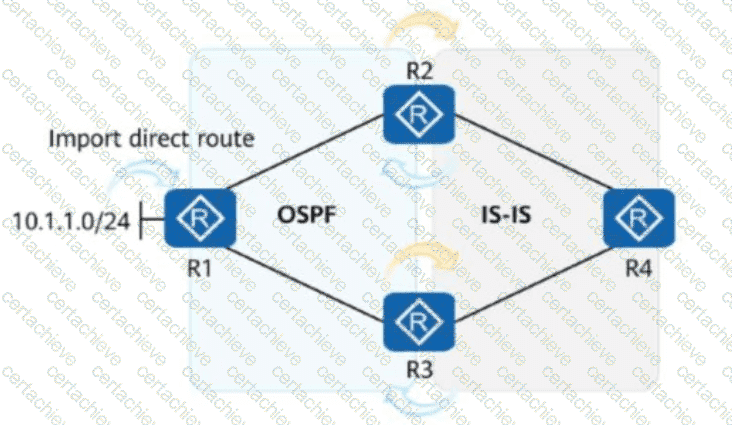
After the network becomes stable, which of the following is the Pre (preference) value of the route 10.1.1.0/24 in the routing table of R3?
Correct Answer & Rationale:
Answer: C
Explanation:
Let's break it down step by step based on Huawei's routing protocol behavior:
R1 imports the direct route 10.1.1.0/24 into OSPF.
This route is advertised by R1 to R2 and R3 via OSPF.
Both R2 and R3 are running IS-IS, and bidirectional route redistribution is configured between OSPF and IS-IS.
R2 and R3 both re-advertise the OSPF-learned route into IS-IS and then potentially re-learn it back from the IS-IS domain, causing redistribution loops unless properly controlled.
Now, the question focuses on R3’s routing table:
R3 already learns the route directly via OSPF from R1.
It also learns the same route again via IS-IS from R2 (looped back due to bidirectional redistribution).
Reference from Huawei HCIP-Datacom-Core Technology Study Guide:
“OSPF ASE routes are assigned a default preference of 150. If a route is redistributed from another protocol (like IS-IS) into OSPF, and then re-learned, it is considered an ASE route.”(Chapter: OSPF Advanced Features – Section: Route Redistribution Behavior)

Verified by Certified Instructors
This Huawei H12-821_V1.0 study pack was audited and verified on October 11, 2026 by Radia Davenport,. We ensure every technical rationale aligns with real-world enterprise standards.
A Stepping Stone for Enhanced Career Opportunities
Your profile having HCIP-Datacom certification significantly enhances your credibility and marketability in all corners of the world. The best part is that your formal recognition pays you in terms of tangible career advancement. It helps you perform your desired job roles accompanied by a substantial increase in your regular income. Beyond the resume, your expertise imparts you confidence to act as a dependable professional to solve real-world business challenges.
Your success in Huawei H12-821_V1.0 certification exam makes your visible and relevant in the fast-evolving tech landscape. It proves a lifelong investment in your career that give you not only a competitive advantage over your non-certified peers but also makes you eligible for a further relevant exams in your domain.
What You Need to Ace Huawei Exam H12-821_V1.0
Achieving success in the H12-821_V1.0 Huawei exam requires a blending of clear understanding of all the exam topics, practical skills, and practice of the actual format. There's no room for cramming information, memorizing facts or dependence on a few significant exam topics. It means your readiness for exam needs you develop a comprehensive grasp on the syllabus that includes theoretical as well as practical command.
Here is a comprehensive strategy layout to secure peak performance in H12-821_V1.0 certification exam:
- Develop a rock-solid theoretical clarity of the exam topics
- Begin with easier and more familiar topics of the exam syllabus
- Make sure your command on the fundamental concepts
- Focus your attention to understand why that matters
- Ensure hands-on practice as the exam tests your ability to apply knowledge
- Develop a study routine managing time because it can be a major time-sink if you are slow
- Find out a comprehensive and streamlined study resource for your help
Ensuring Outstanding Results in Exam H12-821_V1.0!
In the backdrop of the above prep strategy for H12-821_V1.0 Huawei exam, your primary need is to find out a comprehensive study resource. It could otherwise be a daunting task to achieve exam success. The most important factor that must be kep in mind is make sure your reliance on a one particular resource instead of depending on multiple sources. It should be an all-inclusive resource that ensures conceptual explanations, hands-on practical exercises, and realistic assessment tools.
Certachieve: A Reliable All-inclusive Study Resource
Certachieve offers multiple study tools to do thorough and rewarding H12-821_V1.0 exam prep. Here's an overview of Certachieve's toolkit:
Huawei H12-821_V1.0 PDF Study Guide
This premium guide contains a number of Huawei H12-821_V1.0 exam questions and answers that give you a full coverage of the exam syllabus in easy language. The information provided efficiently guides the candidate's focus to the most critical topics. The supportive explanations and examples build both the knowledge and the practical confidence of the exam candidates required to confidently pass the exam. The demo of Huawei H12-821_V1.0 study guide pdf free download is also available to examine the contents and quality of the study material.
Huawei H12-821_V1.0 Practice Exams
Practicing the exam H12-821_V1.0 questions is one of the essential requirements of your exam preparation. To help you with this important task, Certachieve introduces Huawei H12-821_V1.0 Testing Engine to simulate multiple real exam-like tests. They are of enormous value for developing your grasp and understanding your strengths and weaknesses in exam preparation and make up deficiencies in time.
These comprehensive materials are engineered to streamline your preparation process, providing a direct and efficient path to mastering the exam's requirements.
Huawei H12-821_V1.0 exam dumps
These realistic dumps include the most significant questions that may be the part of your upcoming exam. Learning H12-821_V1.0 exam dumps can increase not only your chances of success but can also award you an outstanding score.
Top Exams & Certification Providers
New & Trending
- New Released Exams
- Related Exam
- Hot Vendor
Verified Performance Reports
Authentic score reports from candidates who cleared the H12-821_V1.0 exam.
Verified Case #1

×
![]()