
The HCIE-Datacom V1.0 (H12-891_V1.0)
Passing Huawei HCIE-Datacom exam ensures for the successful candidate a powerful array of professional and personal benefits. The first and the foremost benefit comes with a global recognition that validates your knowledge and skills, making possible your entry into any organization of your choice.


H12-891_V1.0 Exam Dumps
- Exam Code: H12-891_V1.0
- Vendor: Huawei
- Certifications: HCIE-Datacom
- Exam Name: HCIE-Datacom V1.0
Why CertAchieve is Better than Standard H12-891_V1.0 Dumps
In 2026, Huawei uses variable topologies. Basic dumps will fail you.
| Quality Standard | Generic Dump Sites | CertAchieve Premium Prep |
|---|---|---|
| Technical Explanation | None (Answer Key Only) | Step-by-Step Expert Rationales |
| Syllabus Coverage | Often Outdated (v1.0) | 2026 Updated (Latest Syllabus) |
| Scenario Mastery | Blind Memorization | Conceptual Logic & Troubleshooting |
| Instructor Access | No Post-Sale Support | 24/7 Professional Help |
Customers Passed Exams
10
Success backed by proven exam prep tools
Questions Came Word for Word
85%
Real exam match rate reported by verified users
Average Score in Real Testing Centre
90%
Consistently high performance across certifications
Study Time Saved With CertAchieve
60%
Efficient prep that reduces study hours significantly
Huawei H12-891_V1.0 Exam Domains Q&A
Certified instructors verify every question for 100% accuracy, providing detailed, step-by-step explanations for each.
Question 1
Huawei H12-891_V1.0
QUESTION DESCRIPTION:
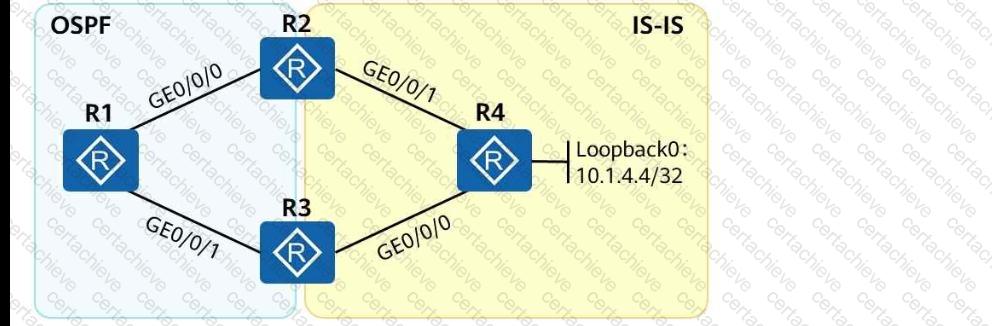
As shown in the following figure, an engineer tests network interconnection between two branches. To implement network interconnection, OSPF is deployed on R1, R2, and R3 of branch 1, and IS-IS is deployed on R2, R3, and R4 of branch 2. Which of the following operations needs to be performed to allow R1 to access R4 ' s loopback interface address?
Correct Answer & Rationale:
Answer: C
Explanation:
Understanding the Network Scenario:
R2 is the boundary router between OSPF and IS-IS.
OSPF and IS-IS do not automatically redistribute routes between each other.
R4 ' s loopback (10.1.4.4/32) exists in the IS-IS domain.
To allow R1 (OSPF) to reach R4’s loopback, R2 must redistribute IS-IS routes into OSPF.
Why Option C Is Correct (✅)
✔ default-route-advertise in OSPF on R2:
This advertises a default route into the OSPF domain, allowing OSPF routers (R1, R3) to forward unknown traffic to R2.
Since IS-IS routes are not automatically injected into OSPF, this ensures R1 can reach R4.
✔ IS-IS Already Has Routes to OSPF
IS-IS routers (R3, R4) already learn routes from OSPF via R2 (assuming route redistribution is properly configured).
No need to run default-route-advertise in IS-IS.
Why Other Options Are Incorrect (❌)
❌ A. Run default-route-advertise in both OSPF and IS-IS views on R2
Unnecessary in IS-IS. The IS-IS domain already learns OSPF routes from R2 via redistribution.
Only OSPF needs a default route to forward unknown traffic to R2.
❌ B. No configuration is required
Incorrect, because OSPF does not automatically learn IS-IS routes.
A default route or redistribution is needed for R1 to reach R4.
❌ D. Run default-route-advertise only in the IS-IS view on R2
Incorrect, because IS-IS already has routing information from OSPF.
The issue is with OSPF not learning IS-IS routes, so the command needs to be in OSPF view.
???? Reference: Huawei HCIE Datacom – OSPF and IS-IS Route Redistribution and Interoperability
Question 2
Huawei H12-891_V1.0
QUESTION DESCRIPTION:
Which of the following headend behaviors can insert SRHs into IPv6 packets? (Select All that Apply)
Correct Answer & Rationale:
Answer: B, C, D
Explanation:
Segment Routing over IPv6 (SRv6) defines several headend behaviors for how SRH (Segment Routing Headers) are added:
B. H.Insert — Inserts an SRH into an existing IPv6 packet.
C. H.Encaps — Encapsulates the original packet in a new IPv6 packet with an SRH.
D. H.Insert.Red — Performs insert behavior and reduces the payload for optimization.
A. H.Encaps.Red is not a defined SRv6 behavior — it’s an invalid option.
Exact Extract - Huawei SRv6 White Paper:
“H.Insert, H.Insert.Red, and H.Encaps are valid behaviors for injecting SRH. H.Encaps.Red is not defined in the SRv6 headend behavior set.”
[Reference:, Huawei SRv6 Solution Guide, HCIE-Datacom Study Guide – Segment Routing over IPv6, , , ]
Question 3
Huawei H12-891_V1.0
QUESTION DESCRIPTION:
Which of the following statements is incorrect about a BGP/MPLS IP VPN?
Correct Answer & Rationale:
Answer: C
Explanation:
The incorrect statement is Option C, which says “A site can only belong to only one VPN.” This is false because a single site can belong to multiple VPNs if needed. For example, in some enterprise designs, a site may be part of both the Finance VPN and the Management VPN by configuring multiple routing instances (VRFs) and policies accordingly.
Exact Extract - HCIE-Datacom VPN Technologies Chapter:
“A site may be associated with one or more VPNs, depending on business requirements. This is achieved through VRF and route-target configurations.”
[Reference:, Huawei HCIE-Datacom Study Guide – L3VPN Architecture, Huawei Training Materials – BGP/MPLS VPN Concepts, , ]
Question 4
Huawei H12-891_V1.0
QUESTION DESCRIPTION:
gRPC (Google Remote Procedure Call) is a language-neutral, platform-neutral, and open-source remote RPC system that supports unary RPCs and streaming RPCs.
Which of the following service methods are NOT supported by gRPC?
Correct Answer & Rationale:
Answer: B, C
Explanation:
Comprehensive and Detailed Explanation:
✔ gRPC supports four types of RPCs:
Unary RPC → Client sends one request, server responds once.
Server streaming RPC → Server sends multiple responses.
Client streaming RPC → Client sends multiple requests.
Bidirectional streaming RPC → Both sides exchange multiple messages.
✔ Why B and C Are Incorrect:
❌ (B) Incorrect → The method rpc dataPublish(stream serviceArgs) returns(stream serviceArgs) {} violates gRPC syntax.
❌ (C) Incorrect → rpc stream LotsOfGreetings(HelloRequest) returns (HelloResponse) {} contains incorrect stream positioning.
???? Reference: Huawei HCIE Datacom – gRPC API and Streaming Mechanisms
Question 5
Huawei H12-891_V1.0
QUESTION DESCRIPTION:
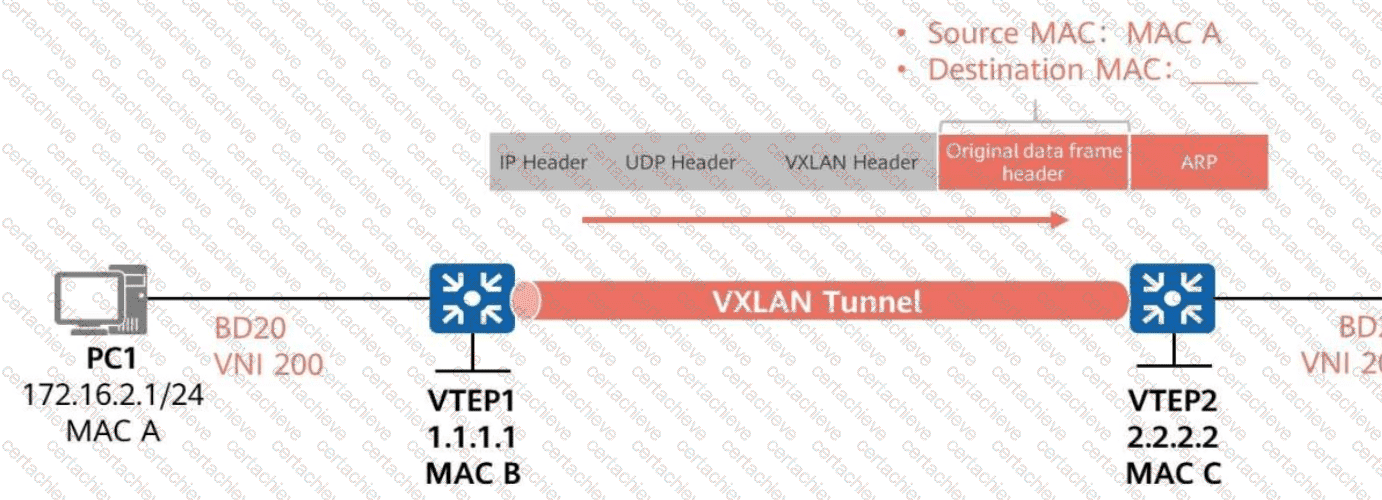
As shown in the figure, ARP broadcast suppression is enabled on VTEP1 in BD 20 (VNI 200).
VTEP1 learns ARP information about PC2 through BGP EVPN routes.
When VTEP1 forwards the ARP request for PC1’s MAC address to VTEP2,
What is the destination MAC address of the inner data frame?
Correct Answer & Rationale:
Answer: B
Explanation:
Understanding VXLAN and ARP Suppression in BGP EVPN
VXLAN (Virtual Extensible LAN) is used to extend Layer 2 networks over Layer 3 infrastructure.
VXLAN uses VTEPs (VXLAN Tunnel Endpoints) to encapsulate and forward Layer 2 traffic.
BGP EVPN (Ethernet VPN) is used for MAC/IP address learning and distribution across VXLAN networks.
How ARP Request Forwarding Works in This Scenario?
1️⃣ ARP Broadcast Suppression Enabled (VXLAN Optimized Forwarding)
Since ARP broadcast suppression is enabled on VTEP1, the ARP request is not flooded.
Instead, VTEP1 checks its EVPN learned database to find PC2’s MAC address (MAC C).
2️⃣ VTEP1 Encapsulates the ARP Request
VTEP1 encapsulates the ARP request in a VXLAN packet and sends it to VTEP2.
The original ARP frame inside the VXLAN tunnel still has:
Source MAC: MAC A (PC1 ' s MAC)
Destination MAC: MAC C (PC2 ' s MAC, learned via EVPN)
3️⃣ VXLAN Outer Headers
The outer VXLAN header uses:
Source IP: 1.1.1.1 (VTEP1)
Destination IP: 2.2.2.2 (VTEP2)
VNI (VXLAN Network Identifier): 200 (BD 20)
4️⃣ VTEP2 Receives and Forwards the ARP Request
VTEP2 decapsulates the VXLAN packet and forwards the original ARP request to PC2 (MAC C).
This ensures that only the intended receiver (PC2) gets the ARP request, preventing unnecessary broadcast flooding.
Why the Answer is MAC C?
✅ B. MAC C is Correct
The destination MAC of the inner data frame is PC2’s MAC (MAC C).
This is because VTEP1 forwards the ARP request directly to VTEP2, which then forwards it to PC2.
Why Other Answers Are Incorrect?
❌ A. MAC B (Incorrect)
MAC B is VTEP1’s MAC address, which is used in the outer VXLAN header, not in the inner Ethernet frame.
❌ C. MAC A (Incorrect)
MAC A is the source MAC of the ARP request (PC1), not the destination.
❌ D. MAC D (Incorrect)
MAC D is not mentioned in the topology, so it is irrelevant.
???? Reference: Huawei HCIE Datacom – VXLAN BGP EVPN and ARP Suppression
Question 6
Huawei H12-891_V1.0
QUESTION DESCRIPTION:
Which of the following commands are mandatory for configuring an OSPF-based SR-MPLS TE tunnel? (Select All that Apply)
Correct Answer & Rationale:
Answer: A, B, C, D
Explanation:
To configure an SR-MPLS TE tunnel based on OSPF, all four options are mandatory:
A. Configure the LSR ID – LSR ID is required as the unique identifier of the router in MPLS and TE.
B. Enable segment routing in the OSPF process view – Needed to advertise segment information (SID).
C. Enable the opaque capability – Opaque LSAs are used to carry SR and TE information in OSPF.
D. Enable MPLS TE in the OSPF process view – Ensures that TE-related attributes (e.g., bandwidth) are advertised in OSPF LSAs.
Exact Extract - Huawei HCIE-Datacom SR-MPLS TE Configuration Guide:
“To support SR-MPLS TE over OSPF, it is necessary to configure the LSR ID, enable SR and MPLS TE capabilities in OSPF, and activate the OSPF opaque capability for carrying TE and SR attributes.”
[Reference:, Huawei SR-MPLS Deployment Guide, HCIE-Datacom Study Guide – Segment Routing and Traffic Engineering Section, ===========, , ]
Question 7
Huawei H12-891_V1.0
QUESTION DESCRIPTION:
Which of the following statements about the SP scheduling algorithm is incorrect?
Correct Answer & Rationale:
Answer: D
Explanation:
Comprehensive and Detailed In-Depth Explanation:
The Strict Priority (SP) scheduling algorithm always gives preference to high-priority queues.
A: Correct. SP scheduling may lead to queue starvation because low-priority queues might never get serviced if high-priority traffic is constant.
B: Correct. SP always schedules the highest-priority queue first.
C: Correct. Among multiple low-priority queues, if SP is combined with FIFO (First In, First Out), packets that arrive first are forwarded first.
D: Incorrect. The SP algorithm does not guarantee minimum bandwidth for lower-priority queues. It prioritizes high-priority queues regardless of bandwidth configuration, which can lead to starvation of lower-priority traffic. To ensure minimum bandwidth, a Weighted Fair Queuing (WFQ) or CBWFQ (Class-Based Weighted Fair Queuing) algorithm would be more suitable.
[Reference:, Huawei HCIE Datacom Official Certification Guide, Huawei QoS Configuration and Implementation Guide, , , ]
Question 8
Huawei H12-891_V1.0
QUESTION DESCRIPTION:
Which of the following community attributes ensure that BGP routes are transmitted only within an AS?
Correct Answer & Rationale:
Answer: B
Explanation:
In BGP, community attributes help control the advertisement scope of BGP routes. Here’s what each option means:
No_Export: This well-known community attribute prevents BGP routes from being advertised to external BGP (EBGP) peers. Routes with this attribute can still be advertised to internal BGP (IBGP) peers within the same AS. This ensures that the route remains within the originating AS.
No_Advertise: This attribute means that the route should not be advertised to any BGP peer, whether internal or external.
Internet: Indicates that the route can be advertised to all BGP peers, both internal and external, with no restrictions.
No_Export_Subconfed: Similar to No_Export, but it also restricts advertisement to peers within a BGP confederation. It ' s more specific and not generally used just to keep routes inside one AS.
Therefore, the correct answer is B. No_Export, as it is the attribute that ensures BGP routes remain within the AS by not being sent to EBGP peers.
[Reference:Huawei HCIE-Datacom V1.0 Study Guide — Routing & Switching TechnologiesChapter: BGP Advanced FeaturesSection: Community Attributes, , ]
Question 9
Huawei H12-891_V1.0
QUESTION DESCRIPTION:
Which of the following technologies can be used to measure performance based on actual service traffic in Huawei ' s CloudWAN solution?
Correct Answer & Rationale:
Answer: D
Explanation:
Understanding Performance Measurement in Huawei CloudWAN
Huawei CloudWAN enables intelligent traffic management, real-time network monitoring, and automated operations.
???? Traditional Performance Monitoring Methods
TWAMP (Two-Way Active Measurement Protocol) → Measures latency and jitter by injecting test traffic.
Telemetry → Provides real-time network visibility, but does not measure actual service traffic performance.
BGP FlowSpec → Used for DDoS mitigation, not performance measurement.
???? iFIT (In-situ Flow Information Telemetry)
✅ iFIT is a next-generation performance monitoring technology that measures:
Real service traffic performance (latency, jitter, packet loss) in real time.
Packet forwarding behavior at each hop without injecting synthetic traffic.
Path delay and service degradation detection.
Why is Answer D Correct?
✅ iFIT provides real-time network performance monitoring based on actual service traffic.
✅ Unlike TWAMP, iFIT does not require probe packets, reducing overhead.
Real-World Application:
5G Transport Networks: Ensures low-latency paths for ultra-reliable services.
CloudWAN Optimization: Detects network congestion without affecting user traffic.
✅ Reference: Huawei HCIE-Datacom Guide – iFIT and Intelligent Performance Monitoring
Question 10
Huawei H12-891_V1.0
QUESTION DESCRIPTION:
On the network shown in the following figure, a remote LDP session needs to be established between SWA and SWC. Which of the following statements is correct?
[SWA] mpls lsr-id 1.1.1.1
[SWA] mpls
[SWA-mpls] mpls ldp
[SWC] mpls lsr-id 33.3.3.3
[SWC] mpls
[SWC-mpls] mpls ldp
SWA ---- SWB ---- SWC
< ------ Remote LDP Session ------ >
Correct Answer & Rationale:
Answer: D
Explanation:
In MPLS LDP, there are two types of sessions:
Direct LDP sessions: Established between directly connected LSRs using LDP Hellos over a link.
Remote LDP sessions (also called targeted LDP sessions): Established between non-directly connected LSRs. These require manual configuration of the remote peer.
In this scenario, SWA and SWC are not directly connected, so a remote (targeted) LDP session must be set up.
For a remote LDP session:
You must configure the remote peer using the command:
[SWA-MPLS-LDP] targeted-peer x.x.x.x
Where x.x.x.x is the LSR ID of SWC (33.3.3.3 in this case).
The current configuration does not include this required step.
Thus, the correct statement is:
D. You need to create a remote peer and specify an LSR ID for the remote peer.
[Reference:Huawei HCIE-Datacom V1.0 Study Guide —Chapter: MPLS LDPSection: Establishing LDP Sessions (Direct and Targeted), , ]

Verified by Certified Instructors
This Huawei H12-891_V1.0 study pack was audited and verified on September 23, 2026 by Radia Davenport,. We ensure every technical rationale aligns with real-world enterprise standards.
A Stepping Stone for Enhanced Career Opportunities
Your profile having HCIE-Datacom certification significantly enhances your credibility and marketability in all corners of the world. The best part is that your formal recognition pays you in terms of tangible career advancement. It helps you perform your desired job roles accompanied by a substantial increase in your regular income. Beyond the resume, your expertise imparts you confidence to act as a dependable professional to solve real-world business challenges.
Your success in Huawei H12-891_V1.0 certification exam makes your visible and relevant in the fast-evolving tech landscape. It proves a lifelong investment in your career that give you not only a competitive advantage over your non-certified peers but also makes you eligible for a further relevant exams in your domain.
What You Need to Ace Huawei Exam H12-891_V1.0
Achieving success in the H12-891_V1.0 Huawei exam requires a blending of clear understanding of all the exam topics, practical skills, and practice of the actual format. There's no room for cramming information, memorizing facts or dependence on a few significant exam topics. It means your readiness for exam needs you develop a comprehensive grasp on the syllabus that includes theoretical as well as practical command.
Here is a comprehensive strategy layout to secure peak performance in H12-891_V1.0 certification exam:
- Develop a rock-solid theoretical clarity of the exam topics
- Begin with easier and more familiar topics of the exam syllabus
- Make sure your command on the fundamental concepts
- Focus your attention to understand why that matters
- Ensure hands-on practice as the exam tests your ability to apply knowledge
- Develop a study routine managing time because it can be a major time-sink if you are slow
- Find out a comprehensive and streamlined study resource for your help
Ensuring Outstanding Results in Exam H12-891_V1.0!
In the backdrop of the above prep strategy for H12-891_V1.0 Huawei exam, your primary need is to find out a comprehensive study resource. It could otherwise be a daunting task to achieve exam success. The most important factor that must be kep in mind is make sure your reliance on a one particular resource instead of depending on multiple sources. It should be an all-inclusive resource that ensures conceptual explanations, hands-on practical exercises, and realistic assessment tools.
Certachieve: A Reliable All-inclusive Study Resource
Certachieve offers multiple study tools to do thorough and rewarding H12-891_V1.0 exam prep. Here's an overview of Certachieve's toolkit:
Huawei H12-891_V1.0 PDF Study Guide
This premium guide contains a number of Huawei H12-891_V1.0 exam questions and answers that give you a full coverage of the exam syllabus in easy language. The information provided efficiently guides the candidate's focus to the most critical topics. The supportive explanations and examples build both the knowledge and the practical confidence of the exam candidates required to confidently pass the exam. The demo of Huawei H12-891_V1.0 study guide pdf free download is also available to examine the contents and quality of the study material.
Huawei H12-891_V1.0 Practice Exams
Practicing the exam H12-891_V1.0 questions is one of the essential requirements of your exam preparation. To help you with this important task, Certachieve introduces Huawei H12-891_V1.0 Testing Engine to simulate multiple real exam-like tests. They are of enormous value for developing your grasp and understanding your strengths and weaknesses in exam preparation and make up deficiencies in time.
These comprehensive materials are engineered to streamline your preparation process, providing a direct and efficient path to mastering the exam's requirements.
Huawei H12-891_V1.0 exam dumps
These realistic dumps include the most significant questions that may be the part of your upcoming exam. Learning H12-891_V1.0 exam dumps can increase not only your chances of success but can also award you an outstanding score.
Top Exams & Certification Providers
New & Trending
- New Released Exams
- Related Exam
- Hot Vendor