
The HCIA-Datacom V1.0 Exam (H12-811_V1.0)
Passing Huawei HCIA-Datacom exam ensures for the successful candidate a powerful array of professional and personal benefits. The first and the foremost benefit comes with a global recognition that validates your knowledge and skills, making possible your entry into any organization of your choice.


H12-811_V1.0 Exam Dumps
- Exam Code: H12-811_V1.0
- Vendor: Huawei
- Certifications: HCIA-Datacom
- Exam Name: HCIA-Datacom V1.0 Exam
Why CertAchieve is Better than Standard H12-811_V1.0 Dumps
In 2026, Huawei uses variable topologies. Basic dumps will fail you.
| Quality Standard | Generic Dump Sites | CertAchieve Premium Prep |
|---|---|---|
| Technical Explanation | None (Answer Key Only) | Step-by-Step Expert Rationales |
| Syllabus Coverage | Often Outdated (v1.0) | 2026 Updated (Latest Syllabus) |
| Scenario Mastery | Blind Memorization | Conceptual Logic & Troubleshooting |
| Instructor Access | No Post-Sale Support | 24/7 Professional Help |
Customers Passed Exams
10
Success backed by proven exam prep tools
Questions Came Word for Word
87%
Real exam match rate reported by verified users
Average Score in Real Testing Centre
86%
Consistently high performance across certifications
Study Time Saved With CertAchieve
60%
Efficient prep that reduces study hours significantly
Huawei H12-811_V1.0 Exam Domains Q&A
Certified instructors verify every question for 100% accuracy, providing detailed, step-by-step explanations for each.
Question 1
Huawei H12-811_V1.0
QUESTION DESCRIPTION:
Which of the following packets are OSPF packets?
Correct Answer & Rationale:
Answer: A, B, C, D
Explanation:
Detailed Explanation:All listed options are valid OSPF (Open Shortest Path First) packet types:
HELLO packets establish and maintain neighbor relationships.
LSR (Link State Request) packets are used to request missing link-state information.
LSU (Link State Update) packets contain link-state advertisements for OSPF routers.
LSA (Link State Advertisement) packets carry route information.(Reference: HCIA-Datacom Training Material, OSPF Packet Types)
Question 2
Huawei H12-811_V1.0
QUESTION DESCRIPTION:
In STP, the bridge ID on the switching network is as follows. With which of the following bridge IDs is the switch selected as the root bridge?
Correct Answer & Rationale:
Answer: B
Explanation:
Comprehensive Explanation: In STP, the switch with the lowest Bridge ID is selected as the root bridge. The Bridge ID consists of the bridge priority and the MAC address. In this case, the switch with the bridge priority of 4096 has the lowest Bridge ID, making it the root bridge. If two switches have the same bridge priority, the MAC address is used to break the tie, with the lower MAC address winning.
Question 3
Huawei H12-811_V1.0
QUESTION DESCRIPTION:
Which of the following packets are exchanged between STAs and an AP to obtain the AP ' s SSID before association with the AP?
Correct Answer & Rationale:
Answer: A, C, D
Explanation:
Detailed Explanation:
Probe Request: Sent by the client to detect nearby APs.
Probe Response: Sent by APs in response to the client’s request.
Beacon: Periodically broadcast by APs to announce their presence and SSID. The Discovery packet type does not exist in the 802.11 standard.
(Reference: HCIA-WLAN Training Material, WLAN Packet Types)
Question 4
Huawei H12-811_V1.0
QUESTION DESCRIPTION:
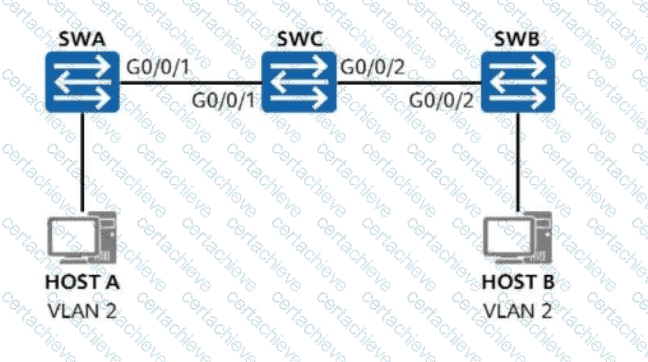
On the network shown in the figure, VLAN 2 is created on SWA and SWB, and interfaces connected to hosts are access ports added to VLAN 2. G0/0/1 on SWA and G0/0/2 on SWB are trunk interfaces allowing all VLANs. What additional configuration is needed on SWC to ensure communication between Host A and Host B?
Correct Answer & Rationale:
Answer: C
Explanation:
To ensure communication between Host A and Host B, we need to analyze the network topology, VLAN configuration, and the role of SWC as an intermediate switch. Let’s break it down step by step, based on VLAN and trunking principles as outlined in HCIA Datacom documentation:
Understanding the Current Network Configuration:
Host A and Host B: Both are connected to SWA and SWB, respectively, via access ports assigned to VLAN 2. Access ports carry untagged traffic for a single VLAN (in this case, VLAN 2), so Host A and Host B are part of VLAN 2.
SWA and SWB Trunk Interfaces: G0/0/1 on SWA and G0/0/2 on SWB are configured as trunk interfaces allowing all VLANs. Trunk ports carry tagged traffic for multiple VLANs (including VLAN 2 in this case) and are used to interconnect switches, enabling VLAN traffic to pass between them. Since these trunk ports allow all VLANs, VLAN 2 traffic can traverse between SWA and SWB.
SWC: SWC is the intermediate switch connecting SWA and SWB via its G0/0/1 (connected to SWA’s G0/0/1) and G0/0/2 (connected to SWB’s G0/0/2). However, the diagram and question do not specify SWC’s current VLAN or port configurations. By default, if no VLAN or trunk configuration exists on SWC, VLAN 2 traffic cannot pass through SWC, preventing communication between Host A and Host B.
Requirements for Communication Between Host A and Host B:
For Host A and Host B (both in VLAN 2) to communicate across the network, VLAN 2 traffic must be able to traverse SWC. This requires:
VLAN 2 to be created on SWC so that the switch recognizes and processes traffic for that VLAN.
The interfaces on SWC (G0/0/1 and G0/0/2) connecting to SWA and SWB must be configured as trunk ports to carry tagged VLAN 2 traffic, matching the trunk configuration on SWA’s G0/0/1 and SWB’s G0/0/2.
Trunk ports are necessary because they can carry traffic for multiple VLANs (tagged) and are typically used between switches to maintain VLAN consistency across the network.
Evaluating Each Option:
A. Create VLAN 2 on SWC.
Creating VLAN 2 on SWC is necessary, but it alone is insufficient. Without configuring the ports (G0/0/1 and G0/0/2) as trunk interfaces allowing VLAN 2, the VLAN traffic cannot pass through SWC. This option is incomplete and incorrect.
B. Configure G0/0/1 on SWC as a trunk interface that allows packets from VLAN 2 to pass through.
Configuring G0/0/1 as a trunk interface allowing VLAN 2 is part of the solution, but it only addresses the connection to SWA. G0/0/2 (connected to SWB) also needs to be configured as a trunk interface allowing VLAN 2 for bidirectional communication between Host A and Host B. This option is incomplete and incorrect.
C. Create VLAN 2 on SWC, and configure G0/0/1 and G0/0/2 as trunk interfaces that allow packets from VLAN 2 to pass through.
This option addresses all requirements:
Creating VLAN 2 on SWC ensures the switch recognizes VLAN 2 traffic.
Configuring both G0/0/1 and G0/0/2 as trunk interfaces allowing VLAN 2 ensures that tagged VLAN 2 traffic can pass between SWA and SWB through SWC, enabling communication between Host A and Host B.
This is the complete and correct solution, aligning with VLAN and trunking principles in HCIA Datacom.
D. On SWC, configure G0/0/1 as a trunk interface that allows packets from VLAN 2 to pass through, configure G0/0/2 as an access interface, and set the PVID to 2.
Configuring G0/0/1 as a trunk interface allowing VLAN 2 is correct for the connection to SWA. However, configuring G0/0/2 as an access interface with PVID 2 (Port VLAN ID) is incorrect for this scenario:
Access ports carry untagged traffic for a single VLAN and are typically used for end devices, not for interconnecting switches. Since SWB’s G0/0/2 is a trunk interface allowing all VLANs, G0/0/2 on SWC must also be a trunk interface to match and carry VLAN 2 traffic.
Using an access port on G0/0/2 would prevent VLAN 2 traffic from passing correctly, as it would expect untagged traffic only for VLAN 2, which conflicts with SWB’s trunk configuration.
This option is incorrect because it mixes access and trunk port types inappropriately for inter-switch links.
Conclusion:
To ensure communication between Host A and Host B (both in VLAN 2), SWC must:
Create VLAN 2.
Configure G0/0/1 and G0/0/2 as trunk interfaces allowing VLAN 2 traffic.
Option C fulfills these requirements, making it the correct answer.
Answer: C
References from HCIA Datacom Documents:
HCIA Datacom V3.0, Chapter 4: VLAN Technologies – Access and Trunk Port Configurations
HCIA Datacom V3.0, Chapter 4: VLAN Trunking and Inter-VLAN Routing – Configuring Trunk Ports for VLAN Traffic
Huawei VLAN Configuration Guide (HCIA Datacom Certification Material) – VLAN Creation and Port Link Types
Question 5
Huawei H12-811_V1.0
QUESTION DESCRIPTION:
(Which of the following statements about IPv6 anycast addresses are true?)
Correct Answer & Rationale:
Answer: A, C, D
Explanation:
IPv6 Anycast Address Characteristics:
Option A: True. Packets are delivered to the nearest interface based on routing distance.
Option B: False. Anycast addresses are not designed for load balancing.
Option C: True. Anycast addresses share the same address space as unicast.
Option D: True. Anycast provides redundancy by allowing multiple endpoints to share the same address.
Question 6
Huawei H12-811_V1.0
QUESTION DESCRIPTION:
As specified by the RSTP protocol, when a root port fails, which type of port will function as a new root port and enter the forwarding state without any delay?
Correct Answer & Rationale:
Answer: A
Explanation:
Comprehensive Explanation: In RSTP (Rapid Spanning Tree Protocol), the Alternate Port is the backup path to the root bridge. If the current root port fails, the Alternate Port immediately transitions to the forwarding state, providing a new path to the root bridge with minimal delay. This rapid transition is one of the key improvements of RSTP over the older STP protocol. Backup ports, on the other hand, provide redundancy on the same switch, and edge ports are used to connect directly to end devices.
Question 7
Huawei H12-811_V1.0
QUESTION DESCRIPTION:
RSTP uses the proposal/agreement mechanism to shorten the time that an upstream port waits before transitioning to the Forwarding state, but no temporary loop occurs. Why?
Correct Answer & Rationale:
Answer: C
Explanation:
Detailed Explanation:RSTP (Rapid Spanning Tree Protocol) employs a synchronization mechanism with the proposal/agreement handshakes to prevent loops during topology changes. By synchronizing states between switches, RSTP avoids temporary loops while quickly transitioning ports to the forwarding state. (Reference: HCIA-Datacom Training Material, RSTP Mechanisms and Synchronization)
Question 8
Huawei H12-811_V1.0
QUESTION DESCRIPTION:
The following figure shows the configuration of a sub-interface on a router. For which VLAN does the sub-interface receive tagged data frames?
Correct Answer & Rationale:
Answer: D
Explanation:
Comprehensive Explanation: The command dot1q termination vid 100 in the configuration specifies that the sub-interface is configured to receive tagged data frames for VLAN 100. VLAN tagging ensures that frames are properly identified and routed through the correct VLAN, and the sub-interface is associated with a specific VLAN ID to handle the tagged traffic.
Question 9
Huawei H12-811_V1.0
QUESTION DESCRIPTION:
Which of the following DHCP options needs to be configured on the DHCP server to allow Fit APs to obtain the IP address of an AC and establish CAPWAP tunnels?
Correct Answer & Rationale:
Answer: D
Explanation:
To help Fit APs locate an AC (Access Controller), the DHCP server must provide the AC IP address using DHCP Option 43.
Option 55 (Incorrect): Used to request a list of DHCP options.
Option 82 (Incorrect): Used for Relay Agent Information, not AC discovery.
Option 10 (Incorrect): Not relevant for APs or CAPWAP.
Option 43 (Correct): This option delivers the AC IP address to Fit APs so they can establish a CAPWAP tunnel.
Thus, the correct answer is D.
[Reference:Huawei HCIA-Datacom Official Documentation - DHCP and Fit AP AC Discovery, , , , ]
Question 10
Huawei H12-811_V1.0
QUESTION DESCRIPTION:
Which of the following sources of routes can be obtained by a router?
Correct Answer & Rationale:
Answer: A, B, C, D
Explanation:
Routers can learn routes from various sources:
Static routes: Manually configured routes.
Direct routes: Routes to networks directly connected to the router.
Summary routes: Aggregated routes summarizing multiple networks, often used in routing protocols.
Dynamic routes: Routes learned via routing protocols like OSPF, RIP, or BGP. These sources contribute to the router ' s routing table, enabling it to forward packets to known destinations.

Verified by Certified Instructors
This Huawei H12-811_V1.0 study pack was audited and verified on September 23, 2026 by Radia Davenport,. We ensure every technical rationale aligns with real-world enterprise standards.
A Stepping Stone for Enhanced Career Opportunities
Your profile having HCIA-Datacom certification significantly enhances your credibility and marketability in all corners of the world. The best part is that your formal recognition pays you in terms of tangible career advancement. It helps you perform your desired job roles accompanied by a substantial increase in your regular income. Beyond the resume, your expertise imparts you confidence to act as a dependable professional to solve real-world business challenges.
Your success in Huawei H12-811_V1.0 certification exam makes your visible and relevant in the fast-evolving tech landscape. It proves a lifelong investment in your career that give you not only a competitive advantage over your non-certified peers but also makes you eligible for a further relevant exams in your domain.
What You Need to Ace Huawei Exam H12-811_V1.0
Achieving success in the H12-811_V1.0 Huawei exam requires a blending of clear understanding of all the exam topics, practical skills, and practice of the actual format. There's no room for cramming information, memorizing facts or dependence on a few significant exam topics. It means your readiness for exam needs you develop a comprehensive grasp on the syllabus that includes theoretical as well as practical command.
Here is a comprehensive strategy layout to secure peak performance in H12-811_V1.0 certification exam:
- Develop a rock-solid theoretical clarity of the exam topics
- Begin with easier and more familiar topics of the exam syllabus
- Make sure your command on the fundamental concepts
- Focus your attention to understand why that matters
- Ensure hands-on practice as the exam tests your ability to apply knowledge
- Develop a study routine managing time because it can be a major time-sink if you are slow
- Find out a comprehensive and streamlined study resource for your help
Ensuring Outstanding Results in Exam H12-811_V1.0!
In the backdrop of the above prep strategy for H12-811_V1.0 Huawei exam, your primary need is to find out a comprehensive study resource. It could otherwise be a daunting task to achieve exam success. The most important factor that must be kep in mind is make sure your reliance on a one particular resource instead of depending on multiple sources. It should be an all-inclusive resource that ensures conceptual explanations, hands-on practical exercises, and realistic assessment tools.
Certachieve: A Reliable All-inclusive Study Resource
Certachieve offers multiple study tools to do thorough and rewarding H12-811_V1.0 exam prep. Here's an overview of Certachieve's toolkit:
Huawei H12-811_V1.0 PDF Study Guide
This premium guide contains a number of Huawei H12-811_V1.0 exam questions and answers that give you a full coverage of the exam syllabus in easy language. The information provided efficiently guides the candidate's focus to the most critical topics. The supportive explanations and examples build both the knowledge and the practical confidence of the exam candidates required to confidently pass the exam. The demo of Huawei H12-811_V1.0 study guide pdf free download is also available to examine the contents and quality of the study material.
Huawei H12-811_V1.0 Practice Exams
Practicing the exam H12-811_V1.0 questions is one of the essential requirements of your exam preparation. To help you with this important task, Certachieve introduces Huawei H12-811_V1.0 Testing Engine to simulate multiple real exam-like tests. They are of enormous value for developing your grasp and understanding your strengths and weaknesses in exam preparation and make up deficiencies in time.
These comprehensive materials are engineered to streamline your preparation process, providing a direct and efficient path to mastering the exam's requirements.
Huawei H12-811_V1.0 exam dumps
These realistic dumps include the most significant questions that may be the part of your upcoming exam. Learning H12-811_V1.0 exam dumps can increase not only your chances of success but can also award you an outstanding score.
Top Exams & Certification Providers
New & Trending
- New Released Exams
- Related Exam
- Hot Vendor