
The Advanced Test Management Exam v 3.0 – ISTQB (ATM)
Passing ISTQB ISTQB Test Manager exam ensures for the successful candidate a powerful array of professional and personal benefits. The first and the foremost benefit comes with a global recognition that validates your knowledge and skills, making possible your entry into any organization of your choice.

ATM Exam Dumps
- Exam Code: ATM
- Vendor: ISTQB
- Certifications: ISTQB Test Manager
- Exam Name: Advanced Test Management Exam v 3.0 – ISTQB
Why CertAchieve is Better than Standard ATM Dumps
In 2026, ISTQB uses variable topologies. Basic dumps will fail you.
| Quality Standard | Generic Dump Sites | CertAchieve Premium Prep |
|---|---|---|
| Technical Explanation | None (Answer Key Only) | Step-by-Step Expert Rationales |
| Syllabus Coverage | Often Outdated (v1.0) | 2026 Updated (Latest Syllabus) |
| Scenario Mastery | Blind Memorization | Conceptual Logic & Troubleshooting |
| Instructor Access | No Post-Sale Support | 24/7 Professional Help |
Customers Passed Exams
10
Success backed by proven exam prep tools
Questions Came Word for Word
93%
Real exam match rate reported by verified users
Average Score in Real Testing Centre
89%
Consistently high performance across certifications
Study Time Saved With CertAchieve
60%
Efficient prep that reduces study hours significantly
Coverage of Official ISTQB ATM Exam Domains
Our curriculum is meticulously mapped to the ISTQB official blueprint.
Testing Process
Master the full lifecycle of test management. Focus on the planning, monitoring, and control of testing activities. Learn to design test strategies that align with organizational goals and master the transition of testing through the analysis, design, and implementation phases in both sequential and iterative lifecycles.
Test Management in Practice
The core of the syllabus. Master Risk-Based Testing (RBT)—identifying, assessing, and mitigating risks to product quality. Focus on test estimation techniques (Wideband Delphi, Three-point), progress monitoring through KPIs, and the business value of testing in a modern CI/CD pipeline.
Reviews and Audits
Mastering the quality gates. Focus on management reviews and audits rather than technical inspections. Learn to identify the success factors for reviews, lead formal review processes, and evaluate the effectiveness of review activities to improve overall product quality.
Defect Management
Deep dive into the defect lifecycle. Master the analysis of defect reports to identify trends and process weaknesses. Focus on the "Root Cause Analysis" (RCA) and how to communicate defect data to stakeholders to drive informed release decisions.
Improving the Test Process
Master the frameworks for excellence. Focus on the TMMi (Test Maturity Model integration) and TPI Next models. Learn to assess the current state of testing, identify improvement goals, and implement a structured roadmap for process evolution.
ISTQB ATM Exam Domains Q&A
Certified instructors verify every question for 100% accuracy, providing detailed, step-by-step explanations for each.
Question 1
ISTQB ATM
QUESTION DESCRIPTION:
You have been looking at the actual vs expected defects in one high risk area of the software The actual is much higher than the expected value What should you do?
Correct Answer & Rationale:
Answer: C
Explanation:
Context Analysis:
Higher-than-expected defects in a high-risk area indicate the need for additional testing to mitigate potential impacts.
Evaluation of Options:
A. Reassess the risk with a higher likelihood number:
Incorrect. While reassessment is useful, immediate action should prioritize more testing.
B. Reassess the risk with a higher impact number:
Incorrect. The impact may already be known, and more testing is the next practical step.
C. Concentrate more testing in the area because the risk is clearly higher:
Correct. Addressing higher-than-expected defects through focused testing ensures risks are adequately mitigated.
D. Concentrate less testing in the area because the defects are already found:
Incorrect. Higher defects warrant more testing, not less.
Syllabus Alignment:
ISTQB highlights increasing test efforts in high-risk areas with higher-than-expected defect levels (TM-1.3.4).
References:
ISTQB Advanced Level Test Management Syllabus (TM-1.3.4)
Question 2
ISTQB ATM
QUESTION DESCRIPTION:
Which of the following Is considered a heavyweight risk-based testing technique'
Correct Answer & Rationale:
Answer: D
Explanation:
Context Analysis:
Heavyweight risk-based techniques involve thorough, detailed analyses to identify and mitigate potential risks comprehensively.
Hazard analysis is a structured method to identify and address risks, commonly used in safety-critical domains.
Evaluation of Options:
A. Systematic software testing:
Incorrect. While methodical, it is not inherently a risk-based technique.
B. Pragmatic risk analysis:
Incorrect. This is a lightweight technique emphasizing practical application over detailed analysis.
C. Brainstorming:
Incorrect. While useful for generating ideas, it is not detailed enough to qualify as heavyweight.
D. Hazard analysis:
Correct. It is a formal and comprehensive approach, qualifying as a heavyweight technique.
Syllabus Alignment:
ISTQB highlights hazard analysis as a detailed, structured risk-based technique (TM-1.3.4).
References:
ISTQB Advanced Level Test Management Syllabus (TM-1.3.4)
Question 3
ISTQB ATM
QUESTION DESCRIPTION:
Which of the following is the proper order for the stages of a tool lifecycle?
Correct Answer & Rationale:
Answer: A
Explanation:
Definition of Tool Lifecycle Stages:
Acquisition: The tool is selected and procured.
Support: Maintenance and updates are provided to ensure ongoing usability.
Evolution: The tool is upgraded or adapted for new needs.
Retirement: The tool is decommissioned when no longer useful.
Evaluation of Options:
A. Acquisition Support Evolution Retirement:
Correct. This sequence reflects the natural progression of a tool lifecycle.
B. Acquisition Evolution Support Retirement:
Incorrect. Support should occur before evolution as maintenance ensures stability before upgrades.
C. Evolution Acquisition Retirement Support:
Incorrect. Evolution cannot occur before acquisition.
D. Evolution Support Acquisition Retirement:
Incorrect. Acquisition must come first.
Syllabus Alignment:
ISTQB highlights the lifecycle stages of tools in test environments as starting with acquisition and ending with retirement (TM-1.6.4).
References:
ISTQB Advanced Level Test Management Syllabus (TM-1.6.4)
Question 4
ISTQB ATM
QUESTION DESCRIPTION:
You have been seeing a high number of rejections of defect reports The developers are complaining that they do not understand what the problem is. even though they have been supplied with screenshots. You have checked a number of the 'problem' defect reports and have not found any information that is missing. The descriptions are very detailed and include all the necessary information in a long descriptive paragraph.
What change should you recommend that should help with the developer s problems?
Correct Answer & Rationale:
Answer: D
Explanation:
Context Analysis:
Long descriptive paragraphs are difficult to parse, even if they contain all necessary information. Developers need concise, structured information for quick understanding.
Evaluation of Options:
A. Instruct your team to make all defects high priority:
Incorrect. Changing priority does not address the clarity issue in defect reports.
B. Highlight all the information and walk through it with the developers:
Incorrect. This is time-consuming and not scalable as a general solution.
C. Email screenshots to developers in addition to attaching them to defect reports:
Incorrect. Duplication of information does not solve the clarity problem.
D. Separate out the steps to reproduce the defect in the description so it is clearer for the developers and easier to find:
Correct. Structuring defect reports improves clarity and makes them easier to process.
Syllabus Alignment:
ISTQB recommends clear and concise defect reports to facilitate understanding and resolution (TM-2.3.5).
References:
ISTQB Advanced Level Test Management Syllabus (TM-2.3.5)
Question 5
ISTQB ATM
QUESTION DESCRIPTION:
Which of the Mowing Is commonly used by a test manager to identity risks'
Correct Answer & Rationale:
Answer: C
Explanation:
Common Risk Identification Techniques :
A test manager often relies on experience with similar projects to foresee risks related to technical complexity, domain challenges, or previous defects.
Other options listed are less effective for comprehensive risk identification.
Evaluation of Options :
A (Lines of code) and B (Function points) are quantitative measures, not directly tied to risk identification.
C is correct as past experience is crucial for identifying risks early.
D (Record/playback tools) is irrelevant to risk analysis.
References and Syllabus Alignment :
Risk identification techniques are discussed under "Risk Management" (TM-1.3.1).
Question 6
ISTQB ATM
QUESTION DESCRIPTION:
You feel that your team has become lazy when applying good software testing techniques You have given each of them a challenge to take a different business rule and build a full decision table and then collapse that table You will then assess the results For this assessment, what competencies are you validating?
Correct Answer & Rationale:
Answer: A
Explanation:
Competence Assessment :
Professional competence is validated by understanding and applying testing techniques to create a decision table.
Methodical competence is validated by systematically collapsing the decision table to ensure efficient test case design.
Evaluation of Options :
B and C involve social and personal skills, which are unrelated to the task.
D misses the professional aspect of understanding business rules.
A is correct because the challenge tests both professional knowledge and methodical skills.
References and Syllabus Alignment :
Decision table techniques and testing competencies are emphasized in "Test Techniques" (TM-1.4.1) and "Test Team Skills" (TM-3.1.1).
Question 7
ISTQB ATM
QUESTION DESCRIPTION:
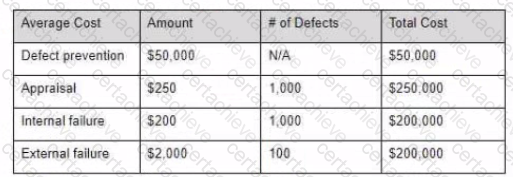
You have assembled the following cost of quality numbers 1 000 defects were found prior to release and 100 were found after.
Given this information what should you conclude?
Correct Answer & Rationale:
Answer: B
Explanation:
Cost of Quality Analysis :
The given table lists costs for defect prevention, appraisal, internal failure, and external failure.
Defect prevention cost is $50,000, while costs for appraisal, internal failures, and external failures are $250,000, $200,000, and $200,000, respectively.
The combined cost of internal and external failures is significantly high compared to defect prevention costs.
Defect Detection and Prevention (DDP) :
DDP measures the effectiveness of defect prevention activities and early detection mechanisms.
In this case, 1,000 defects were caught before release (appraisal) and 100 defects escaped to production.
DDP = (Defects found before release / Total defects) = 1000 / (1000 + 100) = 90.91%.
While this DDP is relatively high, the costs of appraisal and failures indicate that prevention strategies need more investment.
Key Cost Drivers :
High internal and external failure costs indicate inefficiencies in earlier stages of quality assurance.
Shifting investments from appraisal and failure costs towards defect prevention would reduce the overall cost of quality.
Evaluating Options :
Option A ("More testing needed because DDP < 90%") is invalid since DDP is above 90%.
Option C ("The cost of testing is justified") does not address the imbalance between high failure costs and low prevention spending.
Option D ("More effort on appraisal") contradicts the cost-benefit focus of investing in prevention.
Option B is correct because enhancing defect prevention strategies will reduce downstream costs.
References and Syllabus Alignment :
This conclusion aligns with the ISTQB Advanced Test Management syllabus section on "Cost of Quality" and strategies to optimize testing investments. Specifically, prevention is emphasized as more cost-effective than appraisal and failure management.
Question 8
ISTQB ATM
QUESTION DESCRIPTION:
Your team has been assigned to a new project You have a mix of manual testers and automation engineers but everyone is currently doing manual testing. The development learn has already decided to use DevOps as its approach but they have never used it before and are happy to take your input Unfortunately, about 50% of the development is completed already In the testing your team is doing they are finding that about 40% of the defects they catch are actually regressions caused by other changes
Given this information what should you do to help mitigate risk'?
Correct Answer & Rationale:
Answer: B
Explanation:
Identifying the Risk :
High regression rates (40%) indicate a need to improve regression testing capabilities and reduce risks.
Test automation addresses regressions effectively by enabling faster and repeated testing.
Evaluation of Options :
A is irrelevant to the regression risks highlighted.
B is correct because it emphasizes test automation for regressions and quality gates to prevent defect leaks.
C is partially valid but does not directly address regression issues.
D focuses on development practices, which, while helpful, does not directly reduce regression risks.
References and Syllabus Alignment :
This aligns with ISTQB guidelines on balancing manual and automated testing in regression scenarios (TM-1.6.3, TM-1.4.2).
Question 9
ISTQB ATM
QUESTION DESCRIPTION:
You are a new lest manager in an organization You have been asked to assess the defect process to determine if there are any efficiency improvements that could be made that would reduce the cost of quality You have started digging through the defect Information What information would be most helpful for this investigation?
Correct Answer & Rationale:
Answer: D
Explanation:
Key Data for Defect Process Improvement :
Analyzing when defects are introduced versus when they are detected is critical to identifying process inefficiencies.
This information helps pinpoint gaps in earlier phases, allowing the team to implement preventive measures and reduce overall costs.
Evaluation of Options :
A and B are useful but do not address the root cause of inefficiencies.
C (Risk areas and severity relationship) is helpful but secondary to understanding phase discrepancies.
D is correct as it provides the most actionable insights for process improvement.
References and Syllabus Alignment :
Defect lifecycle analysis is discussed under "Defect Management" (TM-2.3.1) in the ISTQB syllabus.
Question 10
ISTQB ATM
QUESTION DESCRIPTION:
Which test process improvement model consists of five maturity levels?
Correct Answer & Rationale:
Answer: A
Explanation:
Test Process Improvement Models :
TMMi® (Test Maturity Model Integration) has five maturity levels: Initial, Managed, Defined, Measured, and Optimization.
Other models, like TPI® NEXT , focus on key areas but do not use a maturity-level framework.
CMMi® (Capability Maturity Model Integration) applies broadly to process improvement but is not specific to testing.
GQM (Goal-Question-Metric) is a measurement approach, not a maturity model.
Evaluation of Options :
A (TMMi®) is correct as it directly incorporates a five-level maturity framework for test process improvement.
Other options are not aligned with the question context.
References and Syllabus Alignment :
TMMi is referenced in the ISTQB syllabus under "Improving the Test Process" (TM-1.5.1) as a standard for maturity models.

Verified by Certified Instructors
This ISTQB ATM study pack was audited and verified on September 23, 2026 by Martin Carlisle,. We ensure every technical rationale aligns with real-world enterprise standards.
A Stepping Stone for Enhanced Career Opportunities
Your profile having ISTQB Test Manager certification significantly enhances your credibility and marketability in all corners of the world. The best part is that your formal recognition pays you in terms of tangible career advancement. It helps you perform your desired job roles accompanied by a substantial increase in your regular income. Beyond the resume, your expertise imparts you confidence to act as a dependable professional to solve real-world business challenges.
Your success in ISTQB ATM certification exam makes your visible and relevant in the fast-evolving tech landscape. It proves a lifelong investment in your career that give you not only a competitive advantage over your non-certified peers but also makes you eligible for a further relevant exams in your domain.
What You Need to Ace ISTQB Exam ATM
Achieving success in the ATM ISTQB exam requires a blending of clear understanding of all the exam topics, practical skills, and practice of the actual format. There's no room for cramming information, memorizing facts or dependence on a few significant exam topics. It means your readiness for exam needs you develop a comprehensive grasp on the syllabus that includes theoretical as well as practical command.
Here is a comprehensive strategy layout to secure peak performance in ATM certification exam:
- Develop a rock-solid theoretical clarity of the exam topics
- Begin with easier and more familiar topics of the exam syllabus
- Make sure your command on the fundamental concepts
- Focus your attention to understand why that matters
- Ensure hands-on practice as the exam tests your ability to apply knowledge
- Develop a study routine managing time because it can be a major time-sink if you are slow
- Find out a comprehensive and streamlined study resource for your help
Ensuring Outstanding Results in Exam ATM!
In the backdrop of the above prep strategy for ATM ISTQB exam, your primary need is to find out a comprehensive study resource. It could otherwise be a daunting task to achieve exam success. The most important factor that must be kep in mind is make sure your reliance on a one particular resource instead of depending on multiple sources. It should be an all-inclusive resource that ensures conceptual explanations, hands-on practical exercises, and realistic assessment tools.
Certachieve: A Reliable All-inclusive Study Resource
Certachieve offers multiple study tools to do thorough and rewarding ATM exam prep. Here's an overview of Certachieve's toolkit:
ISTQB ATM PDF Study Guide
This premium guide contains a number of ISTQB ATM exam questions and answers that give you a full coverage of the exam syllabus in easy language. The information provided efficiently guides the candidate's focus to the most critical topics. The supportive explanations and examples build both the knowledge and the practical confidence of the exam candidates required to confidently pass the exam. The demo of ISTQB ATM study guide pdf free download is also available to examine the contents and quality of the study material.
ISTQB ATM Practice Exams
Practicing the exam ATM questions is one of the essential requirements of your exam preparation. To help you with this important task, Certachieve introduces ISTQB ATM Testing Engine to simulate multiple real exam-like tests. They are of enormous value for developing your grasp and understanding your strengths and weaknesses in exam preparation and make up deficiencies in time.
These comprehensive materials are engineered to streamline your preparation process, providing a direct and efficient path to mastering the exam's requirements.
ISTQB ATM exam dumps
These realistic dumps include the most significant questions that may be the part of your upcoming exam. Learning ATM exam dumps can increase not only your chances of success but can also award you an outstanding score.
Top Exams & Certification Providers
New & Trending
- New Released Exams
- Related Exam
- Hot Vendor
Verified Performance Reports
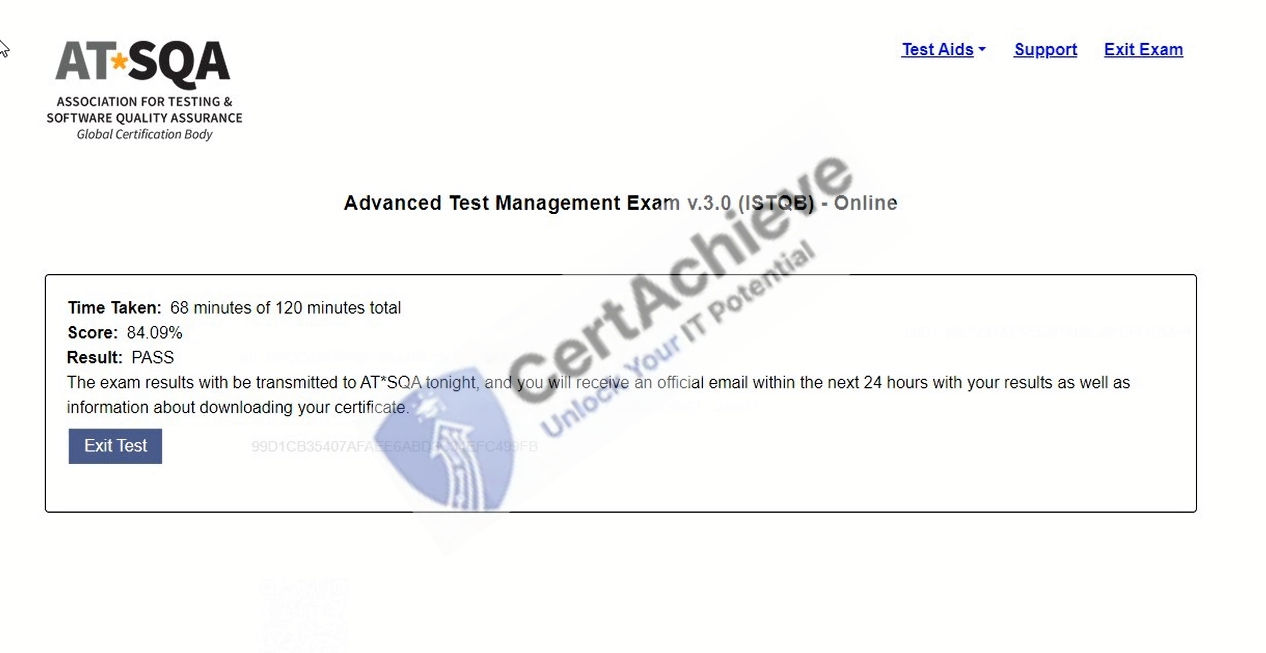
Authentic score reports from candidates who cleared the ATM exam.
Verified Case #1
×
![]()