
The ISTQB Certified Tester AI Testing Exam (CT-AI)
Passing ISTQB ISTQB AI Testing exam ensures for the successful candidate a powerful array of professional and personal benefits. The first and the foremost benefit comes with a global recognition that validates your knowledge and skills, making possible your entry into any organization of your choice.

CT-AI Exam Dumps
- Exam Code: CT-AI
- Vendor: ISTQB
- Certifications: ISTQB AI Testing
- Exam Name: ISTQB Certified Tester AI Testing Exam
Why CertAchieve is Better than Standard CT-AI Dumps
In 2026, ISTQB uses variable topologies. Basic dumps will fail you.
| Quality Standard | Generic Dump Sites | CertAchieve Premium Prep |
|---|---|---|
| Technical Explanation | None (Answer Key Only) | Step-by-Step Expert Rationales |
| Syllabus Coverage | Often Outdated (v1.0) | 2026 Updated (Latest Syllabus) |
| Scenario Mastery | Blind Memorization | Conceptual Logic & Troubleshooting |
| Instructor Access | No Post-Sale Support | 24/7 Professional Help |
Customers Passed Exams
10
Success backed by proven exam prep tools
Questions Came Word for Word
95%
Real exam match rate reported by verified users
Average Score in Real Testing Centre
87%
Consistently high performance across certifications
Study Time Saved With CertAchieve
60%
Efficient prep that reduces study hours significantly
ISTQB CT-AI Exam Domains Q&A
Certified instructors verify every question for 100% accuracy, providing detailed, step-by-step explanations for each.
Question 1
ISTQB CT-AI
QUESTION DESCRIPTION:
Which ONE of the following options represents a technology MOST TYPICALLY used to implement Al?
SELECT ONE OPTION
Correct Answer & Rationale:
Answer: D
Explanation:
Technology Most Typically Used to Implement AI: Genetic algorithms are a well-known technique used in AI. They are inspired by the process of natural selection and are used to find approximate solutions to optimization and search problems. Unlike search engines, procedural programming, or case control structures, genetic algorithms are specifically designed for evolving solutions and are commonly employed in AI implementations.
Reference: ISTQB_CT-AI_Syllabus_v1.0, Section 1.4 AI Technologies, which identifies different technologies used to implement AI.
Question 2
ISTQB CT-AI
QUESTION DESCRIPTION:
Which of the following is an example of a clustering problem that can be resolved by unsupervised learning?
Correct Answer & Rationale:
Answer: A
Explanation:
The syllabus defines clustering as:
“Clustering: This is when the problem requires the identification of similarities in input data points that allows them to be grouped based on common characteristics or attributes. For example, clustering is used to categorize different types of customers for the purpose of marketing.”
(Reference: ISTQB CT-AI Syllabus v1.0, Section 3.1.2, page 26 of 99)
Question 3
ISTQB CT-AI
QUESTION DESCRIPTION:
A beer company is trying to understand how much recognition its logo has in the market. It plans to do that by monitoring images on various social media platforms using a pre-trained neural network for logo detection. This particular model has been trained by looking for words, as well as matching colors on social media images. The company logo has a big word across the middle with a bold blue and magenta border.
Which associated risk is most likely to occur when using this pre-trained model?
Correct Answer & Rationale:
Answer: D
Explanation:
According to the syllabus, pre-trained models often inherit biases and limitations from the data and processes used in their original training, which may not align with the new use case. Specifically, the syllabus states:
"When using a pre-trained model, the training data and process cannot be fully controlled or known by the user of the model. As a result, the model can inherit biases or inaccuracies that were part of its original development and training process."
(Reference: ISTQB CT-AI Syllabus v1.0, Section 1.8.3)
Question 4
ISTQB CT-AI
QUESTION DESCRIPTION:
Which statement describes factors related to test data that make testing AI-based systems difficult?
Choose ONE option (1 out of 4)
Correct Answer & Rationale:
Answer: B
Explanation:
Section 2.2 – Data Preparation and 4.1 – Challenges in Testing AI-Based Systems describe difficulties in obtaining and managing large, representative datasets. AI-based systems require realistic, diverse, and representative data reflecting real-world variations. The syllabus emphasizes that assembling such datasets is time-consuming, resource-intensive, and often constrained by availability, privacy, or domain complexity. Option B directly corresponds to these documented challenges.
Option A is incorrect: using the same implementation risks defect masking , not preventing it; the syllabus warns against this practice. Option C is incorrect because real-world data naturally evolves, and the syllabus notes that drift is normal; expecting stable input data contradicts operational reality. Option D is incorrect: although data privacy is important, the syllabus does not claim that artificially generated data always requires legal approval, nor that sanitization/encryption is mandatory for synthetic data.
Thus, Option B accurately reflects syllabus-defined difficulties in producing representative test data.
Question 5
ISTQB CT-AI
QUESTION DESCRIPTION:
A system was developed for screening the X-rays of patients for potential malignancy detection (skin cancer). A workflow system has been developed to screen multiple cancers by using several individually trained ML models chained together in the workflow.
Testing the pipeline could involve multiple kind of tests (I - III):
I. Pairwise testing of combinations
II. Testing each individual model for accuracy
III. A/B testing of different sequences of models
Which ONE of the following options contains the kinds of tests that would be MOST APPROPRIATE to include in the strategy for optimal detection?
SELECT ONE OPTION
Correct Answer & Rationale:
Answer: B
Explanation:
The question asks which combination of tests would be most appropriate to include in the strategy for optimal detection in a workflow system using multiple ML models.
Pairwise testing of combinations (I) : This method is useful for testing interactions between different components in the workflow to ensure they work well together, identifying potential issues in the integration.
Testing each individual model for accuracy (II) : Ensuring that each model in the workflow performs accurately on its own is crucial before integrating them into a combined workflow.
A/B testing of different sequences of models (III) : This involves comparing different sequences to determine which configuration yields the best results. While useful, it might not be as fundamental as pairwise and individual accuracy testing in the initial stages.
[:, ISTQB CT-AI Syllabus Section 9.2 on Pairwise Testing and Section 9.3 on Testing ML Models emphasize the importance of testing interactions and individual model accuracy in complex ML workflows., , , ]
Question 6
ISTQB CT-AI
QUESTION DESCRIPTION:
Which of the following technologies for implementing AI is considered to be a reasoning technique?
Choose ONE option (1 out of 4)
Correct Answer & Rationale:
Answer: A
Explanation:
The ISTQB Certified Tester AI Testing Syllabus v1.0 explicitly categorizes different AI implementation technologies in Section 1.4 – AI Technologies . Within this section, AI methods are grouped into categories, one of which is “Reasoning techniques.” These reasoning techniques include rule engines, deductive classifiers, case-based reasoning, and procedural reasoning . Because deductive classifiers are directly listed under this set of reasoning approaches, they are recognized as a reasoning-based AI technology.
Reasoning techniques differ from machine learning approaches because they rely on structured, predefined rules or logic to reach conclusions. Deductive classifiers use logical inference and symbolic reasoning to classify inputs by applying encoded knowledge. This makes them fundamentally different from statistical or data-driven ML algorithms.
The other options— Linear regression , Random Forest , and Genetic algorithms —are listed by the syllabus as machine learning techniques , not reasoning methods. Linear regression performs numerical prediction, Random Forest is an ensemble decision-tree ML model, and genetic algorithms are optimization-based ML approaches inspired by evolutionary processes. None of these involve symbolic logical deduction.
Thus, based on the authoritative definitions in the syllabus, Deductive classifiers (Option A) is the only technology classified as a reasoning technique.
Question 7
ISTQB CT-AI
QUESTION DESCRIPTION:
Which ONE of the following approaches to labelling requires the least time and effort?
SELECT ONE OPTION
Correct Answer & Rationale:
Answer: B
Explanation:
Labelling Approaches: Among the options provided, pre-labeled datasets require the least time and effort because the data has already been labeled, eliminating the need for further manual or automated labeling efforts.
Reference: ISTQB_CT-AI_Syllabus_v1.0, Section 4.5 Data Labelling for Supervised Learning, which discusses various approaches to data labeling, including pre-labeled datasets, and their associated time and effort requirements.
Question 8
ISTQB CT-AI
QUESTION DESCRIPTION:
Which statement about AI-based test case generation is correct?
Choose ONE option (1 out of 4)
Correct Answer & Rationale:
Answer: C
Explanation:
The ISTQB CT-AI syllabus indicates in Section 5.2 – AI for Testing that AI-generated test cases may not come with predefined expected results . This is because test-case generation methods—such as evolutionary algorithms, reinforcement learning, or clustering-based sampling—produce inputs , but the tester must still determine the correct outputs. Therefore, Option C is correct: expected results may not be available, especially when AI produces novel or previously unseen input combinations.
Option A is incorrect: AI-based test generation can improve coverage by exploring large input spaces. Option B is incorrect because the need for oracles does not depend on whether the test case is AI-generated. Option D is incorrect because the syllabus allows using a model as an oracle in back-to-back testing , provided limitations are understood.
Therefore, Option C is the correct syllabus-aligned statement.
Question 9
ISTQB CT-AI
QUESTION DESCRIPTION:
A tourist calls an airline to book a ticket and is connected with an automated system which is able to recognize speech, understand requests related to purchasing a ticket, and provide relevant travel options. When the tourist asks about the expected weather at the destination or potential impacts on operations because of the tight labor market, the only response from the automated system is, "I don’t understand your question."
This AI system should be categorized as?
Correct Answer & Rationale:
Answer: D
Explanation:
According to the syllabus, conventional AI systems are limited to specific, pre-defined tasks and do not have generalized intelligence:
"Conventional AI systems are limited in their scope and typically only perform specific tasks within the domain for which they have been designed. They do not exhibit general AI behavior."
(Reference: ISTQB CT-AI Syllabus v1.0, Section 1.2)
Question 10
ISTQB CT-AI
QUESTION DESCRIPTION:
Which of the following statements about ML functional performance metrics is correct?
Choose ONE option (1 out of 4)
Correct Answer & Rationale:
Answer: A
Explanation:
The ISTQB CT-AI syllabus explains ML performance metrics in Section 3.2 – Evaluating ML Models . For clustering , which is an unsupervised learning method, the syllabus lists metrics such as intra-cluster distance , inter-cluster distance , and coherence measures. Intra-cluster metrics evaluate how close data points are within a cluster, which directly corresponds to Option A.
Option B is incorrect because R-squared is a regression metric measuring goodness-of-fit, not classification performance, and has no connection to ROC curves. Option C is wrong because the silhouette coefficient is also a clustering metric, measuring cohesion vs. separation—not regression accuracy. Option D is incorrect because ROC curves evaluate binary or multiclass classification , not clustering.
Thus, Option A is the only accurate statement based on the syllabus.

Verified by Certified Instructors
This ISTQB CT-AI study pack was audited and verified on September 23, 2026 by Martin Carlisle,. We ensure every technical rationale aligns with real-world enterprise standards.
A Stepping Stone for Enhanced Career Opportunities
Your profile having ISTQB AI Testing certification significantly enhances your credibility and marketability in all corners of the world. The best part is that your formal recognition pays you in terms of tangible career advancement. It helps you perform your desired job roles accompanied by a substantial increase in your regular income. Beyond the resume, your expertise imparts you confidence to act as a dependable professional to solve real-world business challenges.
Your success in ISTQB CT-AI certification exam makes your visible and relevant in the fast-evolving tech landscape. It proves a lifelong investment in your career that give you not only a competitive advantage over your non-certified peers but also makes you eligible for a further relevant exams in your domain.
What You Need to Ace ISTQB Exam CT-AI
Achieving success in the CT-AI ISTQB exam requires a blending of clear understanding of all the exam topics, practical skills, and practice of the actual format. There's no room for cramming information, memorizing facts or dependence on a few significant exam topics. It means your readiness for exam needs you develop a comprehensive grasp on the syllabus that includes theoretical as well as practical command.
Here is a comprehensive strategy layout to secure peak performance in CT-AI certification exam:
- Develop a rock-solid theoretical clarity of the exam topics
- Begin with easier and more familiar topics of the exam syllabus
- Make sure your command on the fundamental concepts
- Focus your attention to understand why that matters
- Ensure hands-on practice as the exam tests your ability to apply knowledge
- Develop a study routine managing time because it can be a major time-sink if you are slow
- Find out a comprehensive and streamlined study resource for your help
Ensuring Outstanding Results in Exam CT-AI!
In the backdrop of the above prep strategy for CT-AI ISTQB exam, your primary need is to find out a comprehensive study resource. It could otherwise be a daunting task to achieve exam success. The most important factor that must be kep in mind is make sure your reliance on a one particular resource instead of depending on multiple sources. It should be an all-inclusive resource that ensures conceptual explanations, hands-on practical exercises, and realistic assessment tools.
Certachieve: A Reliable All-inclusive Study Resource
Certachieve offers multiple study tools to do thorough and rewarding CT-AI exam prep. Here's an overview of Certachieve's toolkit:
ISTQB CT-AI PDF Study Guide
This premium guide contains a number of ISTQB CT-AI exam questions and answers that give you a full coverage of the exam syllabus in easy language. The information provided efficiently guides the candidate's focus to the most critical topics. The supportive explanations and examples build both the knowledge and the practical confidence of the exam candidates required to confidently pass the exam. The demo of ISTQB CT-AI study guide pdf free download is also available to examine the contents and quality of the study material.
ISTQB CT-AI Practice Exams
Practicing the exam CT-AI questions is one of the essential requirements of your exam preparation. To help you with this important task, Certachieve introduces ISTQB CT-AI Testing Engine to simulate multiple real exam-like tests. They are of enormous value for developing your grasp and understanding your strengths and weaknesses in exam preparation and make up deficiencies in time.
These comprehensive materials are engineered to streamline your preparation process, providing a direct and efficient path to mastering the exam's requirements.
ISTQB CT-AI exam dumps
These realistic dumps include the most significant questions that may be the part of your upcoming exam. Learning CT-AI exam dumps can increase not only your chances of success but can also award you an outstanding score.
Top Exams & Certification Providers
New & Trending
- New Released Exams
- Related Exam
- Hot Vendor
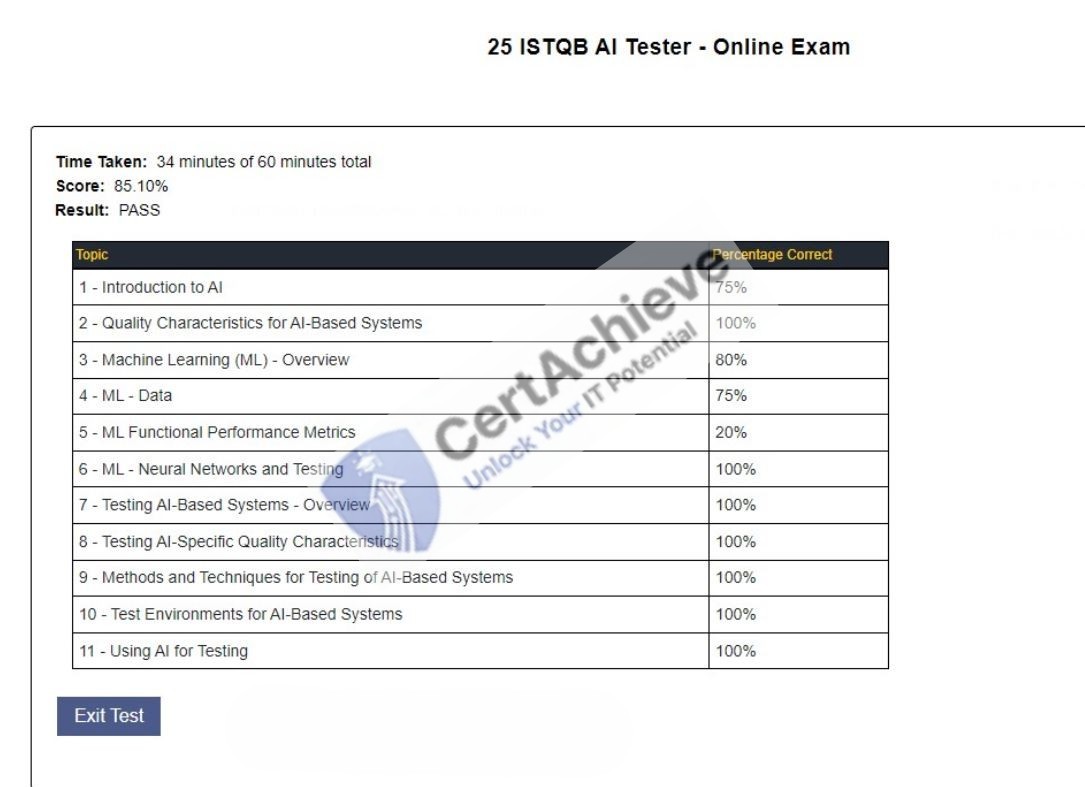
Verified Performance Reports
Authentic score reports from candidates who cleared the CT-AI exam.
Verified Case #1
×
![]()