
The ISTQB Certified Tester Foundation Level (CTFL v4.0) (ISTQB-CTFL)
Passing ISTQB Foundation Level exam ensures for the successful candidate a powerful array of professional and personal benefits. The first and the foremost benefit comes with a global recognition that validates your knowledge and skills, making possible your entry into any organization of your choice.


ISTQB-CTFL Exam Dumps
- Exam Code: ISTQB-CTFL
- Vendor: ISTQB
- Certifications: Foundation Level
- Exam Name: ISTQB Certified Tester Foundation Level (CTFL v4.0)
Why CertAchieve is Better than Standard ISTQB-CTFL Dumps
In 2026, ISTQB uses variable topologies. Basic dumps will fail you.
| Quality Standard | Generic Dump Sites | CertAchieve Premium Prep |
|---|---|---|
| Technical Explanation | None (Answer Key Only) | Step-by-Step Expert Rationales |
| Syllabus Coverage | Often Outdated (v1.0) | 2026 Updated (Latest Syllabus) |
| Scenario Mastery | Blind Memorization | Conceptual Logic & Troubleshooting |
| Instructor Access | No Post-Sale Support | 24/7 Professional Help |
Customers Passed Exams
10
Success backed by proven exam prep tools
Questions Came Word for Word
86%
Real exam match rate reported by verified users
Average Score in Real Testing Centre
86%
Consistently high performance across certifications
Study Time Saved With CertAchieve
60%
Efficient prep that reduces study hours significantly
Coverage of Official ISTQB ISTQB-CTFL Exam Domains
Our curriculum is meticulously mapped to the ISTQB official blueprint.
Fundamentals of Testing (20%)
The "Why" of testing. Master the seven testing principles (e.g., the "Pesticide Paradox" and "Absence-of-errors is a fallacy"). Focus on the fundamental test process—from planning and analysis to execution and completion. In 2026, this domain emphasizes the psychological factors of testing and the essential skills needed to communicate bugs without starting a war with the development team.
Testing Throughout the SDLC (15%)
The "Integration" layer. Master how testing fits into various development models, including Waterfall, V-Model, Agile, and DevOps. Focus on the concept of Shift-Left (testing earlier) and Shift-Right (testing in production). Learn the distinctions between Test Levels (Component, System, Acceptance) and Test Types (Functional, Non-functional, White-box).
Static Testing (10%)
The "Pre-emptive" core. Master the art of finding defects without actually running any code. Focus on the benefits of early feedback and the mechanics of formal and informal reviews. Understand how static analysis tools can catch "dead code" or security vulnerabilities before a single test case is even written, drastically reducing the cost of quality.
Test Analysis & Design (28%)
The "Engineering" engine. This is the highest-weighted domain. Master the triple threat of test techniques: Black-box (Equivalence Partitioning, Boundary Value Analysis), White-box (Statement and Branch coverage), and Experience-based (Exploratory Testing, Error Guessing). In 2026, this also includes Collaboration-based techniques like ATDD and writing user stories with the "Three Cs."
Managing the Test Activities (23%)
The "Strategic" layer. Master the logistics of a test campaign. Focus on Risk-based Testing, where you prioritize effort based on product and project risks (Risk=Likelihood×Impact). Learn to write clear defect reports, manage test progress through monitoring and control, and understand the role of independent testing in an organization.
Test Tools (5%)
The "Efficiency" domain. Master the classification of tools and the risks/benefits of automation. Focus on how to select and implement tools that support various testing activities, from management and static analysis to performance and execution. Understand that a tool is only as good as the process it supports—automating a mess just creates a faster mess.
ISTQB ISTQB-CTFL Exam Domains Q&A
Certified instructors verify every question for 100% accuracy, providing detailed, step-by-step explanations for each.
Question 1
ISTQB ISTQB-CTFL
QUESTION DESCRIPTION:
Consider a given test plan which, among others, contains the following three sections: " Test Scope " , " Testing Communication " , and " Stakeholders " . The features of the test object to be tested and those excluded from the testing represent information that is:
Correct Answer & Rationale:
Answer: B
Explanation:
The features of the test object to be tested and those excluded from the testing represent information that is usually included in a test plan and, in the given test plan, it is more likely to be specified within “Test Scope” rather than in the other two sections mentioned. The test scope defines the boundaries and limitations of the testing activities, such as the test items, the features to be tested, the features not to be tested, the test objectives, the test environment, the test resources, the test assumptions, the test risks, etc. The test scope helps to establish a common understanding of what is included and excluded from the testing, and to avoid ambiguity, confusion, or misunderstanding among the stakeholders. The other two sections, “Testing Communication” and “Stakeholders”, are also important parts of a test plan, but they do not directly address the features of the test object. The testing communication describes the methods, frequency, and responsibilities for the communication and reporting of the testing progress, status, issues, and results. The stakeholders identify the roles and responsibilities of the people involved in or affected by the testing activities, such as the test manager, the test team, the project manager, the developers, the customers, the users, etc. References : ISTQB Certified Tester Foundation Level (CTFL) v4.0 sources and documents:
ISTQB® Certified Tester Foundation Level Syllabus v4.0, Chapter 2.1.1, Test Planning 1
ISTQB® Glossary of Testing Terms v4.0, Test Plan, Test Scope 2
Question 2
ISTQB ISTQB-CTFL
QUESTION DESCRIPTION:
Which of the following statements about the value of maintaining traceability between the test basis and test work products is not true?
Correct Answer & Rationale:
Answer: C
Explanation:
Traceability is the ability to trace the relationships between the items of the test basis, such as the requirements, the design, the risks, etc., and the test artifacts, such as the test cases, the test results, the defects, etc. Traceability can provide various benefits for the testing process, such as improving the test coverage, the test quality, the test efficiency, and the test communication. However, not all the statements given are true about the value of maintaining traceability between the test basis and test work products. The statement that is not true is option C, which says that test objectives should be the same for all test levels, although the number of tests designed at various levels can vary significantly. This statement is false, because test objectives are the goals or the purposes of testing, which can vary depending on the test level, the test type, the test technique, the test environment, the test stakeholder, etc. Test objectives can be defined in terms of the test basis, the test coverage, the test quality, the test risk, the test cost, the test time, etc. Test objectives should be specific, measurable, achievable, relevant, and time-bound, and they should be aligned with the project objectives and the quality characteristics. Test objectives should not be the same for all test levels, as different test levels have different focuses, scopes, and perspectives of testing, such as component testing, integration testing, system testing, and acceptance testing. The other statements are true about the value of maintaining traceability between the test basis and test work products, such as:
Traceability can be useful for assessing the impact of a change to a test basis item on the corresponding tests: This statement is true, because traceability can help to identify which tests are affected by a change in the test basis, such as a new requirement, a modified design, a revised risk, etc., and to determine the necessary actions to update, re-execute, or re-evaluate the tests. Traceability can also help to estimate the effort, the cost, and the time needed to implement the change and to verify its impact on the software system.
Traceability can be useful for determining how many test basis items are covered by the corresponding tests: This statement is true, because traceability can help to measure the test coverage, which is the degree to which the test basis is exercised by the test cases. Traceability can help to identify which test basis items are covered, partially covered, or not covered by the tests, and to evaluate the adequacy, the completeness, and the effectiveness of the testing process. Traceability can also help to identify the gaps, the overlaps, or the redundancies in the test coverage, and to prioritize, optimize, or improve the test cases.
Traceability can be useful to support the needs required by the auditing of testing: This statement is true, because traceability can help to provide evidence, documentation, and justification for the testing activities, results, and outcomes. Traceability can help to demonstrate that the testing process follows the standards, the regulations, the policies, and the best practices that are applicable to the software system, the project, or the organization. Traceability can also help to verify that the testing process meets the expectations, the needs, and the satisfaction of the users and the stakeholders. References : ISTQB Certified Tester Foundation Level (CTFL) v4.0 sources and documents:
ISTQB® Certified Tester Foundati on Level Syllabus v4.0, Chapter 1.2.2, Testing Policies, Strategies, and Test Approaches 1
ISTQB® Certified Tester Foundation Level Syllabus v4.0, Chapter 2.1.1, Test Planning 1
ISTQB® Certif ied Tester Foundation Level Syllabus v4.0, Chapter 2.1.2, Test Monitoring and Control 1
ISTQB® Certified Tester Foundation Level Syllabus v4.0, Chapter 2.1.3, Test Analysis and Design 1
ISTQB® Glossary of Testing Terms v4.0, Traceability, Test Basis, Test Artifact, Test Objective, Test Level, Test Coverage, Test Qualit y, Test Risk, Test Cost, Test Time 2
Question 3
ISTQB ISTQB-CTFL
QUESTION DESCRIPTION:
Which ONE of the following options identifies the perspectives through which a collective authorship process generates a shared vision of user stories?
Correct Answer & Rationale:
Answer: C
Explanation:
Comprehensive and Detailed In-Depth Explanation:
Business, development, and testing (C) are the three key perspectives in agile user story refinement :
Business (Product Owner, Stakeholders) – Ensures the story aligns with user needs and business goals.
Development (Developers) – Provides insights on feasibility and technical constraints.
Testing (Testers, QA) – Ensures testability, acceptance criteria, and risk identification.
(A) is incorrect because the product owner is part of business stakeholders.
(B) is incorrect because architecture is part of development, but not the primary driver of user stories.
(D) is incorrect because acceptance testing is a process, not a stakeholder group .
A cross-functional team collaboration ensures well-defined, testable, and feasible user stories.
[Reference: ISTQB CTFL v4.0 Syllabus, Section 2.1.1 – Agile Team Collaboration in Testing, ]
Question 4
ISTQB ISTQB-CTFL
QUESTION DESCRIPTION:
Which of the following are valid testing principles?
I) Exhaustive testing is in general impossible.
II) Exhaustive testing should be executed for code intended to be reused.
III) Testing may guarantee that a program is correct.
IV) Testing cannot guarantee that a program is correct.
V) Defects cluster together in certain areas of the product.
Correct Answer & Rationale:
Answer: A
Explanation:
Statements I, IV and V are valid testing principles according to the ISTQB syllabus. Statement I states that exhaustive testing is in general impossible, because it would require testing all possible inputs, outputs and combinations of states, which is usually impractical or impossible. Statement IV states that testing cannot guarantee that a program is correct, because testing can only show the presence of defects, not their absence. Statement V states that defects cluster together in certain areas of the product, which means that some modules or functions are more likely to contain defects than others. Statements II and III are invalid testing principles. Statement II states that exhaustive testing should be executed for code intended to be reused, which contradicts statement I. Statement III states that testing may guarantee that a program is correct, which contradicts statement IV. Verified References: A Study Guide to the ISTQB® Foundation Level 2018 Syllabus - Springer , pages 4-5.
Question 5
ISTQB ISTQB-CTFL
QUESTION DESCRIPTION:
Which of the following statements is CORRECT?
Correct Answer & Rationale:
Answer: C
Explanation:
A test case is a set of input values, execution preconditions, expected results and execution postconditions, developed for a particular objective or test condition. A test case is a sequence of actions for test execution that can be followed by a tester or a test automation tool. A test case is specified during the test implementation activity, which is the activity that prepares the testware needed for test execution. A test case does not include actual results, as these are obtained during test execution and compared with the expected results. A test case does not describe items or events to test, as these are derived from the test basis during the test analysis activity. A test case is not derived during the test design activity, as this is the activity that specifies the test conditions or objectives that need to be tested. Verified References: [A Study Guide to the ISTQB® Foundation Level 2018 Syllabus - Springer], Chapter 3, page 23-24; Chapter 4, page 34.
Question 6
ISTQB ISTQB-CTFL
QUESTION DESCRIPTION:
An application is subjected to a constant load for an extended period of time as part of a performance test While running this test, the response time of the application steadily slows down, which results in a requirement not being met This slowdown is caused by a memory leak where the application code does not properly release some of the dynamically allocated memory when it is no longer needed. Which of the following statements is TRUE?
Correct Answer & Rationale:
Answer: A
Explanation:
In software testing terminology, a failure is an observable deviation of the software from its expected behavior. A defect (or bug) is the cause of the failure in the software ' s code. In this case, the observed slowdown is the failure, while the underlying memory leak in the application code is the defect causing this failure. This distinction is clearly outlined in the ISTQB CTFL Syllabus v4.0, which differentiates between failures (observable issues) and defects (underlying issues in the code).
Question 7
ISTQB ISTQB-CTFL
QUESTION DESCRIPTION:
A state transition diagram describes a control system’s behavior in different operational modes. The initial state is “NORMAL MODE” .
Which ONE of the following test cases covers an INVALID sequence ?
Correct Answer & Rationale:
Answer: D
Explanation:
Comprehensive and Detailed In-Depth Explanation:
State transition testing validates valid and invalid state transitions based on defined rules.
D is invalid because it transitions from DIAGNOSTIC MODE directly to EMERGENCY MODE , which is not a valid state change in most systems.
Other options follow valid sequences according to state transition rules .
[Reference: ISTQB CTFL v4.0 Syllabus, Section 4.2.4 – State Transition Testing, , ]
Question 8
ISTQB ISTQB-CTFL
QUESTION DESCRIPTION:
Which one of the following is a typical entry criteria for testing?
Correct Answer & Rationale:
Answer: B
Explanation:
A typical entry criterion for testing is the availability of testable requirements. Testable requirements provide a basis for designing and executing test cases. Without clear and testable requirements, it is challenging to determine what needs to be tested and to create effective test cases. Entry criteria ensure that the necessary preconditions are met before testing begins, which helps in conducting efficient and effective testing.
[References: ISTQB CTFL Syllabus, Section 5.1.3, "Entry and Exit Criteria.", , ]
Question 9
ISTQB ISTQB-CTFL
QUESTION DESCRIPTION:
Which ONE of the following options BEST describes Behavior-Driven Development (BDD)?
Correct Answer & Rationale:
Answer: A
Explanation:
Comprehensive and Detailed In-Depth Explanation:
BDD emphasizes collaboration between developers, testers, and business stakeholders to define system behavior in a readable format (A). It typically uses the Given-When-Then syntax. Unlike unit testing (B), BDD is at a higher level of abstraction. It does not focus solely on non-functional testing (C) and encourages early testing rather than post-development validation (D).
[Reference: ISTQB CTFL v4.0 Syllabus, Section 2.1.5 – Behavior-Driven Development (BDD), , ]
Question 10
ISTQB ISTQB-CTFL
QUESTION DESCRIPTION:
You are responsible for applying the correct technique for a review of the requirements document for a project to develop a new software application. You identify the reviewers and the required roles, including the meeting leader, who is the requirements document author, and a separate role for a scribe. Additionally, you decide to take a relatively informal approach to the requirements review. The goal of the review is to find defects in the requirements document, such as omissions, Inconsistencies, and duplications. Another goal of the review is to improve the software application ' s usability and accessibility by considering the various stakeholders ' viewpoints.
Which of the following statements BEST describes this scenario?
Correct Answer & Rationale:
Answer: C
Explanation:
This scenario is using a walkthrough review type and a perspective-based review technique. In a walkthrough, the author of the document leads the meeting and it typically includes a meeting leader and a scribe, as described. This type of review is informal, focuses on discussion, and often involves scenario-based reading of the document to understand different user perspectives ( ISTQB Main Web ) .
[References:, ISTQB® Certified Tester Foundation Level Syllabus v4.0: ISTQB CTFL Syllabus v4.0 PDF, ]

Verified by Certified Instructors
This ISTQB ISTQB-CTFL study pack was audited and verified on September 23, 2026 by Martin Carlisle,. We ensure every technical rationale aligns with real-world enterprise standards.
A Stepping Stone for Enhanced Career Opportunities
Your profile having Foundation Level certification significantly enhances your credibility and marketability in all corners of the world. The best part is that your formal recognition pays you in terms of tangible career advancement. It helps you perform your desired job roles accompanied by a substantial increase in your regular income. Beyond the resume, your expertise imparts you confidence to act as a dependable professional to solve real-world business challenges.
Your success in ISTQB ISTQB-CTFL certification exam makes your visible and relevant in the fast-evolving tech landscape. It proves a lifelong investment in your career that give you not only a competitive advantage over your non-certified peers but also makes you eligible for a further relevant exams in your domain.
What You Need to Ace ISTQB Exam ISTQB-CTFL
Achieving success in the ISTQB-CTFL ISTQB exam requires a blending of clear understanding of all the exam topics, practical skills, and practice of the actual format. There's no room for cramming information, memorizing facts or dependence on a few significant exam topics. It means your readiness for exam needs you develop a comprehensive grasp on the syllabus that includes theoretical as well as practical command.
Here is a comprehensive strategy layout to secure peak performance in ISTQB-CTFL certification exam:
- Develop a rock-solid theoretical clarity of the exam topics
- Begin with easier and more familiar topics of the exam syllabus
- Make sure your command on the fundamental concepts
- Focus your attention to understand why that matters
- Ensure hands-on practice as the exam tests your ability to apply knowledge
- Develop a study routine managing time because it can be a major time-sink if you are slow
- Find out a comprehensive and streamlined study resource for your help
Ensuring Outstanding Results in Exam ISTQB-CTFL!
In the backdrop of the above prep strategy for ISTQB-CTFL ISTQB exam, your primary need is to find out a comprehensive study resource. It could otherwise be a daunting task to achieve exam success. The most important factor that must be kep in mind is make sure your reliance on a one particular resource instead of depending on multiple sources. It should be an all-inclusive resource that ensures conceptual explanations, hands-on practical exercises, and realistic assessment tools.
Certachieve: A Reliable All-inclusive Study Resource
Certachieve offers multiple study tools to do thorough and rewarding ISTQB-CTFL exam prep. Here's an overview of Certachieve's toolkit:
ISTQB ISTQB-CTFL PDF Study Guide
This premium guide contains a number of ISTQB ISTQB-CTFL exam questions and answers that give you a full coverage of the exam syllabus in easy language. The information provided efficiently guides the candidate's focus to the most critical topics. The supportive explanations and examples build both the knowledge and the practical confidence of the exam candidates required to confidently pass the exam. The demo of ISTQB ISTQB-CTFL study guide pdf free download is also available to examine the contents and quality of the study material.
ISTQB ISTQB-CTFL Practice Exams
Practicing the exam ISTQB-CTFL questions is one of the essential requirements of your exam preparation. To help you with this important task, Certachieve introduces ISTQB ISTQB-CTFL Testing Engine to simulate multiple real exam-like tests. They are of enormous value for developing your grasp and understanding your strengths and weaknesses in exam preparation and make up deficiencies in time.
These comprehensive materials are engineered to streamline your preparation process, providing a direct and efficient path to mastering the exam's requirements.
ISTQB ISTQB-CTFL exam dumps
These realistic dumps include the most significant questions that may be the part of your upcoming exam. Learning ISTQB-CTFL exam dumps can increase not only your chances of success but can also award you an outstanding score.
Top Exams & Certification Providers
New & Trending
- New Released Exams
- Related Exam
- Hot Vendor
Verified Performance Reports
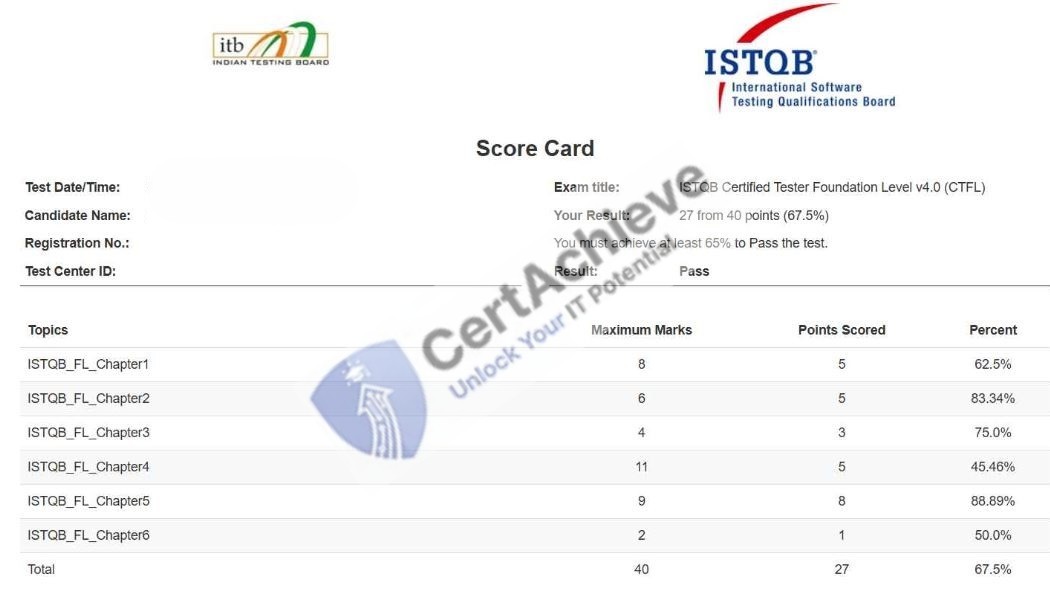
Authentic score reports from candidates who cleared the ISTQB-CTFL exam.
Verified Case #1
×
![]()