
The Certified Tester Advanced Level Test Management (CTAL-TM) v3.0 (CTAL-TM)
Passing ISTQB Test Manager Advanced exam ensures for the successful candidate a powerful array of professional and personal benefits. The first and the foremost benefit comes with a global recognition that validates your knowledge and skills, making possible your entry into any organization of your choice.


CTAL-TM Exam Dumps
- Exam Code: CTAL-TM
- Vendor: ISTQB
- Certifications: Test Manager Advanced
- Exam Name: Certified Tester Advanced Level Test Management (CTAL-TM) v3.0
Why CertAchieve is Better than Standard CTAL-TM Dumps
In 2026, ISTQB uses variable topologies. Basic dumps will fail you.
| Quality Standard | Generic Dump Sites | CertAchieve Premium Prep |
|---|---|---|
| Technical Explanation | None (Answer Key Only) | Step-by-Step Expert Rationales |
| Syllabus Coverage | Often Outdated (v1.0) | 2026 Updated (Latest Syllabus) |
| Scenario Mastery | Blind Memorization | Conceptual Logic & Troubleshooting |
| Instructor Access | No Post-Sale Support | 24/7 Professional Help |
Customers Passed Exams
10
Success backed by proven exam prep tools
Questions Came Word for Word
92%
Real exam match rate reported by verified users
Average Score in Real Testing Centre
87%
Consistently high performance across certifications
Study Time Saved With CertAchieve
60%
Efficient prep that reduces study hours significantly
ISTQB CTAL-TM Exam Domains Q&A
Certified instructors verify every question for 100% accuracy, providing detailed, step-by-step explanations for each.
Question 1
ISTQB CTAL-TM
QUESTION DESCRIPTION:
You are managing the test team that is testing a new mobile application that provides a "step-by-step' hiking guide Your risk assessment resulted in the following table:
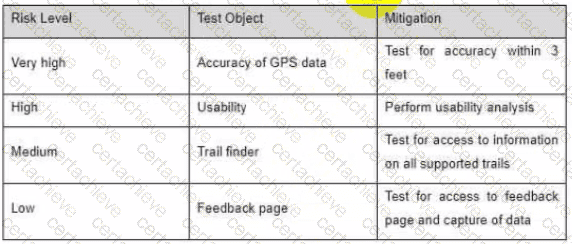
Your team has clone the depth and breadth testing for the GPS accuracy and usability features but when the product was given to beta testers there were some issues Despite the users reporting the app was easy to use at least one user walked off the edge of a cliff and another one ended up in a river. Your team has confirmed that the functionality is working correctly. and the GPS information is accurate.
What other area of testing should you now prioritize?
Correct Answer & Rationale:
Answer: A
Explanation:
Analysis of the Situation :
The GPS accuracy and functionality have been confirmed to work correctly as per depth and breadth testing.
Despite this, users experienced severe issues such as walking off a cliff or into a river. These incidents point to usability problems related to user interpretation of the GPS data and system feedback.
Testing Prioritization :
Usability testing evaluates how effectively and safely users interact with the application. Here, it should focus on improving user guidance, error prevention, and alerts.
Functionality and Performance are not the problem since they passed testing.
Security is unrelated to the specific reported issues.
References and Syllabus Alignment :
This aligns with usability-focused risk mitigation strategies in the ISTQB Advanced Test Management syllabus under "Test Process" and "Test Techniques" (TM-1.3.4).
Question 2
ISTQB CTAL-TM
QUESTION DESCRIPTION:
Which of the Mowing should be used to understand the context of testing within an organization?
Correct Answer & Rationale:
Answer: A
Explanation:
Context Analysis:
The test strategy defines th Context Analysis:
Monitoring code coverage is inherently tied to knowledge of the internal structure of the software, a characteristic of white-box testing.
Evaluation of Options:
A. Black-box:
Incorrect. Black-box testing focuses on functionality without knowledge of internal structures.
B. White-box:
Correct. White-box testing uses internal code knowledge to determine areas that need more coverage.
C. Functional:
Incorrect. Functional testing assesses functionality without inspecting internal code.
D. Non-functional:
Incorrect. Non-functional testing focuses on performance, usability, etc., not code coverage.
Syllabus Alignment:
ISTQB associates code coverage monitoring with white-box testing techniques (TM-1.2.6).
[References:, ISTQB Advanced Level Test Management Syllabus (TM-1.2.6), approach, resources, and processes for testing within an organization.It provides insight into the testing context., Evaluation of Options:, A. The organizational test strategy:, Correct. It offers a comprehensive understanding of the organization's testing framework., B. Stakeholder organization chart:, Incorrect. Useful for identifying roles but does not provide a testing context., C. The schedule:, Incorrect. Reflects timelines but not testing approaches or resources., D. The budget:, Incorrect. Indicates financial constraints but not the testing context., Syllabus Alignment:, ISTQB emphasizes using the organizational test strategy to understand the testing context (TM-1.4.1)., References:, ISTQB Advanced Level Test Management Syllabus (TM-1.4.1), , ]
Question 3
ISTQB CTAL-TM
QUESTION DESCRIPTION:
You have assembled the following cost of quality numbers 1 000 defects were found prior to release and 100 were found after.
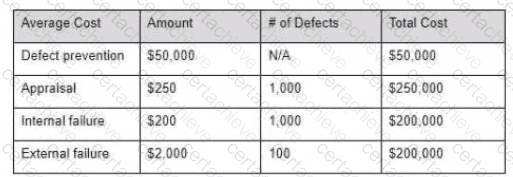
Given this information what should you conclude?
Correct Answer & Rationale:
Answer: B
Explanation:
Cost of Quality Analysis :
The given table lists costs for defect prevention, appraisal, internal failure, and external failure.
Defect prevention cost is $50,000, while costs for appraisal, internal failures, and external failures are $250,000, $200,000, and $200,000, respectively.
The combined cost of internal and external failures is significantly high compared to defect prevention costs.
Defect Detection and Prevention (DDP) :
DDP measures the effectiveness of defect prevention activities and early detection mechanisms.
In this case, 1,000 defects were caught before release (appraisal) and 100 defects escaped to production.
DDP = (Defects found before release / Total defects) = 1000 / (1000 + 100) = 90.91%.
While this DDP is relatively high, the costs of appraisal and failures indicate that prevention strategies need more investment.
Key Cost Drivers :
High internal and external failure costs indicate inefficiencies in earlier stages of quality assurance.
Shifting investments from appraisal and failure costs towards defect prevention would reduce the overall cost of quality.
Evaluating Options :
Option A ("More testing needed because DDP < 90%") is invalid since DDP is above 90%.
Option C ("The cost of testing is justified") does not address the imbalance between high failure costs and low prevention spending.
Option D ("More effort on appraisal") contradicts the cost-benefit focus of investing in prevention.
Option B is correct because enhancing defect prevention strategies will reduce downstream costs.
References and Syllabus Alignment :
This conclusion aligns with the ISTQB Advanced Test Management syllabus section on "Cost of Quality" and strategies to optimize testing investments. Specifically, prevention is emphasized as more cost-effective than appraisal and failure management.
Question 4
ISTQB CTAL-TM
QUESTION DESCRIPTION:
You are working for an outsource testing company You have a client that will only consider candidates that are highly skilled with Salesforce. regardless of the number of years they have spent testing similar products You have looked through your skills matrix and you have no one with the right type of experience for this project.
What competence area is your team lacking?
Correct Answer & Rationale:
Answer: D
Explanation:
Competence Analysis :
Professional competence refers to the knowledge and skills related to the specific domain, in this case, Salesforce.
The client's requirement emphasizes expertise in Salesforce, which your team lacks.
Evaluation of Options :
A (Social competence) and B (Personal competence) focus on interpersonal skills and attitude, not domain knowledge.
C (Methodical competence) involves creating test cases, which is unrelated to the issue described.
D is correct as the team lacks the required Salesforce-specific professional competence.
References and Syllabus Alignment :
Professional competence is highlighted under "Test Team Competencies" (TM-3.1.1).
Question 5
ISTQB CTAL-TM
QUESTION DESCRIPTION:
You are a new lest manager in an organization You have been asked to assess the defect process to determine if there are any efficiency improvements that could be made that would reduce the cost of quality You have started digging through the defect Information What information would be most helpful for this investigation?
Correct Answer & Rationale:
Answer: D
Explanation:
Key Data for Defect Process Improvement :
Analyzing when defects are introduced versus when they are detected is critical to identifying process inefficiencies.
This information helps pinpoint gaps in earlier phases, allowing the team to implement preventive measures and reduce overall costs.
Evaluation of Options :
A and B are useful but do not address the root cause of inefficiencies.
C (Risk areas and severity relationship) is helpful but secondary to understanding phase discrepancies.
D is correct as it provides the most actionable insights for process improvement.
References and Syllabus Alignment :
Defect lifecycle analysis is discussed under "Defect Management" (TM-2.3.1) in the ISTQB syllabus.
Question 6
ISTQB CTAL-TM
QUESTION DESCRIPTION:
Which of the Mowing Is commonly used by a test manager to identity risks'
Correct Answer & Rationale:
Answer: C
Explanation:
Common Risk Identification Techniques :
A test manager often relies on experience with similar projects to foresee risks related to technical complexity, domain challenges, or previous defects.
Other options listed are less effective for comprehensive risk identification.
Evaluation of Options :
A (Lines of code) and B (Function points) are quantitative measures, not directly tied to risk identification.
C is correct as past experience is crucial for identifying risks early.
D (Record/playback tools) is irrelevant to risk analysis.
References and Syllabus Alignment :
Risk identification techniques are discussed under "Risk Management" (TM-1.3.1).
Question 7
ISTQB CTAL-TM
QUESTION DESCRIPTION:
At what testing level do the test management activities Include coordinating with end users7
Correct Answer & Rationale:
Answer: D
Explanation:
End User Involvement in Testing Levels :
Acceptance testing involves validating the product with the end users to ensure it meets their needs and requirements.
It typically requires close coordination with end users for User Acceptance Testing (UAT).
Evaluation of Options :
A (Component testing) and B (Component Integration testing) do not involve end users, as these are technical-level testing activities.
C (System testing) focuses on the integrated system but does not require end-user participation.
D is correct because acceptance testing involves direct collaboration with end users.
References and Syllabus Alignment :
Covered under "Test Levels and Objectives" in the ISTQB syllabus (TM-1.2.5).
Question 8
ISTQB CTAL-TM
QUESTION DESCRIPTION:
Your team has decided that they will build their own test management tool This will allow them to link the requirements and test cases together providing full traceability It will also allow them to create fully customized reporting and color-coded dashboards They have estimated the time required to create the new tool and the cost These fit within the project schedule and budget
What other consideration should be taken before this decision is made?
Correct Answer & Rationale:
Answer: B
Explanation:
Context Analysis:
Building a custom tool may address traceability and customization needs, but ongoing costs such as maintenance are critical for sustainable implementation.
Evaluation of Options:
A. Relative benefits to your vendors:
Incorrect. Vendor benefits are not directly relevant if the decision is to build an internal tool.
B. Maintenance costs:
Correct. Maintenance includes long-term support, updates, and potential scalability, essential considerations for internally developed tools.
C. Licensing fees to other parts of the organization:
Incorrect. The question assumes the tool is internally built, so external licensing fees do not apply.
D. Reduction of manual repetitive testing:
Incorrect. While desirable, this is an indirect benefit and not the primary focus of decision-making in tool development.
Syllabus Alignment: ISTQB syllabus emphasizes the need to evaluate long-term costs (e.g., maintenance) when adopting or developing tools (TM-1.6.2).
[References:, ISTQB Advanced Level Test Management Syllabus, ]
Question 9
ISTQB CTAL-TM
QUESTION DESCRIPTION:
One of your team members is struggling to identify the requirements to be tested for a project The requirements documents are not conventional but you have determined that the data is there. If they do some digging to find it Given this information in what competence area does this person need to improve?
Correct Answer & Rationale:
Answer: B
Explanation:
Competence in Handling Non-Standard Requirements :
Methodical competence refers to the ability to systematically analyze and interpret information, even when it is unconventional or unstructured.
The tester needs to refine their skills in identifying and deriving testable requirements from the available data.
Evaluation of Options :
A (Professional competence) refers to domain knowledge but does not address the specific challenge.
B is correct as it pertains to systematically working through unconventional requirements.
C (Social competence) and D (Personal competence) do not address the analytical challenge.
References and Syllabus Alignment :
Methodical competence is emphasized under "Test Management Skills" in the ISTQB syllabus (TM-3.1.1).
Question 10
ISTQB CTAL-TM
QUESTION DESCRIPTION:
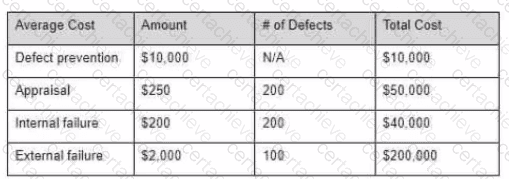
You have assembled the following cost of quality numbers 200 defects were found prior to release and 100 were found after.
Given this information what is the total cost of quality for this project?
Correct Answer & Rationale:
Answer: A
Explanation:
Step by Step Comprehensive Detailed Explanation:
Definition of Cost of Quality (CoQ): CoQ is composed of four components:
Prevention Costs: Costs related to activities to prevent defects (e.g., training, quality planning).
Appraisal Costs: Costs associated with evaluating products to ensure defect-free delivery (e.g., testing).
Internal Failure Costs: Costs due to defects found before delivery to the customer (e.g., rework).
External Failure Costs: Costs from defects discovered after delivery (e.g., warranty claims, reputation damage).
Calculation Process:
Defect Prevention Cost: Given as $10,000 (fixed).
Appraisal Cost: $250 per defect for 200 defects = 250×200=50,000250 \times 200 = 50,000250×200=50,000.
Internal Failure Cost: $200 per defect for 200 defects = 200×200=40,000200 \times 200 = 40,000200×200=40,000.
External Failure Cost: $2,000 per defect for 100 defects = 2,000×100=200,0002,000 \times 100 = 200,0002,000×100=200,000.
Total CoQ: Adding all costs together:
Total CoQ=10,000+50,000+40,000+200,000=300,000.\text{Total CoQ} = 10,000 + 50,000 + 40,000 + 200,000 = 300,000.Total CoQ=10,000+50,000+40,000+200,000=300,000.
Correct Answer and Justification: The total cost is $300,000 , making Option A the correct answer.
References and Documentation from Advanced Test Management:
ISTQB Advanced Test Management Syllabus v3.0, Section 2.2.2: This section emphasizes understanding and calculating the cost of quality by segregating it into the four components as seen above.
ATM Sample Exam Questions 2024 (Example Calculations): Highlights similar numerical examples to calculate CoQ.
ISTQB Exam Structure Rules v1.9: Ensures alignment with K2-level understanding for cost analysis scenarios in test management.

Verified by Certified Instructors
This ISTQB CTAL-TM study pack was audited and verified on September 23, 2026 by Martin Carlisle,. We ensure every technical rationale aligns with real-world enterprise standards.
A Stepping Stone for Enhanced Career Opportunities
Your profile having Test Manager Advanced certification significantly enhances your credibility and marketability in all corners of the world. The best part is that your formal recognition pays you in terms of tangible career advancement. It helps you perform your desired job roles accompanied by a substantial increase in your regular income. Beyond the resume, your expertise imparts you confidence to act as a dependable professional to solve real-world business challenges.
Your success in ISTQB CTAL-TM certification exam makes your visible and relevant in the fast-evolving tech landscape. It proves a lifelong investment in your career that give you not only a competitive advantage over your non-certified peers but also makes you eligible for a further relevant exams in your domain.
What You Need to Ace ISTQB Exam CTAL-TM
Achieving success in the CTAL-TM ISTQB exam requires a blending of clear understanding of all the exam topics, practical skills, and practice of the actual format. There's no room for cramming information, memorizing facts or dependence on a few significant exam topics. It means your readiness for exam needs you develop a comprehensive grasp on the syllabus that includes theoretical as well as practical command.
Here is a comprehensive strategy layout to secure peak performance in CTAL-TM certification exam:
- Develop a rock-solid theoretical clarity of the exam topics
- Begin with easier and more familiar topics of the exam syllabus
- Make sure your command on the fundamental concepts
- Focus your attention to understand why that matters
- Ensure hands-on practice as the exam tests your ability to apply knowledge
- Develop a study routine managing time because it can be a major time-sink if you are slow
- Find out a comprehensive and streamlined study resource for your help
Ensuring Outstanding Results in Exam CTAL-TM!
In the backdrop of the above prep strategy for CTAL-TM ISTQB exam, your primary need is to find out a comprehensive study resource. It could otherwise be a daunting task to achieve exam success. The most important factor that must be kep in mind is make sure your reliance on a one particular resource instead of depending on multiple sources. It should be an all-inclusive resource that ensures conceptual explanations, hands-on practical exercises, and realistic assessment tools.
Certachieve: A Reliable All-inclusive Study Resource
Certachieve offers multiple study tools to do thorough and rewarding CTAL-TM exam prep. Here's an overview of Certachieve's toolkit:
ISTQB CTAL-TM PDF Study Guide
This premium guide contains a number of ISTQB CTAL-TM exam questions and answers that give you a full coverage of the exam syllabus in easy language. The information provided efficiently guides the candidate's focus to the most critical topics. The supportive explanations and examples build both the knowledge and the practical confidence of the exam candidates required to confidently pass the exam. The demo of ISTQB CTAL-TM study guide pdf free download is also available to examine the contents and quality of the study material.
ISTQB CTAL-TM Practice Exams
Practicing the exam CTAL-TM questions is one of the essential requirements of your exam preparation. To help you with this important task, Certachieve introduces ISTQB CTAL-TM Testing Engine to simulate multiple real exam-like tests. They are of enormous value for developing your grasp and understanding your strengths and weaknesses in exam preparation and make up deficiencies in time.
These comprehensive materials are engineered to streamline your preparation process, providing a direct and efficient path to mastering the exam's requirements.
ISTQB CTAL-TM exam dumps
These realistic dumps include the most significant questions that may be the part of your upcoming exam. Learning CTAL-TM exam dumps can increase not only your chances of success but can also award you an outstanding score.
Top Exams & Certification Providers
New & Trending
- New Released Exams
- Related Exam
- Hot Vendor