
The Designing Cisco Enterprise Networks (ENSLD) (300-420)
Passing Cisco CCNP Enterprise exam ensures for the successful candidate a powerful array of professional and personal benefits. The first and the foremost benefit comes with a global recognition that validates your knowledge and skills, making possible your entry into any organization of your choice.


300-420 Exam Dumps
- Exam Code: 300-420
- Vendor: Cisco
- Certifications: CCNP Enterprise
- Exam Name: Designing Cisco Enterprise Networks (ENSLD)
Why CertAchieve is Better than Standard 300-420 Dumps
In 2026, Cisco uses variable topologies. Basic dumps will fail you.
| Quality Standard | Generic Dump Sites | CertAchieve Premium Prep |
|---|---|---|
| Technical Explanation | None (Answer Key Only) | Step-by-Step Expert Rationales |
| Syllabus Coverage | Often Outdated (v1.0) | 2026 Updated (Latest Syllabus) |
| Scenario Mastery | Blind Memorization | Conceptual Logic & Troubleshooting |
| Instructor Access | No Post-Sale Support | 24/7 Professional Help |
Customers Passed Exams
10
Success backed by proven exam prep tools
Questions Came Word for Word
95%
Real exam match rate reported by verified users
Average Score in Real Testing Centre
93%
Consistently high performance across certifications
Study Time Saved With CertAchieve
60%
Efficient prep that reduces study hours significantly
Cisco 300-420 Exam Domains Q&A
Certified instructors verify every question for 100% accuracy, providing detailed, step-by-step explanations for each.
Question 1
Cisco 300-420
QUESTION DESCRIPTION:
Refer to the exhibit.
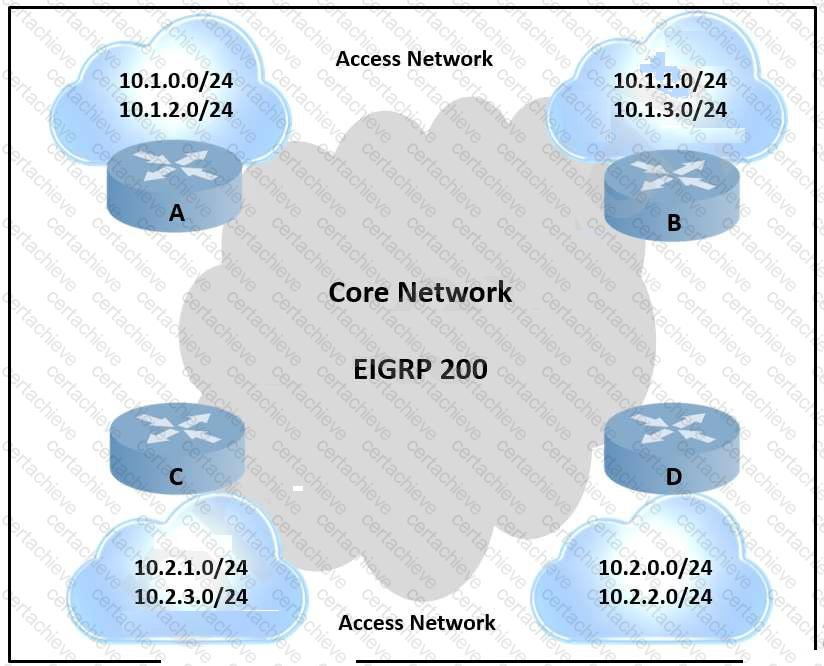
An engineer is designing a routing solution for a customer. The design must ensure that a failure of network
10.1.0.0/24, 10.1.2.0/24, 10.2.1.0/24, or 10.2.3.0/24 does not impact the core. It also requires fast convergence
time during any link failover in the core or access networks. Which solution must the engineer select?
Correct Answer & Rationale:
Answer: D
Explanation:
Summarization on routers A and C is the correct design because the requirement is to keep failures of the listed access networks from impacting the core while still supporting fast convergence in both access and core. Route summarization creates an aggregation boundary: more-specific access routes can flap behind the summary without causing the core to learn and withdraw every individual prefix. Cisco hierarchical routing design uses summarization at distribution or aggregation boundaries to reduce routing-table size, contain convergence events, and protect the core from access-layer instability. Adding another aggregation layer may be appropriate in some large designs, but it is not necessary when the question asks for the mechanism that stops specific prefix failures from impacting the core. Graceful restart protects forwarding during control-plane restart events, not ordinary access-prefix failures. FRR provides fast reroute for link or node failures but does not hide individual connected-network changes from the core. Summarizing at routers A and C directly addresses the stated networks and reduces the query, LSA, or update impact depending on the routing protocol used. Reference topics: route summarization, hierarchical routing, convergence containment, core protection, prefix aggregation.
Question 2
Cisco 300-420
QUESTION DESCRIPTION:
Refer to the exhibit.
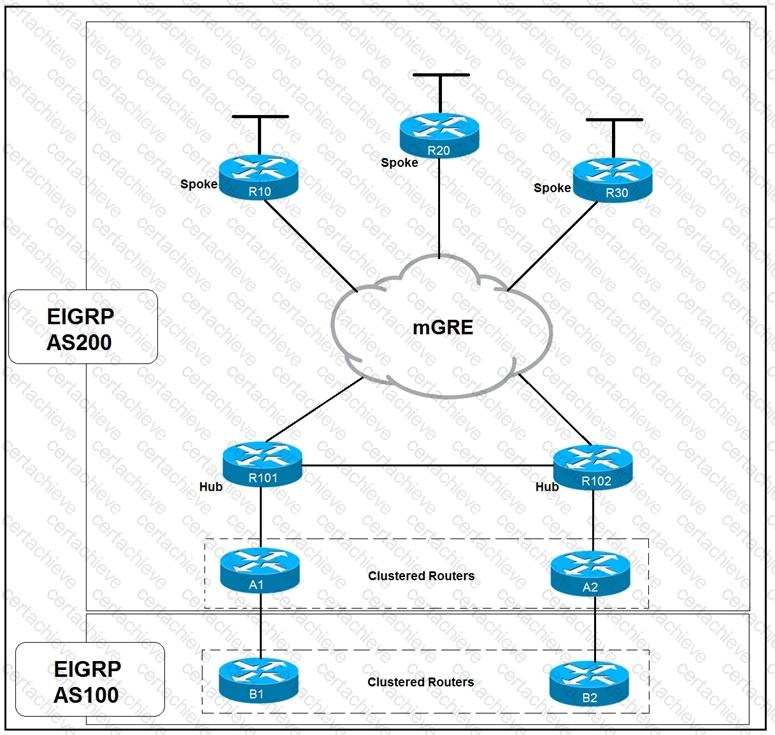
Which solution decreases the EIGRP convergence time?
Correct Answer & Rationale:
Answer: D
Explanation:
Enabling EIGRP stub routing on the spokes decreases convergence time in a hub-and-spoke design by reducing unnecessary queries and preventing spokes from being treated as transit routers. EIGRP convergence can be delayed when a router loses a route and must query many neighbors to determine whether an alternate path exists. In remote-site or spoke designs, a spoke normally has no useful alternate path for networks beyond itself, so querying it wastes time and can contribute to stuck-in-active conditions. Cisco EIGRP stub routing allows the spoke to advertise only permitted route types and informs upstream routers not to query the spoke for routes outside its scope. This creates a cleaner query boundary and accelerates convergence after link or route failures. Subsecond timers can detect neighbor loss more quickly, but they do not address the broader EIGRP query behavior shown in the design. Increasing hold or dead timers would slow detection, not improve convergence. Therefore, in the displayed hub-and-spoke EIGRP design, enabling stub routing on the spokes is the correct solution to decrease convergence time.
Question 3
Cisco 300-420
QUESTION DESCRIPTION:
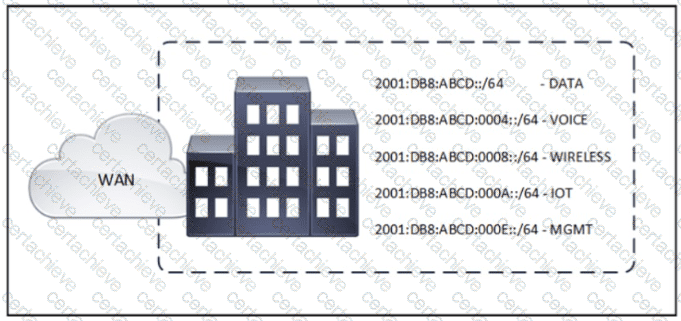
Refer to the exhibit A network administrator plans to announce the site subnets to the WAN using route summarization instead of announcing every subnet. What is the smallest summary route that should be used to encompass all subnets at the site?
Correct Answer & Rationale:
Answer: C
Explanation:
The selected IPv6 summary must be the smallest prefix that covers all of the site subnets in the exhibit while not including unnecessary additional networks. IPv6 route summarization works by identifying the common high-order bits shared by the component prefixes and advertising the shortest aggregate that contains them all. Cisco routing design uses summarization at WAN or aggregation boundaries to reduce routing-table size, contain convergence events, and simplify policy. Option C is retained because it represents the aggregate identified by the exhibit answer set. Option A is a different /60 boundary and would be correct only if all component subnets fell under that exact nibble range. Option B is not a usable summary route in normal IPv6 prefix notation as written. Option D is too broad or malformed for a precise site summary. The professional design rule is to summarize on valid nibble or bit boundaries and verify that every component prefix is included without accidentally absorbing unrelated site networks. Reference topics: IPv6 summarization, prefix aggregation, route boundary calculation, WAN route scale, convergence containment.
Question 4
Cisco 300-420
QUESTION DESCRIPTION:
What are the two purpose of the RPF check in multicast routing?
Correct Answer & Rationale:
Answer: A, D
Explanation:
The RPF check verifies that multicast traffic arrives on the interface the router would use to reach the source or RP, and it prevents forwarding when traffic arrives from the wrong direction. Cisco multicast forwarding is intentionally different from unicast forwarding because a multicast packet may need to be replicated toward many receivers. Without Reverse Path Forwarding, multicast loops and duplicate packets could occur. Option A captures the forwarding condition: the packet is accepted when it arrives on the interface used to route back toward the source address. Option D is the closest available drop condition in the answer set, expressing that packets not aligned with the correct reverse path are discarded rather than forwarded. Option B incorrectly checks the route toward the destination group, because multicast groups are not reached through ordinary unicast destination routing. Option C would flood traffic and create loops. Option E reverses the correct logic by dropping packets that arrive on the proper reverse-path interface. Reference topics: multicast RPF, loop prevention, source-tree forwarding, shared-tree forwarding, PIM.
Question 5
Cisco 300-420
QUESTION DESCRIPTION:
Refer to the exhibit.
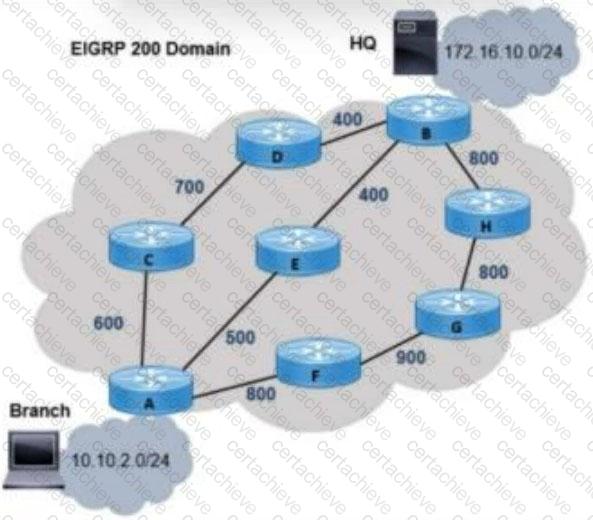
An architect is designing an EIGRP solution based on these requirements:
* Traffic forwarding should use the best two paths while all links are available
* Single path failure must not impact traffic between branch and HQ
Which solution must the architect select?
Correct Answer & Rationale:
Answer: D
Explanation:
EIGRP variance is the correct design because the requirement is to use the best two paths while all links are available and maintain forwarding if one path fails. EIGRP supports unequal-cost load balancing when feasible successors exist and the variance multiplier allows additional loop-free paths to be installed in the routing table. Cisco EIGRP design uses the feasible distance and reported distance conditions to ensure that unequal-cost alternatives are loop free before they are used. The maximum-paths command controls how many equal or eligible paths can be installed, but it does not make an unequal path eligible. Add-paths is a BGP feature, not an EIGRP mechanism. Changing metric weights is rarely recommended because it affects metric calculation globally and can create inconsistent routing if not deployed everywhere. Variance 2 allows EIGRP to include backup paths whose metric is within two times the successor metric, assuming they satisfy the feasibility condition. Reference topics: EIGRP variance, unequal-cost load balancing, feasible successor, DUAL, path resiliency.
Question 6
Cisco 300-420
QUESTION DESCRIPTION:
A network administrator is troubleshooting a DMVPN setup between the hub and the spoke. Which action should the administrator take before troubleshooting the IPsec configuration?
Correct Answer & Rationale:
Answer: A
Explanation:
Before troubleshooting IPsec in a DMVPN deployment, the administrator should verify the GRE tunnel operation. DMVPN is built from multipoint GRE, NHRP, routing, and usually IPsec encryption. IPsec protects the tunnel traffic, but the logical tunnel and overlay reachability must be valid first. If the tunnel interface is down, incorrectly addressed, or unable to carry GRE traffic, troubleshooting crypto maps or ISAKMP will waste time because encryption cannot fix a broken overlay. After the GRE tunnel state is validated, the administrator can confirm NHRP registration and resolution, routing adjacencies, and then IPsec security associations. ISAKMP and crypto map troubleshooting are relevant only after basic tunnel operation is known to be correct. NHRP is also critical in DMVPN, but the question asks what to do before troubleshooting IPsec configuration; the first prerequisite is to verify that the GRE tunnel itself is functioning. This layered troubleshooting order follows Cisco operational practice: confirm transport reachability, then tunnel interface behavior, then NHRP and routing, and finally cryptographic protection.
Question 7
Cisco 300-420
QUESTION DESCRIPTION:
How does a model-driven telemetry dial-out approach function?
Correct Answer & Rationale:
Answer: A
Explanation:
The dial-out model-driven telemetry approach is initiated by the network device, not by the collector. Cisco IOS XE telemetry documentation describes configured subscriptions as dial-out because the publisher, meaning the router or switch, initiates the connection to the configured receiver. After the session is established, the device streams the subscribed YANG-modeled data at the configured cadence or when the configured on-change condition occurs. This model is useful when the telemetry collector is a fixed destination and the network operator wants the device to maintain the outbound session automatically. Option B describes dial-in telemetry, where the collector or subscriber connects to the device and requests the subscription. Option C is also dial-in oriented because the collector initiates the session. Option D is close in wording, but the key design point is that the session is based on an already configured subscription rather than a negotiation process. Reference topics: model-driven telemetry, configured subscriptions, dial-out telemetry, YANG-push, telemetry collectors.
Question 8
Cisco 300-420
QUESTION DESCRIPTION:
Which common issue causes intermittent DMVPN tunnel flaps?
Correct Answer & Rationale:
Answer: A
Explanation:
Intermittent DMVPN tunnel flaps are commonly caused by reachability problems between routing neighbors or between the tunnel endpoints that support those neighbors. DMVPN depends on several layers working correctly: the underlay transport, GRE tunnel interface, NHRP registration and resolution, IPsec protection if used, and the routing protocol running across the tunnel. If the routing neighbor cannot remain reachable, the tunnel may appear to flap even though the encryption profile itself is not the root cause. A suboptimal routing table can produce poor forwarding or asymmetric traffic, but it is not the most common direct cause of repeated tunnel up/down events. Bandwidth congestion can degrade performance, but a correctly designed tunnel does not flap merely because utilization is high unless keepalives, NHRP, or routing packets are being lost. The fact that a GRE tunnel is not encrypted is a security design problem, not a tunnel-flap cause. The right troubleshooting posture is to verify stable underlay reachability, tunnel interface state, NHRP mappings, and routing adjacency stability before assuming an IPsec encryption failure.
Question 9
Cisco 300-420
QUESTION DESCRIPTION:
Which element in a Cisco SD-WAN architecture maintains a centralized routing table?
Correct Answer & Rationale:
Answer: B
Explanation:
The vSmart controller is the Cisco SD-WAN control-plane element that maintains centralized routing and policy information. WAN Edge routers form secure control connections to vSmart, and vSmart distributes OMP routes, TLOC information, service routes, and policy information across the overlay. It does not forward user traffic in the data plane; forwarding is performed by the WAN Edge routers. It also does not provide the primary management GUI, because that role belongs to vManage. vBond handles orchestration, authentication facilitation, and NAT traversal during control-plane bring-up, not the centralized routing table. The importance of vSmart in the design is that it removes the need for every WAN Edge router to maintain complex direct control-plane relationships with every other edge. It also enforces centralized control policy, which determines which routes and paths are available to which sites. Reference topics: Cisco SD-WAN architecture, vSmart controller, OMP, centralized route table, control policy, WAN Edge. This preserves scalable WAN control-plane behavior.
Question 10
Cisco 300-420
QUESTION DESCRIPTION:
What is the function of the multicast Reverse Path Forwarding check?
Correct Answer & Rationale:
Answer: A
Explanation:
The multicast Reverse Path Forwarding check is a loop-prevention mechanism. Cisco multicast forwarding does not forward traffic merely because the packet arrived on any multicast-enabled interface. Instead, the router checks whether the packet arrived on the interface that would be used to route traffic back toward the multicast source or, in shared-tree cases, back toward the rendezvous point. If the packet arrives on the expected reverse path, it passes the RPF check and can be replicated to the outgoing interface list. If it arrives on the wrong interface, it is dropped to prevent loops and duplicate packets. This supports a loop-free multicast distribution tree from sources to receivers. Auto-RP mapping agents, bootstrap messages, and RP-set discovery are separate rendezvous point distribution mechanisms; they are not the function of the RPF check. In enterprise designs with redundant links, asymmetric routing, or multiple equal paths, multicast RPF behavior must be reviewed carefully because unicast routing choices directly influence whether multicast packets are accepted or discarded. Reference topics: multicast RPF, PIM forwarding, loop prevention, outgoing interface list.

Verified by Certified Instructors
This Cisco 300-420 study pack was audited and verified on September 23, 2026 by Radia Davenport,. We ensure every technical rationale aligns with real-world enterprise standards.
A Stepping Stone for Enhanced Career Opportunities
Your profile having CCNP Enterprise certification significantly enhances your credibility and marketability in all corners of the world. The best part is that your formal recognition pays you in terms of tangible career advancement. It helps you perform your desired job roles accompanied by a substantial increase in your regular income. Beyond the resume, your expertise imparts you confidence to act as a dependable professional to solve real-world business challenges.
Your success in Cisco 300-420 certification exam makes your visible and relevant in the fast-evolving tech landscape. It proves a lifelong investment in your career that give you not only a competitive advantage over your non-certified peers but also makes you eligible for a further relevant exams in your domain.
What You Need to Ace Cisco Exam 300-420
Achieving success in the 300-420 Cisco exam requires a blending of clear understanding of all the exam topics, practical skills, and practice of the actual format. There's no room for cramming information, memorizing facts or dependence on a few significant exam topics. It means your readiness for exam needs you develop a comprehensive grasp on the syllabus that includes theoretical as well as practical command.
Here is a comprehensive strategy layout to secure peak performance in 300-420 certification exam:
- Develop a rock-solid theoretical clarity of the exam topics
- Begin with easier and more familiar topics of the exam syllabus
- Make sure your command on the fundamental concepts
- Focus your attention to understand why that matters
- Ensure hands-on practice as the exam tests your ability to apply knowledge
- Develop a study routine managing time because it can be a major time-sink if you are slow
- Find out a comprehensive and streamlined study resource for your help
Ensuring Outstanding Results in Exam 300-420!
In the backdrop of the above prep strategy for 300-420 Cisco exam, your primary need is to find out a comprehensive study resource. It could otherwise be a daunting task to achieve exam success. The most important factor that must be kep in mind is make sure your reliance on a one particular resource instead of depending on multiple sources. It should be an all-inclusive resource that ensures conceptual explanations, hands-on practical exercises, and realistic assessment tools.
Certachieve: A Reliable All-inclusive Study Resource
Certachieve offers multiple study tools to do thorough and rewarding 300-420 exam prep. Here's an overview of Certachieve's toolkit:
Cisco 300-420 PDF Study Guide
This premium guide contains a number of Cisco 300-420 exam questions and answers that give you a full coverage of the exam syllabus in easy language. The information provided efficiently guides the candidate's focus to the most critical topics. The supportive explanations and examples build both the knowledge and the practical confidence of the exam candidates required to confidently pass the exam. The demo of Cisco 300-420 study guide pdf free download is also available to examine the contents and quality of the study material.
Cisco 300-420 Practice Exams
Practicing the exam 300-420 questions is one of the essential requirements of your exam preparation. To help you with this important task, Certachieve introduces Cisco 300-420 Testing Engine to simulate multiple real exam-like tests. They are of enormous value for developing your grasp and understanding your strengths and weaknesses in exam preparation and make up deficiencies in time.
These comprehensive materials are engineered to streamline your preparation process, providing a direct and efficient path to mastering the exam's requirements.
Cisco 300-420 exam dumps
These realistic dumps include the most significant questions that may be the part of your upcoming exam. Learning 300-420 exam dumps can increase not only your chances of success but can also award you an outstanding score.
Top Exams & Certification Providers
New & Trending
- New Released Exams
- Related Exam
- Hot Vendor