
The Service Provider Professional (JNCIP-SP) (JN0-664)
Passing Juniper JNCIP-SP exam ensures for the successful candidate a powerful array of professional and personal benefits. The first and the foremost benefit comes with a global recognition that validates your knowledge and skills, making possible your entry into any organization of your choice.


JN0-664 Exam Dumps
- Exam Code: JN0-664
- Vendor: Juniper
- Certifications: JNCIP-SP
- Exam Name: Service Provider Professional (JNCIP-SP)
Why CertAchieve is Better than Standard JN0-664 Dumps
In 2026, Juniper uses variable topologies. Basic dumps will fail you.
| Quality Standard | Generic Dump Sites | CertAchieve Premium Prep |
|---|---|---|
| Technical Explanation | None (Answer Key Only) | Step-by-Step Expert Rationales |
| Syllabus Coverage | Often Outdated (v1.0) | 2026 Updated (Latest Syllabus) |
| Scenario Mastery | Blind Memorization | Conceptual Logic & Troubleshooting |
| Instructor Access | No Post-Sale Support | 24/7 Professional Help |
Customers Passed Exams
10
Success backed by proven exam prep tools
Questions Came Word for Word
85%
Real exam match rate reported by verified users
Average Score in Real Testing Centre
90%
Consistently high performance across certifications
Study Time Saved With CertAchieve
60%
Efficient prep that reduces study hours significantly
Coverage of Official Juniper JN0-664 Exam Domains
Our curriculum is meticulously mapped to the Juniper official blueprint.
Advanced OSPF & IS-IS Routing
The "Core" foundation. Master the deep mechanics of link-state protocols. Focus on OSPFv2/v3 multi-area hierarchies, LSA type filtering, and stub area types. For IS-IS, master levels (L1/L2), metrics, and TLVs. In 2026, this domain emphasizes fast-reroute (FRR) mechanisms and protocol extensions for Segment Routing (SR).
BGP Path Selection & Scaling
The "Internet" engine. Master the professional-level configuration of BGP. Focus on route reflection, confederations, and sophisticated path selection using attributes (Local Preference, AS-Path, MED, Communities). Learn to manage massive routing tables using prefix lists and route-filters to ensure carrier-grade stability and security.
MPLS, LDP & RSVP-TE
The "Traffic Engineering" core. Master the deployment of MPLS signaling protocols. Focus on the differences between LDP and RSVP. Learn to engineer paths using CSPF (Constrained Shortest Path First), manage label-switched paths (LSPs), and implement link/node protection to maintain zero-packet-loss environments during core failures.
Layer 3 VPNs
The "Multi-Tenant" layer. Master the architectural design of MP-BGP L3VPNs. Focus on VRFs, Route Distinguishers (RDs), and Route Targets (RTs). Learn to implement complex topologies, including Hub-and-Spoke and Inter-AS (Option A, B, and C) VPNs, ensuring secure and isolated traffic flow across a shared provider backbone.
Layer 2 VPNs & EVPN
The "Modernized" edge. This is a critical focus for 2026. Master the transition from legacy VPLS and L2Circuits to EVPN-MPLS. Focus on EVPN route types, multi-homing (All-Active vs. Single-Active), and Integrated Routing and Bridging (IRB). Understand how EVPN provides the control plane needed for modern, distributed data center interconnects (DCI)
IP Multicast & Class of Service
The "Optimization" domain. Master the delivery of high-bandwidth content via PIM-SM and SSM. Focus on Rendezvous Point (RP) placement and IGMP snooping. Additionally, master Class of Service (CoS), including BA/Multi-field classifiers, rewrite rules, and scheduling (WRR/Strict High) to prioritize latency-sensitive traffic like Voice and Video.
Juniper JN0-664 Exam Domains Q&A
Certified instructors verify every question for 100% accuracy, providing detailed, step-by-step explanations for each.
Question 1
Juniper JN0-664
QUESTION DESCRIPTION:
Exhibit
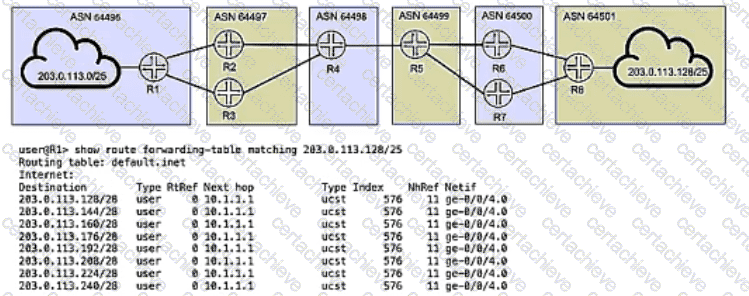
You are troubleshooting the connection between AS 64496 and AS 64497 and notice that only one of the paths is being used for traffic forwarding.
Referring to the exhibit, which three actions will ensure that R1 is configured properly for load balancing BGP routes? (Choose three.)
Correct Answer & Rationale:
Answer: A, C, D
Explanation:
https://www.juniper.net/documentation/us/en/software/junos/bgp/topics/topic-map/load-balancing-bgp-session.html
Question 2
Juniper JN0-664
QUESTION DESCRIPTION:
Your organization manages a Layer 3 VPN for multiple customers To support advanced route than one BGP community on advertised VPN routes to remote PE routers.
Which routing-instance configuration parameter would support this requirement?
Correct Answer & Rationale:
Answer: A
Explanation:
The vrf-target statement is used in routing-instances to define route-target communities for VPN route import and export policies .
vrf-target export → Controls which route targets (RTs) are added to advertised routes (used when sending routes to remote PEs).
vrf-target import → Controls which VPN routes are accepted into the VRF (used when receiving routes from remote PEs).
Question 3
Juniper JN0-664
QUESTION DESCRIPTION:
In IS-IS, which two statements are correct about the designated intermediate system (DIS) on a multi-access network segment? (Choose two)
Correct Answer & Rationale:
Answer: A, C
Explanation:
Option A (Correct):
In IS-IS, the Designated Intermediate System (DIS) is elected based on the highest configured priority (as defined in Junos OS).
If priorities are equal, the router with the highest MAC address becomes the DIS.
A priority value of 10 will always override a lower priority (e.g., 1).
[Reference: Juniper IS-IS DIS Election., Option C (Correct):, On a multi-access network (e.g., Ethernet), all IS-IS routers form adjacencies with every other router on the segment., Unlike OSPF, IS-IS does not restrict adjacencies to only the DIS., The DIS is responsible for creating a pseudonode LSP to represent the broadcast network, but full mesh adjacencies are maintained., Reference: Juniper IS-IS Adjacency Formation., , Why Other Options Are Incorrect:, Option B: Incorrect. Higher priority always wins the DIS election. A priority of 1 cannot override a priority of 10., Option D: Incorrect. IS-IS routers form adjacencies with all neighbors, not just the DIS., , Key Takeaways:, DIS Election: Prioritizes highest numerical value (e.g., 10 > 1)., Adjacency Behavior: Full mesh adjacencies are maintained, unlike OSPF., DIS Role: Primarily for generating pseudonode LSPs and optimizing flooding, not adjacency restriction., For further details, refer to Juniper’s official IS-IS documentation:Juniper IS-IS Configuration Guide., , https://www.juniper.net/documentation/us/en/software/junos/is-is/topics/concept/routing-protocol-is-is-security-designated-router-understanding.html, ]
Question 4
Juniper JN0-664
QUESTION DESCRIPTION:
Exhibit
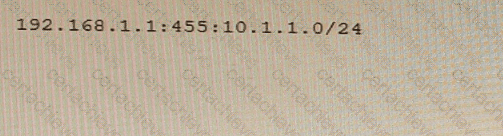
You are examining an L3VPN route that includes the information shown in the exhibit
Which statement is correct in this scenario?
Correct Answer & Rationale:
Answer: A
Explanation:
Type 1: When Type value is 1, the Administrator field is 4-bytes and Assigned Number field is 2-bytes. The Administrator field should be set to the IP address (public IP addresses should be used). The Assigned Number field contains a number from a numbering space that is administered by the enterprise to which the IP address has been assigned by the appropriate authority.
Question 5
Juniper JN0-664
QUESTION DESCRIPTION:
You are configuring anycast RP for load balancing and redundancy in your PIM-SM domain. You want to share active sources between RPs.
In this scenario, what are two solutions that will accomplish this task? (Choose two.)
Correct Answer & Rationale:
Answer: A, B
Explanation:
In a PIM Sparse Mode (PIM-SM) domain , Anycast RP is used for load balancing and redundancy by configuring multiple RPs with the same IP address. However, for active multicast sources to be shared between RPs , an additional mechanism is needed since PIM-SM does not automatically synchronize sources between RPs.
Evaluating the Answer Choices
Option A: " Configure MSDP on each RP router. " ✅
Multicast Source Discovery Protocol (MSDP) is required in an Anycast RP setup to share active source information between RPs.
MSDP allows RPs to exchange source-active (SA) messages , ensuring that multicast receivers in different regions can still receive traffic from sources registered with different RPs.
Juniper Documentation confirms that MSDP is used to synchronize active sources across multiple RPs in an Anycast RP deployment.
✅ This is a correct answer.
Option B: " Configure anycast PIM with the rp-set statement on each RP router. " ✅
Anycast PIM allows multiple RPs to share the same IP address, and the rp-set statement is used to define the set of Anycast RPs.
This enables receivers and sources to register with the closest RP .
However, Anycast PIM alone does not share active source information between RPs ; MSDP is still needed for that.
The combination of Anycast PIM (rp-set) and MSDP is the correct approach.
✅ This is a correct answer.
Question 6
Juniper JN0-664
QUESTION DESCRIPTION:
Which two statements describe PIM-SM? (Choose two)
Correct Answer & Rationale:
Answer: A, D
Explanation:
PIM sparse mode (PIM-SM) is a multicast routing protocol that uses a pull model to deliver multicast traffic. In PIM-SM, routers with receivers send join messages to their upstream neighbors toward a rendezvous point (RP) or a source-specific tree (SPT). The RP or SPT acts as the root of a shared distribution tree for a multicast group. Traffic is only forwarded to routers that request to join the distribution tree by sending join messages. PIM-SM does not flood traffic to all routers or prune routers without receivers, as PIM dense mode does.
Question 7
Juniper JN0-664
QUESTION DESCRIPTION:
Exhibit.
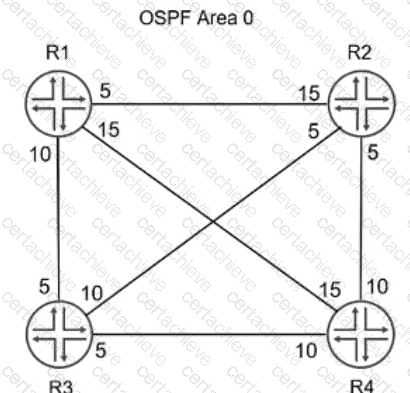
Referring to the exhibit, which path would traffic passing through R1 take to get to R4?
Correct Answer & Rationale:
Answer: C
Explanation:
The OSPF cost is carried in the LSAs that are exchanged within an OSPF area. When a router calculates the cost to a destination it uses the cost of the exit interface of each router in the path to the destination.
Question 8
Juniper JN0-664
QUESTION DESCRIPTION:
Your network is receiving the 203.0.113.0/24 network using EBGP from AS 64500 and AS 64501. Both of these advertisements have identical local-preference values, AS-path lengths, and BGP origin codes. You want to influence the way your AS sends traffic to the 203.0.113.0/24 network.
In this scenario, which attribute would you consider next when selecting the best path?
Correct Answer & Rationale:
Answer: B
Explanation:
To determine the correct answer, let ' s analyze the BGP path selection process and identify which attribute would be considered next in this scenario.
Background on BGP Path Selection
When multiple paths to the same destination are received via BGP, the router uses a step-by-step process to select the best path. The order of attributes considered is as follows (simplified for this scenario):
Highest Local Preference : The path with the highest local preference is preferred.
Shortest AS Path : The path with the shortest AS path length is preferred.
Lowest Origin Code : Paths with an origin code of IGP are preferred over EGP , and EGP is preferred over Incomplete .
Lowest MED (Multi-Exit Discriminator) : If the first three attributes are identical, the path with the lowest MED value is preferred.
eBGP over iBGP : eBGP paths are preferred over iBGP paths.
IGP Metric to Next Hop : The path with the lowest IGP metric to the next-hop router is preferred.
Router ID : If all else is equal, the path from the router with the lowest Router ID is preferred.
Peer IP Address : As a last tiebreaker, the path from the peer with the lowest IP address is preferred.
Scenario Analysis
In this scenario:
You are receiving the 203.0.113.0/24 network via EBGP from two different autonomous systems ( AS 64500 and AS 64501 ).
Both advertisements have identical local-preference values , AS-path lengths , and BGP origin codes .
Given that the first three attributes in the BGP path selection process are identical, the next attribute to consider is the MED (Multi-Exit Discriminator) value.
Analysis of the Options
Option A: Router ID
Incorrect : The Router ID is considered much later in the BGP path selection process, only after other attributes like MED and IGP metric have been evaluated. Since MED is still relevant here, Router ID is not the next attribute to consider.
Option B: MED value
Correct : The MED value is used to influence inbound traffic from neighboring ASes. When local preference, AS path length, and origin code are identical, the path with the lowest MED value is preferred. This makes MED the next attribute to consider in this scenario.
Option C: Peer IP Address
Incorrect : The peer IP address is a tiebreaker used only at the very end of the BGP path selection process, after all other attributes have been evaluated. It is not relevant here because MED has not yet been considered.
Option D: IGP Metric
Incorrect : The IGP metric to the next-hop router is considered after MED. Since MED is still relevant in this scenario, IGP metric is not the next attribute to evaluate.
Final Answer
The correct answer is:
B. MED value
Summary
When local preference, AS path length, and origin code are identical, the MED value is the next attribute considered in the BGP path selection process.
MED is used to influence how traffic enters your AS from neighboring ASes.
Question 9
Juniper JN0-664
QUESTION DESCRIPTION:
An interface is configured with a behavior aggregate classifier and a multifield classifier How will the packet be processed when received on this interface?
Correct Answer & Rationale:
Answer: B
Explanation:
When a Juniper device receives a packet on an interface with both a Behavior Aggregate (BA) classifier and a Multifield (MF) classifier , Junos OS follows a specific processing order to apply Class of Service (CoS).
Understanding the Classifiers in Junos CoS
1️ ⃣ Behavior Aggregate (BA) Classifier
Uses packet headers (DSCP, IP precedence, or MPLS EXP bits) to classify traffic into forwarding classes.
Applied at the ingress interface.
Example: A packet with DSCP 46 (Expedited Forwarding) is mapped to a high-priority queue .
2️ ⃣ Multifield (MF) Classifier
Uses match conditions (like source/destination IP, port numbers, protocol types) to classify traffic.
Typically used for more granular classification beyond what BA can provide.
Junos Processing Order:
???? When both BA and MF classifiers are configured on an interface, Junos first applies the BA classifier, then the MF classifier.
???? MF classifier can override the BA classification if necessary.
Evaluating the Answer Choices
✅ B. The packet will be processed by the BA classifier first, then the MF classifier.
Correct , because Junos first applies BA classification based on DSCP/MPLS EXP bits.
After BA classification, the MF classifier is applied , which can refine or override the BA classification.
❌ A. The packet will be discarded.
Incorrect , because classification does not drop packets unless explicitly configured with a filter or policing action.
❌ C. The packet will be forwarded with no classification changes.
Incorrect , because both classifiers are applied in a specific order, meaning classification changes will occur.
❌ D. The packet will be processed by the MF classifier first, then the BA classifier.
Incorrect , because BA classification is always applied first , followed by MF classification.
Final Answer: ✅ B. The packet will be processed by the BA classifier first, then the MF classifier.
???? Official Juniper Reference:
" When both BA and MF classifiers are applied on an interface, Junos OS first classifies packets using the BA classifier before applying the MF classifier. "
Question 10
Juniper JN0-664
QUESTION DESCRIPTION:
Exhibit
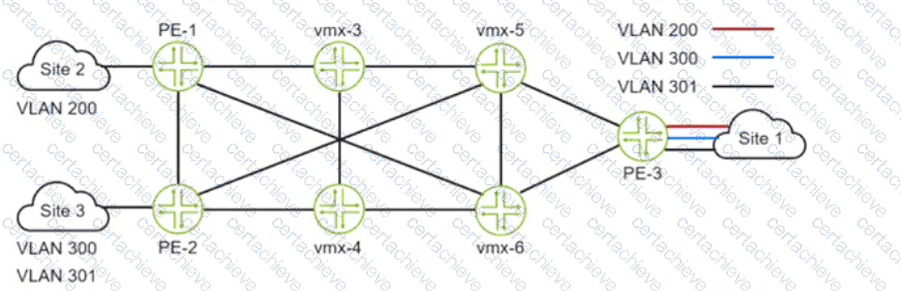
You want Site 1 to access three VLANs that are located in Site 2 and Site 3 The customer-facing interface on the PE-1 router is configured for Ethernet-VLAN encapsulation.
What is the minimum number of L2VPN routing instances to be configured to accomplish this task?
Correct Answer & Rationale:
Answer: B
Explanation:
To allow Site 1 to access three VLANs that are located in Site 2 and Site 3, you need to configure three L2VPN routing instances on PE-1, one for each VLAN. Each L2VPN routing instance will have a different VLAN ID and a different VNI for VXLAN encapsulation. Each L2VPN routing instance will also have a different vrf-target export value to identify which VPN routes belong to which VLAN. This way, PE-1 can forward traffic from Site 1 to Site 2 and Site 3 based on the VLAN tags and VNIs.

Verified by Certified Instructors
This Juniper JN0-664 study pack was audited and verified on September 23, 2026 by Radia Davenport,. We ensure every technical rationale aligns with real-world enterprise standards.
A Stepping Stone for Enhanced Career Opportunities
Your profile having JNCIP-SP certification significantly enhances your credibility and marketability in all corners of the world. The best part is that your formal recognition pays you in terms of tangible career advancement. It helps you perform your desired job roles accompanied by a substantial increase in your regular income. Beyond the resume, your expertise imparts you confidence to act as a dependable professional to solve real-world business challenges.
Your success in Juniper JN0-664 certification exam makes your visible and relevant in the fast-evolving tech landscape. It proves a lifelong investment in your career that give you not only a competitive advantage over your non-certified peers but also makes you eligible for a further relevant exams in your domain.
What You Need to Ace Juniper Exam JN0-664
Achieving success in the JN0-664 Juniper exam requires a blending of clear understanding of all the exam topics, practical skills, and practice of the actual format. There's no room for cramming information, memorizing facts or dependence on a few significant exam topics. It means your readiness for exam needs you develop a comprehensive grasp on the syllabus that includes theoretical as well as practical command.
Here is a comprehensive strategy layout to secure peak performance in JN0-664 certification exam:
- Develop a rock-solid theoretical clarity of the exam topics
- Begin with easier and more familiar topics of the exam syllabus
- Make sure your command on the fundamental concepts
- Focus your attention to understand why that matters
- Ensure hands-on practice as the exam tests your ability to apply knowledge
- Develop a study routine managing time because it can be a major time-sink if you are slow
- Find out a comprehensive and streamlined study resource for your help
Ensuring Outstanding Results in Exam JN0-664!
In the backdrop of the above prep strategy for JN0-664 Juniper exam, your primary need is to find out a comprehensive study resource. It could otherwise be a daunting task to achieve exam success. The most important factor that must be kep in mind is make sure your reliance on a one particular resource instead of depending on multiple sources. It should be an all-inclusive resource that ensures conceptual explanations, hands-on practical exercises, and realistic assessment tools.
Certachieve: A Reliable All-inclusive Study Resource
Certachieve offers multiple study tools to do thorough and rewarding JN0-664 exam prep. Here's an overview of Certachieve's toolkit:
Juniper JN0-664 PDF Study Guide
This premium guide contains a number of Juniper JN0-664 exam questions and answers that give you a full coverage of the exam syllabus in easy language. The information provided efficiently guides the candidate's focus to the most critical topics. The supportive explanations and examples build both the knowledge and the practical confidence of the exam candidates required to confidently pass the exam. The demo of Juniper JN0-664 study guide pdf free download is also available to examine the contents and quality of the study material.
Juniper JN0-664 Practice Exams
Practicing the exam JN0-664 questions is one of the essential requirements of your exam preparation. To help you with this important task, Certachieve introduces Juniper JN0-664 Testing Engine to simulate multiple real exam-like tests. They are of enormous value for developing your grasp and understanding your strengths and weaknesses in exam preparation and make up deficiencies in time.
These comprehensive materials are engineered to streamline your preparation process, providing a direct and efficient path to mastering the exam's requirements.
Juniper JN0-664 exam dumps
These realistic dumps include the most significant questions that may be the part of your upcoming exam. Learning JN0-664 exam dumps can increase not only your chances of success but can also award you an outstanding score.
Top Exams & Certification Providers
New & Trending
- New Released Exams
- Related Exam
- Hot Vendor
Verified Performance Reports
Authentic score reports from candidates who cleared the JN0-664 exam.
Verified Case #1

×
![]()