
The Data Center Professional (JNCIP-DC) Exam (JN0-683)
Passing Juniper JNCIP-DC exam ensures for the successful candidate a powerful array of professional and personal benefits. The first and the foremost benefit comes with a global recognition that validates your knowledge and skills, making possible your entry into any organization of your choice.


JN0-683 Exam Dumps
- Exam Code: JN0-683
- Vendor: Juniper
- Certifications: JNCIP-DC
- Exam Name: Data Center Professional (JNCIP-DC) Exam
Why CertAchieve is Better than Standard JN0-683 Dumps
In 2026, Juniper uses variable topologies. Basic dumps will fail you.
| Quality Standard | Generic Dump Sites | CertAchieve Premium Prep |
|---|---|---|
| Technical Explanation | None (Answer Key Only) | Step-by-Step Expert Rationales |
| Syllabus Coverage | Often Outdated (v1.0) | 2026 Updated (Latest Syllabus) |
| Scenario Mastery | Blind Memorization | Conceptual Logic & Troubleshooting |
| Instructor Access | No Post-Sale Support | 24/7 Professional Help |
Customers Passed Exams
10
Success backed by proven exam prep tools
Questions Came Word for Word
87%
Real exam match rate reported by verified users
Average Score in Real Testing Centre
95%
Consistently high performance across certifications
Study Time Saved With CertAchieve
60%
Efficient prep that reduces study hours significantly
Juniper JN0-683 Exam Domains Q&A
Certified instructors verify every question for 100% accuracy, providing detailed, step-by-step explanations for each.
Question 1
Juniper JN0-683
QUESTION DESCRIPTION:
Exhibit.
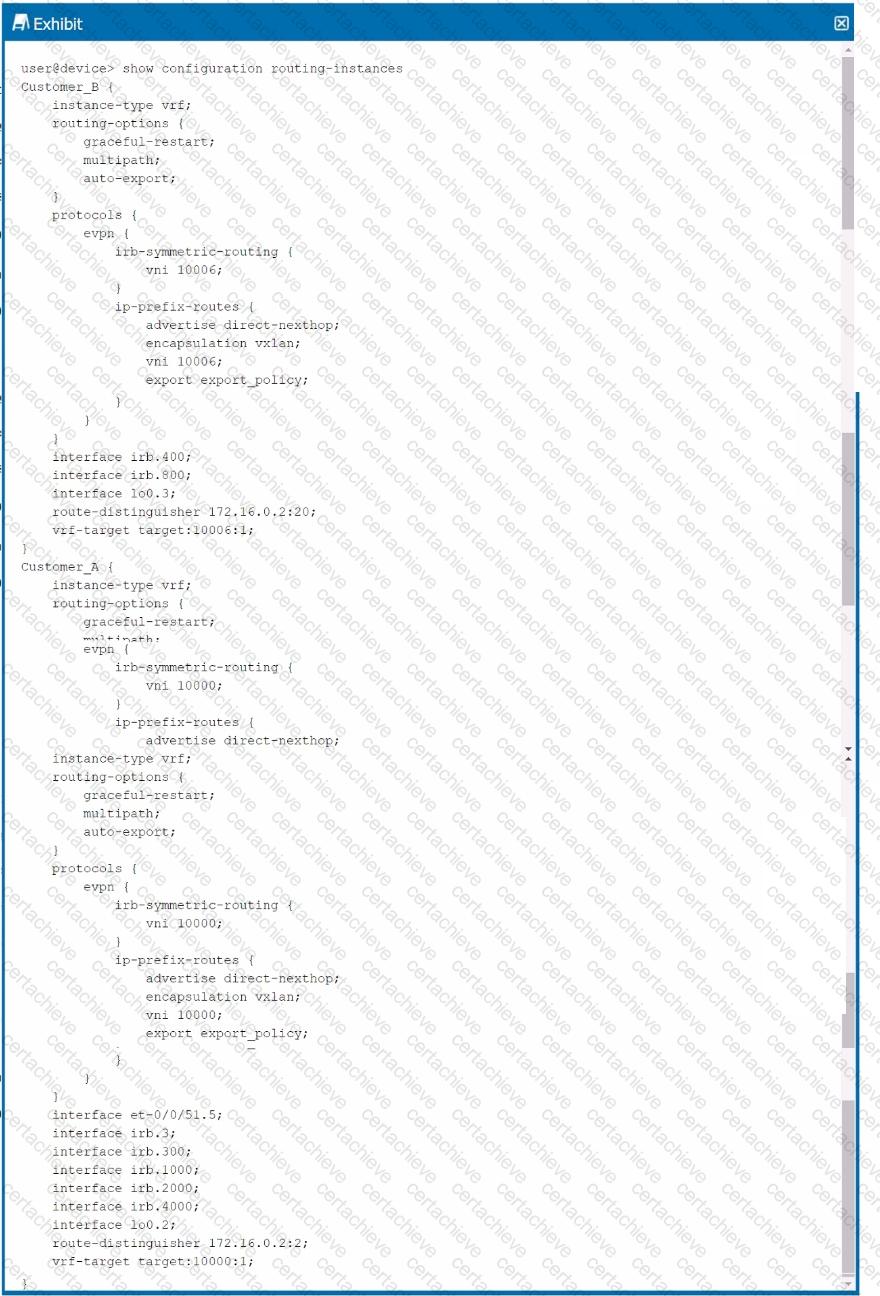
Referring to the configuration shown in the exhibit, assume that there is no external router present, and that the configuration is fabric-only.
Which two statements are true about the example configuration? (Choose two.)
Correct Answer & Rationale:
Answer: B, D
Explanation:
Understanding the Configuration:
The exhibit shows configurations for two VRFs (Customer_A and Customer_B) with specific VLANs and VNIs assigned. Each VRF has interfaces (IRBs) associated with particular VLANs.
Communication Between VLANs and Routing Instances:
Option B: VLAN 400 (irb.400) is part of Customer_B, and there is no direct connection or routing between Customer_A and Customer_B in the configuration provided. Therefore, devices in irb.400 cannot communicate directly with devices in the Customer_A routing instance.
Option D: Since irb.400 (VLAN 400) and irb.800 (VLAN 800) are part of the same routing instance (Customer_B), they can communicate over the fabric using VXLAN encapsulation.
Conclusion:
Option B: Correct—There is no direct communication between devices in irb.400 (Customer_B) and routing instance Customer_A.
Option D: Correct—Devices in VLAN 400 and VLAN 800 can communicate within the Customer_B routing instance over the fabric.
Question 2
Juniper JN0-683
QUESTION DESCRIPTION:
Exhibit.
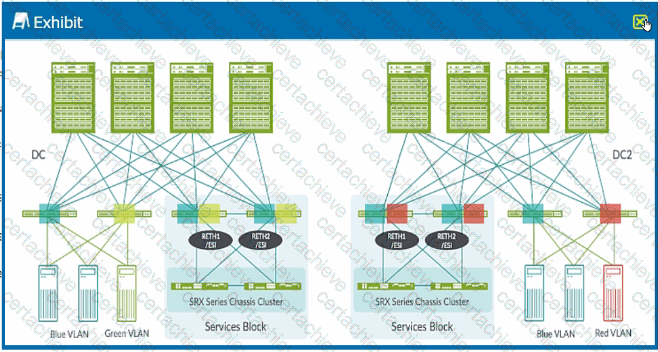
Both DC and DC2 ate using EVPN-VXLAN technology deployed using an ERB architecture. A server on the Red VLAN must communicate with a server on the Green VLAN. The Blue VLAN in DC and DC2 needs to be the same VLAN.
Which statement is correct in this scenario?
Correct Answer & Rationale:
Answer: B
Explanation:
ERB Architecture in EVPN-VXLAN:
ERB (Edge Routed Bridging) architecture is commonly used in data center networks where routing decisions are made at the network edge (leaf or border devices), while bridging (Layer 2 forwarding) is extended across the fabric. This architecture allows for efficient L3 routing while still enabling L2 services like VLANs to span across multiple locations.
VLAN and VNI Configuration:
The scenario specifies that a server on the Red VLAN needs to communicate with a server on the Green VLAN. Since these VLANs are in different data centers (DC and DC2), and given the use of EVPN-VXLAN, the communication between these VLANs will require a transit VNI (Virtual Network Identifier). This transit VNI will allow traffic to traverse the VXLAN tunnel across the DCI (Data Center Interconnect).
Interconnect between SRX Series Devices:
The exhibit shows SRX Series Chassis Clusters used as service devices (likely for firewalling or other security services). These devices need to be interconnected between the two data centers to ensure that VLANs can communicate effectively. The Blue VLAN needs to be stretched between DC and DC2 to maintain the same Layer 2 domain across both data centers.
Conclusion:
Option B: Correct—Interconnecting the SRX Series devices will ensure the necessary service chaining, while stretching the Blue VLAN and adding a transit VNI for the Red and Green VLANs will enable the required communication across the data centers.
Question 3
Juniper JN0-683
QUESTION DESCRIPTION:
Exhibit.
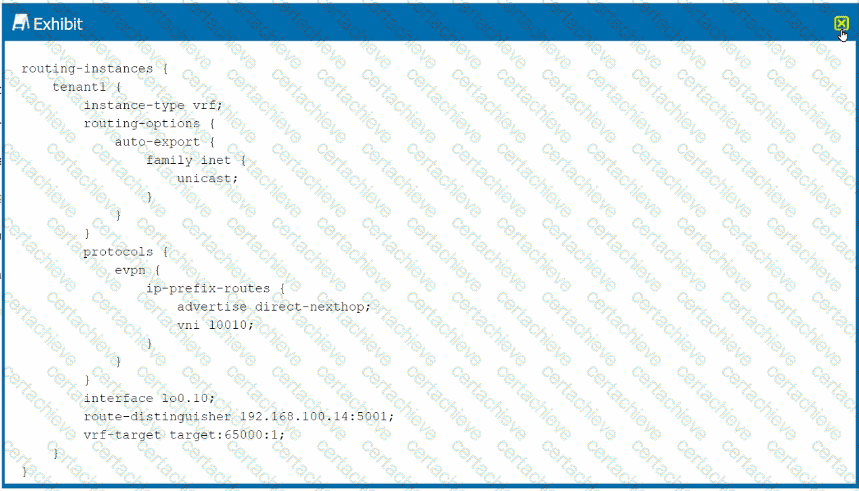
You want to enable the border leaf device to send Type 5 routes of local networks to the border leaf device in another data center. What must be changed to the configuration shown in the exhibit to satisfy this requirement?
Correct Answer & Rationale:
Answer: A
Explanation:
In this scenario, you want the border leaf device to advertise Type 5 EVPN routes to another border leaf in a different data center. Type 5 routes in EVPN are used to advertise IP prefixes, which means that for proper route advertisement, you need to configure the correct settings within the evpn hierarchy.
Step-by-Step Analysis:
Understanding EVPN Type 5 Routes:
EVPN Type 5 routes are used to advertise IP prefixes across EVPN instances, which allow different data centers or networks to exchange routing information effectively.
VRF Target Setting:
The vrf-target configuration is crucial because it defines the export and import policies for the VRF within the EVPN instance. For EVPN Type 5 routes to be advertised to other border leaf devices, the vrf-target needs to be correctly configured under the evpn hierarchy, not just within the routing instance.
Command to solve this:
move vrf-target target:65000:1 to evpn
Other Options:
Option B: Adding a VLAN configuration would not address the requirement to advertise Type 5 routes.
Option C: Adding VXLAN encapsulation may be necessary for other scenarios but does not directly address the Type 5 route advertisement.
Option D: Changing the route-distinguisher will differentiate routes but does not impact the advertisement of Type 5 routes to other data centers.
By moving the vrf-target to the evpn hierarchy, you enable the proper route advertisement, ensuring that the Type 5 routes for local networks are shared with other data center border leaf devices. This is aligned with best practices for multi-data center EVPN implementations, which emphasize the correct placement of routing policies within the EVPN configuration.
Question 4
Juniper JN0-683
QUESTION DESCRIPTION:
You are asked to implement VXLAN group-based policies (GBPs) in your data center. Which two statements are correct in (his scenario? (Choose two.)
Correct Answer & Rationale:
Answer: B, C
Explanation:
VXLAN Group-Based Policies (GBP):
VXLAN Group-Based Policies are used to apply security policies consistently across the network. These policies are often tied to user or device identities rather than static IP addresses, which allows for more dynamic and scalable security management.
Scalable Group Tags via RADIUS and 802.1X:
Option B: VXLAN GBP can use scalable group tags configured on a RADIUS server, which are then pushed to network devices through 802.1X. This allows for centralized and automated policy application based on user or device identity.
Consistent Security Policy Application:
Option C: GBP ensures that security policies are consistently applied across the network, regardless of where a user or device connects. This consistency is crucial in environments where security policies must follow the user or device.
Conclusion:
Option B: Correct—Group tags can be configured on a RADIUS server and pushed via 802.1X, enabling centralized policy management.
Option C: Correct—GBP ensures consistent application of security policies, which is essential for maintaining security across a dynamic network environment.
Question 5
Juniper JN0-683
QUESTION DESCRIPTION:
You want to ensure that VXLAN traffic from the xe-0/0/12 interlace is being encapsulated by logical vlep.32770 and sent to a remote leaf device in this scenario, which command would you use to verify that traffic is flowing?
Correct Answer & Rationale:
Answer: C
Explanation:
VXLAN Traffic Verification:
To ensure VXLAN traffic from the xe-0/0/12 interface is correctly encapsulated by the logical vtep.32770 and sent to a remote leaf device, it is essential to monitor the relevant interface statistics.
The command show interfaces terse vtep.32770 statistics provides a concise overview of the traffic statistics for the specific VTEP interface, which can help verify whether traffic is being correctly encapsulated and transmitted.
Explanation:
This command is particularly useful for quickly checking the traffic counters and identifying any potential issues with VXLAN encapsulation or transmission.
It allows you to confirm that traffic is flowing as expected, by checking the transmitted and received packet counters.
Data Center References:
Monitoring interface statistics is a crucial step in troubleshooting and validating network traffic, particularly in complex overlay environments like EVPN-VXLAN.
Question 6
Juniper JN0-683
QUESTION DESCRIPTION:
Which two statements are true about a pure IP fabric? (Choose two.)
Correct Answer & Rationale:
Answer: A, D
Explanation:
Understanding Pure IP Fabric:
A pure IP fabric is a network design where all devices operate at Layer 3, meaning that each device in the fabric is a router that makes forwarding decisions based on IP addresses.
Layer 2 Support:
In a pure IP fabric, traditional Layer 2 protocols such as Spanning Tree Protocol (STP) or VLANs are not supported. Instead, the network relies entirely on Layer 3 routing protocols to manage traffic between devices.
Routing Functionality:
Since devices in an IP fabric operate as Layer 3 routers, they handle IP routing and provide network services based on IP addresses, not on MAC addresses or Layer 2 switching.
Conclusion:
Option A: Correct—Devices in an IP fabric function as Layer 3 routers.
Option D: Correct—A pure IP fabric does not support traditional Layer 2 protocols, making it a purely routed environment.
Question 7
Juniper JN0-683
QUESTION DESCRIPTION:
You are implementing VXLAN broadcast domains in your data center environment. Which two statements are correct in this scenario? (Choose two.)
Correct Answer & Rationale:
Answer: A, C
Explanation:
VXLAN Overview:
VXLAN (Virtual Extensible LAN) is a network virtualization technology that encapsulates Layer 2 Ethernet frames into Layer 3 UDP packets for transmission over an IP network. It allows the creation of Layer 2 overlay networks across a Layer 3 infrastructure.
Understanding VXLAN Components:
VTEP (VXLAN Tunnel Endpoint): A VTEP is responsible for encapsulating and decapsulating Ethernet frames into and from VXLAN packets.
VNI (VXLAN Network Identifier): A 24-bit identifier used to distinguish different VXLAN segments, allowing for up to 16 million unique segments.
Correct Statements:
C. Layer 2 frames are encapsulated by the source VTEP: This is correct. In a VXLAN deployment, the source VTEP encapsulates the original Layer 2 Ethernet frame into a VXLAN packet before transmitting it over the IP network to the destination VTEP, which then decapsulates it.
A. A VXLAN packet does not contain a VLAN ID: This is correct. The VXLAN header does not carry the original VLAN ID; instead, it uses the VNI to identify the network segment. The VLAN ID is local to the switch and does not traverse the VXLAN tunnel.
Incorrect Statements:
B. The VNI must match the VLAN tag to ensure that the remote VTEP can decapsulate VXLAN packets: This is incorrect. The VNI is independent of the VLAN tag, and the VLAN ID does not need to match the VNI. The VNI is what the remote VTEP uses to identify the correct VXLAN segment.
D. The VNI is a 16-bit value and can range from 0 through 16,777,215: This is incorrect because the VNI is a 24-bit value, allowing for a range of 0 to 16,777,215.
Data Center References:
VXLAN technology is critical for modern data centers as it enables scalability and efficient segmentation without the constraints of traditional VLAN limits.
Question 8
Juniper JN0-683
QUESTION DESCRIPTION:
Which three statements are correct about VXLAN control planes? (Choose three.)
Correct Answer & Rationale:
Answer: B, D, E
Explanation:
VXLAN Control Planes:
VXLAN (Virtual Extensible LAN) uses different control planes to handle MAC learning and traffic forwarding. The control planes include multicast and EVPN (Ethernet VPN).
Multicast and EVPN Comparison:
Option B: Both multicast and EVPN can be used for MAC learning in a VXLAN environment. Multicast is a more traditional approach, while EVPN is more advanced and supports distributed MAC learning.
Option D: EVPN offers benefits such as fast convergence and rapid updates, making it more efficient and scalable for modern data center environments.
Option E: Multicast does not require as many resources because it relies on traditional Layer 3 multicast mechanisms to distribute broadcast, unknown unicast, and multicast (BUM) traffic. However, it can be less flexible and less scalable compared to EVPN.
Conclusion:
Option B: Correct—Both control planes facilitate MAC learning.
Option D: Correct—EVPN provides fast convergence and updates.
Option E: Correct—Multicast is resource-efficient but less flexible.
Question 9
Juniper JN0-683
QUESTION DESCRIPTION:
Exhibit.
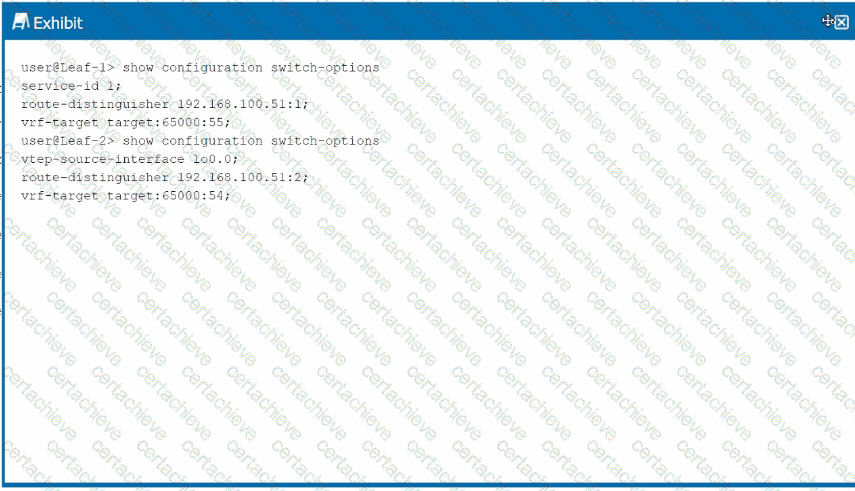
Connections between hosts connected to Leaf-1 and Leaf-2 are not working correctly.
Referring to the exhibit, which two configuration changes are required to solve the problem? (Choose two.)
Correct Answer & Rationale:
Answer: B, D
Explanation:
Review of the Exhibit:
The exhibit shows the switch configuration for Leaf-1 and Leaf-2. The configurations include route distinguishers, VRF targets, and service IDs, all of which are crucial for ensuring proper operation in an EVPN-VXLAN environment.
Service-ID Consistency:
The service ID must be consistent across all participating leaf devices in the same EVPN instance to ensure that they are part of the same VXLAN overlay network.
VRF Target Consistency:
The vrf-target parameter must also be consistent across devices to ensure that VRFs (Virtual Routing and Forwarding instances) are correctly imported and exported between leaf nodes.
Conclusion:
Option B: Correct—Setting the same service-id on Leaf-2 ensures that it is part of the same VXLAN overlay as Leaf-1.
Option D: Correct—The vrf-target on Leaf-2 should match Leaf-1 to ensure consistent routing policies and proper route exchange.
Question 10
Juniper JN0-683
QUESTION DESCRIPTION:
What are two ways in which an EVPN-signaled VXLAN is different from a multicast-signaled VXLAN? (Choose two.)
Correct Answer & Rationale:
Answer: B, C
Explanation:
Multicast-Signaled VXLAN:
In traditional multicast-signaled VXLAN, VTEPs (VXLAN Tunnel Endpoints) use multicast to flood and learn about remote VTEPs. This method relies on multicast in the underlay network to distribute BUM (Broadcast, Unknown unicast, and Multicast) traffic.
This approach can be resource-intensive due to the need for multicast group management and increased network traffic, especially in large deployments.
EVPN-Signaled VXLAN:
EVPN-signaled VXLAN uses BGP (Border Gateway Protocol) to signal the presence of VTEPs and distribute MAC address information. BGP is used for VTEP autodiscovery and the distribution of endpoint information.
This method is more efficient because it reduces the reliance on multicast, instead using BGP control-plane signaling to handle VTEP discovery and MAC learning, which reduces the overhead on the network and improves scalability.
Correct Statements:
B. An EVPN-signaled VXLAN can perform autodiscovery of VTEPs using BGP: This is correct because EVPN uses BGP for VTEP autodiscovery, making it more efficient and scalable compared to multicast-based methods.
C. An EVPN-signaled VXLAN is less resource-intensive: This is correct because it eliminates the need for multicast flooding in the underlay, instead using BGP for signaling, which is less demanding on network resources.
Incorrect Statements:
A. An EVPN-signaled VXLAN can perform autodiscovery of VTEPs using IS-IS: This is incorrect because EVPN relies on BGP, not IS-IS, for VTEP discovery and signaling.
D. An EVPN-signaled VXLAN features slower and more complete convergence: This is incorrect; EVPN with BGP typically provides faster convergence due to its use of a control plane rather than relying on data plane learning.
Data Center References:
EVPN-VXLAN is widely adopted in modern data center designs due to its scalability, efficiency, and reduced resource consumption compared to multicast-based VXLAN solutions. It leverages the strengths of BGP for control-plane-driven operations, resulting in more efficient and scalable networks.

Verified by Certified Instructors
This Juniper JN0-683 study pack was audited and verified on September 23, 2026 by Radia Davenport,. We ensure every technical rationale aligns with real-world enterprise standards.
A Stepping Stone for Enhanced Career Opportunities
Your profile having JNCIP-DC certification significantly enhances your credibility and marketability in all corners of the world. The best part is that your formal recognition pays you in terms of tangible career advancement. It helps you perform your desired job roles accompanied by a substantial increase in your regular income. Beyond the resume, your expertise imparts you confidence to act as a dependable professional to solve real-world business challenges.
Your success in Juniper JN0-683 certification exam makes your visible and relevant in the fast-evolving tech landscape. It proves a lifelong investment in your career that give you not only a competitive advantage over your non-certified peers but also makes you eligible for a further relevant exams in your domain.
What You Need to Ace Juniper Exam JN0-683
Achieving success in the JN0-683 Juniper exam requires a blending of clear understanding of all the exam topics, practical skills, and practice of the actual format. There's no room for cramming information, memorizing facts or dependence on a few significant exam topics. It means your readiness for exam needs you develop a comprehensive grasp on the syllabus that includes theoretical as well as practical command.
Here is a comprehensive strategy layout to secure peak performance in JN0-683 certification exam:
- Develop a rock-solid theoretical clarity of the exam topics
- Begin with easier and more familiar topics of the exam syllabus
- Make sure your command on the fundamental concepts
- Focus your attention to understand why that matters
- Ensure hands-on practice as the exam tests your ability to apply knowledge
- Develop a study routine managing time because it can be a major time-sink if you are slow
- Find out a comprehensive and streamlined study resource for your help
Ensuring Outstanding Results in Exam JN0-683!
In the backdrop of the above prep strategy for JN0-683 Juniper exam, your primary need is to find out a comprehensive study resource. It could otherwise be a daunting task to achieve exam success. The most important factor that must be kep in mind is make sure your reliance on a one particular resource instead of depending on multiple sources. It should be an all-inclusive resource that ensures conceptual explanations, hands-on practical exercises, and realistic assessment tools.
Certachieve: A Reliable All-inclusive Study Resource
Certachieve offers multiple study tools to do thorough and rewarding JN0-683 exam prep. Here's an overview of Certachieve's toolkit:
Juniper JN0-683 PDF Study Guide
This premium guide contains a number of Juniper JN0-683 exam questions and answers that give you a full coverage of the exam syllabus in easy language. The information provided efficiently guides the candidate's focus to the most critical topics. The supportive explanations and examples build both the knowledge and the practical confidence of the exam candidates required to confidently pass the exam. The demo of Juniper JN0-683 study guide pdf free download is also available to examine the contents and quality of the study material.
Juniper JN0-683 Practice Exams
Practicing the exam JN0-683 questions is one of the essential requirements of your exam preparation. To help you with this important task, Certachieve introduces Juniper JN0-683 Testing Engine to simulate multiple real exam-like tests. They are of enormous value for developing your grasp and understanding your strengths and weaknesses in exam preparation and make up deficiencies in time.
These comprehensive materials are engineered to streamline your preparation process, providing a direct and efficient path to mastering the exam's requirements.
Juniper JN0-683 exam dumps
These realistic dumps include the most significant questions that may be the part of your upcoming exam. Learning JN0-683 exam dumps can increase not only your chances of success but can also award you an outstanding score.
Top Exams & Certification Providers
New & Trending
- New Released Exams
- Related Exam
- Hot Vendor