
The Fortinet NSE 6 - FortiEDR 7.0 Administrator (NSE6_EDR_AD-7.0)
Passing Fortinet NSE 6 Network Security Specialist exam ensures for the successful candidate a powerful array of professional and personal benefits. The first and the foremost benefit comes with a global recognition that validates your knowledge and skills, making possible your entry into any organization of your choice.


NSE6_EDR_AD-7.0 Exam Dumps
- Exam Code: NSE6_EDR_AD-7.0
- Vendor: Fortinet
- Certifications: NSE 6 Network Security Specialist
- Exam Name: Fortinet NSE 6 - FortiEDR 7.0 Administrator
Why CertAchieve is Better than Standard NSE6_EDR_AD-7.0 Dumps
In 2026, Fortinet uses variable topologies. Basic dumps will fail you.
| Quality Standard | Generic Dump Sites | CertAchieve Premium Prep |
|---|---|---|
| Technical Explanation | None (Answer Key Only) | Step-by-Step Expert Rationales |
| Syllabus Coverage | Often Outdated (v1.0) | 2026 Updated (Latest Syllabus) |
| Scenario Mastery | Blind Memorization | Conceptual Logic & Troubleshooting |
| Instructor Access | No Post-Sale Support | 24/7 Professional Help |
Customers Passed Exams
10
Success backed by proven exam prep tools
Questions Came Word for Word
93%
Real exam match rate reported by verified users
Average Score in Real Testing Centre
87%
Consistently high performance across certifications
Study Time Saved With CertAchieve
60%
Efficient prep that reduces study hours significantly
Coverage of Official Fortinet NSE6_EDR_AD-7.0 Exam Domains
Our curriculum is meticulously mapped to the Fortinet official blueprint.
FortiEDR System Architecture
Master the foundational components of the FortiEDR ecosystem. Understanding the interaction between the Central Manager, Aggregator, and Core components, including communication ports and high-availability (HA) configurations.
Security Settings and Policies
Deep dive into proactive defense mechanisms. Mastering the configuration of Playbooks, communication control policies, and the Fortinet Cloud Service (FCS) to ensure automated, real-time response to suspicious behavior.
Events, Forensics, and Threat Hunting
Expertise in advanced threat analysis. Mastering the use of forensic data to investigate security events, configuring threat hunting profiles, and executing scheduled queries to identify malicious executables across the environment.
FortiEDR Integration & Security Fabric
Understanding the power of a unified ecosystem. Mastering the deployment of FortiXDR and the integration of FortiEDR into the Fortinet Security Fabric to share intelligence and automate defense across FortiGate and other third-party tools.
Troubleshooting and Maintenance
Ensuring long-term system health. Mastery of troubleshooting collector connectivity, performing alert analysis, and utilizing system tools to resolve policy application errors or inventory discrepancies.
Fortinet NSE6_EDR_AD-7.0 Exam Domains Q&A
Certified instructors verify every question for 100% accuracy, providing detailed, step-by-step explanations for each.
Question 1
Fortinet NSE6_EDR_AD-7.0
QUESTION DESCRIPTION:
You are asked to configure a query to run every 15 minutes, automatically searching for specific registry modifications across all endpoints. Which FortiEDR feature must you configure? (Choose one answer)
Correct Answer & Rationale:
Answer: C
Explanation:
The correct answer is C.
The FortiEDR guide explains that Threat Hunting searches across endpoint activity events, including registry activity. It states that Threat Hunting can search based on attributes of files, registry keys and values, network, processes, event log, and activity event types. This fits the requirement to search for specific registry modifications across endpoints.
The guide also explains that after filtering activity events, the query can be saved and defined as a Scheduled Query. It says: “Scheduled Query: Mark this option to automate the process of detecting threats so that this query is run automatically according to the schedule that you define.” It also states that a security event is automatically created in the Incidents tab when matches are detected, and notifications can be sent through email, Syslog, and other configured methods.
The guide further states that the Repeat Every/On options define the frequency and schedule when the query runs. Therefore, a 15-minute recurring query is handled through the Scheduled Query capability in Threat Hunting, not Communication Control, policy override, or a manual Playbook trigger.
Strictly speaking, the guide calls this a scheduled query under Threat Hunting saved queries, not a “communication control rule” or “manual query.” Option C is the intended answer.
=========
Question 2
Fortinet NSE6_EDR_AD-7.0
QUESTION DESCRIPTION:
What action does an on-premises reputation server take when it receives a hash request that is not found in its local database? (Choose one answer)
Correct Answer & Rationale:
Answer: C
Explanation:
The correct answer is C .
The FortiEDR 7.0.0 Administration Guide states that for on-premises deployments, the on-premise reputation service requests missing hashes from the cloud reputation service . If a proxy is not enabled, it requests the missing hashes from the cloud reputation service through the manager nginx . If a proxy is enabled, the on-premises reputation service requests the missing hashes through the proxy.
So, when the local reputation database does not contain the requested hash, the on-premises reputation server does not ignore the request, wait for endpoint input, or automatically block the application. It queries the cloud reputation service for the missing hash reputation data.
=========
Question 3
Fortinet NSE6_EDR_AD-7.0
QUESTION DESCRIPTION:
An employee leaves the company and no longer has access to the FortiEDR system. You must ensure GDPR compliance regarding the employee’s personal data stored in FortiEDR. Which two data types must be removed to meet GDPR requirements? (Choose two answers)
Correct Answer & Rationale:
Answer: A, D
Explanation:
The correct answers are A. Device and user name and D. IP address and MAC address .
The FortiEDR 7.0.0 Administration Guide states that the GDPR feature is implemented in Administration > Settings > Personal Data Handling . It is used to remove relevant data for an employee or FortiEDR user who no longer has access to or uses the FortiEDR system. The guide explicitly identifies the personal data as device name, IP address, MAC address, and user name . It further states: “You must remove all device name, IP address, MAC address, and user name data from FortiEDR in order to fully comply with the GDPR standard.”
Therefore, installed applications and installed OS name are not the required GDPR personal data types in this FortiEDR procedure. The required removal is performed iteratively for the employee’s/user’s device name , IP address , MAC address , and user name . The guide also instructs administrators to continue removing the other required data: IP address, MAC address, and user name , and to delete any reports that may contain the user’s data.
Question 4
Fortinet NSE6_EDR_AD-7.0
QUESTION DESCRIPTION:
You are asked to create a playbook to isolate a device with a collector. Which action category does isolating a device with a collector fall under? (Choose one answer)
Correct Answer & Rationale:
Answer: A
Explanation:
The correct answer is A. Investigation .
The FortiEDR 7.0.0 Administration Guide states that Investigation actions enable administrators to isolate a device or assign it to a high-security Collector Group for further investigation of the device’s activity. Under the Investigation section, the guide lists the available investigation action types, including “Isolate device with Collector,” “Isolate device with NAC,” and “Move device to High Security Group.”
For Isolate device with Collector , the guide explains that the action blocks communication to and from the affected Collector, and it applies only to endpoint Collectors. If the Playbook policy is configured to isolate a device for a malicious event, then when a malicious security event is triggered, the device is isolated from communicating with the outside world for both sending and receiving.
So, this is not a Remediation , Custom , or Notification action. In FortiEDR Playbook policy terminology, Isolate device with Collector belongs under Investigation .
=========
Question 5
Fortinet NSE6_EDR_AD-7.0
QUESTION DESCRIPTION:
A playbook is configured with two actions: terminate process and isolate device. The terminate process action fails because the process is protected by Windows. What is the expected behavior for the second action, isolate device? (Choose one answer)
Correct Answer & Rationale:
Answer: D
Explanation:
The correct answer is D .
The FortiEDR guide confirms that Playbook actions are automatic incident response actions configured under Security Settings > Playbooks and applied based on security event classification. It also confirms that actions such as Terminate Process and device isolation actions can be configured as playbook responses. For scheduled-query-triggered events, the guide states that FortiEDR can automatically apply the Playbook action assigned to the Collector Group that the triggering device belongs to.
For isolation, the guide shows that isolation actions such as Isolate device with NAC are configured under the Investigation section of Playbooks, and similar isolation actions are triggered automatically when selected for the relevant classification.
The uploaded guide does not provide a specific line saying “if terminate process fails, continue to the next action.” Based on FortiEDR playbook behavior, configured actions are executed independently. A failure to terminate a protected Windows process does not automatically cancel the remaining playbook actions. Therefore, the next configured action, isolate device , is still executed.
Options A , B , and C are wrong because the playbook does not pause for administrator intervention, does not stop merely because an email is generated, and does not cancel all remaining configured actions because one action failed.
=========
Question 6
Fortinet NSE6_EDR_AD-7.0
QUESTION DESCRIPTION:
You added three new applications to FortiEDR using only the Path attribute. What are two expected outcomes of this configuration? (Choose two answers)
Correct Answer & Rationale:
Answer: A, B
Explanation:
The correct answers are A and B .
The FortiEDR 7.0.0 Administration Guide states that newly added applications are disabled by default , which means they are not blocked unless enabled. The guide further explains that the default state can be changed by enabling the Enable Default application state option in the Application Control Manager settings. Therefore, option A is correct.
Option B is also correct because Application Control allows an application to be defined by Hash or by any combination of File Name / Path / Signer . The guide says that the Path field specifies the path to the executable file of the application to be blocked. When using path-based matching, the enforcement is tied to the specified path criteria, not to every possible location of the same file.
Option C is wrong because the file name does not also need to match when only the Path attribute is used. Option D is wrong because blocking all instances regardless of location applies when only the File Name field is used, not when the match is path-specific. The guide explicitly states that if only the File Name field is filled, the application is blocked no matter where the executable appears.
Question 7
Fortinet NSE6_EDR_AD-7.0
QUESTION DESCRIPTION:
A playbook is configured to block a file hash on the network through the FortiGate connector, and then isolate the device that generated the malicious hash event.
What is the expected behavior if FortiGate is unreachable?
Correct Answer & Rationale:
Answer: D
Explanation:
Comprehensive and Detailed 100 to 150 words of Explanation From FortiEDR 7.0 Administrator topics:
“This action blocks the communication to/from the affected Collector.”
“A Firewall Connector must already be configured in order to perform this action.”
FortiEDR Playbooks support separate remediation and investigation actions. The firewall-blocking action depends on the configured FortiGate connector, while Collector-based device isolation operates through the protected endpoint. If FortiGate is unreachable, the firewall action cannot complete successfully, but the independent Collector isolation action can still execute. The intended outcome is therefore successful device isolation with a failure recorded for the unsuccessful response.
Verification qualification: The documented firewall action blocks malicious remote addresses, not file hashes directly. Additionally, the Administration Guide does not explicitly define the overall playbook status when one action fails. Consequently, D is the strongest intended answer, but its aggregate failure-status behavior is not conclusively verified by the cited documentation.
[Reference: FortiEDR 7.0.0 Administration Guide, pages 237–245., , ]
Question 8
Fortinet NSE6_EDR_AD-7.0
QUESTION DESCRIPTION:
Refer to the Exhibit:

Based on the FortiEDR status output shown in the exhibit, what are two reasons for the degraded state? (Choose two answers)
Correct Answer & Rationale:
Answer: B, C
Explanation:
The correct answers are B and C .
The exhibit shows:
FortiEDR Service: Up
FortiEDR Driver: Up
FortiEDR Status: Degraded (no configuration)
This means the local Collector service and driver are running, but the Collector has not received valid configuration. In FortiEDR, a Collector must register and communicate with the FortiEDR Aggregator to receive its configuration. The guide states that the Collector initially sends registration information to the FortiEDR Aggregator using SSL, sends ongoing health/status/security-event information, and receives its configuration from the Aggregator.
During installation, a non-customized Windows Collector requires the correct Aggregator address , Aggregator port 8081 , and registration password . The guide explicitly states that the Aggregator port should be specified as 8081 , and that the registration password must be entered during installation.
Therefore, an incorrect registration password or incorrect port number can prevent proper registration/configuration retrieval, resulting in a degraded/no-configuration state.
Option A is not the best answer because Windows Firewall being enabled by itself does not automatically cause this FortiEDR status; only if it blocks required FortiEDR communication would it matter, and the option is too generic. Option D is also not correct as written because the Collector receives configuration from the Aggregator , not directly from the Central Manager. The guide describes Collector-to-Aggregator communication for registration and configuration.
=========
Question 9
Fortinet NSE6_EDR_AD-7.0
QUESTION DESCRIPTION:
Refer to the Exhibit:

Based on the incident details shown in the exhibit, which two statements about this incident are true? (Choose two answers)
Correct Answer & Rationale:
Answer: A, C
Explanation:
The correct answers are A and C .
The exhibit shows an audit/response action stating that IP address 74.125.235.20 was added to malicious IP addresses on firewall FortiGate . This matches the FortiEDR playbook action Block address on Firewall . The guide states that this action ensures connections to remote malicious addresses associated with the security event are blocked, and that a firewall connector must already be configured for this action. It also explains that a checkmark in a classification column means communication with the affected destination is automatically blocked when a security event with that classification is triggered.
Option C is the second best answer because FortiEDR events are initially classified by FortiEDR detection logic/Core, and the guide states that classifications are initially determined by the Core but can later be changed automatically by FortiEDR Cloud Service or manually. The exhibit shows “Classification Changed To: Suspicious (By Fortinet)” , but it does not say the event was manually classified by an administrator. So the event classification process is FortiEDR-driven, with later Fortinet/FCS-style automatic classification possible.
Option B is wrong. The exhibit shows one raw-data row with device cwinserv-32 +2 , which indicates more than one affected device/raw item is represented in the aggregation. So it did not occur on only one device.
Option D is wrong because the incident rows clearly show Unhandled . The guide states that security events are initially marked as unread and unhandled, and the unread/unhandled status helps users track whether anyone has read and handled the event.
=========
Question 10
Fortinet NSE6_EDR_AD-7.0
QUESTION DESCRIPTION:
Refer to the Exhibit:
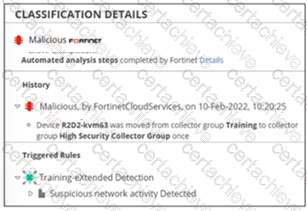
Based on the event shown in the exhibit, which two statements about the event are true? (Choose two answers)
Correct Answer & Rationale:
Answer: A, B
Explanation:
The correct answers are A and B .
The exhibit shows the event classification as Malicious , classified by FortinetCloudServices , and the history states that device R2D2-kvm63 was moved from the Training Collector Group to the High Security Collector Group . This is a Playbook action. The FortiEDR guide explains that after classification changes, the Overview pane displays the history of automatic FortiEDR actions, including Playbook policy-related actions .
The guide specifically lists Move device to High Security Group under Investigation actions in Playbook policies. It states that a checkmark in a classification column means the device is automatically moved to the High Security Collector Group when a security event with that classification is triggered. So the exhibit proves that Playbooks are configured for this event.
The second correct answer is B because the triggered rule is under Training • Extended Detection . The FortiEDR guide states that the eXtended Detection Policy logs events and displays them in the Incidents tab, but no blocking options are provided for this policy.
Option C is wrong because moving a device to the High Security Collector Group is not the same as isolating the device. Isolation would block communication to/from the affected Collector. The exhibit shows a Collector Group move, not isolation.
Option D is wrong because Extended Detection does not block. The guide explicitly says Extended Detection events are logged and displayed, with no blocking options provided.
=========
A Stepping Stone for Enhanced Career Opportunities
Your profile having NSE 6 Network Security Specialist certification significantly enhances your credibility and marketability in all corners of the world. The best part is that your formal recognition pays you in terms of tangible career advancement. It helps you perform your desired job roles accompanied by a substantial increase in your regular income. Beyond the resume, your expertise imparts you confidence to act as a dependable professional to solve real-world business challenges.
Your success in Fortinet NSE6_EDR_AD-7.0 certification exam makes your visible and relevant in the fast-evolving tech landscape. It proves a lifelong investment in your career that give you not only a competitive advantage over your non-certified peers but also makes you eligible for a further relevant exams in your domain.
What You Need to Ace Fortinet Exam NSE6_EDR_AD-7.0
Achieving success in the NSE6_EDR_AD-7.0 Fortinet exam requires a blending of clear understanding of all the exam topics, practical skills, and practice of the actual format. There's no room for cramming information, memorizing facts or dependence on a few significant exam topics. It means your readiness for exam needs you develop a comprehensive grasp on the syllabus that includes theoretical as well as practical command.
Here is a comprehensive strategy layout to secure peak performance in NSE6_EDR_AD-7.0 certification exam:
- Develop a rock-solid theoretical clarity of the exam topics
- Begin with easier and more familiar topics of the exam syllabus
- Make sure your command on the fundamental concepts
- Focus your attention to understand why that matters
- Ensure hands-on practice as the exam tests your ability to apply knowledge
- Develop a study routine managing time because it can be a major time-sink if you are slow
- Find out a comprehensive and streamlined study resource for your help
Ensuring Outstanding Results in Exam NSE6_EDR_AD-7.0!
In the backdrop of the above prep strategy for NSE6_EDR_AD-7.0 Fortinet exam, your primary need is to find out a comprehensive study resource. It could otherwise be a daunting task to achieve exam success. The most important factor that must be kep in mind is make sure your reliance on a one particular resource instead of depending on multiple sources. It should be an all-inclusive resource that ensures conceptual explanations, hands-on practical exercises, and realistic assessment tools.
Certachieve: A Reliable All-inclusive Study Resource
Certachieve offers multiple study tools to do thorough and rewarding NSE6_EDR_AD-7.0 exam prep. Here's an overview of Certachieve's toolkit:
Fortinet NSE6_EDR_AD-7.0 PDF Study Guide
This premium guide contains a number of Fortinet NSE6_EDR_AD-7.0 exam questions and answers that give you a full coverage of the exam syllabus in easy language. The information provided efficiently guides the candidate's focus to the most critical topics. The supportive explanations and examples build both the knowledge and the practical confidence of the exam candidates required to confidently pass the exam. The demo of Fortinet NSE6_EDR_AD-7.0 study guide pdf free download is also available to examine the contents and quality of the study material.
Fortinet NSE6_EDR_AD-7.0 Practice Exams
Practicing the exam NSE6_EDR_AD-7.0 questions is one of the essential requirements of your exam preparation. To help you with this important task, Certachieve introduces Fortinet NSE6_EDR_AD-7.0 Testing Engine to simulate multiple real exam-like tests. They are of enormous value for developing your grasp and understanding your strengths and weaknesses in exam preparation and make up deficiencies in time.
These comprehensive materials are engineered to streamline your preparation process, providing a direct and efficient path to mastering the exam's requirements.
Fortinet NSE6_EDR_AD-7.0 exam dumps
These realistic dumps include the most significant questions that may be the part of your upcoming exam. Learning NSE6_EDR_AD-7.0 exam dumps can increase not only your chances of success but can also award you an outstanding score.
Top Exams & Certification Providers
New & Trending
- New Released Exams
- Related Exam
- Hot Vendor