
The Fortinet NSE 6 - OT Security 7.6 Architect (NSE6_OTS_AR-7.6)
Passing Fortinet NSE 6 Network Security Specialist exam ensures for the successful candidate a powerful array of professional and personal benefits. The first and the foremost benefit comes with a global recognition that validates your knowledge and skills, making possible your entry into any organization of your choice.


NSE6_OTS_AR-7.6 Exam Dumps
- Exam Code: NSE6_OTS_AR-7.6
- Vendor: Fortinet
- Certifications: NSE 6 Network Security Specialist
- Exam Name: Fortinet NSE 6 - OT Security 7.6 Architect
Why CertAchieve is Better than Standard NSE6_OTS_AR-7.6 Dumps
In 2026, Fortinet uses variable topologies. Basic dumps will fail you.
| Quality Standard | Generic Dump Sites | CertAchieve Premium Prep |
|---|---|---|
| Technical Explanation | None (Answer Key Only) | Step-by-Step Expert Rationales |
| Syllabus Coverage | Often Outdated (v1.0) | 2026 Updated (Latest Syllabus) |
| Scenario Mastery | Blind Memorization | Conceptual Logic & Troubleshooting |
| Instructor Access | No Post-Sale Support | 24/7 Professional Help |
Customers Passed Exams
10
Success backed by proven exam prep tools
Questions Came Word for Word
95%
Real exam match rate reported by verified users
Average Score in Real Testing Centre
91%
Consistently high performance across certifications
Study Time Saved With CertAchieve
60%
Efficient prep that reduces study hours significantly
Coverage of Official Fortinet NSE6_OTS_AR-7.6 Exam Domains
Our curriculum is meticulously mapped to the Fortinet official blueprint.
Asset Management & Compliance
Master the identification and management of OT assets. Deep dive into Fortinet Security Fabric integration for OT, implementing device detection on FortiGate and FortiNAC, and aligning technical infrastructure with global OT standards and compliance frameworks
Network Access Control & Segmentation
Expertise in securing the OT network perimeter and internal boundaries. Mastering OT Ethernet fundamentals, designing secure segmentation schemas based on the Purdue Model, and configuring multi-factor authentication to verify access across industrial levels.
Industrial Network Security & Protection
Mastering the application of security inspections specifically for industrial protocols (Modbus, DNP3, etc.). Expert proficiency in implementing Virtual Patching to protect legacy ICS components and configuring automation stitches to enhance real-time threat response.
Monitoring, Risk Assessment & Analytics
Expertise in centralized security intelligence. Mastering FortiAnalyzer event handlers for OT monitoring, performing technical risk assessments, and analyzing security reports to maintain long-term industrial resilience.
Fortinet NSE6_OTS_AR-7.6 Exam Domains Q&A
Certified instructors verify every question for 100% accuracy, providing detailed, step-by-step explanations for each.
Question 1
Fortinet NSE6_OTS_AR-7.6
QUESTION DESCRIPTION:
Refer to the exhibit.
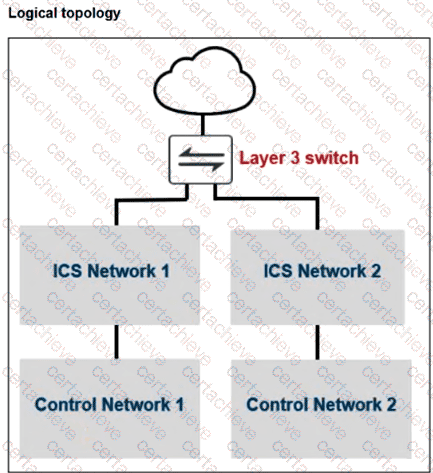
A partial OT network is shown. You must improve the security of this OT network and implement internal segmentation between network 1 and network 2. How can you achieve the segmentation? (Choose one answer)
Correct Answer & Rationale:
Answer: D
Explanation:
The correct answer is D. You can configure forward domain IDs for each network .
The study guide explains that in FortiGate transparent mode, all interfaces belong to the same broadcast domain, even interfaces with different VLAN IDs , and then states that you can “subdivide into multiple broadcast domains” by configuring set forward-domain <</b> domain_ID > . It also states that “interfaces with the same domain ID belong to the same broadcast domain” and, with multiple forward domains, “traffic arriving on one interface is broadcast only to interfaces in the same forward domain ID.” That is the mechanism used to separate internal networks and confine traffic between network segments.
The other options do not fit this requirement. Universal ZTNA is for application access control, not segmentation between two OT networks. One traffic VDOM does not create segmentation by itself; multiple VDOMs would be needed for that type of isolation. An explicit software switch controls intraswitch traffic inside the same software-switch domain, not segmentation between separate networks like network 1 and network 2. Therefore, the correct way to implement the internal segmentation asked in the question is to assign different forward domain IDs to each network.
Question 2
Fortinet NSE6_OTS_AR-7.6
QUESTION DESCRIPTION:
What is the main OT component for monitoring and controlling industrial processes? (Choose one answer)
Correct Answer & Rationale:
Answer: C
Explanation:
The correct answer is C. Industrial Control System (ICS) . The study guide states that “ICS is a main component of OT” and “consists of systems used for monitoring and controlling industrial processes.” It also explains that ICS includes various devices, systems, controls, and networks that manage industrial processes, and that the most common types are SCADA and distributed control systems (DCS) . This makes ICS the primary OT component for monitoring and controlling industrial processes.
The other options are related OT components, but they are not the best answer to this wording. SCADA collects real-time data and helps visualize and control the OT environment, but it is described as a system within the broader ICS structure. PLC devices collect and transmit real-time data and connect sensors and RTUs to SCADA, while IIoT refers to sensors, actuators, and other connected field devices. Therefore, the overarching main OT component for monitoring and controlling industrial processes is ICS .
Question 3
Fortinet NSE6_OTS_AR-7.6
QUESTION DESCRIPTION:
What is the next step if FortiGate cannot detect a device locally? (Choose one answer)
Correct Answer & Rationale:
Answer: A
Explanation:
The correct answer is A. FortiGate queries FortiGuard servers . The study guide explains the device detection process very clearly: “First, FortiGate attempts to detect the devices based on the information in the local device database (CIDB). If FortiGate cannot detect the devices locally, it queries the FortiGuard servers by sending data about the unknown devices to the FortiGuard servers. In response, the FortiGuard servers provide additional information about those devices.” This directly answers the question and shows that querying FortiGuard is the next step after local detection fails.
Option D is incorrect because the guide says FortiGate checks the local device database (CIDB) first, before this next step. Option B refers more to FortiNAC-style profiling logic, not FortiGate’s OT device detection flow. Option C is also incorrect because service connectors are not described here as the immediate follow-up step for unknown local device detection. The study guide specifically identifies FortiGuard servers as the next destination for device identification assistance.
Question 4
Fortinet NSE6_OTS_AR-7.6
QUESTION DESCRIPTION:
Refer to the exhibit.

Based on the information provided on the partial Event Monitor page shown in the exhibit, how was the attack detected? (Choose one answer)
Correct Answer & Rationale:
Answer: D
Explanation:
The correct answer is D. Automatically by an event handler . The study guide explicitly states that “Event handlers generate events on FortiAnalyzer” and “FortiAnalyzer uses event handlers to filter all incoming logs. If the logs received match the conditions set in the event handlers, FortiAnalyzer generates an event.” It also says “You can view all generated events on the Event Monitor page.” This directly matches the exhibit, which is showing entries on the Event Monitor page. Therefore, the attack shown there was detected automatically through an event handler .
The guide also explains the detection flow: “FortiAnalyzer receives logs,” “FortiAnalyzer parses logs,” and “FortiAnalyzer generates an event if a rule is matched in an event handler.” In addition, the Event Monitor view includes the Handler column, which identifies the event handler that generated the event. That is why the attack is not considered manually detected, and it is not primarily detected by a playbook or stitch. Playbooks and stitches are used for subsequent automation actions, but the event appearing in Event Monitor is created by the event handler mechanism.
Question 5
Fortinet NSE6_OTS_AR-7.6
QUESTION DESCRIPTION:
You want to improve access control for your large OT network using passive authentication. What must you configure on FortiGate? (Choose one answer)
Correct Answer & Rationale:
Answer: A
Explanation:
The correct answer is A. Fortinet Single-Sign On (FSSO) . The study guide states under Active and Passive Authentication that for passive authentication, “User does not receive a login prompt from FortiGate” , “Credentials are determined automatically” , and specifically “FSSO, RSSO, and NTLM can be used.” It then explains that passive authentication occurs with the single sign-on method and explicitly identifies Fortinet SSO (FSSO) as one of those methods.
The guide also says: “For passive authentication, you can implement FSSO. FSSO allows users who have already authenticated on the network through another system to be transparently identified. After initial login to any system on the network, users can access allowed resources without being prompted for credentials.” That is exactly what the question asks for: improving access control in a large OT network using passive authentication .
The other options do not match passive authentication. Local users are part of local authentication, two-factor authentication adds an extra security factor but still uses active authentication, and FortiAuthenticator as a remote server supports centralized authentication for mid-to-large networks, but by itself it is not the specific passive-authentication method being asked here. The study guide is explicit that the FortiGate configuration for passive authentication is FSSO .
Question 6
Fortinet NSE6_OTS_AR-7.6
QUESTION DESCRIPTION:
Refer to the exhibit.
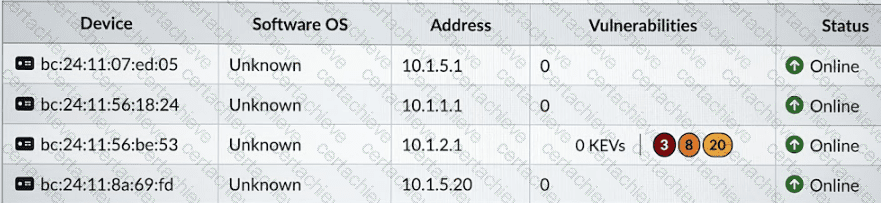
Which statement about this partial Asset Identity List page is correct? (Choose one answer)
Correct Answer & Rationale:
Answer: B
Explanation:
The correct answer is B. A firewall policy has a Virtual Patching security profile applied to it .
The decisive clue in the exhibit is the Vulnerabilities column showing KEVs and device-specific vulnerability counts. The study guide explains the virtual patching workflow in this exact way: “FortiGate performs a lookup for device-specific vulnerabilities and mitigation rules in FortiGuard,” then “FortiGuard returns specific OT virtual patching signatures,” and “FortiGate caches the signatures and mitigation rules that apply to each device.” That is the same behavior reflected by the Asset Identity List showing vulnerability information per detected device.
The guide then states that “When traffic related to the vulnerable device reaches FortiGate, the firewall policy with the virtual patching profile applies.” It also says “A virtual patching profile can be applied to firewall policies in any direction, protecting traffic from or to the vulnerable OT device.” This directly links the per-device vulnerability visibility to a Virtual Patching profile enforced through firewall policy.
The other options do not match the exhibit. Antivirus is not described in the study guide as building a device-by-device vulnerability list, Application Control is used for OT protocol and message visibility, and IPS focuses on exploit detection and prevention. The Vulnerabilities/KEVs display is the indicator that FortiGate is using Virtual Patching logic for those OT devices.
Question 7
Fortinet NSE6_OTS_AR-7.6
QUESTION DESCRIPTION:
You want to improve the security of your OT network and therefore deploy a FortiGate device with the OT signatures database. Which two statements about this database are true? (Choose two answers)
Correct Answer & Rationale:
Answer: A, D
Explanation:
The correct answers are A and D .
Option A is correct because the study guide states that for OT protocol coverage, “a valid OT security service license is required to receive updates on both intrusion prevention and application control signatures.” It also shows “Valid license required” in the FortiGuard subscriptions section for OT protocol coverage. This confirms that a valid OT security service license is required to use and maintain the OT signatures database correctly.
Option D is also correct because the guide explicitly shows the CLI configuration used “To enable OT signatures” :
config ips global
set exclude-signatures none
end
It then states that “By default, OT signatures are excluded from the signatures lists on the GUI until you enable them on the CLI.” This directly confirms that you must set exclude-signatures to none in the CLI to enable OT signatures.
Option B is incorrect because the study guide does not say you manually import the OT signatures database. Instead, it explains that FortiGuard maintains updated OT signatures and that a valid license is required to receive updates. Option C is incorrect because the guide clearly says OT signatures are excluded by default until enabled from the CLI.
Question 8
Fortinet NSE6_OTS_AR-7.6
QUESTION DESCRIPTION:
As the first step in your OT network protection plan, you must identify the OT protocols that the FortiGate device supports. Which two configurations must you implement on this FortiGate device? (Choose two answers)
Correct Answer & Rationale:
Answer: B, C
Explanation:
The correct answers are B and C . The study guide states that “You can use application control signatures to detect OT protocols” and that “Application control detects the protocols used in applications like Modbus, IEC 104, and the contents of the telecontrol messages” . It also shows that a Modbus application control profile can be enabled on a firewall policy “for OT protocol visibility in the monitor status.” This directly supports B , because application control is the feature used to identify and monitor OT protocols on FortiGate.
The guide also explains under IPS that “By default, OT signatures are excluded from the signatures lists on the GUI until you enable them on the CLI” using config ips global and set exclude-signatures none . Once enabled, FortiGate can use those OT signatures for OT-aware inspection and protection. That supports C as the second required configuration. A is related to device discovery, not protocol identification, and D is focused on exploit and vulnerability detection rather than the first-step goal of identifying OT protocols.
Question 9
Fortinet NSE6_OTS_AR-7.6
QUESTION DESCRIPTION:
Refer to the exhibits.
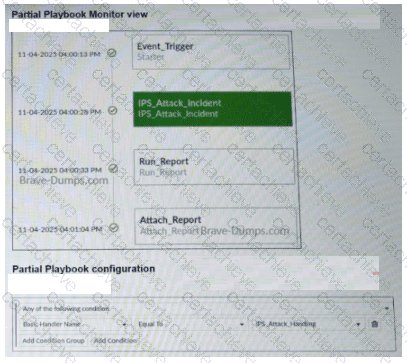
A partial view of the Playbook Monitor page and the corresponding playbook configuration are shown. Based on the monitor page and the configuration of the playbook, what has triggered the Run_Report task? (Choose one answer)
Correct Answer & Rationale:
Answer: A
Explanation:
Based on the provided exhibits from the FortiAnalyzer playbook engine:
Playbook Trigger Condition : The Partial Playbook configuration exhibit shows that the playbook is set to trigger based on a condition where the Basic Handler Name is Equal To IPS_Attack_Handling.
Event vs. Log : In FortiAnalyzer, the field Basic Handler Name is a property of an Event record, indicating the specific Event Handler that generated it. A playbook configured with this condition is triggered by an Event , not directly by a raw log.
Playbook Execution Flow : The Partial Playbook Monitor view shows the execution sequence:
Event_Trigger (Starter) : This is the entry point of the playbook, which matches the condition defined in the configuration.
IPS_Attack_Incident : The first task executed after the trigger.
Run_Report : The task in question, which is executed as part of the automated workflow initiated by the starter.
Conclusion : Since the playbook ' s " Starter " is defined by the IPS_Attack_Handling handler name, an event produced by that handler is the root trigger for the entire playbook execution, including the Run_Report task.
Therefore, the Run_Report task was triggered (as part of the playbook) by an IPS_Attack_Handling event .
Question 10
Fortinet NSE6_OTS_AR-7.6
QUESTION DESCRIPTION:
Refer to the exhibit.
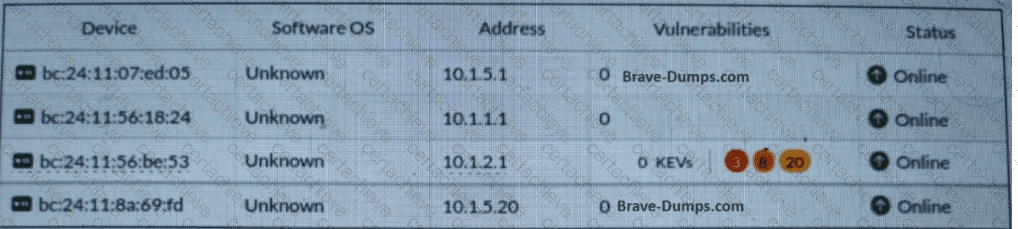
Which statement about this partial Asset Identity List page is correct? (Choose one answer)
Correct Answer & Rationale:
Answer: B
Explanation:
Based on the OT Security 7.6 Architect study guide regarding the Asset Identity Center and Asset Management :
Vulnerability Visibility : The Asset Identity List tab displays key metadata for IT and OT devices, including detected addresses, users, and a specific column for Vulnerabilities .
Virtual Patching Feature : In the OT Security 7.6 architecture, the " Vulnerabilities " column is populated through the OT Security Service license, which includes " OT vulnerability correlation definitions & virtual patching signatures " .
Correlation Mechanism : FortiGate extracts metadata from OT traffic and uses these signatures to identify known vulnerabilities on the assets. For these vulnerabilities to be identified and correlated in the Asset Identity Center as shown in the exhibit (displaying a count of 8 vulnerabilities), the Virtual Patching feature must be active.
Architectural Implementation : Virtual patching is a critical component of the " Protection " layer in OT networks, allowing administrators to secure legacy or unpatchable PLCs and RTUs by blocking exploit attempts at the network level using IPS-based virtual patching signatures.
Exhibit Analysis : The presence of identified vulnerabilities (the number " 8 " in the red shield) in the Asset Identity List confirms that the FortiGate is actively performing vulnerability correlation, which is the operational result of having a Virtual Patching security profile applied to the relevant firewall policy.
A Stepping Stone for Enhanced Career Opportunities
Your profile having NSE 6 Network Security Specialist certification significantly enhances your credibility and marketability in all corners of the world. The best part is that your formal recognition pays you in terms of tangible career advancement. It helps you perform your desired job roles accompanied by a substantial increase in your regular income. Beyond the resume, your expertise imparts you confidence to act as a dependable professional to solve real-world business challenges.
Your success in Fortinet NSE6_OTS_AR-7.6 certification exam makes your visible and relevant in the fast-evolving tech landscape. It proves a lifelong investment in your career that give you not only a competitive advantage over your non-certified peers but also makes you eligible for a further relevant exams in your domain.
What You Need to Ace Fortinet Exam NSE6_OTS_AR-7.6
Achieving success in the NSE6_OTS_AR-7.6 Fortinet exam requires a blending of clear understanding of all the exam topics, practical skills, and practice of the actual format. There's no room for cramming information, memorizing facts or dependence on a few significant exam topics. It means your readiness for exam needs you develop a comprehensive grasp on the syllabus that includes theoretical as well as practical command.
Here is a comprehensive strategy layout to secure peak performance in NSE6_OTS_AR-7.6 certification exam:
- Develop a rock-solid theoretical clarity of the exam topics
- Begin with easier and more familiar topics of the exam syllabus
- Make sure your command on the fundamental concepts
- Focus your attention to understand why that matters
- Ensure hands-on practice as the exam tests your ability to apply knowledge
- Develop a study routine managing time because it can be a major time-sink if you are slow
- Find out a comprehensive and streamlined study resource for your help
Ensuring Outstanding Results in Exam NSE6_OTS_AR-7.6!
In the backdrop of the above prep strategy for NSE6_OTS_AR-7.6 Fortinet exam, your primary need is to find out a comprehensive study resource. It could otherwise be a daunting task to achieve exam success. The most important factor that must be kep in mind is make sure your reliance on a one particular resource instead of depending on multiple sources. It should be an all-inclusive resource that ensures conceptual explanations, hands-on practical exercises, and realistic assessment tools.
Certachieve: A Reliable All-inclusive Study Resource
Certachieve offers multiple study tools to do thorough and rewarding NSE6_OTS_AR-7.6 exam prep. Here's an overview of Certachieve's toolkit:
Fortinet NSE6_OTS_AR-7.6 PDF Study Guide
This premium guide contains a number of Fortinet NSE6_OTS_AR-7.6 exam questions and answers that give you a full coverage of the exam syllabus in easy language. The information provided efficiently guides the candidate's focus to the most critical topics. The supportive explanations and examples build both the knowledge and the practical confidence of the exam candidates required to confidently pass the exam. The demo of Fortinet NSE6_OTS_AR-7.6 study guide pdf free download is also available to examine the contents and quality of the study material.
Fortinet NSE6_OTS_AR-7.6 Practice Exams
Practicing the exam NSE6_OTS_AR-7.6 questions is one of the essential requirements of your exam preparation. To help you with this important task, Certachieve introduces Fortinet NSE6_OTS_AR-7.6 Testing Engine to simulate multiple real exam-like tests. They are of enormous value for developing your grasp and understanding your strengths and weaknesses in exam preparation and make up deficiencies in time.
These comprehensive materials are engineered to streamline your preparation process, providing a direct and efficient path to mastering the exam's requirements.
Fortinet NSE6_OTS_AR-7.6 exam dumps
These realistic dumps include the most significant questions that may be the part of your upcoming exam. Learning NSE6_OTS_AR-7.6 exam dumps can increase not only your chances of success but can also award you an outstanding score.
Top Exams & Certification Providers
New & Trending
- New Released Exams
- Related Exam
- Hot Vendor