
The Understanding Cisco Cybersecurity Operations Fundamentals (CBROPS) (200-201)
Passing Cisco CyberOps Associate exam ensures for the successful candidate a powerful array of professional and personal benefits. The first and the foremost benefit comes with a global recognition that validates your knowledge and skills, making possible your entry into any organization of your choice.


200-201 Exam Dumps
- Exam Code: 200-201
- Vendor: Cisco
- Certifications: CyberOps Associate
- Exam Name: Understanding Cisco Cybersecurity Operations Fundamentals (CBROPS)
Why CertAchieve is Better than Standard 200-201 Dumps
In 2026, Cisco uses variable topologies. Basic dumps will fail you.
| Quality Standard | Generic Dump Sites | CertAchieve Premium Prep |
|---|---|---|
| Technical Explanation | None (Answer Key Only) | Step-by-Step Expert Rationales |
| Syllabus Coverage | Often Outdated (v1.0) | 2026 Updated (Latest Syllabus) |
| Scenario Mastery | Blind Memorization | Conceptual Logic & Troubleshooting |
| Instructor Access | No Post-Sale Support | 24/7 Professional Help |
Customers Passed Exams
10
Success backed by proven exam prep tools
Questions Came Word for Word
90%
Real exam match rate reported by verified users
Average Score in Real Testing Centre
89%
Consistently high performance across certifications
Study Time Saved With CertAchieve
60%
Efficient prep that reduces study hours significantly
Coverage of Official Cisco 200-201 Exam Domains
Our curriculum is meticulously mapped to the Cisco official blueprint.
Security Concepts (20%)
Master the foundational principles of confidentiality, integrity, and availability (CIA). Understand risk management, common attack vectors, and the latest social engineering tactics, including those powered by generative AI.
Security Monitoring (25%)
Deep dive into network security monitoring tools. Master the use of NetFlow, packet captures (PCAP), and interpreting logs from Next-Gen Firewalls (NGFW), IDS/IPS, and web/email content filters.
Host-Based Analysis (20%)
Expertise in analyzing endpoints. Learn to interpret Windows and Linux system logs, registry keys, and file systems. Understand the role of EDR (Endpoint Detection and Response) and antimalware technologies in a SOC environment.
Network Intrusion Analysis (20%)
Master the art of traffic analysis. Identify key elements of an intrusion through protocol headers (IPv4, IPv6, TCP, UDP, ICMP) and learn to interpret common artifacts from security events to identify real threats.
Security Policies and Procedures (15%)
Understand the structured approach to security. Focus on the NIST incident response framework (Preparation, Detection, Containment, Eradication, and Recovery) and the legal/ethical requirements for evidence collection.
Cisco 200-201 Exam Domains Q&A
Certified instructors verify every question for 100% accuracy, providing detailed, step-by-step explanations for each.
Question 1
Cisco 200-201
QUESTION DESCRIPTION:
What is the difference between deep packet inspection and stateful inspection?
Correct Answer & Rationale:
Answer: D
Explanation:
Deep packet inspection (DPI) and stateful inspection are two techniques that are used by firewalls and other network security devices to inspect and filter network traffic. Stateful inspection allows visibility on Layer 4 (transport layer) of the OSI model, which means it can track the state of TCP or UDP connections and filter packets based on source and destination IP addresses, ports, and protocols. Deep packet inspection allows visibility on Layer 7 (application layer) of the OSI model, which means it can inspect the contents and payloads of packets and filter packets based on application-specific criteria, such as signatures, keywords, URLs, or behaviors. References:
Understanding Cisco Cybersecurity Operations Fundamentals (CBROPS) v1.0, Module 2: Security Monitoring, Lesson 2.2: Network Security Monitoring Tools
Cisco Certified CyberOps Associate Overview, Exam Topics, 2.2 Describe the impact of network security monitoring tools on data privacy
Question 2
Cisco 200-201
QUESTION DESCRIPTION:
A SOC analyst detected connections to known C & C and port scanning activity to main HR database servers from one of the HR endpoints via Cisco StealthWatch. What are the two next steps of the SOC team according to the NISTSP800-61 incident handling process? (Choose two)
Correct Answer & Rationale:
Answer: A, C
Explanation:
According to the NIST SP 800-61 incident handling process, the SOC team should first isolate the affected endpoints to prevent further spread of the attack and take disk images for analysis (A). This helps in preserving evidence for a thorough investigation. The next step would be to block the connection to the C & C server on the perimeter next-generation firewall ©, which helps to cut off the communication between the compromised endpoint and the attacker’s server, thereby mitigating the threat123.
The answers are based on the guidelines provided in the NIST SP 800-61 Computer Security Incident Handling Guide, which outlines the steps for incident handling, including detection, analysis, containment, eradication, recovery, and post-incident activities
Question 3
Cisco 200-201
QUESTION DESCRIPTION:
A user received a targeted spear-phishing email and identified it as suspicious before opening the content. To which category of the Cyber Kill Chain model does to this type of event belong?
Correct Answer & Rationale:
Answer: B
Explanation:
The delivery phase of the Cyber Kill Chain model involves the transmission of the weapon to the targeted environment. In the case of a spear-phishing email, the delivery is the act of sending the email to the user. The email itself is the weapon, designed to exploit the recipient’s trust to cause a breach
Question 4
Cisco 200-201
QUESTION DESCRIPTION:
According to CVSS, what is attack complexity?
Correct Answer & Rationale:
Answer: B
Explanation:
In the Common Vulnerability Scoring System (CVSS), attack complexity refers to the conditions beyond the attacker’s control that must exist for the vulnerability to be successfully exploited.
This includes factors such as the need for user interaction, the presence of specific configurations, or network conditions that are not easily controlled by the attacker.
A high attack complexity means that these external factors make exploitation more difficult, while a low attack complexity indicates that fewer such conditions are required.
References
CVSS v3.1 Specifications Document
Understanding Attack Complexity in Vulnerability Assessments
Cybersecurity Frameworks and Metrics
Question 5
Cisco 200-201
QUESTION DESCRIPTION:
How is attacking a vulnerability categorized?
Correct Answer & Rationale:
Answer: C
Explanation:
Attacking a vulnerability is categorized as exploitation, which is the third phase of the cyberattack lifecycle. Exploitation is the process of taking advantage of a vulnerability in a system, application, or network to gain access, escalate privileges, or execute commands. Action on objectives, delivery, and installation are other phases of the cyberattack lifecycle, but they do not involve attacking a vulnerability. Action on objectives is the final phase, where the attacker achieves their goal, such as stealing data, disrupting services, or destroying assets. Delivery is the second phase, where the attacker delivers the malicious payload, such as malware, phishing email, or malicious link, to the target. Installation is the fourth phase, where the attacker installs the malicious payload on the compromised system or network to maintain persistence or spread laterally. References: What is a Cyberattack? | IBM, Recognizing the seven stages of a cyber-attack - DNV
Question 6
Cisco 200-201
QUESTION DESCRIPTION:
Refer to exhibit.
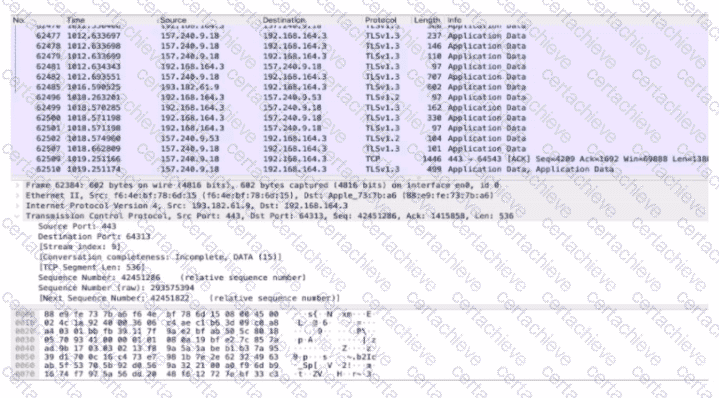
An analyst performs the analysis of the pcap file to detect the suspicious activity. What challenges did the analyst face in terms of data visibility?
Correct Answer & Rationale:
Answer: D
Explanation:
When analyzing a pcap file, data encryption can pose a significant challenge in terms of visibility. Encrypted data cannot be easily inspected, which means that the analyst may not be able to view the contents of the network packets to detect suspicious activity.
The answers are based on the general knowledge of host-based firewalls and the challenges faced during the analysis of pcap files in cybersecurity, as outlined in Cisco’s cybersecurity documentation and resources.
Question 7
Cisco 200-201
QUESTION DESCRIPTION:
Refer to the exhibit.
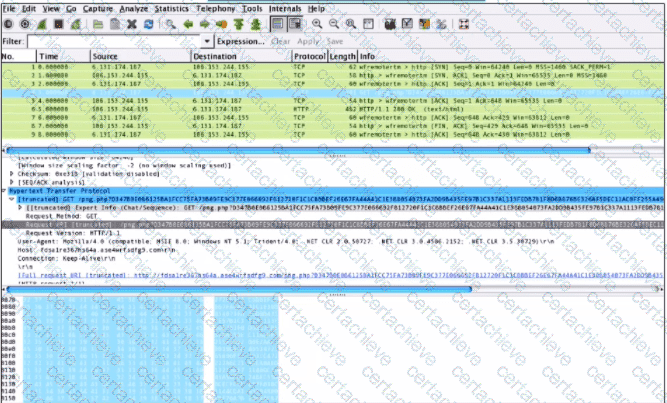
What is shown in this PCAP file?
Correct Answer & Rationale:
Answer: C
Explanation:
The PCAP file shows a network packet capture of an HTTP GET request from a client to a server. The User-Agent header field identifies the type and version of the client software that generated the request. In this case, the User-Agent is Mozilla/5.0, which indicates that the client is using a Mozilla-based browser or application. The User-Agent can help the server to customize the response based on the client’s capabilities and preferences. References: Understanding Cisco Cybersecurity Operations Fundamentals (CBROPS) v1.0, Module 3: Network Protocols and Services, Lesson 3.2: HTTP and HTTPS, Topic 3.2.1: HTTP Headers.
1of30
Question 8
Cisco 200-201
QUESTION DESCRIPTION:
Which action matches the weaponization step of the Cyber Kill Chain model?
Correct Answer & Rationale:
Answer: B
Explanation:
The weaponization step in the Cyber Kill Chain model involves creating or repurposing malware based on the information gathered during reconnaissance to exploit vulnerabilities in the target’s system. This step culminates in the preparation of the malware to be delivered to the victim2.
Understanding Cisco Cybersecurity Operations Fundamentals (CBROPS)
Cyber Kill Chain
Question 9
Cisco 200-201
QUESTION DESCRIPTION:
Which principle is being followed when an analyst gathers information relevant to a security incident to determine the appropriate course of action?
Correct Answer & Rationale:
Answer: A
Explanation:
Decision making is a principle that guides an analyst to gather information relevant to a security incident to determine the appropriate course of action. Decision making involves identifying the problem, defining the criteria, analyzing the alternatives, and choosing the best solution. Decision making helps an analyst to respond to an incident effectively and efficiently, while minimizing the impact and risk to the organization. References: https://learningnetworkstore.cisco.com/on-demand-e-learning/understanding-cisco-cybersecurity-operations-fundamentals-cbrops-v1.0/CSCU-LP-CBROPS-V1-028093.html (Module 3: Security Monitoring, Lesson 3.1: Security Operations Center)
Question 10
Cisco 200-201
QUESTION DESCRIPTION:
Refer to the exhibit.

Which component is identifiable in this exhibit?
Correct Answer & Rationale:
Answer: C
Explanation:
The exhibit shows “HKEY_LOCAL_MACHINE,” which is a Windows Registry hive. The registry is a database used to store low-level settings for the operating system and for applications that opt to use the registry. The other options are not related to the exhibit, as they are either a part of the Windows Certificate Manager, a naming convention for Windows PowerShell commands, or a component of the Windows Services Manager. References := Cisco Cybersecurity
https://docs.microsoft.com/en-us/windows/win32/sysinfo/registry-hives
https://ldapwiki.com/wiki/HKEY_LOCAL_MACHINE#:~:text=HKEY_LOCAL_MACHINE%20Windows%20registry%20hive%20contains,detected%20hardware%20and%20device%20drivers.

Verified by Certified Instructors
This Cisco 200-201 study pack was audited and verified on September 23, 2026 by Radia Davenport,. We ensure every technical rationale aligns with real-world enterprise standards.
A Stepping Stone for Enhanced Career Opportunities
Your profile having CyberOps Associate certification significantly enhances your credibility and marketability in all corners of the world. The best part is that your formal recognition pays you in terms of tangible career advancement. It helps you perform your desired job roles accompanied by a substantial increase in your regular income. Beyond the resume, your expertise imparts you confidence to act as a dependable professional to solve real-world business challenges.
Your success in Cisco 200-201 certification exam makes your visible and relevant in the fast-evolving tech landscape. It proves a lifelong investment in your career that give you not only a competitive advantage over your non-certified peers but also makes you eligible for a further relevant exams in your domain.
What You Need to Ace Cisco Exam 200-201
Achieving success in the 200-201 Cisco exam requires a blending of clear understanding of all the exam topics, practical skills, and practice of the actual format. There's no room for cramming information, memorizing facts or dependence on a few significant exam topics. It means your readiness for exam needs you develop a comprehensive grasp on the syllabus that includes theoretical as well as practical command.
Here is a comprehensive strategy layout to secure peak performance in 200-201 certification exam:
- Develop a rock-solid theoretical clarity of the exam topics
- Begin with easier and more familiar topics of the exam syllabus
- Make sure your command on the fundamental concepts
- Focus your attention to understand why that matters
- Ensure hands-on practice as the exam tests your ability to apply knowledge
- Develop a study routine managing time because it can be a major time-sink if you are slow
- Find out a comprehensive and streamlined study resource for your help
Ensuring Outstanding Results in Exam 200-201!
In the backdrop of the above prep strategy for 200-201 Cisco exam, your primary need is to find out a comprehensive study resource. It could otherwise be a daunting task to achieve exam success. The most important factor that must be kep in mind is make sure your reliance on a one particular resource instead of depending on multiple sources. It should be an all-inclusive resource that ensures conceptual explanations, hands-on practical exercises, and realistic assessment tools.
Certachieve: A Reliable All-inclusive Study Resource
Certachieve offers multiple study tools to do thorough and rewarding 200-201 exam prep. Here's an overview of Certachieve's toolkit:
Cisco 200-201 PDF Study Guide
This premium guide contains a number of Cisco 200-201 exam questions and answers that give you a full coverage of the exam syllabus in easy language. The information provided efficiently guides the candidate's focus to the most critical topics. The supportive explanations and examples build both the knowledge and the practical confidence of the exam candidates required to confidently pass the exam. The demo of Cisco 200-201 study guide pdf free download is also available to examine the contents and quality of the study material.
Cisco 200-201 Practice Exams
Practicing the exam 200-201 questions is one of the essential requirements of your exam preparation. To help you with this important task, Certachieve introduces Cisco 200-201 Testing Engine to simulate multiple real exam-like tests. They are of enormous value for developing your grasp and understanding your strengths and weaknesses in exam preparation and make up deficiencies in time.
These comprehensive materials are engineered to streamline your preparation process, providing a direct and efficient path to mastering the exam's requirements.
Cisco 200-201 exam dumps
These realistic dumps include the most significant questions that may be the part of your upcoming exam. Learning 200-201 exam dumps can increase not only your chances of success but can also award you an outstanding score.
Top Exams & Certification Providers
New & Trending
- New Released Exams
- Related Exam
- Hot Vendor