
The FCSS - SD-WAN 7.4 Architect (FCSS_SDW_AR-7.4)
Passing Fortinet Fortinet Certified Solution Specialist exam ensures for the successful candidate a powerful array of professional and personal benefits. The first and the foremost benefit comes with a global recognition that validates your knowledge and skills, making possible your entry into any organization of your choice.


FCSS_SDW_AR-7.4 Exam Dumps
- Exam Code: FCSS_SDW_AR-7.4
- Vendor: Fortinet
- Certifications: Fortinet Certified Solution Specialist
- Exam Name: FCSS - SD-WAN 7.4 Architect
Why CertAchieve is Better than Standard FCSS_SDW_AR-7.4 Dumps
In 2026, Fortinet uses variable topologies. Basic dumps will fail you.
| Quality Standard | Generic Dump Sites | CertAchieve Premium Prep |
|---|---|---|
| Technical Explanation | None (Answer Key Only) | Step-by-Step Expert Rationales |
| Syllabus Coverage | Often Outdated (v1.0) | 2026 Updated (Latest Syllabus) |
| Scenario Mastery | Blind Memorization | Conceptual Logic & Troubleshooting |
| Instructor Access | No Post-Sale Support | 24/7 Professional Help |
Customers Passed Exams
10
Success backed by proven exam prep tools
Questions Came Word for Word
93%
Real exam match rate reported by verified users
Average Score in Real Testing Centre
90%
Consistently high performance across certifications
Study Time Saved With CertAchieve
60%
Efficient prep that reduces study hours significantly
Fortinet FCSS_SDW_AR-7.4 Exam Domains Q&A
Certified instructors verify every question for 100% accuracy, providing detailed, step-by-step explanations for each.
Question 1
Fortinet FCSS_SDW_AR-7.4
QUESTION DESCRIPTION:
Refer to the exhibits.
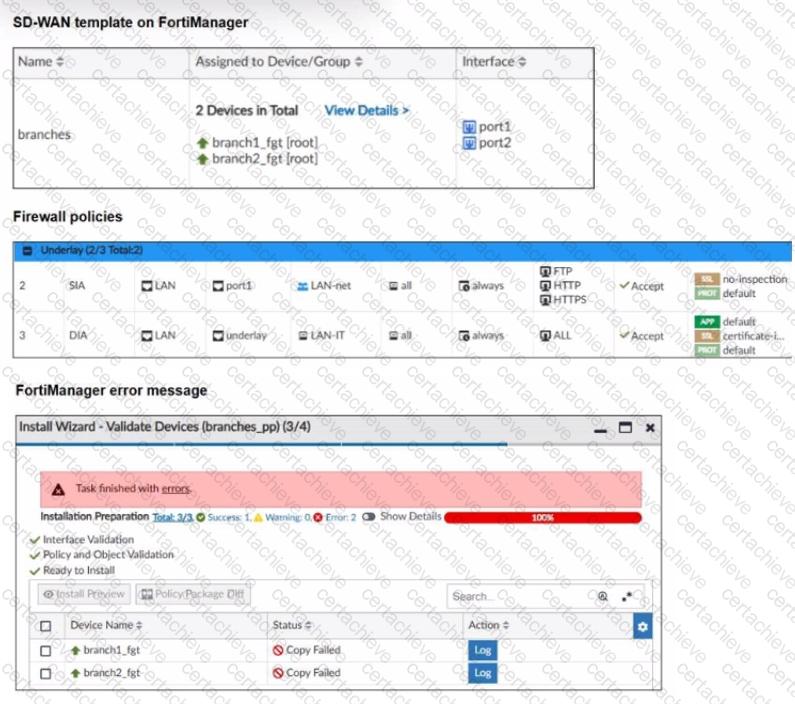
You use FortiManager to manage the branch devices and configure the SD-WAN template. You have configured direct internet access (DIA) for the IT department users. Now. you must configure secure internet access (SIA) for all local LAN users and have set the firewall policies as shown in the second exhibit.
Then, when you use the install wizard to install the configuration and the policy package on the branch devices, FortiManager reports an error as shown in the third exhibit.
Which statement describes why FortiManager could not install the configuration on the branches?
Correct Answer & Rationale:
Answer: C
Explanation:
FortiManager enforces a strict distinction:
" Firewall policies must reference SD-WAN zones, not individual SD-WAN members, when used in conjunction with SD-WAN templates. Attempting to install a policy that references a specific member (interface) will result in a deployment error, as member-level targeting is not supported in SD-WAN policy abstraction. This enforces centralized policy consistency and proper SD-WAN operation. "
Ensuring policies target zones allows FortiGate to dynamically select the optimal member.
Question 2
Fortinet FCSS_SDW_AR-7.4
QUESTION DESCRIPTION:
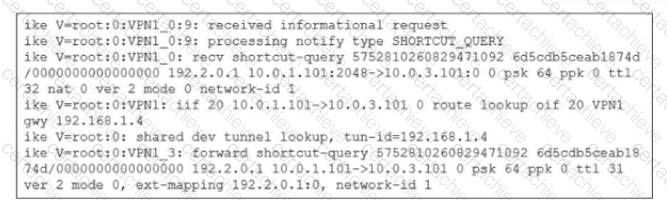
Refer to the exhibit.
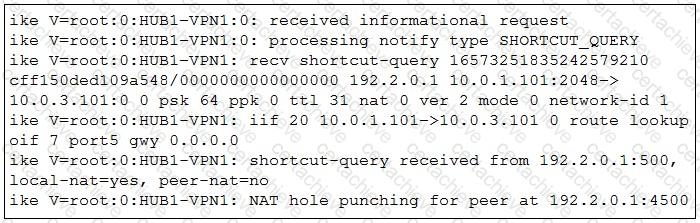
Which statement best describe the role of the ADVPN device in handling traffic?
Correct Answer & Rationale:
Answer: B
Explanation:
The log shows messages on HUB1-VPN1 where the device processes a SHORTCUT_QUERY and performs NAT hole punching (peer at 192.2.0.1:4500). This indicates that the device is acting as a hub, helping two spokes (192.2.0.1 and 10.0.3.101) establish a direct ADVPN shortcut tunnel between each other, instead of routing their traffic through the hub.
Question 3
Fortinet FCSS_SDW_AR-7.4
QUESTION DESCRIPTION:
The FortiGate devices are managed by ForliManager, and are configured for direct internet access (DIA). You confirm that DIA is working as expected for each branch, and check the SD-WAN zone configuration and firewall policies shown in the exhibits.
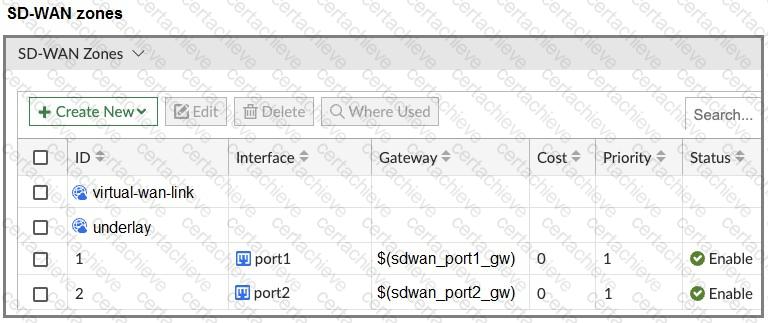


Then, you use the SD-WAN overlay template to configure the IPsec overlay tunnels. You create the associated SD-WAN rules to connect existing branches to the company hub device and apply the changes on the branches.
After those changes, users complain that they lost internet access. DIA is no longer working.
Based on the exhibit, which statement best describes the possible root cause of this issue?
Correct Answer & Rationale:
Answer: A
Explanation:
The SD-WAN overlay template defines a zone for each underlay interface and moves the interfaces into those zones. This statement perfectly describes the likely sequence of events. The template, when applied, re-organizes the interfaces and zones, causing the existing firewall policy that relies on the old zone configuration to fail. This is the most plausible root cause.
Question 4
Fortinet FCSS_SDW_AR-7.4
QUESTION DESCRIPTION:
Refer to the exhibit that shows an SD-WAN zone configuration on the FortiManager GUI.
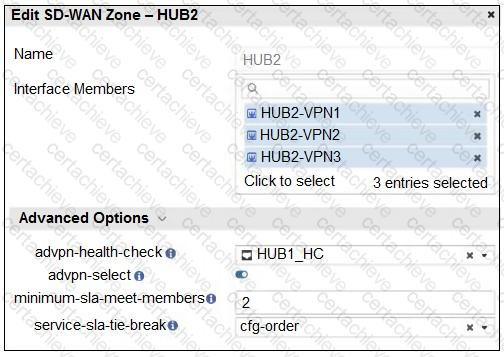
Based on the exhibit, how will the FortiGate device behave after it receives this configuration?
Correct Answer & Rationale:
Answer: C
Explanation:
This is because the setting minimum-sla-meet-members = 2 requires at least two SD-WAN zone members (in this case, HUB2-VPN1, HUB2-VPN2, and HUB2-VPN3) to pass the defined SLA health check (HUB1_HC) before the FortiGate will establish ADVPN shortcuts. If fewer than two members meet the SLA, shortcuts will not be created.
Question 5
Fortinet FCSS_SDW_AR-7.4
QUESTION DESCRIPTION:
Refer to the exhibit.
Which statement best describe the role of the ADVPN device in handling traffic?
Correct Answer & Rationale:
Answer: C
Explanation:
Within ADVPN topologies, shortcut requests and responses traverse spokes and hubs. Fortinet documentation states:
" When a spoke receives a shortcut query from another spoke, it may forward the response to its hub for validation or to facilitate dynamic shortcut tunnel setup. This mechanism allows direct spoke-to-spoke communication for optimized routing and performance, reducing latency and offloading the hub after initial control-plane mediation. "
This is a core benefit of ADVPN’s dynamic shortcut feature.
Question 6
Fortinet FCSS_SDW_AR-7.4
QUESTION DESCRIPTION:
Refer to the exhibits.
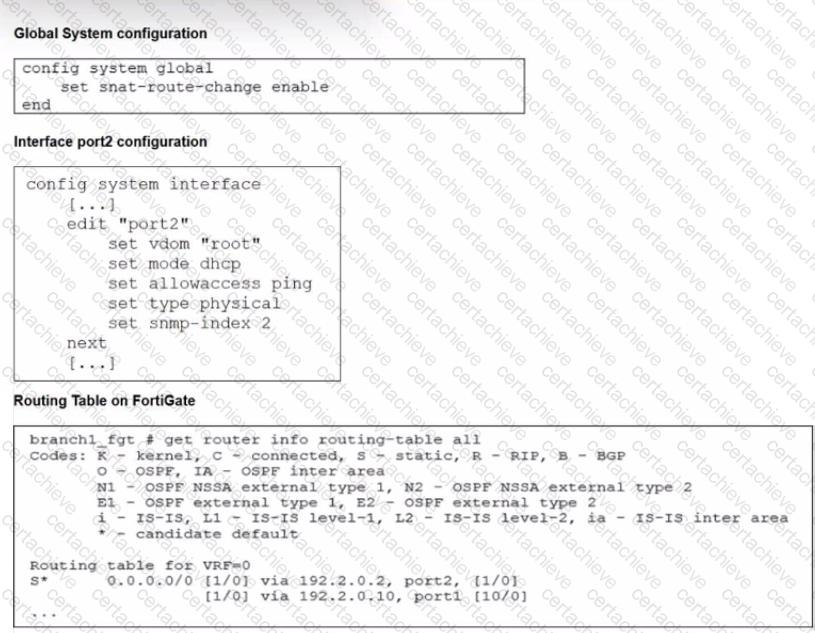
The exhibits show the source NAT (SNAT) global setting. port2 interface settings, and the routing table on FortiGate.
The administrator increases the member priority on port2 to 20.
Upon configuration changes and the receipt of new packets, which two actions does FortiGate perform on existing sessions established over port2? (Choose two.)
Correct Answer & Rationale:
Answer: D, E
Explanation:
When the member priority of a port is increased (e.g., port2 to 20), FortiGate evaluates existing sessions and applies “dirty” flags where applicable. The SD-WAN session management mechanism is described in detail: “Upon a change in SD-WAN member priority, all existing sessions using that member are marked as dirty. For SNAT sessions, the gateway information is updated to ensure future packets are routed through the newly preferred member, in this case, port1. This automatic re-evaluation allows SD-WAN to dynamically respond to topology or priority changes, maintaining optimal routing.” This is fundamental to seamless failover and session persistence in Fortinet SD-WAN, ensuring active flows are redirected based on updated priorities or health status.
[References:, [FCSS_SDW_AR-7.4 1-0.docx Q13], FortiOS 7.4 SD-WAN Concept Guide, “Session Management During Path Change”, FortiGate CLI Reference: diagnose sys session list, ]
Question 7
Fortinet FCSS_SDW_AR-7.4
QUESTION DESCRIPTION:
Refer to the exhibit, which shows the SD-WAN rule status and configuration.
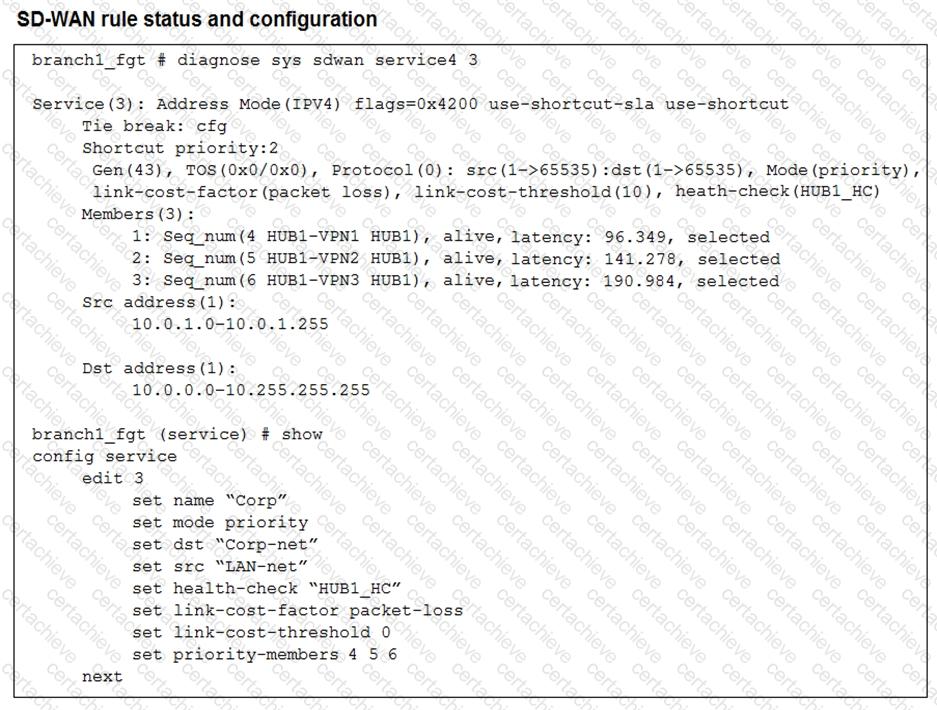
Based on the exhibit, which change in the measured latency will first make HUB1-VPN3 the new preferred member?
Correct Answer & Rationale:
Answer: D
Explanation:
The rule is in priority mode with HUB1-VPN1 (seq 4) as the first preferred member, HUB1-VPN2 second, and HUB1-VPN3 third. Latency itself does not cause HUB1-VPN3 to become preferred unless a higher-priority member fails SLA. If HUB1-VPN1’s latency exceeds the SLA threshold (here simulated by latency reaching 200 ms), FortiGate stops using it and moves down the priority list. That is when HUB1-VPN3 could become the active path.
Question 8
Fortinet FCSS_SDW_AR-7.4
QUESTION DESCRIPTION:
Exhibit.
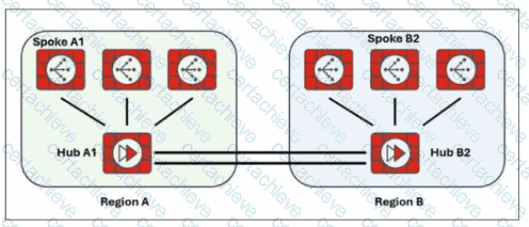
Two hub-and-spoke groups are connected through redundant site-to-site IPsec VPNs between Hub 1 and Hub 2
Which two configuration settings are required for the spoke A1 to establish an ADVPN shortcut with the spoke B2? (Choose two.)
Correct Answer & Rationale:
Answer: A, D
Explanation:
To allow spokes in different hub-and-spoke groups to establish ADVPN shortcuts, the hubs must be configured to forward and send ADVPN shortcut offers. The key required settings on the hub are auto-discovery-forwarder (for VPNs to hubs) and auto-discovery-sender (for VPNs to spokes). This ensures the hub can facilitate and advertise ADVPN shortcut offers between spokes.
[References:, [FCSS_SDW_AR-7.4 1-0.docx Q1], Fortinet SD-WAN 7.4 ADVPN Guide (Auto-discovery settings for hub-and-spoke topologies), ]
Question 9
Fortinet FCSS_SDW_AR-7.4
QUESTION DESCRIPTION:
When you use the command diagnose sys session list, how do you identify the sessions that correspond to traffic steered according to SD-WAN rules?
Correct Answer & Rationale:
Answer: D
Explanation:
When using the diagnose sys session list command, SD-WAN-specific session steering is indicated by the presence of the sdwan_service_id field in the session data. This identifier ties the session directly to a specific SD-WAN rule or service. As noted in the Fortinet documentation: “Sessions that are handled according to SD-WAN rules will include a service ID tag (sdwan_service_id) in their session listing. This allows administrators to correlate live sessions with SD-WAN policy matches for troubleshooting and visibility.” This is a crucial diagnostic tool, as it distinguishes between traffic managed by traditional routing and that explicitly controlled by SD-WAN steering logic, aiding in operational insight and troubleshooting.
[References:, [FCSS_SDW_AR-7.4 1-0.docx Q15], FortiOS 7.4 CLI Reference, “diagnose sys session list: SD-WAN Service ID Tagging”, SD-WAN 7.4 Concept Guide, Section: "Session Identification for SD-WAN Traffic", ]
Question 10
Fortinet FCSS_SDW_AR-7.4
QUESTION DESCRIPTION:
Refer to the exhibit.
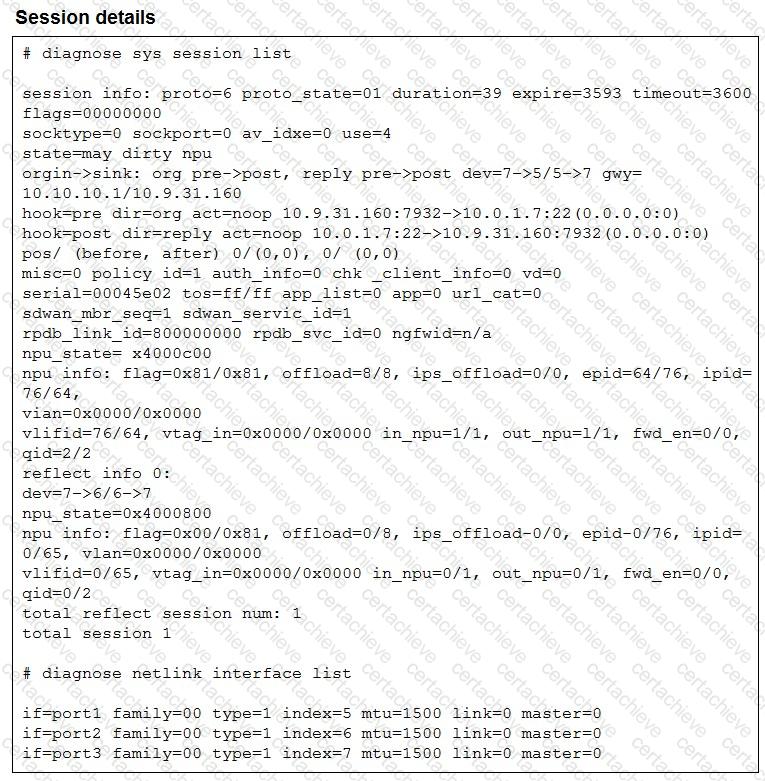
The exhibit shows the details of a session and the index numbers of some relevant interfaces on a FortiGate device that supports hardware offloading.
Based on the information shown in the exhibits, which two conclusions can you draw? (Choose two.)
Correct Answer & Rationale:
Answer: B, C
Explanation:
The session details show the symmetric flow’s original direction as port3 → port2.
The asymmetric flow’s reply direction is listed as port2 → port3.

Verified by Certified Instructors
This Fortinet FCSS_SDW_AR-7.4 study pack was audited and verified on September 23, 2026 by Radia Davenport,. We ensure every technical rationale aligns with real-world enterprise standards.
A Stepping Stone for Enhanced Career Opportunities
Your profile having Fortinet Certified Solution Specialist certification significantly enhances your credibility and marketability in all corners of the world. The best part is that your formal recognition pays you in terms of tangible career advancement. It helps you perform your desired job roles accompanied by a substantial increase in your regular income. Beyond the resume, your expertise imparts you confidence to act as a dependable professional to solve real-world business challenges.
Your success in Fortinet FCSS_SDW_AR-7.4 certification exam makes your visible and relevant in the fast-evolving tech landscape. It proves a lifelong investment in your career that give you not only a competitive advantage over your non-certified peers but also makes you eligible for a further relevant exams in your domain.
What You Need to Ace Fortinet Exam FCSS_SDW_AR-7.4
Achieving success in the FCSS_SDW_AR-7.4 Fortinet exam requires a blending of clear understanding of all the exam topics, practical skills, and practice of the actual format. There's no room for cramming information, memorizing facts or dependence on a few significant exam topics. It means your readiness for exam needs you develop a comprehensive grasp on the syllabus that includes theoretical as well as practical command.
Here is a comprehensive strategy layout to secure peak performance in FCSS_SDW_AR-7.4 certification exam:
- Develop a rock-solid theoretical clarity of the exam topics
- Begin with easier and more familiar topics of the exam syllabus
- Make sure your command on the fundamental concepts
- Focus your attention to understand why that matters
- Ensure hands-on practice as the exam tests your ability to apply knowledge
- Develop a study routine managing time because it can be a major time-sink if you are slow
- Find out a comprehensive and streamlined study resource for your help
Ensuring Outstanding Results in Exam FCSS_SDW_AR-7.4!
In the backdrop of the above prep strategy for FCSS_SDW_AR-7.4 Fortinet exam, your primary need is to find out a comprehensive study resource. It could otherwise be a daunting task to achieve exam success. The most important factor that must be kep in mind is make sure your reliance on a one particular resource instead of depending on multiple sources. It should be an all-inclusive resource that ensures conceptual explanations, hands-on practical exercises, and realistic assessment tools.
Certachieve: A Reliable All-inclusive Study Resource
Certachieve offers multiple study tools to do thorough and rewarding FCSS_SDW_AR-7.4 exam prep. Here's an overview of Certachieve's toolkit:
Fortinet FCSS_SDW_AR-7.4 PDF Study Guide
This premium guide contains a number of Fortinet FCSS_SDW_AR-7.4 exam questions and answers that give you a full coverage of the exam syllabus in easy language. The information provided efficiently guides the candidate's focus to the most critical topics. The supportive explanations and examples build both the knowledge and the practical confidence of the exam candidates required to confidently pass the exam. The demo of Fortinet FCSS_SDW_AR-7.4 study guide pdf free download is also available to examine the contents and quality of the study material.
Fortinet FCSS_SDW_AR-7.4 Practice Exams
Practicing the exam FCSS_SDW_AR-7.4 questions is one of the essential requirements of your exam preparation. To help you with this important task, Certachieve introduces Fortinet FCSS_SDW_AR-7.4 Testing Engine to simulate multiple real exam-like tests. They are of enormous value for developing your grasp and understanding your strengths and weaknesses in exam preparation and make up deficiencies in time.
These comprehensive materials are engineered to streamline your preparation process, providing a direct and efficient path to mastering the exam's requirements.
Fortinet FCSS_SDW_AR-7.4 exam dumps
These realistic dumps include the most significant questions that may be the part of your upcoming exam. Learning FCSS_SDW_AR-7.4 exam dumps can increase not only your chances of success but can also award you an outstanding score.
Top Exams & Certification Providers
New & Trending
- New Released Exams
- Related Exam
- Hot Vendor